
B.C. Teachers’ Contract: Government Threatens Wage Cut

     By Keven Drews and Tamsyn Burgmann

05/16/2014

VANCOUVER – The B.C. government is threatening to cut teachers’ wages by five per cent if a new contract agreement isn’t reached by the end of the school year, but the union representing those teachers vows it will take that threat to the Labour Relations Board.

Peter Cameron, chief negotiator of the BC Public School Employers’ Association, the organization representing the provincial government, also said Friday that teachers will receive a $1,200 signing bonus if both sides reach an agreement by the end of June.

The incentives and disincentives placed on the table by the government were the latest details to emerge from a year of contentious labour relations between the B.C. Teachers Federation and the provincial government that included a 89 per cent strike vote and involved a B.C. Supreme Court judgment.

Both sides remain firmly divided over issues related to wages, class size, the composition of those classes and the length of the contract term.

“The proposal we have on the table to try and get a settlement, and the disincentives that we are putting in place are all aimed at getting a deal, and in fact the disincentives will rise if there’s further job action,” said Cameron. “So if they do move to Stage 2 we will, it’s pretty well definite that we’ll have a further response to that.”

The purpose of the government’s actions, he added, is not to try and provoke further strike action but to “provoke a settlement.”

Both sides were back at the bargaining table Friday, and B.C. Teachers’ Federation president Jim Iker said his members will deal with the threat of the five per cent pay cut at the Labour Relations Board.

He said the government still hasn’t addressed issues related to class size and composition and specialist teachers, and the government’s offer of a 6.5-per-cent pay hike over six years isn’t enough. On Thursday, Education Minister Peter Fassbender announced the provincial government was dropping its demand of a 10-year contract.

“They need to put some proposals to get us closer to a deal, including preparation time,” said Iker. “Bargaining is about compromise, and we want a compromise.

But Cameron said teachers are demanding a pay raise of 15.9 per cent over four years. With increased benefits and other factors taken into consideration, the total compensation package demanded by teachers is about 21 per cent, he added.

“We need to see some movement from the union now to come into the ball park because they’re at this point still far, far away from the settlement pattern of all the other unions.”

On Thursday, the B.C. government and the 11-union, 47,000-strong Facilities Bargaining Association announced a tentative deal that would see unionized workers receive a 5.5 per cent over five years.

The teachers have been without a contract since last June. In early March, some 26,051 members of the B.C. Teachers’ Federation voted overwhelmingly in favour of job action, and in April, the union began Stage 1 of its job action.

Teachers stopped supervising students outside the classroom or communicating in writing with administrators, which prompted about a dozen school districts to cancel recess.

A B.C. Supreme Court decision in January awarded the federation $2 million in damages and declared the province’s removal of class size and composition from contract negotiations unconstitutional.
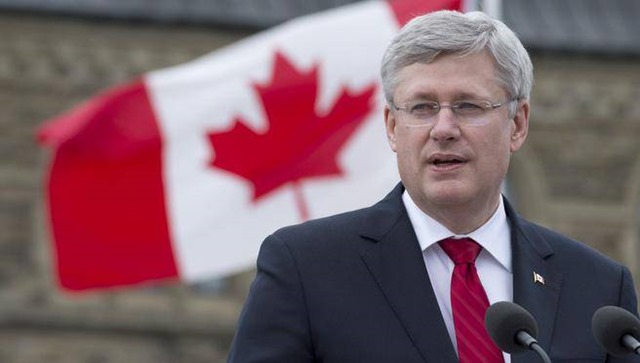
SURETTE: Harper could still hang on, even after defacing Canada

http://thechronicleherald.ca     ralph Surette    May 16, 2014

B97319909Z.120140516151800000GUH5J504.11           Three little-tent parties suit Stephen Harper just fine, because small, dirty and divided is his game, writes Ralph Surette. (ADRIAN WYLD / CP)

Watching Stephen Harper envenom not only the politics of the day but hammer at our deepest societal framework — the rule of law, democratic process — is to wonder what will be left of our self-respect as a nation if he wins the next election, thanks to a splintered electorate.

Once the light of the world on many fronts, Canada is now denounced regularly on environment, foreign aid and other things. Germany’s Bertelsmann Foundation, which rates governments every three years, has Canada slipping fast in “good government” ratings. Of the “high-quality governance structures” Canada once had in place, it said in its most recent report, “the actions of the Canadian government . . . have jeopardized this situation.”

Harper is a genius at totalitarian-style manipulation that feeds on the divisions that it has itself created, and at keeping the public confused. The fact that his party is still in the game at all according to the polls, despite one anti-democratic binge after another, attests to that.

Despite everything, he comes out with only a few light scratches over his scandalous attack on Supreme Court Chief Justice Beverley McLachlin on a trumped-up accusation.

This is not just a nasty spat. The Harperists have been attacking the courts from Day 1, and their problem is not with this or that judge — it is with the rule of law itself. The PMO’s reported fury at a string of setbacks suffered at the hands of the Supreme Court tells us ever more clearly that the Conservatives see the law as their plaything, to be bent to their purposes.

Harper is a clear-headed ideologue — all the more dangerous for that. Having bragged to the effect that “you won’t recognize Canada after I’m through with it,” his stated goal is to destroy the Liberal party and turn his own into the “natural governing party.”

The time for natural governing parties is probably over, but he can take some satisfaction in the reduced state of the Liberal party. The Harperists’ one telling argument is that Justin Trudeau “is not ready for prime time.” As regularly as Harper assaults democracy, Trudeau puts his foot in his mouth. And the recent signal given by its exclusion of pro-life candidates on the abortion issue is that the Liberal party is no longer a “big-tent” party. Three little-tent parties suit Harper fine, because small, dirty and divided is his game.

One would hope that by the time the next election rolls around in a year and a half, the game will be absolutely clear to the electorate. The idea of Harper in power another four years to rip up treaties, pervert the electoral process, pass manipulative omnibus bills, deepen the hold of oil and other resource companies over government, rig the tax system for partisan purposes, politicize the bureaucracy, plus attack environmentalists, scientists, civil society groups and parliamentary watchdogs, among others, should give us pause indeed.

Actually, many people get it now — the Harperists linger at some 20 per cent in the polls in Atlantic Canada and at 13 per cent in Quebec, raising the prospects of election night opening with fewer than a half dozen Conservative seats east of Ontario, and maybe none at all. The Prairies won’t budge much, despite some Conservative libertarians objecting to Harper’s iron grip, leaving Ontario and B.C. to decide. There, the Harperists are behind the Liberals, but not by much.

Harper’s argument there is that he’s going to heroically balance the budget and cut taxes. That is, he’s going to slash at everything, like services to veterans, and, especially, dump costs on the provinces. (Even the Parliamentary Budget Officer doesn’t know what exactly is being cut — that’s hidden in the last omnibus bill.)

With these savings, he’ll propose to cut taxes aimed at key voting groups in the money belts around Toronto and Vancouver that can be counted on to put self-interest above country.

If only Canadians saw what the outside sees. Once the light of the world on many fronts, Canada is now denounced regularly on environment, foreign aid and other things. Germany’s Bertelsmann Foundation, which rates governments every three years, has Canada slipping fast in “good government” ratings. Of the “high-quality governance structures” Canada once had in place, it said in its most recent report, “the actions of the Canadian government . . . have jeopardized this situation.”

Meanwhile, last November, with the media saturated with the Senate and Rob Ford scandals, Canadians heard nothing of the thrashing we got at the Warsaw Climate Change Conference, where several studies put us down with Saudi Arabia, which flares off oilfield gas, and a couple of others as one of the dirtiest nations on Earth per capita, thanks mostly to the tar sands.

Meanwhile, the opposition Liberals and NDP, which two-thirds of the electorate would like to see come together to put an end to Harper, instead are locked in their own frenzied combat, making it more likely that the Conservatives will slip through in those contested areas. And another Harper victory, even in a squeaky minority, would kill any chance that this country can retake its place as a positive force in the world.

Harper is a genius at totalitarian-style manipulation that feeds on the divisions that it has itself created, and at keeping the public confused. The fact that his party is still in the game at all according to the polls, despite one anti-democratic binge after another, attests to that.

About the Author

ralph Surette

Ralph Surette is a freelance journalist in Yarmouth County.

E-Mail: rsurette@herald.ca

BC Supreme Court Rejects Just Cause Allegation against Manager with Abrasive Management Style, Awards $50,000 Punitive Damages and $35,000 Aggravated

Dan Gleadle      http://employmentlawvancouver.blogspot.ca/

Mr. Justice Goepel of the BC Supreme Court handed down comprehensive reasons for judgment on January 27, 2012 dismissing a just cause defence by the BC Liquor Distribution Branch in a wrongful dismissal damage claim by a senior manager.

Vernon v. British Columbia (Liquor Distribution Branch), 2012 BCSC 133 (CanLII)

Ms. Vernon had been employed by the BC LDB since age 19, for a period of 30 years, during which she was promoted from entry level positions to the role of Senior Store Manager in the Richmond Branch. She had a “rough and ready” management style, and had over the years functioned effectively in an environment that persons with modern sensibilities would find offensive. Her style involved swearing and directions to employees given in a manner which might be found offensive. A complaint was filed by an employee with particular sensibilities, and the LDB launched an investigation, followed by a summary dismissal.

Flawed Investigation

The court found that the investigation leading to the dismissal was flawed. So seriously flawed, in fact, that an award of both aggravated and punitive damages was granted.

The key aspects of the finding as to a flawed investigation were:

  • it was headed by another employee who, by reason of prior involvement with the dismissed employee, even in relation to recent HR disputes between the complainant and the manager, should not have been given the task of investigating
  • there was a “rush to judgment” which was apparently motivated by arbitrary deadlines dictated by employer policies as a quasi governmental organization
  • the investigator chose to speak mainly to persons critical of the plaintiff, and not to other employees who supported the plaintiff
  • the investigator was not a neutral, but self regarded as a prosecutor
  • when the investigator talked to others who were supportive of the manager, their comments were not accepted at face value, but rather challenged
  • the manager was confronted with a long list of accusations at a threatening meeting, without any sufficient warning of the accusations or even the reason for the meeting
  • no sufficient reason was given to warnings, or other discipline short of dismissal, or mandatory remedial courses, as the employer was apparently of the view that it did not have those choices, in error
  • the employee was left “in limbo” for an unnecessary and unreasonable period of time
  • those in charge of the investigation changed over time, with inadequate communication between those handing off responsibility, so that the person who concluded the investigation reported to those making the termination decision an inaccurate conclusion – that the manager denied all accusation against her, and thus was both untruthful, and incapable of training, as she did not accept any responsibility. This was found to be incorrect and an important failure
  • those in charge of the investigation failed to “take a step back” and put the allegations in their proper context, where the employee was a long service employee without any prior performance problems, and in fact a most credible work history

Just Cause

Judge Goepel followed well established precedent in his consideration of the question of whether just cause existed for summary dismissal.

He referred to the 2001 decision of the Manitoba Court of Appeal in Boulet, where a useful list of factors was set out for cause cases.

[285] In Boulet v. Federated Co-operatives Ltd. 2001MBQB 174, 157 Man.R. (2d) 256 aff’d 2002 MBCA 114, 170 Man. R. (2d) 9 (“Boulet”), McCawley J. summarized the principles applicable when cause is alleged at para. 3:

  1. Each case must be decided on its facts.
  2. An employer’s displeasure at an employee’s performance is not enough to warrant dismissal. There must be some serious misconduct or substantial incompetence.
  3. The onus of proving just cause rests with the employer and the standard of proof is beyond a balance of probabilities.
  4. The performance of an employee, especially one in a management position, must be gauged against an objective standard.
  5. The employer must establish (a) the level of the job performance required, (b) that the standard was communicated to the employee, (c) that suitable instruction and/or supervision was given to enable the employee to meet the standard, (d) the employee was incapable of meeting the standard, and (e) the employee was warned that failure to meet the standard would result in dismissal.
  6. Where the employee’s performance is grossly deficient and the likelihood of discharge should be obvious to the employee, warnings and reasonable notice are not required.
  7. While the standard of incompetence to warrant discharge for cause is severe, the threshold of incompetence necessary to warrant dismissal for cause is significantly lower where dismissal is preceded by many warnings indicating unsatisfactory performance.
  8. In considering whether an employer has provided adequate warning to an employee, where the dismissal is for repeated instances of inadequate work performance, the employer must show (a) it has established a reasonable objective standard of performance, (b) the employee has failed to meet those standards, (c) the employee has had warnings that he or she has failed to meet those standards and the employee’s position will be in jeopardy if he or she continues to fail to meet them; and (d) the employee has been given reasonable time to correct the situation.
  9. An employer who has condoned an inadequate level of performance by his employee may not later rely on any condoned behavior as a ground for dismissal.
  10. Condoned behavior is relevant if the employee fails to respond after appropriate warnings. Condonation is always subject to the implied condition that the employee will be of good behavior and will attempt to improve.

Aggravated Damages

The court awarded $35,000 in aggravated damages, recognizing that this head is only appropriate by way of compensation for losses experienced by the plaintiff, flowing from some sort of wrongful behavior on the part of the employer at the time of or in the manner of dismissal.

[369] Aggravated damages in wrongful dismissal cases are compensatory in nature. It is an implied term of an employment contract that an employer will act in good faith in the manner of dismissal: Beggs v. Westport Foods Ltd., 2011 BCCA 76 (CanLII), 2011 BCCA 76, 14 B.C.L.R. (5th) 1 at para 48.

[373] The foundation of the claim for aggravated damages is the manner of dismissal. The meeting of April 19, 2010, could not have been handled in a more insensitive manner. Ms. Vernon, a 30-year employee with an unblemished record, was summoned to a meeting where she was told her conduct was shameful and that she was an embarrassment to the LDB. When she asked for additional time to consider her position she was told she only had until noon on Friday because Mr. Branham was not prepared to wait around until 4:00 p.m. on a Friday to learn her decision. Having told Ms. Vernon that she was to be terminated, the LDB then suspended her without pay and left her in limbo from April 19 to May 31 when they finally got around to telling her she was fired.

[377] I find that the LDB’s conduct during the course of dismissal was unfair and unduly insensitive. I accept the evidence of Ms. Vernon and Dr. Phillips that the manner of dismissal caused Ms. Vernon mental distress over and above the normal distress and hurt feelings resulting from the dismissal itself. She is entitled to an award of aggravated damages.

Punitive Damages

The court awarded $50,000 by way of punitive damages – clearly distinguishing this head of damages as an award appropriate for other policy reasons, aside from compensation.

[381] Unlike aggravated damages (which are compensatory in nature), punitive damages are directed towards punishment. The leading authority remains Whiten v. Pilot Insurance Co.,2002 SCC 18 (CanLII), 2002 SCC 18, [2002] 1 S.C.R. 595 at para. 36(“Whiten”)

[382] The three objects of punitive damages are retribution, deterrence and denunciation. The Supreme Court of Canada has directed trial courts to approach punitive damages with caution and restraint and to resort to them only in exceptional circumstances: Whiten at para. 69.

[383] An award of punitive damages is rational only when compensatory damages do not adequately achieve the objectives of retribution, deterrence and denunciation:Performance Industries Ltd. v. Sylvan Lake Golf & Tennis Club Ltd.,2002 SCC 19 (CanLII), 2002 SCC 19, [2002] 1 S.C.R. 678 at para. 87.

[386] In this case, I have made an award of aggravated damages arising out of the insensitive manner in which Ms. Vernon was terminated. To award punitive damages for the same conduct would lead to double punishment for the same acts.

[387] There is, however, one exception. At the termination meeting of April 19, Ms. Ferrara told Ms. Vernon that if she agreed to resign, the LDB would provide her with a reference letter. While an employer is under no obligation to give a reference letter (Shinn v. TBC Teletheatre B.C., 2001 BCCA 83 (CanLII), 2001 BCCA 83, 85 B.C.L.R. (3d) 75), to offer Ms. Vernon a reference letter, conditional on her resignation, was reprehensible and departed to a marked degree from ordinary standards of decent behaviour. If Ms. Vernon’s conduct was sufficiently serious that the LDB had the right to summarily dismiss her without notice, it would have been improper for the LDB to give her a reference letter. To offer a reference letter as a carrot to resign, is, in my opinion, conduct which is properly the subject matter of retribution, deterrence and denunciation.

Summary and Conclusion

This decision will give employers cause for serious concern when considering the dismissal of long term managers for conduct which has been accepted as useful without complaint.

Employers will be well advised to avoid conduct in the course of investigations which might be seen as impartial, or heavy handed, particularly with long service employees.

The consequences of a finding of conduct meriting a punitive damage award are not just financial, and employers should consider the impact of their actions on employees, or risk unwanted outcomes.

Four Easy Ways to Get Fired

http://employmentlawcanada.wordpress.com/

Here are four things that many employees do on a regular basis that could get them fired.  Some may be surprising.

1) Checking Facebook  – an employee is required to spend all of their working time working.  Shocking I know!  Using computers for personal purposes such as checking Facebook, your stock portfolio, or playing minesweeper can be considered time-theft, insubordination or disobedience and can be just cause for dismissal.

2) Questioning the Boss – challenging the boss’s directions, even if their decisions are bone-headed and destined to fail, so long as they aren’t illegal, can be cause for your dismissal.  Insubordination is particularly culpable if it is done in front of other employees, since this can seriously undermine the boss’ ability to control the workforce.  It is the boss’ company and she or he has the right to run it into the ground if they so choose.

3) Updating your Linkedin Profile/Blogging – if you are using linkedin to try to find a new job, or to take away customers for some private gain, that could be considered competing with your employer and acting against their interests.  It will be interesting to see a case make it to the courts over who owns the data in a linkedin account.  In general, employees don’t get to take their contact lists when they leave a company.  Linkedin and other cloud based electronic devices change the game in this regard.  If you blog, do so on your own time or with your employer’s express permission.

4)  Bragging in the Interview – everyone talks their best game in the job interview.  However, you had better be able to put your money where your mouth is.  Courts have held that employees who do not live up to the hype they put out in their job interviews can be terminated for this reason, without notice, in the early stages of the employment.  However, after a certain point the employer will be taken to have accepted any such shortcomings, and will be required to provide the requisite notice.

Canadian case law, such as McKinley v. BC Tel, [2001] 2 S.C.R. 161, states that each case is circumstance-dependant and must be judged in the context of the entire employment relationship.  Discipline imposed by the employer must be proximate to the seriousness of the improper employee behaviour.  Further, in most cases warnings must be given along with corrective measures the employee is to take, before such issues can be a proper basis for just cause.

BC’s Elusive LNG Tax

http://qwlaw.ca/qw-law-blog      May 11, 2014

The BC government has one devil of a problem on its hands.

Last year, it won re-election largely on the basis of promises of enormous wealth and revenues flowing from the birth of a massive Liquefied Natural Gas export industry. Billions of dollars would flow into the treasury, the provincial debt would vaporize, and we would all be awash in jobs, jobs, jobs.

Mt Hayes LNG

FortisBC Energy Inc.’s LNG plant at Mt. Hayes, serving BC utility customers – and a target for the upcoming BC LNG Revenue Tax

But has something gone wrong? Last spring, the government announced that by autumn it would unveil its taxation scheme to extract this revenue from an LNG export industry. The months passed, and the taxation plan was postponed to the winter. In the February budget, it said the plan would be made public next fall.

Why the delay?

Because figuring out how to extract significant provincial revenue out of LNG exports is a very difficult problem – and this is on top of the uncertain prospects for the LNG industry to happen at all, or on the kind of scale the Premier heralded on the campaign trail.

There is no obvious point in the process for a provincial government to insert itself and extract a share of the money.

The gas starts out in the ground. When it is extracted, there is no way of telling which molecules are destined for export and which will be burned to keep homes warm in Prince George or Surrey.

The gas is then refined. Same problem here – there is no way to sort out which gas is headed where.

Then it’s shipped by pipe to the coast, where it is super-cooled and condensed, loaded onto tankers, and off it goes to Korea or other points west. There it is sold for perhaps double or more the price it was worth on our side of the Pacific Ocean.

So imagine you are a provincial government and you want to make billions of dollars out of this activity. Here’s your great big problem: the province cannot impose an export duty on the gas, whether it’s called a duty or disguised as something else.

They already charge a tax called a “royalty” on the gas when it is sucked out of the ground. The only way to get a higher rate of revenue at this stage is to increase the royalty on all the gas at the point of extraction. Some of that royalty will come out of the LNG trade, but the rest will come out of BC homes and businesses who use natural gas for heating and other purposes.

They can’t charge a tax at the dock in Japan when the gas is offloaded into the Asian market.

Somewhere in between? What happens “in between” is the refinery, the pipeline to the Coast, the liquefaction plant, and the tanker ship terminal. If the gas belongs to the same company throughout these steps, there are no financial transactions to tax. It’s just the company’s gas being moved along through its system.

What Victoria has hit upon is to tax the revenue from the liquefaction process. Sounds fine, but there’s one problem – what if there is no revenue flowing from that step? Is Shell paying itself at the LNG plant for the gas it delivered there in its pipeline? Not likely.

So what they will need to do is invent some sort of make-believe commercial transaction at the point of liquefaction. Calculate some notional value-added by that process and tax it. I can hear the wheels spinning in the heads of the companies’ tax lawyers about ways to structure the whole arrangement to minimize the tax hit.

And there’s yet another problem – if the government singles out LNG for export, they are probably guilty of imposing an unconstitutional tax. In its budget announcements this winter, the government said that the LNG tax would apply whether the gas was for export or for domestic use. They really have no choice, if they want an LNG tax at all (see above – disguised export duties).

Did you know that there are already two LNG plants in BC? One is on Tilbury Island in the Fraser Delta, and the other is on Vancouver Island at Mount Hayes. They belong to FortisBC Energy (aka BC Gas or Terasen). Those facilities are used for the utility’s BC customers.  They are LNGs for domestic use and therefore would be caught by the new tax.

So the supreme irony is that it is possible that the LNG tax will only be paid by BC residents. That’s because it is not at all certain that we will see an LNG export industry in BC. If we do, it is highly unlikely to be on anywhere near the scale the Premier was trumpeting during the election.

But more about that in a future article.