Jocks on strike? Congress looks at unions organizing athletes


By Eric Schulzke, Deseret News National Edition

Monday, May 19 2014

With the National Labor Relations Board deliberating whether to clear the way for Northwestern’s football team to unionize, a congressional panel met last week to debate how to respond to charges that college atheletes are exploited labor.

Whatever comes of the current dispute at Northwestern, the controversy puts pressure on the NCAA to change how it treats atheletes. Some changes appear to be in the likely result, whichever way the unionization fight goes.

“For its part,” the Chronicle of Higher Education notes, “the NCAA has stepped up efforts to help athletes. Last month its Division I Board of Directors approved a measure allowing colleges to provide more meals for players. The board also endorsed changes in the Division I governance structure that are expected to provide wealthy colleges with more autonomy, setting the stage for big-time athletics programs to increase the value of scholarships and to provide new health and welfare benefits.”

Many of the lawmakers at the hearing doubted that unionization was a real answer. “Can the NCAA and institutions do more to protect students? Absolutely,” said Rep. John P. Kline Jr., a Minnesota Republican and chairman of the House Education and the Workforce Committee in prepared remarks.

“They could start by giving students a greater role in shaping policies that govern college athletics. They could also work to help ensure a sports injury doesn’t end a student’s academic career and find a responsible solution that will deliver the health care injured players may need. While promoting change is often difficult, student athletes deserve a determined effort to address these concerns,” Kline added.

Prior to the hearing, union organizers, including a former UCLA linebacker, expressed fears that Congress would consider legislation that would head off the unionization effort.

“CAPA is concerned that this hearing has been called in an attempt to legitimize the NCAA’s illegitimate effort to eliminate college athletes’ rights,” Ramogi Huma, president of the College Athletes Players Association, told the Associated Press.

Northwestern’s football players voted last month on whether to unionize, but the results of the vote will not be made known until after the National Labor Relations Board makes a final determination on whether they are allowed to do so.

ESPN noted that “the ballots will not be opened until after the national NLRB body rules on whether to accept the ruling of its regional director in Chicago that players are employees. But the 76 eligible voters — those scholarship players with remaining NCAA eligibility — are under significant pressure to vote no.”

“Head football coach Pat Fitzgerald has led the defensive effort,” Slate noted, “which seems befitting for a former linebacker. A generally beloved figure in the locker room and on campus, he has been meeting with players to ‘educate’ them about the apparently dreadful repercussions of bringing union reps onto campus. Publicly, he’s simply argued that the school can address athletes’ concerns, like better medical care, without collective bargaining.”

The Deep Roots of Skilled Labor Shortages: Anti-Union, Anti-Worker Corporations

May 16, 2014 by Ross Eisenbrey    http://www.epi.org

A recent story from NPR’s Andrew Schneider, about a construction boom and skilled labor shortage in Texas, is missing some of the links needed to understand what is happening there and why. The elements are all there: the huge loss of construction jobs following the financial crisis in 2008, the energy boom creating jobs regionally even while construction employment nationally remains about a million and a half jobs lower than its peak, a decline in unauthorized immigration, and contractors grudgingly increasing pay to attract workers.

The two missing links are the role of the construction owner, like Chevron, in crushing the unions that provide skilled journeymen in the construction trades, and a clear discussion of the wage levels needed to attract skilled workers from parts of the country the recovery hasn’t reached. The story says wages are rising in Texas, but from what to what? Are wage levels high enough to persuade a journeyman electrician from Michigan or Los Angeles to relocate to Houston? Or are they unreasonably low, given the scarcity of skilled workers and the years of training required to produce a journeyman? How do union wages compare with non-union wages? The story never says.

Oil giants like Chevron can afford to have their construction contractors pay well for skilled work, but they resist. Organizations they fund, such as the Business Roundtable, have led a decades-long campaign to weaken or destroy the building trades unions that actually train the greatest number of skilled tradesmen. Chevron, Koch Industries, ExxonMobil and many other energy industry corporations fund the American Legislative Exchange Council and its legislative efforts to kill unions and eliminate labor standards. It’s hard to hear Chevron complain about a labor shortage when Chevron and other Fortune 500 companies themselves are a major cause. They don’t merely fight unionization, they also oppose the state and federal prevailing wage laws that protect construction wages from being driven lower and allow union apprenticeship programs to continue providing the best-trained workers.

Schneider is wrong to suggest that community college vocational training programs are the long-term solution to the shortage of skilled labor in Texas. The real solution is to restore the power and reach of the unions, raise wages to attract more workers, and grow the only proven way to develop the necessary skilled labor—apprenticeship programs funded by employers and jointly administered by unions and employers.

International Trade Union Confederation World Congress, Berlin 18 – 23 May 2014

http://www.ituc-csi.org

Over 1500 trade unionists from 161 countries will gather at the Berlin City Cube in Berlin, Germany from May 18 to 23 for the 3rd International Trade Union Confederation World Congress which takes place every four years. The ITUC is the largest democratic organisation in the world representing 325 national trade unions and working people all over the world. The 2014 theme is “Building Workers’ Power”.

Press Conference: ITUC General Secretary Sharan Burrow will hold a press conference at 12:45 – 1:15 pm on Sunday 18th May at the Berlin City Cube.

The opening ceremony takes place 2:30 p.m. on Sunday, 18 May and includes addresses from German Foreign Minister Frank-Walter Steinmeier and Helen Clark, UNDP Administrator, representing the United Nations, and ITUC President Michael Sommer.

The ITUC General Secretary’s address by Sharan Burrow outlining the state of the world for working people and the findings of the ITUC Global Poll 2014 will take place on Monday 19th May followed by an address by ILO Director-General Guy Ryder.

Delegates will debate organising campaigns in multi-national companies including T-Mobile USA and Deutsche Telekom, organising in the informal sector, government action plans to address inequality including a minimum living wage and social protection, climate action and trade agreements. The Congress will hold a public vote for the worst boss in the world.

There will be workers’ hearings on the informal sector and discrimination and panel debates on indigenous rights, domestic workers. A new global rights index will be released on the worst countries for workers based on violations recorded from 2013 – 2014. The Congress will adopt an action plan for the ITUC mandated by the 325 national trade union centres for a four-year programme of work.

Special guests include former professional footballers Abdeslam Ouaddou and Zahir Belounis who was trapped in Qatar for 17 months; Gordon Brown MP, UN Special Envoy for Global Education; Jay Naidoo, Chairman of the Global Alliance for Improved Nutrition and a former Minister in the Mandela Cabinet; Professor Ozlem Onaran, Professor of Workforce and Economic Development Policy at University of Greenwich; Larry Elliott, Guardian Economics Editor; and Jayati Ghosh, Professor of Economics at Jawaharlal Nehru University, New Delhi, India.

For complete details of the ITUC World Congress agenda and arrangements please see: http://congress2014.ituc-csi.org/programme

The International Trade Union Confederation represents 176 million workers from 161 countries. The ITUC brings together the world’s independent and free national trade unions centres.

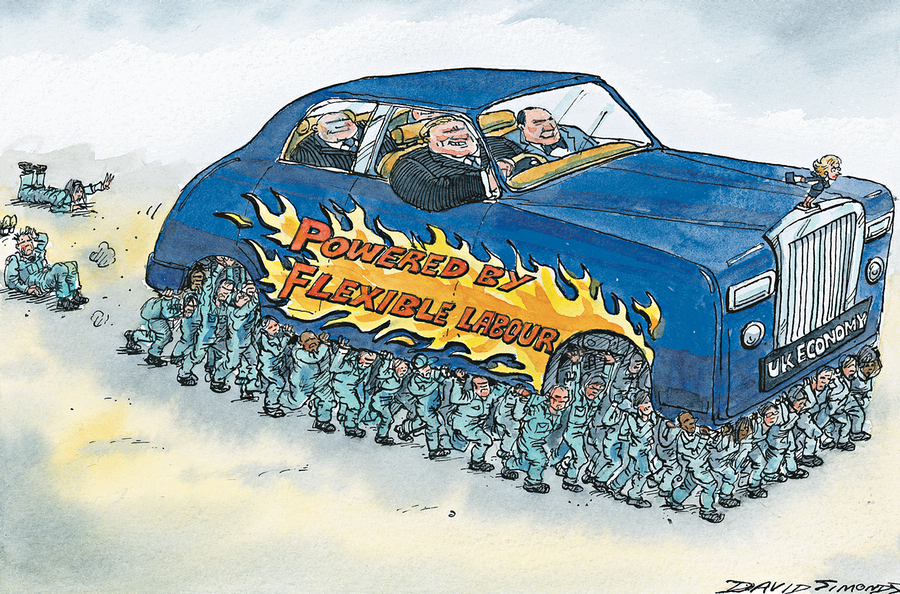
Workers have become the prey: now a natural balance needs to be restored

Britain’s flexible labour market has denied workers the security and purchasing power necessary to keep the economy healthy

  • The Observer, Sunday 18 May 2014


    In his book Why Most Things Fail, the economist Paul Ormerod tells the story of the struggle between the arctic hare and its predator, the lynx. Statisticians in Canada found that when the population of hares was big and growing, the lynx thrived because there was plentiful prey. The population of lynx went up and they killed more and more hares. Eventually, there were too few hares left and the lynx starved. The population of lynx went down and the number of hares started to rise again.

    This story has a bearing on the way the UK economy works. For the past 30 years, one of the big aims of policy has been to make the labour market more flexible. Trade unions have been curbed, industries have been privatised, welfare reformed and employment protection reduced. The balance of power between labour and capital has been tilted decisively in favour of the latter.

    The evidence of this is all around. There are 1.3m jobs on zero-hour contracts; wages can barely keep pace with price increases, even with unemployment coming down at a fair lick. Around 80% of the jobs created in the past year have been for the self-employed, with the suspicion that many of those “running their own business” are doing so involuntarily.

    This is the flexible labour market in action. It is what has distinguished the UK economy from some of the more heavily regulated economies in the rest of Europe. Supporters of the reforms of the past three decades say the flexible labour market is the reason the jobless rate is around half the average for the eurozone. Critics say that the smashing of organised labour and the triumph of management is bad for workers, bad for growth and ultimately bad for employers.

    Vince Cable can now be added to the list of those who wonder whether the labour market has become too flexible. The business secretary is right to pose the question because there are three big downsides to the way it works now.

    The first is that the taxpayer ends up subsidising low pay through the tax credits and benefits system. There are now more people in poverty who are working than are jobless.

    The second problem is that the loss of labour’s bargaining power has meant the share of national income taken by wages has fallen. That has created a problem of weak demand, which in the buildup to the financial crisis was solved by households taking on more debt. It was a period of rising house prices and equity withdrawal.

    When the crisis broke, individuals became more debt-averse. They started to pay off some of what they had borrowed and were reluctant to take out new loans. What needed to happen was for real wages to grow, since that would have allowed living standards to rise while indebtedness fell. Instead, real wages have fallen by 8%, and ultra-low interest rates have been required to get people borrowing again. Household debt is on the way back up again.

    The final problem is that the surfeit of cheap, insecure labour discourages investment. There is little inducement for firms to buy expensive new kit when demand rises, because they can always hire inexpensive labour that can be summarily dismissed later.

    What does all this mean? It means that in the long term there is a clear choice. Either the power of labour will be increased by full employment, stronger trade unions and collective bargaining or the flexible labour market will arrive at its ultimate destination: a form of capitalism that cannot function without excessive debt; is marked by low wages, low investment and low productivity; and which eventually ends up eating itself.

    Britain is well advanced down that road. As with the lynx, there is a price to be paid for slaughtering too many hares.

    Pay battle hots up

    As the weather gets warmer, so does the temperature at the annual shareholder meetings that take place at this time of year. Last week, investors at Hiscox, BG and ITV joined their peers at Pearson, Standard Chartered and AstraZeneca in registering their concerns about big bonuses. But a serious blow had yet to be landed.

    And then it finally happened. Vince Cable’s binding vote on remuneration policies claimed its first victim: the FTSE 250 engineering company Kentz. Based in Jersey, Kentz was not only the first to have its remuneration policy opposed but also have its remuneration report voted down at the same time.

    The significance? The vote on the remuneration report is one that has been in place for 10 years and covers pay that was handed out in the past. It is advisory. Companies can ignore it – but at their peril, as they risk a bad run with shareholders in the future. The vote on the remuneration policy is binding: it cannot be ignored and was introduced by the business secretary in October to cover the pay plans for the coming three years.

    For Kentz, which had managed to avoid putting its pay deals to a vote until this year by exploiting a loophole created by its registration in Jersey, it was a moment of shame.

    But it is one that has been narrowly avoided by others. The Lloyd’s of London insurer Hiscox, for instance, had a 42% vote against its remuneration policy. Standard Chartered had suffered a rebellion on a similar scale the week before.

    Little wonder, then, that HSBC took steps to head off a full-scale row over proposals to hand its chairman Douglas Flint up to £2.2m in shares at this week’s shareholder gathering.

    HSBC said Flint would be more likely get a smaller sum and only as a “one-off”: a valiant attempt to show it is listening to concerns. But shareholders may still ask if any bank chairman should be handed a bonus – as is being proposed here – for working to improve relationships with regulators. The HSBC vote will be one to watch.

    Engineering a manufacturing boom

    Celebrations to mark 175 years of train building in Derby were held last week at Bombardier’s factory, which is Britain’s oldest surviving rail plant.

    With his thoughts on the 2015 election, transport secretary and member for Derbyshire Dales Patrick McLoughlin pointed to the renewed optimism around Bombardier as a sign that the economy is now back on track.

    Yet the important contracts that have kept Bombardier’s historic Litchurch Lane works afloat did not come from the private sector, and were not the export orders that George Osborne craves. They were government-backed contracts. Had McLoughlin not signed off a £1bn deal to build trains for Crossrail back in February, it could have been 175 and out for Derby.

    This economy wasn’t sustained by Osborneomics but by the Keynesian stimulus of a public infrastructure scheme: digging the giant Crossrail tunnels under London. Good news for Derby, and the supply chain, but a long way from evidence of a sustainable manufacturing-led recovery.

  • South Africa: Lonmin fails to break 16-week platinum strike

    http://www.wsws.org

    By Thabo Seseane Jr.
    17 May 2014

    70,000 striking platinum miners, members of the Association of Mineworkers and Construction Union (AMCU), ignored a May 14 back-to-work deadline sent for them in text messages by mining company Lonmin.

    Workers at Anglo American Platinum (Amplats), Impala Platinum (Implats) and Lonmin have been on strike for basic entry-level wages of R12,500 [US$1,211] since January 23.

    On the day of the deadline, Lonmin bussed scabs into work at the company’s Marikana mine under police guard. However, the number of strikebreakers was very low, prompting Lonmin spokeswoman Sue Vey to argue, “We are not going to provide a blow-by-blow insight of the number of people returning because that’s what incites violence.”

    Meanwhile, an estimated 5,000 AMCU members gathered at Marikana’s Wonderkop Stadium, are refusing to return to work. They were addressed by AMCU President Joseph Mathunjwa as well as James Nichol, AMCU representative at the Marikana Commission of Inquiry into the death of 44 people in the mining town in 2012, including 34 miners shot by police.

    Mathunjwa mocked the employers’ attempts to get workers to break the strike via text messages, and declared that Lonmin and the government were “in bed together.” Turning to the privations facing workers and their families, he said, “Yes, it’s difficult. But let’s hold each other by the hand and stay strong. Onward!”

    At the stadium, Mathunjwa cut a very different figure from the upper-middle class bureaucrat who earlier spoke to the Mail & Guardian. In remarks to the newspaper in the days leading up to the deadline, he warned against a reprise of the August 2012 police massacre. “I have advised [the mine owners] that what they are doing now is a repeat of 2012 … I am getting very worried,” he cautioned. “One should draw from history.”

    In comments to the South African Broadcasting Corporation, Mathunjwa gave the impression of a man aware that he is out of his depth. He querulously maintained that he could not take the blame for any violence during the unprecedented 16-week strike.

    He was speaking as private security contractors bolstered a heavy police presence at mining operations near Rustenburg. The reinforcements arrived following a weekend of killings ahead of the deadline set by Lonmin management, over Mathunjwa’s head, for employees to return to work.

    According to Business Day, Lonmin and the police confirmed the death of a scab killed on his way to work at the company’s Saffy shaft on May 12. In more than 20 incidents in the days leading to the Lonmin deadline, another six workers were attacked for scabbing, with one being strangled together with his girlfriend and another set on fire.

    Tensions were clearly stoked by the employers’ efforts to circumvent the AMCU bureaucracy by communicating wage offers directly to workers. The companies sent teams to the rural areas from which they draw labour, as well as text messages to workers. Lonmin also used texting to take a snap survey whose results it claimed reflected a desire among the majority of strikers to return to work.

    Miners and residents in the Marikana area are angry over the text messages. They see the campaign for the calculated effort to divide workers that it is. At Bapong village, community members on May 13 called on their headmen to take up the issue with mine managers at Marikana.

    AMCU launched an urgent Labour Court application in Johannesburg last Monday to interdict the mining companies from communicating any new wage offers directly to workers. The union said this contravened the regulations of the Labour Relations Act.

    In a joint statement, the companies said they would ask the court to endorse their efforts to reach workers directly following the negotiations deadlock. The statement rejected the AMCU assertion that they had contravened the act, recognition agreements or employees’ constitutional rights.

    Having failed in their efforts to break the strike, the employers are now weighing legal action against AMCU. Parliament considered an amendment to the Labour Relations Act that would have given employers the chance of interdicting an ongoing strike in the event of violence. However, this clause was removed from the bill by a parliamentary committee in February following union criticism.

    As matters now stand, legal experts are unanimous that the employers would gain nothing from such an effort. Business Day quoted University of Cape Town law professor, Halton Cheadle, saying, “There is no room in terms of the Labour Relations Act to interdict the strike or have its [legal] protection lifted on the basis of violence.”

    The African National Congress government will now come under increasing pressure from international and domestic capital to find other means of breaking the strike, up to and including further violence.

    Thus far, however, government is keeping its distance.

    Through spokesman Thabo Masebe, the office of Deputy President Kgalema Motlanthe issued a statement saying, “The strike is a result of a dispute between workers … and the platinum producers. The government is not in power to intervene in a way that would benefit one party and disadvantage another.”

    Motlanthe, a former National Union of Mineworkers bureaucrat, was appointed by President Jacob Zuma last year to head a task team to bring about peace and stability in the mining sector following the Marikana massacre.

    The ANC is worried that direct intervention on its part may provoke ever wider and more determined opposition.

    This week, President Jacob Zuma further restricted the already narrow terms of reference of the Farlam Commission of inquiry into the Marikana massacre, publishing an amendment in the Government Gazette of May 5 removing paragraph 1.5.

    This derails the Marikana Commission’s second stage of proceedings, which has been running concurrently with the first stage since the beginning of April. The newer phase was supposed to take into account in a series of public seminars, the views of academics, industry experts and others on the underlying causes of the violence. It would necessarily have focused greater attention on political actors such as Police Minister Nathi Mthethwa, Mineral Resources Minister Susan Shabangu and African National Congress (ANC) Deputy President Cyril Ramaphosa, who is expected to serve as Zuma’s deputy president in the incoming administration.

    On behalf of deceased miners, the Socio-Economic Rights Institute of South Africa had expressed concern that the trio, who are culpable for the mass killing, could now be excluded from testifying by the excision of paragraph 1.5.

    Even before the new restriction, the commission’s terms of reference were composed in such a way as to focus the investigation as much as possible only on the police and their victims. This was done in an effort to whitewash the political origins of the massacre within the ANC government, which purposely unleashed a paramilitary force to assassinate workers carrying only sticks and spears.

    Economic Freedom Fighters (EFF) leader Julius Malema has called on workers to “intensify” the strike. This led to a complaint from North West province police that the party was fuelling tensions on the platinum belt. “People should be very cautious of the statements they make,” police spokesman Thulane Ngubane observed. “This country is not a banana republic.”

    Fresh from a general election performance that gives it the third largest bloc of seats in the next parliament, the EFF is intent on attracting wider sections of the working class into its ranks through striking a militant pose. Among its incoming MPs is Primrose Sonti, the widow of one of the workers slain in the 2012 Marikana killings.