We are being left in the dust—BCFED Fight For 15

https://d3n8a8pro7vhmx.cloudfront.net/wevotebc/pages/16/attachments/original/1416162716/BCFED_minimum_wage_Fight_for_15_logo_web_500_pixels.png?1416162716

This fall BC’s minimum wage dropped to the second lowest in Canada, yet we have the highest cost of living.

Other jurisdictions, like Seattle, San Francisco and Alberta, have a plan to get to a $15/hr minimum wage in the next couple of years. But Christy Clark’s plan won’t get us there until 2034.

Isn’t it time we built an economy that works for everyone?

Send a message to your MLA and let them know it is time for BC to step up.

left_in_the_dust.jpg
BCFED  http://www.fightfor15bc.ca/

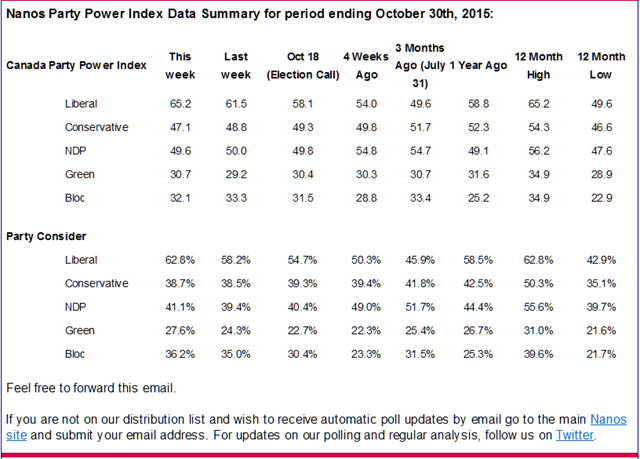
Federal Liberals score high on Nanos Party Power Index – Nanos Weekly Tracking (ending October 30, 2015)

image

The Nanos Party Power Index

  • Nanos Party Power Index – The Index, which is a composite of a series of variables including ballot preferences and impressions of the federal party leaders, has the Liberals at a twelve month high of 65.2 out of a possible 100 points.  The NDP scored 49.6 points, the Conservatives 47.1 points, the Greens 30.7 points, and in the province of Quebec, the BQ scored 32.1 points. 
  • Accessible Voters – Canadians were asked whether they would consider or not consider voting for each of the federal parties.  More than six of ten Canadians (62.8%) said they would consider voting for the Liberals, 41.1% would consider voting NDP, 38.7% would consider voting for the Conservatives, 27.6% would consider voting for the Greens, and  36.2% of Quebecers would consider voting for the BQ.

The team at Nanos in conjunction with Klipfolio have launched our new live political data portal where you run the numbers you want and can explore the trends and data you need.  This is part of our campaign, not only to provide the most reliable data to Canadians but to let them use it as they wish. We were the first to do nightly tracking and now we are the first research organization to post live public opinion data for Canadians. Here’s the link to check it out 

To view the detailed tracking visit our website.

Methodology

The views of 1,000 respondents are compiled into a party power brand index for each party that goes from 0 to 100, where 0 means that the party has no brand power and 100 means it has maximum brand power. A score above 50 is an indication of brand power for the party and its leader at this time.

The important factors in this weekly tracking include the direction of the brand strength or weakness and also the brand power of one federal party relative to another.

The data is based on random telephone interviews with 1,000 Canadians, using a four week rolling average of 250 respondents each week, 18 years of age and over. The random sample of 1,000 respondents may be weighted by age and gender using the latest census information for Canada, and the sample is geographically stratified to be representative of Canada. 

The interviews are compiled into a four week rolling average of 1,000 interviews where each week, the oldest group of 250 interviews is dropped and a new group of 250 interviews is added. Note: the current wave of tracking is based on the final weekend of the election writ period ending October 18th as well as the two weeks ending October 30th. As we move forward the tracking will revert to a four-week rolling average of 1,000 Canadians (250 per week).

A random telephone survey of 1,000 Canadians is accurate 3.1 percentage points, plus or minus, 19 times out of 20.

All references or use of this data must cite “Nanos Party Power Index” as the source. 

image

Saunders: Our unions will never give up – 2015 Cupe National Convention November 3, 2015 Summary

Saunders: Our unions will NEVER give up

AFCSME President Lee Saunders inspired delegates today with a stirring speech about the labour movement’s durability despite the ongoing and relentless attacks against it.

Challenging CUPE members to stand together against attacks on working people and to protect our past victories, Saunders said that we are in the fight of our lives.

The Friedrichs case currently before U.S. courts attacks our ability to speak up for working people, he said. On the other hand, our members and our unions will still be around long after the current politicians are gone.

“We hung in, we fought back, we organized and we won our rights back,” said Saunders, adding that we must collectively speak out for fairness, equity, wages, retirement security and vital public services.

Brother Saunders also paid tribute to Paul Moist, thanking CUPE’s National President for his outspoken leadership in fighting for economic justice and fairness for all working families.

Strategic Directions: Strengthening our union

The first round of Strategic Directions discussions focused on CUPE’s plan to strengthen and expand our membership.

Delegates spoke about the importance of organizing precarious workers, including young workers, and building a more diverse union. Bargaining strong and inclusive contracts is key to this strategy.

Delegates called for increased efforts to protect public services as another way to fight for good, full-time, secure jobs.

Time for a global labour agenda: Pavanelli

With union rights constantly under attack the time has come for a united global labour front to resist neoliberalism, said Rosa Pavanelli, general secretary of Public Services International (PSI).

Workers are under more pressure than ever to coordinate their efforts, she said.

“We are the only barrier to complete profit for the corporate sector and the limits they want to put on us,” said Pavanelli, noting that PSI is fighting hard at the International Labour Organization for the right to organize and the right to strike.

Highlighting strategies to deal with mental injuries

Attendees at the Health and Safety Forum shared stories and strategies on how to understand and prevent mental injuries in the workplace. Speakers urged delegates to recognize increasing workloads are leading to rising stress levels. They shared tactics on coping with mental injuries such as post-traumatic stress disorder (PTSD), caused by critical incidents.

Over the last two years a new Health and Safety Learning Series was developed and launched at last night’s forum.

CUPE’s Health and Safety representatives also introduced a new violence prevention kit containing tools and tips for members in the workplace.

Katie McGovern wins Grace Hartman Award

Katie McGovern, a union and community activist from CUPE 4400, is the winner of this year’s Grace Hartman Award for her ground breaking labour and community campaigns.

McGovern was unable to attend convention but urged delegates through a written statement to “take joy in the struggle” and advance “an agenda for all of us.” Yolanda McLean, CUPE 4400, accepted the award on her behalf.

Elizabeth Paris receives Ed Blackman Award

Recipient of the inaugural Ed Blackman Award, Elizabeth Paris of CUPE 2330, is a true example of how CUPE activists affect positive change in the community. Her efforts to fight for racial and social justice are an inspiration to all members.

“The CUPE rainbow is an unbreakable force,” said Paris.

TONIGHT

  • 8 p.m.   Global Justice Forum, West Ballroom C & D

THURSDAY

  • 12 p.m.   Rally: Canada is Ready for The Leap, Jack Poole Plaza outside the Convention Centre.

Source: Saunders: Our unions will never give up – Convention Bulletin

Full list of Justin Trudeau’s cabinet—CBC NEWS

November 4, 2015   CBC News

http://www.ctvnews.ca/polopoly_fs/1.2642542.1446659515!/httpImage/image.jpg_gen/derivatives/landscape_620/image.jpg          The full list of Prime Minister Justin Trudeau’s new 31-member cabinet, in order of precedence, sworn in today at Rideau Hall in Ottawa (with their province in parenthesis):

  • Justin Trudeau (Quebec) – Prime Minister, Intergovernmental Affairs and Youth.
  • Ralph Goodale (Saskatchewan) – Public Safety and Emergency Preparedness.
  • Lawrence MacAulay (P.E.I.) – Agriculture and Agri-Food.
  • Stéphane Dion (Quebec) – Foreign Affairs.
  • John McCallum (Ontario) – Immigration, Citizenship and Refugees.
  • Carolyn Bennett (Ontario) – Indigenous and Northern Affairs.
  • Scott Brison (Nova Scotia) – Treasury Board President.
  • Dominic Leblanc (New Brunswick) – Leader of the Government in the House of Commons.
  • Navdeep Bains (Ontario) – Innovation, Science and Economic Development.
  • Bill Morneau  – Finance Minister
  • Jody Wilson-Raybould (B.C.) – Justice and Attorney General  of Canada.
  • Judy Foote (Newfoundland and Labrador) – Public Services and Procurement.
  • Chrystia Freeland (Ontario) – International Trade.
  • Jane Philpott (Ontario) – Health.
  • Jean-Yves Duclos (Quebec) – Families, Children and Social Development.
  • Marc Garneau (Quebec) – Transport.
  • Marie-Claude Bibeau (Quebec) – International Development and La francophonie.
  • Jim Carr (Manitoba) – Natural Resources.
  • Mélanie Joly (Quebec) – Heritage.
  • Diane Lebouthillier (Quebec) – National Revenue.
  • Kent Hehr (Alberta) – Veterans Affairs, and Associate Minister of National Defence.
  • Catherine McKenna (Ontario) – Environment and Climate Change.
  • Harjit Sajjan (B.C.) – National Defence.
  • MaryAnn Mihychuk (Manitoba) – Employment Workforce Development and Labour.
  • Amarjeet Sohi (Alberta) – Infrastructure and Communities.
  • Maryam Monsef (Ontario) – Democratic Institutions.
  • Carla Qualtrough (B.C.) – Sport, and Persons with Disabilities.
  • Hunter Tootoo (Nunavut) – Fisheries and Oceans, and Canadian Coastguard.
  • Kirsty Duncan (Ontario) – Science.
  • Patricia Hajdu (Ontario) – Status of Women.
  • Bardish Chagger (Ontario) – Small Business and Tourism.

Map          Map shows the regional distribution of ministers in the cabinet of Prime Minister Justin Trudeau. (CBC)

List of Cabinet Committees: cabinet-committees