Mystery of how snakes lost their legs solved by reptile fossil

Fresh analysis of a reptile fossil is helping scientists solve an evolutionary puzzle – how snakes lost their limbs.

The 90 million-year-old skull is giving researchers vital clues about how snakes evolved.

Comparisons between CT scans of the fossil and modern reptiles indicate that snakes lost their legs when their ancestors evolved to live and hunt in burrows, which many snakes still do today.

The findings show snakes did not lose their limbs in order to live in the sea, as was previously suggested.

Scientists used CT scans to examine the bony inner ear of Dinilysia patagonica, a 2-metre long reptile closely linked to modern snakes. These bony canals and cavities, like those in the ears of modern burrowing snakes, controlled its hearing and balance.

They built 3D virtual models to compare the inner ears of the fossils with those of modern lizards and snakes. Researchers found a distinctive structure within the inner ear of animals that actively burrow, which may help them detect prey and predators. This shape was not present in modern snakes that live in water or above ground.

The findings help scientists fill gaps in the story of snake evolution, and confirm Dinilysia patagonica as the largest burrowing snake ever known. They also offer clues about a hypothetical ancestral species from which all modern snakes descended, which was likely a burrower.

The study, published in Science Advances, was supported by the Royal Society.

Dr Hongyu Yi, of the University of Edinburgh’s School of GeoSciences, who led the research, said: “How snakes lost their legs has long been a mystery to scientists, but it seems that this happened when their ancestors became adept at burrowing. The inner ears of fossils can reveal a remarkable amount of information, and are very useful when the exterior of fossils are too damaged or fragile to examine.”

Mark Norell, of the American Museum of Natural History, who took part in the study, said: “This discovery would not have been possible a decade ago – CT scanning has revolutionised how we can study ancient animals. We hope similar studies can shed light on the evolution of more species, including lizards, crocodiles and turtles.”

Source: Mystery of how snakes lost their legs solved by reptile fossil | Science Codex

Clean Energy Could Fuel Most Countries by 2050, Study Shows

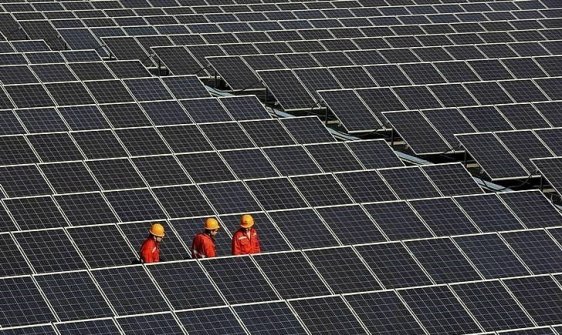
Workers walk among newly installed solar panels at a solar power plant in Zhouquan township of Tongxiang, Zhejiang province in China on December 18, 2014. Credit: REUTERS/Stringer

A new study claims to leave little room for doubt that the world can run 100 percent on renewable energy, and it even maps how individual countries should best make this transition—by mid-century.

The main barriers to overhauling the global energy system “are social and political,” said Mark Z. Jacobson, lead study author. “They aren’t technical or economic,” added Jacobson, a professor of civil and environmental engineering at Stanford University.

Jacobson and his Stanford colleagues published the analysis in a draft paper online to coincide with the start of global climate talks in Paris on Nov. 30. In those vastly complicated negotiations, most of the world’s nations have agreed on at least one thing: keeping the earth’s warming to within 2-degrees Celsius compared to pre-industrial levels—a target that scientists agree is relatively safe for the planet––will require a wholesale transformation of the world’s energy economy.

The paper, which will likely be submitted to scientific journals for publication next year, offers detailed roadmaps showing how most countries can make the switch to run entirely on clean energy across all sectors, from electricity to transportation to agriculture, as early as 2050.

Focusing on the 139 countries with available 2015 energy data, researchers first used computer models to calculate how each nation’s energy demand and mix would change by 2050. This so-called “business-as-usual” scenario was based on the assumption that the countries would continue to rely on conventional fossil fuels such as coal, oil and natural gas.

Next, the researchers determined how each country could meet its future energy demands using only renewable sources. Under this “wind, water and solar” scenario, every country’s ideal renewable energy mix was calculated based on its existing energy infrastructure and available clean energy resources, such as sunlight and wind. The researchers concluded that making this switch would lower a country’s total energy demands because clean energy sources are more efficient than fossil fuels. They also concluded the transition would curb global warming, create jobs, and reduce air pollution, which, in turn, would boost public health.

Take the United States, for example. By pursuing business as usual, the U.S. would require a total power load of 2,310 gigawatts by 2050. Under a clean energy scenario, however, the country would need only 1,296 gigawatts of power, the study said. Most of the energy would come from onshore and offshore wind (48 percent), utility-scale and rooftop solar (40 percent), and a mix of other sources, including hydropower, geothermal and wave energy. The estimated total electricity, health and climate cost savings of this transition would amount to about $8,000 per American per year (in 2013 dollars).

Jacobson’s team has also conducted a parallel study, recently published in the journal Proceedings of the National Academy of Sciences. That study dives deeper into the United States’ clean energy transition, offering energy roadmaps for all 50 states, using the same modeling approach applied in the global study.

If all the 139 countries succeed in getting 80 percent of their energy from renewables by 2030 and 100 percent by 2050, the Stanford researchers said, the world’s warming would stay below the 2-degrees Celsius warming threshold. They also predict about 22 million net jobs would be created.

Getting there won’t be easy or cheap, Jacobson explained. The price tag of greening the world’s energy system is $100 trillion, or $2 million per megawatt, over the next 35 years. Even without overhauling the energy system, the International Energy Association expects about $60 trillion should be invested during that same period to maintain electric grids and power plants and improve energy efficiency.

The analysis doesn’t say where the trillions should come from—or prescribe policies—but it shows “the burden of proof is now on the people who want to grow fossil fuels in any shape or form to explain to [the public] why they are doing something that we know is worse for the planet,” Jacobson said.

As of 2014, only 3.8 percent of the power capacity needed for 100 percent clean energy worldwide had been installed. Norway, Paraguay and Iceland lead the transition because they have successfully tapped their vast hydropower or geothermal resources. On the opposite end of the spectrum, there’s a mix of developing nations such as Trinidad and Tobago and oil-rich countries such as Saudi Arabia and Qatar. The United States is in the middle, ranking 56th out of 139 countries in terms of its progress toward 100 percent renewables by 2050.

Jacobson’s study is not the only recent report drumming up support for renewables. Earlier this month, the International Energy Agency released its World Energy Outlook 2015 report, which demonstrated renewable energy is increasing. Despite that trend, the agency expects growth in coal and other fossil fuels unless other countries––notably India––change their policies.

In addition, the International Renewable Energy Agency released a recent study suggesting renewables could make up 36 percent of the world’s energy mix by 2030. Both reports said furthering the growth of clean energy is an essential piece in addressing climate change.

“With the climate challenge in front of us, this can easily lead people to worry about our ability to meet that challenge,” said Rachel Cleetus, lead economist and a climate policy specialist at the Union of Concerned Scientists. “The bottom line from all these studies is the challenge here is political will.”

“Mark’s findings are not extreme,” said Karl Rabago, executive director of the Pace Energy and Climate Center at Pace Law School, in White Plains, N.Y. “They are well established,” said Rabago, reflecting the latest science and experience in the lab and on the ground with how efficient and productive different clean energy sources can be.

According to Rabago, “The real question now is: are we finally ready to get started?”

Source: Clean Energy Could Fuel Most Countries by 2050, Study Shows | InsideClimate News

Will Ebola change the game? Ten essential reforms before the next pandemic. The report of the Harvard-LSHTM Independent Panel on the Global Response to Ebola – The Lancet

Executive summary

The west African Ebola epidemic that began in 2013 exposed deep inadequacies in the national and international institutions responsible for protecting the public from the far-reaching human, social, economic, and political consequences of infectious disease outbreaks. The Ebola epidemic raised a crucial question: what reforms are needed to mend the fragile global system for outbreak prevention and response, rebuild confidence, and prevent future disasters? To address this question, the Harvard Global Health Institute and the London School of Hygiene & Tropical Medicine jointly launched the Independent Panel on the Global Response to Ebola. Panel members from academia, think tanks, and civil society have collectively reviewed the worldwide response to the Ebola outbreak. After difficult and lengthy deliberation, we concluded that major reforms are both warranted and feasible. The Panel’s conclusions offer a roadmap of ten interrelated recommendations across four thematic areas:

1. Preventing major disease outbreaks

All countries need a minimum level of core capacity to detect, report, and respond rapidly to outbreaks. The shortage of such capacities in Guinea, Liberia, and Sierra Leone enabled Ebola to develop into a national, and worldwide, crisis.

  • Recommendation 1: The global community must agree on a clear strategy to ensure that governments invest domestically in building such capacities and mobilise adequate external support to supplement efforts in poorer countries. This plan must be supported by a transparent central system for tracking and monitoring the results of these resource flows. Additionally, all governments must agree to regular, independent, external assessment of their core capacities.

  • Recommendation 2: WHO should promote early reporting of outbreaks by commending countries that rapidly and publicly share information, while publishing lists of countries that delay reporting. Funders should create economic incentives for early reporting by committing to disburse emergency funds rapidly to assist countries when outbreaks strike and compensating for economic losses that might result. Additionally, WHO must confront governments that implement trade and travel restrictions without scientific justification, while developing industry-wide cooperation frameworks to ensure private firms such as airlines and shipping companies continue to provide crucial services during emergencies.

2. Responding to major disease outbreaks

When preventive measures do not succeed, outbreaks can cross borders and surpass national capacities. Ebola exposed WHO as unable to meet its responsibility for responding to such situations and alerting the global community.

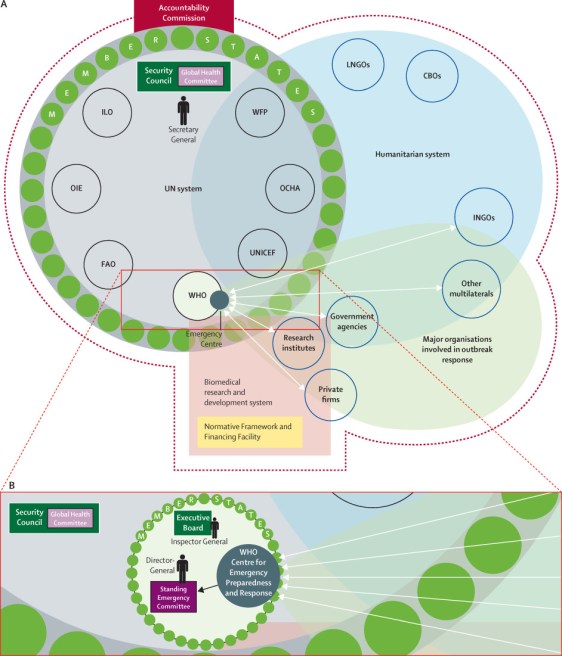
  • Recommendation 3: A dedicated centre for outbreak response with strong technical capacity, a protected budget, and clear lines of accountability should be created at WHO, governed by a separate Board.

  • Recommendation 4: A transparent and politically protected WHO Standing Emergency Committee should be delegated with the responsibility for declaring public health emergencies.

  • Recommendation 5: An independent UN Accountability Commission should be created to do system-wide assessments of worldwide responses to major disease outbreaks.

3. Research: production and sharing of data, knowledge, and technology

Rapid knowledge production and dissemination are essential for outbreak prevention and response, but reliable systems for sharing epidemiological, genomic, and clinical data were not established during the Ebola outbreak.

  • Recommendation 6: Governments, the scientific research community, industry, and non-governmental organisations must begin to develop a framework of norms and rules operating both during and between outbreaks to enable and accelerate research, govern the conduct of research, and ensure access to the benefits of research.

  • Recommendation 7: Additionally, research funders should establish a worldwide research and development financing facility for outbreak-relevant drugs, vaccines, diagnostics, and non-pharmaceutical supplies (such as personal protective equipment) when commercial incentives are not appropriate.

4. Governing the global system for preventing and responding to outbreaks

An effective worldwide response to major outbreaks needs leadership, clarity about roles and responsibilities, and robust measures for accountability, all of which were delayed or absent during the Ebola epidemic.

  • Recommendation 8: For a more timely response in the future, we recommend the creation of a Global Health Committee as part of the UN Security Council to expedite high-level leadership and systematically elevate political attention to health issues, recognising health as essential to human security.

  • Recommendation 9: Additionally, decisive, time-bound governance reforms will be needed to rebuild trust in WHO in view of its failings during the Ebola epidemic. With respect to outbreak response, WHO should focus on four core functions: supporting national capacity building through technical advice; rapid early response and assessment of outbreaks (including potential emergency declarations); establishing technical norms, standards, and guidance; and convening the global community to set goals, mobilise resources, and negotiate rules. Beyond outbreaks, WHO should maintain its broad definition of health but substantially scale back its expansive range of activities to focus on core functions (to be defined through a process launched by the WHO Executive Board).

  • Recommendation 10: The Executive Board should mandate good governance reforms, including establishing a freedom of information policy, an Inspector General’s office, and human resource management reform, all to be implemented by an Interim Deputy for Managerial Reform by July 2017. In exchange for successful reforms, governments should finance most of the budget with untied funds in a new deal for a more focused WHO. Finally, member states should insist on a Director-General with the character and capacity to challenge even the most powerful governments when necessary to protect public health.

These ten recommendations are concrete, actionable, and measurable. High-level political leadership is now needed to translate this roadmap into enduring systemic reform so that the catastrophe of the Ebola outbreak will never be repeated.

Source: Will Ebola change the game? Ten essential reforms before the next pandemic. The report of the Harvard-LSHTM Independent Panel on the Global Response to Ebola – The Lancet

Canadians say climate change a threat to Canada’s economic future and that Canada’s reputation has taken a hit on the global stage – CTV

Canadians see climate change as a threat to Canada’s economic future; support moving forward with climate change targets

Canadians agree or somewhat agree that the science behind climate change is irrefutable, and that climate change presents a threat to our economic future. They do believe that our previous efforts on climate change have harmed our reputation internationally, and generally support or somewhat support job losses in the oil industry in order to move forward with meeting environmental targets. Canadians are generally willing to pay more for products to help meet those commitments.

  • Climate’s threat to our economic future – Just under three quarters of Canadians (73%) either agree or somewhat agree that climate change represents a significant threat to our economic future (51% agree; 21% somewhat agree). Respondents in British Columbia were the most likely to agree or somewhat agree (82%). Just 16% either disagree or somewhat disagree (six percent disagree; 10% somewhat disagree) that climate change is a threat, while 10% said that they neither agree nor disagree that climate change is a threat.
  • The science of climate change – Just over seven in ten Canadians (72%) believe that the science of climate change is irrefutable, with half saying they agree (50%) and a little over one fifth saying they somewhat agree (22%) with that statement. Comparatively, only 17% said they either disagree or slightly disagree with that statement (10% disagree; eight percent somewhat disagree). Eight percent said they neither agree nor disagree that the science of climate change is irrefutable. Canadians in Atlantic Canada were the most likely to say the agree or somewhat agree (82%) that the science behind climate change is irrefutable, and participants in the Prairies were the least likely to say they agree or somewhat agree (58%) with the same statement.
  • Reputation damage from previous climate action – Just under seven in ten Canadians (69%) agree that Canada’s reputation on the global stage been hurt by our previous efforts on climate change (52% agree; 17% somewhat agree). Eighteen percent on Canadians either disagree or somewhat disagree that there was any reputation damage (11% disagree; seven percent somewhat disagree). Twelve percent said they neither agree nor disagree with that statement. Quebecers were most likely to agree or somewhat agree (81%) that Canada’s reputation had been damaged (61% agree; 20% somewhat agree), while those in the Prairies were the least likely to agree or somewhat agree (52%) to the same thing (35% agree; 17% somewhat agree).
  • Paying more to meet climate commitments – Just over three fifths of Canadians (63%) are willing to pay more for certain products in order to help Canada meet its environmental commitments, with (37% agree; 26% somewhat agree). However, just under a quarter of respondents either disagree or somewhat disagree that they would be willing to pay more (15% disagree; nine percent somewhat disagree). Twelve percent of Canadians neither agree nor disagree that they would be willing to pay more for certain products. Canadians  in Atlantic Canada  were most likely to agree to pay more, with almost three quarters (74%) saying they would agree or somewhat agree to pay more, compared to only half (50%) of Canadians in the Prairies who would say the same thing.
  • Moving forward with new targets – The majority of Canadians (66%) either support or somewhat support going forward with new climate change targets and processes even if the result is significant job loss in Canada’s oil patch (38% support; 28% somewhat support). Conversely, just under a third of Canadians (30%) would oppose or somewhat oppose the same thing (18% oppose; 12% somewhat oppose). Support for this plan is lowest among Canadians in the Prairies, where only 45% would agree or somewhat agree to move forward with new targets irrespective of job losses in the oil industry.

The full survey results can be found by visiting our website.

Methodology
Nanos conducted an RDD dual frame (land- and cell-lines) hybrid telephone and online random survey of 1,000 Canadians, 18 years of age or older, between November 21st and 24th, 2015 as part of an omnibus survey. Participants were randomly recruited by telephone using live agents and administered a survey online. The sample included both land- and cell-lines across Canada. The results were statistically checked and weighted by age and gender using the latest Census information and the sample is geographically stratified to be representative of Canada. Canadians without internet access or telephone lines were excluded by default.
Individuals randomly called using random digit dialling with a maximum of five call backs.

The margin of error for a random survey of 1,000 Canadians is ±3.1 percentage points, 19 times out of 20.

Note: Charts may not add up to 100 due to rounding.


NHL MORNING SKATE – NOVEMBER 28, 2015

 nhllogo

NHL MORNING SKATE – NOVEMBER 28, 2015

Welcome to the “NHL Morning Skate,” a daily collection of the latest news and notes from around the League.

FRIDAY’S RESULTS

Home Team in Caps
BOSTON 4, NY Rangers 3
PHILADELPHIA 3, Nashville 2 (OT)
Winnipeg 3, MINNESOTA 1
Chicago 3, ANAHEIM 2 (OT)
WASHINGTON 4, Tampa Bay 2
BUFFALO 4, Carolina 1
Montreal 3, NEW JERSEY 2 (SO)
COLUMBUS 2, Pittsburgh 1 (OT)
DETROIT 4, Edmonton 3 (OT)
FLORIDA 3, NY Islanders 2 (SO)
DALLAS 3, Vancouver 2 (SO)
ARIZONA 2, Calgary 1 (OT)

EXTRA HELPINGS OF HOCKEY

After a one-day break, the NHL returned with a 12-game schedule Friday highlighted by eight contests that required extra time.

* According to the Elias Sports Bureau, eight games went past regulation on the same day for the first time since Feb. 22, 2007 (also 8 of 12). Two teams secured victories after 60 minutes on both days: the Coyotes, who defeated the Flames in overtime on both occasions (GWG: Shane Doan in 2007, Oliver Ekman-Larsson in 2015); and the Canadiens, who posted shootout victories on both dates (6-5 W at NSH in 2007, 3-2 W at NJ in 2015).

* Ten games were tied or within one goal during the third period (NYR-BOS, NSH-PHI, WPG-MIN, CHI-ANA, MTL-NJD, PIT-CBJ, EDM-DET, NYI-FLA, VAN-DAL and CGY-ARI).

* Three teams overcame a multi-goal deficit to earn at least a point (CHI, MTL and NYI). Of those clubs, two earned victories: the Blackhawks and Canadiens.
* Two players scored a tying goal in the final minute of regulation: Predators forward Mike Fisher (19:40) and Blackhawks defenseman Duncan Keith (19:33).

BLACKHAWKS STAGE RARE COMEBACK

Down 2-0 with less than two minutes remaining in regulation, Marian Hossa (18:19) and Duncan Keith (19:33) scored 74 seconds apart to force overtime, where Artem Anisimov completed the comeback for the Blackhawks.

* Via Elias, the Blackhawks won when trailing by two goals in the final two minutes of regulation for the second time in club history – and for the first time in 89 years (also Dec. 29, 1926 against the Montreal Maroons). They are the first team to accomplish the feat in the NHL since Jan. 7, 2014 when Sidney Crosby collected 1-1—2 in the final 1:11 of the third period and then scored the lone shootout goal to rally the Penguins past the Canucks (5-4 W SO).
* Anisimov, who was acquired from the Blue Jackets during the offseason, scored his fourth career overtime goal. He has 10-6—16 in his first 23 games with the Blackhawks.

KANE EXTENDS POINT STREAK TO 18 GAMES

Patrick Kane (0-1—1) notched an assist on the tying goal with 26.6 seconds left in the third period to extend his career-high point streak to 18 games (10-19—29).

* Via Elias, Kane – who paces the League in assists and points this season (13-22—35 in 23 GP) – became the first player (on any team) to post a point streak of 18 or more games since Nov. 5 – Dec. 28, 2010, when Penguins forward Sidney Crosby totaled 26-24—50 during a 25-game point streak.
* Elias adds that Kane’s point streak is tied for the third-longest in Blackhawks franchise history:

LONGEST SINGLE-SEASON POINT STREAK, BLACKHAWKS HISTORY

21 games – Bobby Hull from Dec. 5, 1971 – Jan. 23, 1972 (23-12—35)
19 games – Denis Savard from Dec. 6, 1985 – Jan. 15, 1986 (16-21—37)
18 games – Denis Savard from Jan. 10 – Feb. 15, 1982 (8-23—31)
18 games – Clint Smith from Nov. 4 – Dec. 22, 1943 (10-19—29)
18 games – Patrick Kane from Oct. 17 – Nov. 27, 2015 (10-19—29)

BRUINS ALSO RALLY LATE TO TAKE THANKSGIVING SHOWDOWN

The Bruins scored twice in the final four minutes of regulation, including the game-winning goal by David Krejci with 1:43 left on the clock, to overcome a pair of one-goal deficits and defeat the Rangers in the 2015 Discover Thanksgiving Showdown.

* The Bruins extended their overall winning streak to five games, including three straight victories at TD Garden and four consecutive wins against an Original Six rival (TOR: 2-0 W, 4-3 W SO; DET: 3-2 W OT; and NYR: 4-3 W).
* Via Elias, the Bruins have won four consecutive team games, all against Original Six opponents, for the first time in the NHL’s expansion era (since 1967-68). This marks the 28th time the club has played four or more straight games against Original Six teams within a season in the 48 years since expansion.
* The Bruins improved to 12-1-3 in their last 16 meetings with the Rangers dating to April 1, 2012 (NYR: 4-11-1), including a five-game series victory in the second round of the 2013 Stanley Cup Playoffs.

HOLTBY, CAPITALS CONTINUE WINNING WAYS

Braden Holtby made 32 saves, including 18 in the third period, to help the Capitals close their season-high five-game homestand with four straight wins (4-1-0) and improve to 8-2-1 in their last 11 contests overall.
* At 16-5-1 (33 points), the Capitals are off to their second-best 22-game start to a season – in terms of wins and points – in the franchise’s 41-year history. They went 17-5-0 (34 points) through 21 games in 1991-92.
* Holtby extended his personal winning streak to six games (1.83 GAA, .934 SV%, 1 SO), equaling the longest stretch of his career established in his rookie campaign from March 7-26, 2011 and matched from April 2-16, 2013. Overall, Holtby (14-4-0, 1.95 GAA, .925 SV%, 1 SO) leads the NHL in wins and goals-against average in 2015-16 (among goaltenders with at least 300:00 TOI).
* Jason Chimera (1-1—2), Evgeny Kuznetsov (0-2—2) and John Carlson (0-2—2) each had two points apiece. Kuznetsov leads the Capitals – and ranks fifth in the League – with 8-18—26 this season (22 GP), including seven multi-point efforts.
* The Capitals improved to 19-2-2 in their last 23 regular-season meetings with the Lightning at Verizon Center dating to March 18, 2007 (TBL: 4-15-4), including a 10-0-2 mark in their last 12 such contests.

CANADIENS, STARS KEEP PACE ATOP NHL STANDINGS

The top two teams in the NHL – the Canadiens (18-4-2, 38 points) and Stars (18-5-0, 36 points) – both earned shootout victories on Friday:

* Down 2-0 in the second period, Sven Andrighetto and Alex Galchenyuk scored in regulation, then added both shootout goals to rally the Canadiens to victory in the first half of a home-and-home series with the Devils. It was the fourth consecutive victory overall for the Canadiens, who lead the League in wins (tied w/ DAL) and points. Mike Condon made 25 saves through overtime and denied four of five shootout attempts to improve to 8-2-2 in his NHL career (2.14 GAA, .917 SV%).
* Tyler Seguin (0-1—1) scored the lone goal in the shootout to lift the Stars to their ninth consecutive victory over the Canucks dating to April 18, 2013 (VAN: 0-6-3). The Stars, who improved to 9-2-0 in their last 11 games overall, are off to their best 23-game start to a season in franchise history. Seguin (3-6—9) and Jamie Benn (7-5—12) stretched their point streaks to seven games. Overall, Benn (17-16—33) leads the League in goals and ranks second in points, one point ahead of Seguin (12-20—32).

OVERTIME MAGIC

The Flyers, Coyotes, Red Wings and Blue Jackets also earned overtime victories on Friday:

* Shayne Gostisbehere scored his second overtime goal in five days (also Monday vs. CAR) to lift the Flyers over the Predators. Gostisbehere – a third-round selection (78th overall) in the 2012 NHL Draft who hails from Pembroke Pines, Fla – became the first rookie in Flyers history to score multiple overtime goals in one season. Elias adds that Gostisbehere (9 GP) is the fastest player to score multiple overtime goals – in terms of games played – since the NHL introduced the five-minute overtime format in 1983-84.
* Oliver Ekman-Larsson scored with 39.9 seconds remaining in overtime to lift the Coyotes to their third consecutive home win. Ekman-Larsson, who paces the club with three game-winning goals in 2015-16, scored his fifth career overtime goal. Overall, Ekman-Larsson has collected 19 game-winning goals since entering the NHL in 2010-11 – two more than the next-closest defensemen in that span (Dustin Byfuglien: 17 GWG). The decisive tally also moved Ekman-Larsson into a tie with Teppo Numminen (19 GWG) for the most game-winning goals by a defenseman in Coyotes/Jets franchise history.
* Nicklas Kronwall scored his fourth career overtime goal 26 seconds into the extra frame to help the Red Wings improve to 16-1-1 in their last 18 meetings with the Oilers dating to March 30, 2010 (EDM: 2-12-4). Dylan Larkin (1-1—2), Gustav Nyquist (1-1—2), Tomas Tatar (1-1—2) and Henrik Zetterberg (0-2—2) all registered multiple points for the Red Wings. Larkin (9-8—17) leads all rookies with nine goals in 2015-16.
* Cam Atkinson scored his first career overtime goal (15th career game-winning goal) to lead the Blue Jackets to an 8-4-0 record in November. Only two players in Blue Jackets history have more game-winning goals than Atkinson: Rick Nash (44 GWG) and David Vyborny (17 GWG). Sergei Bobrovsky made 25 saves to improve to 8-2-0 in November, tied with Braden Holtby for the most wins this month.

DID YOU KNOW?

The Blue Jackets became the final NHL team to play past regulation this season. Via Elias, their franchise-record 23 consecutive games without an overtime contest to start the season was the longest such streak since 1998-99 (NYI: 27 GP).

SHOOTOUT THE LIGHTS

Aleksander Barkov scored the game-deciding goal in the fifth round of the shootout to help the Panthers snap a three-game skid (0-2-1). Nine of the 10 combined shooters scored in the tiebreaker (FLA: 5 goals, NYI: 4 goals). Via Elias, it marked the first time in NHL history that all but one shooter scored in a shootout of at least five rounds.

MILESTONES AND BENCHMARKS

* Panthers goaltender Roberto Luongo earned his 408th career win to surpass Glenn Hall (407) for sole possession of eighth place in NHL history; Tony Esposito holds the seventh position with 423 victories. Luongo also tied John Vanbiesbrouck for eighth place on the League’s all-time games played list (882 GP).
* Andrei Markov (0-1—1), a sixth-round selection by the Canadiens (162nd overall) in the 1998 NHL Draft, became the third defenseman in franchise history to record 400 assists. The others: Larry Robinson (686) and Guy Lapointe (406).
* Capitals head coach Barry Trotz earned his 618th career win to surpass Jacques Lemaire for sole possession of 11th place on the League’s all-time coaching wins list. He also became the 10th coach in NHL history to serve 1,300 games behind an NHL bench (618-531-151).
* Coyotes head coach Dave Tippett earned his 500th career win to become the ninth active coach to reach the milestone.
* The Predators contested the 1,300th regular-season game in franchise history (616-510-174), while goaltender Pekka Rinne (33 SV) became the fourth Finnish-born netminder to play in 400 career games (all w/ NSH). Other Finnish-born goaltenders to reach the milestone: Miikka Kiprusoff (623), Kari Lehtonen (520) and Niklas Backstrom (409).
* Lightning defenseman Anton Stralman played in his 500th career game.
* Jets goaltender Connor Hellebuyck, a fifth-round selection (130th overall) in the 2012 NHL Draft, made 14 saves to earn a victory in his League debut. Via Elias, he is the second netminder in Jets/Thrashers history to win his NHL debut (Kari Lehtonen: March 19, 2004 vs. FLA).
* Canadiens forward Bud Holloway, a third-round selection (86th overall) in the 2006 NHL Draft (by LAK), made his League debut (7:19 TOI).

LOOSE PUCKS

Jack Eichel scored the first of three unanswered goals to help the Sabres halt a six-game losing streak (0-4-2). Eichel, the second overall selection in the 2015 NHL Draft, has 8-4—12 in his first 23 career games and is tied for second in goals among all rookies . . . Dustin Byfuglien (1-1—2), who hails from Roseau, Minn., scored the game-winning goal in his home state to help the Jets snap a six-road game skid (0-5-1) . . . Brent Seabrook (0-3—3) registered at least three assists in a game for the fourth time in his career (last: Dec. 5, 2010 vs. CGY: 0-3—3) . . . Penguins captain Sidney Crosby (0-1—1) has 3-2—5 in his last four contests . . . Capitals captain Alex Ovechkin scored his team-leading 12th goal of the season, tied for fourth in the League . . . Ovechkin has compiled 38-39—77 in 58 career appearances vs. TB, his second-highest point total against one opponent (43-42—85 in 58 GP vs. WPG/ATL) . . . Canucks teammates Daniel (1-1—2) and Henrik Sedin (1-0—1) extended their point streaks to seven and six games, respectively (D. Sedin: 6-6—12, H. Sedin: 3-7—10) . . . Flyers  captain Claude Giroux (0-2—2) has notched the primary assist on each of the club’s last two game-winning goals (both in overtime). He has 2-4—6 in his last three contests . . . Brett Connolly and Ryan Spooner both registered power-play tallies as the Bruins went 2-for-3 with the man advantage. Overall, the Bruins pace the NHL in power-play goals (22) and power-play percentage (32.4%) . . . Rangers forwards Rick Nash and Oscar Lindberg both scored their eighth goal of the season. Nash has six strikes in his last four contests (6-0—6), while Lindberg is one goal shy of the rookie lead . . . Islanders defenseman Marek Zidlicky (0-2—2) registered his first multi-point effort since March 15 at PIT (w/ DET: 1-2—3) . . . Oilers forward Iiro Pakarinen (2-0—2) registered his first career multi-goal game (32 GP) . . . Columbus Blue Jackets center Brandon Dubinsky will have a hearing with the NHL Department of Player Safety on Saturday for cross-checking Pittsburgh Penguins’ Sidney Crosby on Friday.

SNEAK PEEK AT SATURDAY’S ACTION

All Times Eastern
Philadelphia @ NY Rangers, 1:30 p.m., CSN-PH, MSG
Washington @ Toronto, 7:00 p.m., CBC, NHLN-US, CSN-DC+
New Jersey @ Montreal, 7:00 p.m., TVAS, CITY, MSG
NY Islanders @ Tampa Bay, 7:00 p.m., MSG+, SUN
Edmonton @ Pittsburgh, 7:00 p.m., SN, ROOT
Columbus @ St. Louis, 8:00 p.m., FS-O, FS-MW
Buffalo @ Nashville, 8:00 p.m., MSG-B, BELL TV, FS-TN
Dallas @ Minnesota, 8:00 p.m., FS-SW+, FS-N, FS-WI
Winnipeg @ Colorado, 10:00 p.m., SN, ALT
Ottawa @ Arizona, 10:00 p.m., CITY, FS-A
Calgary @ San Jose, 10:00 p.m., CBC, CSN-CA
Chicago @ Los Angeles, 10:30 p.m., WGN, FS-W

WESTERN CONFERENCE POWERS HIGHLIGHT 12-GAME SATURDAY

For the second consecutive day the NHL schedule will feature a 12-game slate of games, highlighted by a key Western Conference match-up loaded with Stanley Cup champions when the Blackhawks visit the Kings at STAPLES Center on Saturday night.

* The Blackhawks and Kings have combined to capture the Stanley Cup in five of the last six seasons, including each of the last four (CHI: 2009-10, 2012-13, 2014-15; LAK: 2011-12, 2013-14).
* Chicago is led by Patrick Kane, who looks to extend his career-high point streak to 19 games (10-19—29 in 18 GP), while Tyler Toffoli of the Pacific Division-leading Kings has registered at least one point in eight of his last nine appearances (2-7—9).

SIX CANADIAN TEAMS FEATURED ON HOCKEY NIGHT IN CANADA

Hockey Night in Canada will feature six games on Saturday night including Alex Ovechkin and the Capitals, who have won four straight contests, visiting the Maple Leafs (5-2-3 in their last 10 GP). The League-leading Canadiens (18-4-2, 38 points) host the Devils in the second half of a home-and-home series after Montreal rallied from a two-goal deficit to defeat the Devils in a shootout on Friday night in New Jersey. Other featured games include the Oilers visiting the Penguins, the Jets making a trip to Colorado to face the Avalanche, the Coyotes hosting the Senators and the Flames making a stop in San Jose to face the Sharks.

Follow us @NHL and @PR_NHL | Like us on Facebook | Follow us on Instagram