An Assessment of Canadian Government’s Fiscal Outlook

1 December 2015

Get the report
An Assessment of the Government’s Fiscal Outlook.PDF

Summary
Forecast comparison

On balance, the outlooks for the budgetary balance between 2015-16 and 2018-19 are similar. Finance Canada projects budget deficits averaging $2.7 billion a year while PBO projects budget deficits averaging $2.9 billion.

However, for the fiscal years 2019-20 and 2020-21, the Government projects budget surpluses of $1.7 billion and $6.6 billion respectively, while PBO projects deficits of $4.6 billion and $4.2 billion. Relative to gross domestic product (GDP), the difference in outlooks amounts to 0.3 percentage points in 2019-20 and 0.4 percentage points in 2020-21.

Comparison of outlooks for the budgetary balance ($ billions)
2015-16 2016-17 2017-18 2018-19 2019-20 2020-21
PBO 1.2 -3.0 -4.7 -5.0 -4.6 -4.2
Finance Canada -3.0 -3.9 -2.4 -1.4 1.7 6.6
Difference -4.2 -0.9 2.3 3.6 6.3 10.8
Sources:  Finance Canada and Parliamentary Budget Officer.

The difference in budgetary balance projections over 2017-18 to 2020-21 stems from the Government’s more optimistic outlook for revenues from personal and corporate income taxes (PIT and CIT), as well as the Goods and Services Tax (GST).

Forecast revisions

Finance Canada’s downward revision to its planning assumption for nominal gross domestic product (GDP) from Budget 2015 averages $40 billion a year (-1.8 per cent) over 2016 to 2019. Even so, relative to Budget 2015 the department shows only a modest downward revision to its outlook for revenues from PIT, CIT and GST, averaging $1.1 billion (-0.4 per cent) a year over 2016-17 to 2019-20. This reflects Finance Canada’s assumption that higher-than-expected revenues observed in 2014-15 and 2015-16 (year to date) carry forward over the entire forecast horizon.

In contrast, PBO does not assume that higher-than-expected revenues carry forward over the entire forecast.

Finance Canada’s forecast adjustment

To account for the possibility of lower oil prices or weaker-than-expected global growth in its Update, the Government adjusted downward the private sector forecast of nominal GDP from Finance Canada’s October 2015 survey.

In PBO’s view, the Government’s forecast adjustment would only balance the downside risk to the private sector outlook for oil prices. PBO believes that downside risk remains to the Government’s planning assumption for nominal GDP. This reflects a relatively optimistic private sector forecast of real GDP growth over 2018 to 2020.

A note of clarification:  PBO’s fiscal outlook provided to the House of Commons Standing Committee on Finance in April 2015 was based on the fiscal measures and fiscal structure from Budget 2015. Our April outlook indicated—based on our economic outlook at the time—that this structure would generate relatively small deficits over the medium term.

In November we downgraded our fiscal projection on the basis of a weaker projected economic outlook. We now believe that the current fiscal structure will lead to a deficit in 2016-17 and larger deficits over the rest of the forecast period relative to PBO’s April forecast.

Source: An Assessment of the Government’s Fiscal Outlook

10-minute test that detects a stroke from a few drops of blood is a ‘game-changer’, scientists say

The new test for stroke uses just a few drops of blood. Rapid, inexpensive and easy to administer, it could be a game-changer, say its inventors

By Fiona Macrae Science Editor For The Daily Mail

  • Quicker detection should lead to more people being treated – saving lives
  • Rapid, inexpensive and easy to administer, test could be available by 2018
  • Uses plates coated with enzymes to detect chemicals that rise in the blood after a stroke

A ten-minute test that detects strokes from just a few drops of blood is being developed by scientists.

Quicker detection should lead to more people being treated – saving lives.

Early treatment would also cut the odds of disability, increasing patients’ chances of being able to continue living independently.

Rapid, inexpensive and easy to administer, the test could be a game-changer, say its inventors.

Stroke is Britain’s third-biggest killer and the main cause of severe disability in Britain.

At least 450,000 men and women are living with problems from muscle weakness and paralysis to loss of co-ordination and balance caused by an interruption in the blood supply to the brain.

Drug treatment can limit the damage from the most common form of stroke, which is caused by a clot in the brain, but it has to be given within three or four hours of falling ill.

And it can’t be started without a hospital scan, as the drug could prove fatal for patients with a second, less common-type of stroke caused by bleeds in the brain.

This means that it is crucial to distinguish between the two and do it quickly.

The new test, which could be done in an ambulance and cost just several pounds, could save precious time, allowing many more patients to be treated.

The brainchild of scientists at Cornell University in the US, it uses plates coated with enzymes to detect chemicals that rise in the blood after a stroke.

When the enzymes bind to the chemicals, they trigger a chain reaction that leads to the emission of light.

Blood tests have been developed for stroke in the past but typically take several hours, meaning they are not widely used.

The combination of technology in the Cornell test gives results in under ten minutes and uses just a few drops of blood.

Currently, it can pick up a chemical known to be made when the brain is damaged by stroke and other illness.

It is hoped that by adapting it to detect several key chemicals, it will be able to zero in on strokes and distinguish between the two types.

It may even be suitable for a paramedic to administer in the back of an ambulance, the journal PLOS ONE reports.

Researcher Alex Travis said the first test could be available by 2018 – saving and improving lives.

Roy Cohen, the study’s lead author, said: ‘Three-quarters of stroke patients suffer from ischemic stroke – a blockage of a blood vessel in the brain.

The brainchild of scientists at Cornell University in the US, it uses plates coated with enzymes to detect chemicals that rise in the blood after a stroke (pictured

The brainchild of scientists at Cornell University in the US, it uses plates coated with enzymes to detect chemicals that rise in the blood after a stroke (pictured

‘In those cases, time is of the essence, because there is a good drug available, but for a successful outcome it has to be given within three or four hours after the onset of symptoms.

‘By the time someone identifies the symptoms, gets to the hospital, and sits in the emergency room you don’t have much time to obtain the full benefit of this drug.

‘This technology is potentially game-changing.’

Dr Shamim Quadir, of the Stroke Association, said: ‘A stroke is a medical emergency so rapid diagnosis and treatment is essential. The sooner that treatment is given, the less damage is done to the brain.

‘Currently, too many people arrive at hospital outside of the window for treatment or have an unknown time of onset of their stroke.’

However, he cautioned that the blood test is still at an early stage in development.

It is hoped the test could be adapted to detect other conditions, including concussion, heart disease and some dementias and cancers.

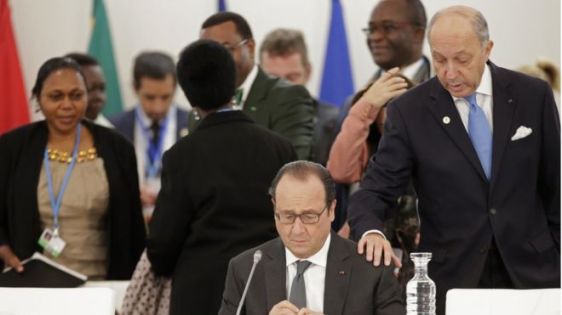
Now that the leaders have left COP21, what happens next?

Everyone said the right things. The prospects of a deal, haven’t been harmed, even if they weren’t hugely advanced.

On Tuesday the more regular routines of COP life kicked in.

The day started with a plenary session of the parties, where every nation’s negotiating team is represented.

This involved formal opening statements, summing up the key points from each country’s perspective.

Complex process

Right now there are three layers of negotiation going on.

At the very bottom, dozens of informal meetings are taking place in all corners of this massive complex

Groups of countries, often just a handful, are working through a paragraph of text at a time.

Channelling Donald Rumsfeld, these meetings have been dubbed “informal informals”.

The next layer up is what are termed facilitated sessions.

Facilitators have been appointed by the co-chairs of the ADP (Adhoc working group on the Durban Platform for enhanced action, if you want to be formal about it), the part of this overall meeting that’s delivering the new deal.

There are between ten and 20 of these strands, looking at elements in the text and trying to streamline it and find compromises.

They’ve already been working very late, indicating some progress is being made.

On top of this, according to those familiar with the process, is a new, “open ended contact group” of negotiators that will try to bring together all the links between all the different elements in the proposed agreement.

The hope is that by Saturday, the current text that runs to more than 50 pages will have been slimmed down somewhat or at least knocked into a fashion where it can be handed over to the French president of this meeting, Laurent Fabius.

He has promised to take it to the environment ministers who will arrive next week to make the difficult political decisions.

Minister Fabius has promised openness and transparency.

“No hidden agenda, no secret plan, no text in our pocket,” he told the meeting.

He then hopes to guide the negotiations to a successful conclusion and to utter the four words that climate delegates have been waiting years to hear.

“Our mission is accomplished.”

Source: Now that the leaders have left COP21, what happens next? – BBC News

Insects Other Than Bees are Important Crop Pollinators, Say Scientists

This image shows a syrphid fly, a common non-bee crop pollinator. Image credit: Tobias Smith.

This image shows a syrphid fly, a common non-bee crop pollinator. Image credit: Tobias Smith.

Dec 1, 2015 by Natali Anderson

According to a large multinational team of scientists led by University of New England researcher Dr Romina Rader, non-bee insects – flies, beetles, moths, butterflies, wasps, and ants – are efficient pollinators providing 39 percent of visits to crop flowers.

“Non-bee insects are an insurance against bee population declines,” said team member Dr Margie Mayfield, of the University of Queensland.

“We are trying to get the message out there to use scientific findings such as these to promote a change in agricultural practices.”

Dr Rader, Dr Mayfield and their colleagues analyzed data from 480 fields for 17 crops examined in 39 studies on five continents.

They discovered that non-bee insects performed around 39% of the total number of flower visits.

“Although non-bees were less effective pollinators than bees per flower visit, they provided slightly more visits,” Dr Rader explained.

“These two factors compensated for each other, resulting in pollination services similar to bees.”

She added: “non-bee insect pollinators had other advantages. Fruit set in crops increased with non-bee insect visits, independently of bee visitation rates, indicating that non-bee insects provide a unique benefit not provided by bees.”

“We also found that non-bee pollinators were less sensitive to habitat fragmentation than bees.”

The findings were published this week in the journal Proceedings of the National Academy of Sciences.

“A shift in perspective from a bee-only focus is needed for assessments of crop pollinator biodiversity and the economic value of pollination,” the scientists said.

“These studies should also consider the services provided by other types of insects – important pollinators that are currently overlooked.”

_____

Romina Rader et al. Non-bee insects are important contributors to global crop pollination. PNAS, published online November 30, 2015; doi: 10.1073/pnas.1517092112

Source: Insects Other Than Bees are Important Crop Pollinators, Say Scientists | Biology | Sci-News.com