Lack of business investment could derail Canada’s economic growth

OTTAWA, May 30, 2016 /CNW/ – Business investment outside of the energy sector remains sluggish, despite many manufacturing industries being at or close to full capacity, according to a new briefing released by The Conference Board of Canada.

“For the past year, we at the Conference Board have stressed the need for a rebound in business investment to support Canada’seconomic growth,” said Matthew Stewart, Associate Director, Economic Forecasting and co-author of the briefing. “If non-energy investment does not rebound over the coming months, capacity constraints in some manufacturing industries could impact future growth.”

HIGHLIGHTS

  • In order for exports to continue to drive economic growth, a pickup in non-energy investment aimed at expanding productive capacity is needed.
  • Our current economic outlook assumes a modest increase in non-energy investment spending in the second quarter with a stronger pick up in the second half.
  • Current business investment intentions are much more pessimistic than what is included in our current economic outlook.
  • Most leading manufacturing industries have reached or nearly reached their capacity to continue to grow.
  • Manufacturing industries in particular are expected to reduce capital expenditures this year by an average of 10.9 per cent.
  • Without a pickup in investment, capacity constraints have the potential to upset recent economic momentum.

The transportation equipment, wood products, food, primary metal and paper industries have been the key drivers of manufacturing growth in Canada, accounting for 64 per cent of year-over-year increases in output. These manufacturing industries, which have been leading Canada’s rebound in exports, are at or fast approaching full capacity. In the fourth quarter of last year, the wood products manufacturing industry was operating at 99.3 per cent capacity. Paper manufacturing was not far behind, operating at 98.2 per cent and transportation equipment operated at 97.3 per cent of its capacity. Meanwhile, transportation equipment manufacturing recorded its highest capacity utilization rate in history in the third quarter of 2015.

Despite many manufacturing industries operating near capacity, businesses remain reluctant to invest. In fact, manufacturers across a range of industries expect to cut investment this year by an average of nearly 11 per cent. Moreover, the transportation equipment, wood products, food, primary metal and paper manufacturers are expected to post worse-than-average investment declines.

In the Conference Board’s Index of Business Confidence survey, business leaders cited weak market demand, government policies, a shortage of qualified staff, and the depreciation of the Canadian dollar (which increases the cost of imported technology and machinery) as reasons for not investing. While market demand should improve as the U.S. economy continues to strengthen, the remaining factors—government policies, a shortage of qualified staff, and the depreciation of the Canadian dollar—will likely continue to hold back investment.

While we still expect non-energy investment spending to pick up in the second half of the year as accelerating demand from the U.S. improves the incentive for firms to expand their capacity, the continued lack of investment has the potential to severely limit Canada’s future growth.

The executive briefing is available on The Conference Board of Canada’s e-library.

SOURCE Conference Board of Canada

Source: Lack of business investment could derail Canada’s economic growth

TOP PROSPECTS DESCEND ON BUFFALO FOR NHL COMBINE

Top prospects Auston Matthews, Patrik Laine, Jesse Puljujarvi, Pierre-Luc Dubois, Matthew Tkachuk and Alexander Nylander are among the 114 draft-eligible players expected to attend the 2016 NHL Combine, which runs through this Saturday at First Niagara Center and HarborCenter in Buffalo.

The event will be held at First Niagara Center and the HarborCenter in Buffalo from May 30 to June 4.

cut

Auston Matthews

The week includes one-on-one interviews with NHL teams, medical examinations and fitness testing.

Among the top North American skaters invited to the Combine are left wing Pierre-Luc Dubois (6-2, 201) of Cape Breton in the Quebec Major Junior Hockey League, left wing Matthew Tkachuk (6-1, 200) of London in the Ontario Hockey League, left wing Alexander Nylander (6-0, 180) of Mississauga in the OHL, and defenseman Jakob Chychrun (6-2, 205) of Sarnia in the OHL.

Nine goaltenders were invited to the Combine, among them Evan Fitzpatrick of Sherbrooke of the QMJHL and Filip Gustavsson of Lulea’s team in Sweden’s junior league. Fitzpatrick (6-3, 206) is No. 1 on NHL Central Scouting’s final ranking of North American goaltenders and Gustavsson (6-1, 184) is No. 1 on the final ranking of international goaltenders.

Click here for a list of expected attendees.

Statement by the Prime Minister of Canada on the International Day of United Nations Peacekeepers 

Ottawa, Ontario
29 May 2016

The Prime Minister, Justin Trudeau, today issued the following statement on the International Day of United Nations Peacekeepers:

“Today, we salute United Nations peacekeepers, past and present, who have dedicated their lives to the pursuit of peace, safety, and freedom for others. They have greatly sacrificed to provide hope and security for the most vulnerable persons around the globe.

“Peacekeeping has a deep connection to Canadian values and leadership. The first UN peacekeeping mission came about in large part due to the efforts of Lester B. Pearson, our fourteenth Prime Minister, and the leadership of UN Forces Commander E.L.M. “Tommy” Burns. Together, their actions during the Suez Crisis of 1956 marked the beginning of Canada’s identity as a peacekeeping country.

“Since then, UN peace operations have evolved from separating belligerents and monitoring cease fires to protecting vulnerable populations and working to establish the conditions for durable peace. As conflicts have grown in intensity and complexity, so too have the risks for UN peacekeepers who put their lives on the line for the safety of others.

“On behalf of all Canadians, I commend UN peacekeepers for their selfless work and tremendous contributions to the advancement of global peace and human rights. We will continue working with the UN to promote peace and the resolution of serious conflicts around the world.”

Source: Statement by the Prime Minister of Canada on the International Day of United Nations Peacekeepers | Prime Minister of Canada

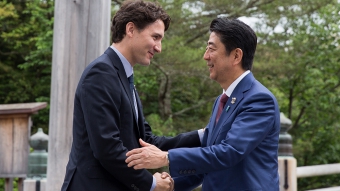
Prime Minister attends the G7 Summit in Ise-Shima

Ise-Shima, Japan
27 May 2016

The Government of Canada remains committed to creating jobs, strengthening the middle class, and helping those working hard to join it. When the majority of middle class Canadians feel confident about their future – and their families’ future – the whole country benefits.

Today, the Prime Minister, Justin Trudeau, concluded the G7 Leaders’ Summit in Ise-Shima, Japan. Following the Summit, the G7 leaders issued a joint-declaration where they committed to tackle major global challenges such as the need to promote sustainable economic growth that benefits all citizens, not just the wealthiest one per cent.

While in Ise-Shima, Prime Minister Trudeau shared Canada’s proactive approach to bolster economic growth by making strategic investments in infrastructure and clean technologies – investments that will support good, well-paying jobs and strengthen the middle class. He underscored the need to improve growth around the world, but also stressed the need to question who the growth is going to benefit.

The G7 leaders also discussed pressing foreign policy and security challenges, including Russian interference in Ukraine, the fight against the Islamic State of Iraq and the Levant (ISIL), and the global migration crisis. The Prime Minister highlighted the need for G7 solidarity to refrain from paying ransom to terrorist groups.

During the Summit, the Prime Minister also supported Japan’s decision – as host country of the Summit – to place a particular focus on women’s empowerment and health. He shared Canada’s commitment to advancing gender equality and advancing women’s rights, and he encouraged his G7 counterparts to demonstrate leadership in the context of the Fifth Replenishment Conference of the Global Fund to Fight AIDS, Tuberculosis and Malaria, which will be held in Montreal in September 2016.

Quote

“For Canada, we know what made us successful in the past – a strong middle class. At the G7 this week, we had the opportunity to sit down with some of our closest international partners and discuss ways to not only improve global economic growth, but to also make sure that growth benefits all our citizens, not just a select few.”
– Rt. Hon. Justin Trudeau, Prime Minister of Canada

Quick Facts

  • The Leaders of the G7 – united by common values of freedom and democracy, and respect for human rights and the rule of law – come together each year to discuss issues of domestic and global concern. The G7 includes Canada, France, Germany, Italy, Japan, the United Kingdom and the United States. Representatives of the European Union also attend meetings.
  • The G7 presidency rotates annually among country members. Japan holds the G7 presidency in 2016, and will be followed by Italy in 2017 and Canada in 2018.
  • G7 Leaders also took part in discussions with the Leaders of Laos, Indonesia, Vietnam, Bangladesh, Sri Lanka, Papua New Guinea, and Chad, who had been invited by Japan to discuss shared challenges.
  • G7 ministerial-level meetings are also held each year to build on the Leaders’ agenda. Japan has convened a total of 10 G7 ministerial meetings in 2016.

Associated links

Source: Prime Minister attends the G7 Summit in Ise-Shima

Stop trade deals that undermine local power – CUPE

May 27, 2016

Canadians want their communities governed in the public interest. But increasingly, trade deals like the Comprehensive Economic and Trade Agreement (CETA) between Canada and the European Union and the Trans-Pacific Partnership (TPP) threaten municipal rights and powers in favour of the interests of multinational corporations.

While the Canadian government has signed the TPP and CETA, both can still be blocked during the upcoming ratification process. There are many reasons why the federal government should not ratify either of these deals.

Canada is a trading nation and international trade is vital to all levels of our economy. But trade agreements must put the interests of Canadians before corporate profits. Modern trade deals like CETA and the TPP are more about expanding corporate rights and powers, and less about trade.

In fact, trade between Canada and its 11 TPP partners is already 97 per cent tariff free. The TPP’s 6,000 pages are mainly focused on giving corporations the power to challenge laws and regulations which affect their investments – and profits – in signatory countries where they do business. Both the CETA and TPP would give corporations the right to challenge, and potentially overturn, Canadian laws and regulations.

Unlike the North American Free Trade Agreement (NAFTA), CETA will fully cover Canadian municipalities. While the TPP does not currently cover subnational governments, like provinces and municipalities, Article 15.24 mandates Canada to begin negotiations to expand coverage, including to subnational governments no later than three years after the deal comes into force.

Trading away our democracy 

The TPP’s investor-state dispute settlement (ISDS) provisions, are similar to rules set out in NAFTA and CETA. The TPP’s investor arbitration rules will let transnational corporations bypass our public court system and sue governments over legislation or policies made in the public interest. The claims will be heard by secretive, pro-investor arbitration panels. It only takes two of three arbitrators – all corporate lawyers whose pay depends on the number of cases – to override legislation enacted by democratically-elected governments. This gives multinational corporations excessive power to undermine the authority of cities, provinces and the federal government to create reasonable rules and regulations such as environmental, health and labour safeguards; climate policy, food safety standards; protections for local jobs and businesses. As an example, when the Canadian government banned the import of a neuro-toxic gasoline additive called MMT, the US producer sued under NAFTA’s investment protections. Canada was forced to agree on a $13 million dollar settlement and reverse the ban.

CETA’s dispute settlement mechanism has recently been rebranded as Investor Court System (ICS) in order to make it sound more palatable. However, the accompanying cosmetic changes do little to prevent abuses from investors and arbitrators.

Locking in privatization and corporate profits

Under international trade rules, municipalities may find it expensive to bring a utility or service back in house, even if the costs of private delivery have sky-rocketed, or privatization has failed. Both CETA and the TPP ‘lock in’ privatization, and could make any attempt to bring contracted-out services back in house the target of an investor-state claim.

Similarly, living wage policies could trigger challenges. In 2012, the French utility company Veolia, present in some Canadian municipalities, launched a $115 million suit against the Egyptian government, under a bilateral investment treaty. The dispute stems from the City of Alexandria refusing to revise a waste disposal contract to meet higher costs, in part due to the introduction of a minimum wage.

Municipalities that want to favour local solar and wind energy over polluting fossil fuels may also face trade-related barriers. Under NAFTA, almost 40 per cent of investor claims using ISDS have challenged environmental regulations. A recent example is TransCanada Corporation suing the US government for $15 billion, after a democratically-elected president rejected the Keystone XL Pipeline over environmental concerns, and under mounting public pressure.

Driving up health, education costs

Major patent extensions in both CETA and the TPP will increase the price of prescription drugs as much as $2 billion per year, by some estimates. Drug costs are already the second-highest cost for provincial governments. Rising costs will mean pressure on municipal transfers and programs. Municipalities can also expect similar impacts on the costs of health benefit plans for employers.

Similarly, the TPP’s US-style copyright extensions will increase the time it takes for materials to fall into the public domain from 50 to 70 years. That will translate into up to $100 million per year in higher costs for municipal libraries, post-secondary libraries and public education more broadly.

Opening up municipal procurement

The total government procurement market in Canada is worth at least $100 billion per year. CETA will give access to provincial and municipal contracts and purchasing. The thresholds are so low (near $300,000 for goods and services contracts and $8 million for infrastructure projects) that most procurement contracts will be open to European firms. This will severely limit the ability of municipalities, school districts and other local authorities to establish ‘buy local’ or ‘buy Canadian’ policies. This would include banning measures that protect or promote local business opportunities and local jobs when municipalities contract for goods and services. Strategic purchasing strategies that promote local green jobs and local food policies may also be at risk.

Municipalities will likely also face increased costs associated with providing the federal government with information about their procurement activities. This includes publishing detailed notices and announcements of intended procurement, issuing tenders which comply with CETA procedures, and justifying procurement decisions to unsuccessful suppliers.

Need for more transparency and public debate

The investor protections and dispute settlement provisions included in both the TPP and CETA give too much power to corporations, at the expense of our democracy. Nobel Laureate and world-renowned economist Joseph Stiglitz recently described the TPP as “the worst trade deal ever.” And investor rights in CETA have sparked massive mobilizations across Europe.

Canada’s experience with NAFTA has meant the loss of between 300,000 and 400,000 well-paying manufacturing jobs, declining wages and a hollowing out of the middle class. Implementing the TPP and CETA will only entrench this new economic structure and further increase inequality.

More than 70 Canadian municipalities have passed resolutions expressing concern or asking to be exempted from CETA. Canadian municipalities are now beginning to pass resolutions raising similar concerns about the TPP. Cities and towns can use their voice at the table in provincial and federal forums to call for a real public debate and full, independent analysis of these trade agreements. Let’s ensure our public services, municipal rights and local democracy are not traded away.

For more information about CETA and the TPP visit cupe.ca/trade

Source: Stop trade deals that undermine local power – CUPE