Asbestos Threats to Health Rise as Demolitions Skyrocket | The Tyee

An asbestos-abatement worker takes down drywall to access the attic, where there is insulation containing asbestos. Photo credit: Luiz Lopes

BC doubles inspectors; industry urges mandatory licencing for removers.

By João Vitor Corrêa and Luiz Lopes, June 4, 2016, TheTyee.ca

The soaring number of house demolitions in B.C. has prompted work safety officials to almost double the number of asbestos-prevention officers in the province, a move that could cost an extra $1 million a year.

”Because asbestos continues to be a hazard of the magnitude it is, we have put budget towards hiring another seven officers this year,” said Scott McCloy, director of media relations at WorkSafeBC.

From 2006 to 2015, the wrecking ball swung into 26,632 residential units across Metro Vancouver with an annual average of 2,663 demolitions, according to a report.

Part of the asbestos exposure problem is being caused by pressed homeowners who are willing to hire the ”cheap guys,” said Jerome Klett, who runs an asbestos-removal firm and has been in the business for more than 17 years.

”They wouldn’t be in business if there weren’t people to hire them,” he said.

According to Klett, costs per house can range from $500 to $30,000, depending on the affected area of the house and the level of risk. There are fixed costs such as labour, incidental, and disposal costs.

”A bin of asbestos drywall, for example, costs $4,000 to $5,000 to dispose of because the company has to ship it to Alberta,” he said.

Cracking down on ‘wild west show’

”It was kind of a Wild West show on the residential side of asbestos removal,” said Klett. ”It’s only been now, in the last three or four years, when they’ve started trying to crack down on it but they’ve let it go for so long and it’s gotten so bad they can’t keep up with it.”

According to a WorkSafeBC database, inspections conducted by prevention officers resulted in fines totalling $648,959 imposed on companies that breached workplace regulations when handling asbestos in 2015. Penalties have ranged from $1,000 to approximately $130,000. From over 70 cases, 62 penalties were for residential sites, four were unclear, and two were for commercial sites.

”As long as the asbestos is not disturbed, workers are safe and families are safe. But if the asbestos is disturbed through renovations or through demolitions, that’s when those fibres can enter the lungs of a person,” said McCloy from WorkSafeBC.

More than 60 per cent of the fines handed out in 2015 were for repeated violations of the Occupational Health and Safety Regulation and Workers’ Compensation Act.

WorkSafeBC officers receive and review demolition permits issued by five municipalities (Coquitlam, Vancouver, Saanich, Nanaimo, Port Coquitlam and Surrey). The agency mainly relies on consultations, education, and inspections to ensure workplace safety rules are followed. If enforcement is necessary, an officer can issue a warning letter or impose an administrative penalty.

But the B.C. Insulators Association’s business manager, Lee Loftus, said penalties are not enough to regulate the industry. He said there has to be mandatory licensing of contractors and workers since currently any person with a business licence can open an asbestos-abatement firm.

McCloy said WorkSafeBC is open to the idea of mandatory licensing, but ”that would be considered an extra measure, protection.”

”It doesn’t mean that workers will necessarily be any safer with certification than they are now,” said McCloy.

If a worker does not dispose of hazardous material properly, the problem evolves from a safety violation in the workplace to a serious community issue. Neighbours, family members, bystanders, they can all get exposed to asbestos fibers.

”When they do the demolitions and they haven’t done the testings and they run the excavator over the top of this thing, the whole surrounding area is contaminated with dust. And what do you find in that dust? You find asbestos in that dust,” said Loftus. ”(Bystanders) don’t know they are being exposed.”

WorkSafeBC is embroiled in a court case against Seattle Environmental Consulting Ltd., which is at the top of the list of several companies with violations. The firm racked up almost $280,000 in penalties since 2007 for knowingly providing false information and improperly removing hazardous material from demolition sites.

The company has paid none of the fines at the time, according to court documents.

Asbestos exposure has been the leading cause of all workers’ deaths in B.C. for the past six years, according to WorkSafeBC data. In 2015, it was responsible for 44 per cent of all workplace deaths in the province, based on compensation claims.

WorkSafeBC estimates that asbestos-related fatalities will peak between 2015 and 2020, fuelled by a large number of workers who were exposed decades ago.

That’s because a person affected by an asbestos-related disease takes decades to show symptoms. Once breathed in, asbestos fibers can remain in the lungs for years without being noticed. Several diseases are associated with the exposure to asbestos-containing products, such as lung and colorectal cancer, asbestosis, and mesothelioma.

Tracey Ford lost her father to mesothelioma in 2008, 18 months after he was diagnosed. It is an incurable form of cancer in the lining of the lungs caused almost entirely by exposure to asbestos.

”He and my mom, they had just started their retirement. They worked for decades, very hard, to have a long, healthy retirement and he didn’t get that. So it was really sad,” she said, a little teary-eyed.

Her father, Dave Ford, had a long career working as an electrician for a pulp and paper mill. Tracey Ford believes her dad was exposed to asbestos when handling wires and other products containing asbestos fibers.

”He was exposed through his workplace unknowingly,” she said.

”Health and safety were a big deal to him. He was very safety conscious and if he had known, he would’ve taken whatever precautions were necessary. It definitely would’ve made a difference.”  [Tyee]

Source: Asbestos Threats to Health Rise as Demolitions Skyrocket | The Tyee

Canadian milk matters-thousands of dairy farmers from across Canada gather for rally on Parliament

OTTAWA, June 2, 2016 /CNW/ – Today, thousands of dairy farmers and supporters came together for a rally on Parliament Hill to highlight the critical importance of supply management in Canada.

This was in addition to other regional events, one held in Prince Edward Island at the office of the Minister of Agriculture and Agri-Food Lawrence MacAuley, and one in downtown Regina.

Dairy Farmers of Canada (DFC) President Wally Smith, joined by representatives from all 10 provinces, called on the Government to take action to ensure a sustainable dairy industry.

“We are here today, from all corners of this nation, not only to celebrate the economic, social, and health contributions and benefits of nutritious and high quality milk to our country, but to also celebrate the supply management system,” said Wally Smith.

“To ensure the continued sustainability of the supply management system, the Government needs to work with us to tackle these challenges head on. We want to thank Canadians for their support and ask the Government to work with us to ensure a robust industry.”

The situation in Canada is significantly better than others around the world where supply management has been dismantled. With low global milk prices, and massive surpluses, the global markets are failing and foreign governments have had to step in to keep their national dairy industry viable.

The Canadian dairy industry is currently facing a number of challenges that need to be addressed by the Government to ensure that the three fundamental pillars of the supply management system are sustained.

Quick Facts

As a key economy driver of the national economy, the industry contributes:

  • $19 Billion a year to Canada’s GDP
  • $3.6 Billion in taxes each year
  • Supports 215,000 jobs

About Dairy Farmers of Canada

DFC is the national organization representing Canada’s dairy farmers striving to create stable conditions for the Canadian dairy industry, today and in the future. Among other activities, DFC invests in research that will continue to reduce farming’s impact on the environment and promotes practices that improve sustainability and viability of dairy farms, as well as save money and energy. To learn more, visit dairyfarmers.ca.

SOURCE Dairy Farmers of Canada (Corporate)

Source: Canadian milk matters-thousands of dairy farmers from across Canada gather for rally on Parliament

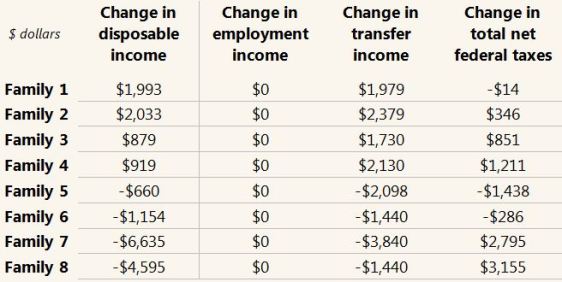
Financial Impacts of Budget 2016 Measures on Selected Families with Children

Source: Financial Impacts of Budget 2016 Measures on Selected Families with Children

17 million women/children tasked with household water collection in 24 African countries 

WASHINGTON, DC (June 1, 2016)–Nearly 17 million women and children (mostly girls) in 24 sub-Saharan African countries are responsible for hauling water long distances to their homes, a task that takes them more than 30 minutes per trip, according to a study published today in the journal PLOS ONE.

“The journey to collect water every day harms health, uses up limited human energy and takes time away from other opportunities,” says Jay Graham, PhD, an Assistant Professor of Environmental and Occupational Health at Milken Institute School of Public Health (Milken Institute SPH) at the George Washington University. “By reducing the distance to water – preferably by having water piped to each property – many women and girls would be freed up for work, school or other activities.”

Although many researchers have documented the lack of access to clean water in developing countries this study is one of the first to look at the absolute number affected and the gender imbalance in water collection labor.

Graham and his colleagues looked at data from international survey programs to calculate the number of people in 24 Sub-Saharan African countries affected by the daily grind to collect enough water for individual households. They found that among families spending more than 30 minutes a day collecting water, adult females were often tasked with going to the local water pump or collection site.

Jugs of water easily weigh 40 pounds or more and can cause health problems – such as pressure on the skeletal system that can lead to early arthritis, Graham says. He says that people who carry water may suffer from spinal pain and be more prone to injury resulting from multiple collection trips.

Adult women were the primary collectors of water across all 24 counties studied, ranging from 46 percent in Liberia to 90 percent in Cote d’Ivoire.

Graham and his colleagues also found that when children had the water collection task it often fell to girls–62 percent versus 38 percent for boys. Health problems that affect children assigned this task include exposure to unclean water that can lead to serious diseases.

Six countries in the study had more than 100,000 households where children were reported to be primarily responsible for water collection trips that took more than 30 minutes a day. Two countries, Ethiopia and Nigeria, had more than 1 million households affected by this labor. In addition to health problems, children tasked with this job also report losing time at school.

Graham and his colleagues created a new metric that allows public health leaders to plug in numbers of females versus males to get the gender ratio of water collectors. All of the countries had gender ratios above 1, a finding which indicates that more adult women were tasked with this job. The researchers found seven countries had gender ratios that were above 10, a finding that suggests an extreme gender imbalance.

“We didn’t look at the underlying reason for the gender imbalance in water collection,” Graham says. “However, in some African countries collecting water is considered a low status job and often falls to women and girls.” In addition to fatigue, illness and injury – women and young girls are put at risk of sexual violence on trips to collect water, especially if they are traveling far from home or along isolated paths, Graham points out.

Graham hopes the metric will allow public health leaders in Sub-Saharan African countries to take a hard look at the gender imbalance and take steps to fix it. “Our study suggests water collection by children and gender ratios should be considered when measuring a nation’s progress toward providing better access to water.”

Source: George Washington University Milken Institute School of Public Health

Source: 17 million women/children tasked with household water collection in 24 African countries | Science Codex

Shifting Bird Distribution Indicates a Changing Arctic 

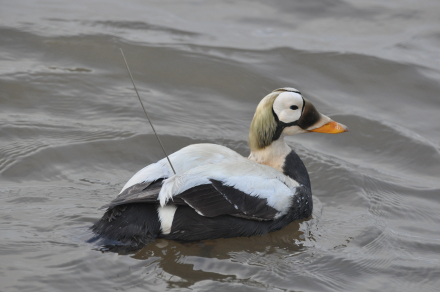
A Spectacled Eider with a satellite transmitter. Image credit: USGS

June 1, 2016

Shifts in the distribution of Spectacled Eiders, a predatory bird at the top of the Bering Sea’s benthic food web, indicate possible changes in the Arctic’s marine ecosystem, according to new research in The Condor: Ornithological Applications.

Matt Sexson of the USGS Alaska Science Center and his colleagues compared recent satellite telemetry data from molting eiders with data from the mid-1990s. They found that in two of the species’ four primary molting areas, the birds have shifted their range significantly in the intervening decades, and the researchers interpret this as an indicator of ecosystem change—eiders go where their prey is, and their movements could indicate big changes in the community of bottom-dwelling, cold-water-dependent invertebrates they eat.

It’s easier to track marine predators than it is to track their prey, explains Sexson. “It’s tough to speculate on the connection with climate change because the data are so sparse, but we know that the north Pacific is changing,” he says. “There’s a lot of corresponding evidence that together all says something big is happening here, and eiders provide a readily available indicator that changes are occurring.”

Sexson and his colleagues spent months at a time in the remote Arctic to catch eiders on land during their breeding season, luring them into nets before making a two-hour trek back to base camp with each bird to surgically implant a satellite transmitter. “It’s a lot of hard work, but it’s a lot of fun,” Sexson says. “I used to just flip past the eiders in bird field guides, thinking I’d never see any of these. Now five years later I’m catching them and holding them. I’ve really developed a love for this group of birds—how unique they are, how beautiful they are. I’ve just become attached.”

According to the University of Maryland’s Jackie Grebmeier, an expert on Arctic marine ecosystems who was not involved with the new study, “The results of this research provide an important finding of biological response of an upper-trophic-level seabird to climate warming and sea ice retreat, another piece in the puzzle to address ecosystem change in the Pacific Arctic region.” As Arctic water warms, whole communities of animals are moving north—and there’s only so far they can go.

Shifts in the distribution of molting Spectacled Eiders (Somateria fischeri) indicate ecosystem change in the Arctic is available at http://www.aoucospubs.org/doi/full/10.1650/CONDOR-15-139.1.

About the journal: The Condor: Ornithological Applications is a peer-reviewed, international journal of ornithology. It began in 1899 as the journal of the Cooper Ornithological Club, a group of ornithologists in California that became the Cooper Ornithological Society.

Source: Shifting Bird Distribution Indicates a Changing Arctic | Auk & Condor Updates