2016 NHL Draft Rankings: HockeyProspect.com Final Top 30

From living computers to nanorobots: how we’re taking DNA beyond genetics

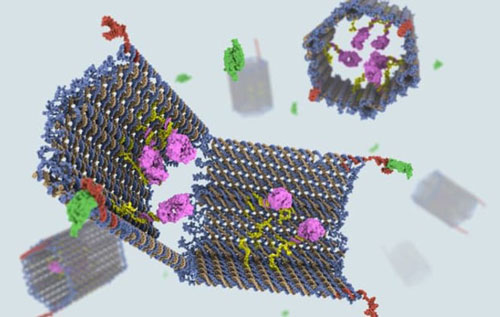
DNA barrel. (Image: Campbell Strong, Shawn Douglas, & Gaël McGill) Read more: From living computers to nanorobots: how we’re taking DNA beyond genetics

(Nanowerk News) DNA is one of the most amazing molecules in nature, providing a way to carry the instructions needed to create almost any lifeform on Earth in a microscopic package.

Now scientists are finding ways to push DNA even further, using it not just to store information but to create physical components in a range of biological machines.

Deoxyribonucleic acid or “DNA” carries the genetic information that we, and all living organisms, use to function. It typically comes in the form of the famous double-helix shape, made up of two single-stranded DNA molecules folded into a spiral. Each of these is made up of a series of four different types of molecular component: adenine (A), guanine (G), thymine (T), and cytosine (C).

Genes are made up from different sequences of these building block components, and the order in which they appear in a strand of DNA is what encodes genetic information. But by precisely designing different A,G,T and C sequences, scientists have recently been able to develop new ways of folding DNA into different origami shapes (Nature, “Folding DNA to create nanoscale shapes and patterns”), beyond the conventional double helix.

This approach has opened up new possibilities of using DNA beyond its genetic and biological purpose, turning it into a Lego-like material for building objects that are just a few billionths of a metre in diameter (nanoscale).

DNA-based materials are now being used for a variety of applications, ranging from templates for electronic nano-devices, to ways of precisely carrying drugs to diseased cells.

DNA-based nanothermometers

Designing electronic devices that are just nanometres in size opens up all sorts of possible applications but makes it harder to spot defects. As a way of dealing with this, researchers at the University of Montreal have used DNA to create ultrasensitive nanoscale thermometers (Nano Letters, “Programmable Quantitative DNA Nanothermometers”) that could help find minuscule hotspots in nanodevices (which would indicate a defect). They could also be used to monitor the temperature inside living cells.The nanothermometers are made using loops of DNA that act as switches, folding or unfolding in response to temperature changes. This movement can be detected by attaching optical probes to the DNA. The researchers now want to build these nanothermometers into larger DNA devices that can work inside the human body.

Biological nanorobots

Researchers at Harvard Medical School have used DNA to design and build a nanosized robot that acts as a drug delivery vehicle to target specific cells (Science, “A Logic-Gated Nanorobot for Targeted Transport of Molecular Payloads”).

The nanorobot comes in the form of an open barrel made of DNA, whose two halves are connected by a hinge held shut by special DNA handles. These handles can recognise combinations of specific proteins present on the surface of cells, including ones associated with diseases.

When the robot comes into contact with the right cells, it opens the container and delivers its cargo. When applied to a mixture of healthy and cancerous human blood cells, these robots showed the ability to target and kill half of the cancer cells, while the healthy cells were left unharmed. DNA barrel. Campbell Strong, Shawn Douglas, & Gaël McGill

Bio-computers in living animals

Because DNA structures can act as switches, moving from one position to another and back again, they can be used to perform the logical operations that make computer calculations possible. Researchers at Harvard and Bar-Ilan University in Israel have used this principle to build different nanoscale robots that can interact with each other, using their DNA switches to react to and produce different signals.

What’s more, the scientists implanted the robots into a living animal, in this instance a cockroach (Nature Nanotechnology, “Universal computing by DNA origami robots in a living animal”). This allowed them to develop a novel type of biological computer that can control the delivery of therapeutic molecules inside the cockroach by switching elements of their structure “on” or “off”. A trial of these DNA nanorobots is now scheduled to take place in humans.

Light-harvesting antennas

As well as creating minuscule machines, DNA can provide a way for us to copy natural processes at the nanoscale. For example, nature can capture energy from the sun using photosynthesis to convert light into chemical energy, which acts as fuel for plants and other organisms (and the animals that eat them).

Researchers at Arizona State University and the University of British Columbia have now built a three-arm DNA structure that can capture and transfer light that mimics this process (JACS, “A DNA-Directed Light-Harvesting/Reaction Center System”).

Photosynthesis occurs in living organisms thanks to tiny antennas made up of a large number of pigment molecules at specific orientations and distances from each other, which are able to absorb visible light.

The artificial DNA-based structures act as similar antennas, controlling the position of specific dye molecules that absorb the light energy and channel it to a reaction centre where it is converted into chemical energy.

This work could pave the way for devices capable of more efficiently using the most abundant source of energy we have at our disposal: sunlight.

So what’s next for DNA nanotechnology? It is hard to know but, with DNA, nature has given us a very versatile tool. It is now up to us to make the best use of it.

Source: By Matteo Palma, Queen Mary University of London
Source: From living computers to nanorobots: how we’re taking DNA beyond genetics


Beijing Launches Ice Hockey Program for Children

Students play in a ice hockey leauge held in Beijing on May 21, 2016. 749 students from 46 primary schools and middle schools in the city participated in the games. [Photo: qianlong.com]

 2016-06-07 20:10:49   From:  CRIENGLISH.com

Pupils in Beijing now have opportunities to play ice hockey.

Over 20 primary schools in the city have joined a program that aims to promote the sport and an athletic spirit among youngsters.

Initiated by the National Committee for the Wellbeing of the Youth and Beijing Ice Star Sports Management, the Thousands of Children on the Ice program will provide students with free professional ice hockey lessons and equipment.

The company said the program will use two of its existing rinks and another five that are expected to be put into operation later this year.

The program’s organizers hope the students can start to enjoy ice hockey games after playing it firsthand.

Ice hockey, known for its intense actions, is widely popular in North America and Europe.

But in China, the sport is still quite new. Relatively high costs of equipment and training have also prevented the sport’s growth here.

Ice hockey equipment cost 3,000 yuan (460 U.S. dollars) on average, while expenses for training can be as high as 100,000 yuan a year.

Beijing, as one of the host cities of the 2022 Winter Olympics, has been actively working to promote winter sports, including ice hockey, in recent years.

Thanks to these efforts, ice hockey has seen fast development here.

A total of 15 hockey clubs and 116 minor hockey teams have been set up in the city so far.

Source: Beijing Launches Ice Hockey Program for Children

DROP THE GLOVES: CANADA’S TOUGHEST HOCKEY LEAGUE

June 7, 2016    From: 

The LNAH has been called the toughest league in the world. Whereas the NHL averages around 0.3 fights per game, LNAH audiences are treated to more than four per game, with no shortage of bench-clearing brawls, fan fights, and, of course, poutine.

But the game is changing, and the pressure to reduce fighting in the LNAH has players wondering what that will mean for a league whose identity and brand revolved around violence for nearly two decades. The guys here make a few hundred dollars per game at most, and still it’s drawn over 200 former NHL players.

This VICE Sports documentary brings you behind-the-scenes with the Laval team as we follow some of the toughest players in the league during the playoffs, to discuss the pressure they feel to take their gloves off in the twilight of their hockey careers.

The All Blacks: Team for the corporate elite 

Dylan Cleaver on sport

Sport analysis and comment from Dylan Cleaver

Wednesday Jun 8, 2016    http://www.nzherald.co.nz/

Photo / Greg Bowker

The All Blacks have only rarely had to cultivate an image of being the team for all New Zealand.

Apart from a period during and post-1981, when they were the team for half of New Zealand, they’ve slotted unchallenged into that role.

Success will do that for you.

Sure, they’re never going to please everyone. There will always be a section of society that has a disdain for organised sport, particularly rugby, and the coverage it receives, but by and large New Zealanders take enormous pride in the fact the All Blacks consistently produce a team better than any other country can muster.

Success of your flagship team is about the best anti-blemish cream on the market, but there is a boil on the back of rugby here that needs lancing: the increasing creep of elitism into the game.

It is at that tingling, barely perceptible stage at the moment, but it threatens to burst to the surface.

It can be seen most obviously in Auckland, where New Zealand Rugby and toothless college sports bodies have allowed to run unchecked the domination of a few schools with chequebooks large enough to take the best players from low-decile schools.

It’s not the fact that these kids are often sold an unrealistic vision of a life of wealth in rugby that rankles most. Most damaging is the perpetuation of the idea that they should be grateful for being given the opportunity to escape less prestigious rugby environments.

One of the stated aims of NZ Rugby according to their latest AGM was to make rugby the game of choice for wider Auckland. By their own admission they have failed, but it is these schools and their born-to-rule old boys’ networks that are actively working against that aim – making it instead the game for narrower Auckland.

This creeping elitism can be also seen in pricing, where we’re asked to accept the idea that tickets to tests will be unaffordable to a large chunk of New Zealanders as if it is the most obvious thing in the world.

Said NZR chief executive Steve Tew to Fairfax a few days ago: “There’s no question when you get to the [Lions 2017] test matches the prices will be familiar to people having had a World Cup and Lions tour in the past. But we’ve got a number of games so there’ll be opportunity certainly for kids to come cheaply to watch the Super clubs.”

Tew has confirmed the fears of many: the All Blacks are only available to those who can pay the most, but never mind, there’s always the Blues!

Anybody who dares suggest that pricing the All Blacks for maximum return is not an ethos that sits well with the idea that they are a team for everyone is dismissed as having lost their “economic realities” faculties.

And maybe they have.

It is tough to keep producing the best team in the world and bloody expensive to provide the framework and infrastructure to enable that to happen, but I don’t believe people are naïve about this.

The rugby public grudgingly accepts that daylight tests are the Hanging Gardens of Babylon – a thing of great beauty and wonder that we’ll never see again. They painstakingly acknowledge that to watch the All Blacks live from the comfort of their couches, they will have to pay the broadcasters a monthly fee (which has just increased, again).

They might cringe when the front of the shirt – “it’s not a jersey, it’s a portal through which men pass” – is sold to an American insurer, just one more piece of crass commercialism that was captured inventively here by The Spinoff’s Calum Henderson, but understood it to be inevitable.

They have long accepted that the All Blacks’ mystique is available to the highest bidder, but they will surely baulk at the idea that All Blacks tests have become the domain of the corporate elite. “The team of the boardroom” does not quite have the same ring to it.

NZ Rugby is in the midst of a gilded age. The All Blacks are back-to-back world champions. They are led by a popular coach and are sprinkled with a seemingly neverending supply of stardust.

They can host a side that has played seven tests in New Zealand and lost all seven by a combined score of 284-46 and put the “Full House” signs out. They can point at those signs and say the market has spoken.

Eden Park is not sold out because they’re seduced by the allure of Wales, or the night-time time elements, or the extortionately priced food and beverage; they’re coming because the All Blacks are the hottest ticket in town.

And NZ Rugby are milking that for all its worth. They just need to remember, from time to time, that the bedrock of the sport here and what separates it from most of the other rugby playing nations is its egalitarian appeal. The All Blacks need to remain the face of that appeal.

Lose that and only time will tell what else you might lose in the process.

Source: The All Blacks: Team for the corporate elite – Sport – NZ Herald News