The Prime Minister announces changes in the senior ranks of the Public Service

OTTAWA, June 7, 2016 /CNW/ – The Prime Minister, Justin Trudeau, today announced the following changes in the senior ranks of the Public Service:

Serge Dupont, currently Deputy Clerk of the Privy Council and Associate Secretary to the Cabinet, will take on additional responsibilities as Deputy Minister of Intergovernmental Affairs, effective June 23, 2016.

Marta Morgan, currently Associate Deputy Minister of Finance, becomes Deputy Minister of Immigration, Refugees and Citizenship, effective June 27, 2016.

Manon Brassard, currently Assistant Deputy Minister, Compensation and Labour Relations, Treasury Board Secretariat, becomes President of the Economic Development Agency of Canada for the Regions of Quebec, effective June 27, 2016.

Stephen Lucas, currently Deputy Secretary to the Cabinet (Plans and Consultations and Intergovernmental Affairs), Privy Council Office, becomes Senior Associate Deputy Minister (Climate Change) of Environment and Climate Change, effective June 23, 2016.

Chantal Maheu, currently Assistant Secretary to the Cabinet (Priorities and Planning), Privy Council Office, becomes Deputy Secretary to the Cabinet (Plans and Consultations), Privy Council Office, effective September 6, 2016.

Ian McCowan, currently Deputy Secretary to the Cabinet (Legislation and House Planning and Machinery of Government), Privy Council Office, becomes Deputy Secretary to the Cabinet (Governance), Privy Council Office.  This change in title takes effect immediately.

The Prime Minister took the opportunity to congratulate Margaret Biggs, Senior Advisor to the Privy Council, Anita Biguzs, Deputy Minister of Immigration, Refugees and Citizenship, and Ward Elcock, Special Advisor to the Privy Council Office on the occasion of their retirements from the Public Service, following distinguished careers marked by dedication and excellence in serving Canadians.

Biographical notes attached.

This document is also available at http://pm.gc.ca


SERGE DUPONT

EDUCATION

International Diploma, Public Administration, École Nationale d’Administration, Paris
Master of Management Sciences, University of Waterloo
Bachelor of Management Sciences (Operational Research), University of Ottawa

PROFESSIONAL EXPERIENCE

Since May 2016
Deputy Clerk of the Privy Council and Associate Secretary to the Cabinet

2014 – 2016
Executive Director, International Monetary Fund (Constituency of Canada, Ireland and the Caribbean)

2010 – 2014
Deputy Minister of Natural Resources

2009 – 2010
Deputy Minister of Intergovernmental Affairs, Privy Council Office and Special Advisor to the Minister of Natural Resources on Nuclear Energy Policy

2008 – 2009
Associate Deputy Minister of Natural Resources

2005 – 2008
Director General and then Assistant Deputy Minister, Financial Sector Policy, Finance Canada

2001 – 2005
Director General, Tax Policy (Analysis), Finance Canada

1999 – 2001
Director General, Corporate Governance, Industry and Science Policy Sector, Industry Canada

1997 – 1999
Corporate Secretary, Industry Canada

1996 – 1997
Departmental Assistant, Office of the Minister, Finance Canada

1993 – 1996
Finance Counsellor, Canadian Embassy in Paris

1991 – 1993
Chief, Current Economic Conditions, International Trade and Finance Branch, Finance Canada

1990 – 1991
Senior Analyst, then Acting Chief, Strategic Planning, Sales Tax Division, Tax Policy Branch, Finance Canada

1986 – 1989
Analyst, Privatization Directorate, Office of Privatization and Regulatory Affairs

1983 – 1986
Analyst, Energy Policy Research Group, then Special Assistant to the Chair, Economic Council of Canada


MARTA MORGAN

EDUCATION

Master in Public Policy, Harvard University
Bachelor of Arts, Economics (Honours), McGill University

PROFESSIONAL EXPERIENCE

Since August  2014
Associate Deputy Minister of Finance

2012 – 2014
Associate Deputy Minister of Industry

2011 – 2012
Assistant Deputy Minister, Industry Sector, Industry Canada

2009 – 2011
Assistant Deputy Minister, Strategic Policy Sector, Industry Canada

2003 – 2009
Vice President, Trade and Competitiveness, Forest Products Association of Canada

2000 – 2001
Director General, Social Policy, Human Resources Development Canada

1997 – 2000
Director, Children’s Policy, Human Resources Development Canada

1993 – 1997
Various positions, Privy Council Office


MANON BRASSARD

EDUCATION

Bachelor of Law, Université Laval

PROFESSIONAL EXPERIENCE

Since February 2014
Assistant Deputy Minister, Compensation and Labour Relations, Treasury Board Secretariat

2013 – 2014
Assistant Deputy Minister, Programs, Agriculture and Agri-Food Canada

2010 – 2013
Assistant Deputy Minister, Corporate Services, Citizenship and Immigration Canada

2003 – 2010
Vice President, Operations, Economic Development Agency of Canada for the Regions of Quebec

2002 – 2003
Director General, Policy, Planning and Research, Immigration and Refugee Board

2001 – 2002
Director General, Office of the Implementation Act, Immigration and Refugee Board


STEPHEN LUCAS

EDUCATION

Ph.D. (Structural Geology and Tectonics), Brown University
Bachelor of Science with Honours (Geological Engineering), Queen’s University

PROFESSIONAL EXPERIENCE

Since July 2014
Deputy Secretary to the Cabinet (Plans and Consultations and Intergovernmental Affairs), Privy Council Office

2013 – 2014
Assistant Secretary to the Cabinet, Economic and Regional Development Policy, Privy Council Office

2009 – 2013
Assistant Deputy Minister, Science and Policy Integration, Natural Resources Canada

2007 – 2009
Assistant Deputy Minister, Minerals and Metals Sector, Natural Resources Canada

2003 – 2007
Director General, Health Products and Food Branch, Health Canada

2000 – 2003
Senior Director, Science, Innovation, Regional and Aboriginal Affairs, Natural Resources Canada

1998 – 2000
Director, Policy Planning and Coordination, Earth Sciences Sector, Natural Resources Canada

1988 – 1998
Research Scientist, then Subdivision Head, Geological Survey of Canada, Natural Resources Canada


CHANTAL MAHEU

EDUCATION

Master of Arts, Economics, Queen’s University
Bachelor of Business Administration, École des Hautes Études Commerciales

PROFESSIONAL EXPERIENCE

Since June 2014
Assistant Secretary to the Cabinet (Priorities and Planning), Privy Council Office

2011 – 2014
Director General, Federal-Provincial Relations and Social Policy, Finance Canada

2006 – 2011
Director General, Energy Policy, Natural Resources Canada

2004 – 2006
Director of Operations and Acting Assistant Secretary, Canada-United States Secretariat, Privy Council Office

2000 – 2004
Director, Health Care System Division, Health Canada

1997 – 2000
Acting Chief and Chief, Economic Development and Corporate Finance, Finance Canada


IAN MCCOWAN

EDUCATION

Master of Law, University of Cambridge, England
Bachelor of Laws, Queen’s University
Bachelor of Commerce, Queen’s University

PROFESSIONAL EXPERIENCE

Since March 2015
Deputy Secretary to the Cabinet (Legislation and House Planning and Machinery of Government), Privy Council Office

2012 – 2015
Assistant Secretary to the Cabinet (Communications and Consultations), Privy Council Office

2006 – 2012
Assistant Commissioner, Policy, Correctional Service of Canada

2001 – 2006
Director and General Counsel, Correctional Service Canada Legal Services, Justice Canada

1999 – 2001
Director and Senior Counsel, Parks Canada Agency Legal Services, Justice Canada

1993 – 1999
Counsel, Civil Litigation Section, Justice Canada


SOURCE Prime Minister’s Office

Source: The Prime Minister announces changes in the senior ranks of the Public Service

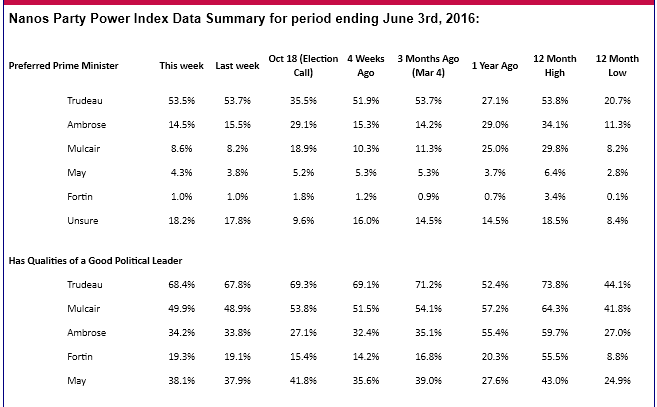
Seven in ten Canadians say Trudeau has qualities of a good political leader, Mulcair scores second highest (ending June 3, 2016)

Nanos Weekly Leadership Tracking

  • Preferred Prime Minister – The latest Nanos tracking has 53.5 per cent of Canadians preferring Trudeau as Prime Minister while 14.5 per cent preferred Ambrose, 8.6 per cent preferred Mulcair, 4.3 per cent preferred May and 18.2 per cent were unsure.
  • Qualities of a Good Political Leader – Asked a series of independent questions for each federal party leader almost seven of ten Canadians (68.4%) thought Trudeau had the qualities of a good political leader, one of two (49.9%) had similar views of Mulcair.  May was seen as a good political leader by 38.1 per cent of Canadians and Ambrose by 34.2 per cent of Canadians.

The team at Nanos in conjunction with Klipfolio have launched our new live political data portal where you run the numbers you want and can explore the trends and data you need.  This is part of our campaign, not only to provide the most reliable data to Canadians but to let them use it as they wish. We were the first to do nightly tracking and now we are the first research organization to post live public opinion data for Canadians.

We were the first to do nightly tracking and now we are the first research organization to post live public opinion data for Canadians. Here’s the link to check it out.

To view the detailed tracking visit our website.

Methodology

The views of 1,000 respondents are compiled into a party power brand index for each party that goes from 0 to 100, where 0 means that the party has no brand power and 100 means it has maximum brand power. A score above 50 is an indication of brand power for the party and its leader at this time.

The important factors in this weekly tracking include the direction of the brand strength or weakness and also the brand power of one federal party relative to another.

The data is based on random telephone interviews with 1,000 Canadians, using a four week rolling average of 250 respondents each week, 18 years of age and over. The random sample of 1,000 respondents may be weighted by age and gender using the latest census information for Canada, and the sample is geographically stratified to be representative of Canada.

The interviews are compiled into a four week rolling average of 1,000 interviews where each week, the oldest group of 250 interviews is dropped and a new group of 250 interviews is added. The current wave of tracking is based on a four-week rolling average of 1,000 Canadians (250 per week) ending June 3rd, 2016.

A random telephone survey of 1,000 Canadians is accurate 3.1 percentage points, plus or minus, 19 times out of 20.

All references or use of this data must cite “Nanos Party Power Index” as the source.

FireShot Screen Capture #305 - '' - _C__Users_apchernoff_Desktop_Seven%20in%20ten%20Canadians%20say%20Trudeau%20has%20qualities%20of%20a%20good%20poli

2016 High hit on Canadian consumer confidence – real estate the key driver (released June 3, 2016)

Bloomberg-Nanos Economic Banner

Bloomberg Nanos Weekly Consumer Confidence Tracking

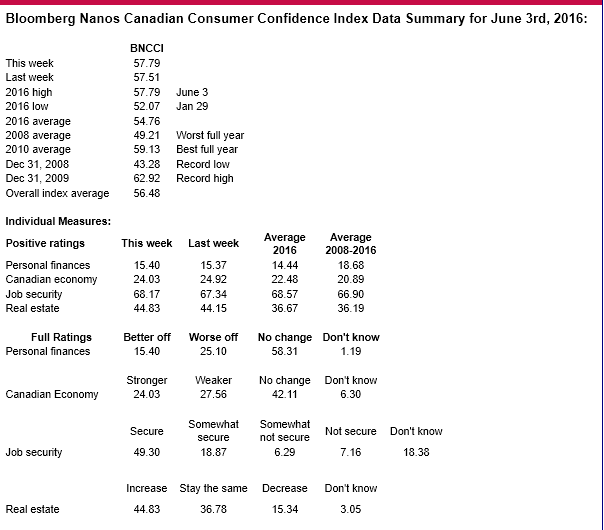
The Bloomberg Nanos Canadian Confidence Index hit a new high for 2016 largely on positive sentiment related to real estate.

“The bullish sentiment on the value of real estate continues in the Bloomberg Nanos tracking,” said Nanos Research Group Chairman Nik Nanos. “Positive views on the value of interest hit a level not seen since July 2014.

“To the extent that consumer sentiment is signaling a housing bubble, the monetary authorities might need to balance the necessity of extremely low interest rates during the economy’s period of adjustment with policies that tighten the availability of household credit and dampen the domestic demand for housing”, said Bloomberg economist Robert Lawrie.

The BNCCI, a composite of a weekly measure of financial health and economic expectations, registered at 57.79 compared with last week’s 57.51. The twelve month high stands at 58.62.

The Bloomberg Nanos Pocketbook Index is based on survey responses to questions on personal finances and job security. This sub-indice was at 58.08 this week compared to 58.23 the previous week. The Bloomberg Nanos Expectations Index, based on surveys for the outlook for the economy and real estate prices, was at 56.49 this week (compared to 56.78 last week).

The average for the BNCCI since 2008 has been 56.48 with a low of 43.28 in December 2008 and a high of 62.92 in December 2009. The index has averaged 54.76 this year.

To view the weekly tracking visit our website.

Methodology

The BNCCI is produced by the Nanos Research Corporation, headquartered in Canada,  which operates in Canada and the United States.  The data is based on random telephone interviews with 1,000 Canadian consumers (land- and cell-lines), using a four week rolling average of 250 respondents each week, 18 years of age and over. The random sample of 1,000 respondents may be weighted by age and gender using the latest census information for Canada and the sample is geographically stratified to be representative of Canada. The interviews are compiled into a four week rolling average of 1,000 interviews where each week, the oldest group of 250 interviews is dropped and a new group of 250 interviews is added. The views of 1,000 respondents are compiled into a diffusion index from 0 to 100. A score of 50 on the diffusion index indicates that positive and negative views are a wash while scores above 50 suggest net positive views, while those below 50 suggest net negative views in terms of the economic mood of Canadians.

A random telephone survey of 1,000 consumers in Canada is accurate 3.1 percentage points, plus or minus, 19 times out of 20.

All references or use of this data must cite Bloomberg Nanos as the source.

FireShot Screen Capture #304 - '' - _C__Users_apchernoff_Desktop_2016%20High%20hit%20on%20Canadian%20consumer%20confidence%20-%20real%20estate%20%20th

Lunch Atop a Skyscraper Photograph: The Story Behind the Famous Shot 

(Bettmann / Corbis)

Source: Lunch Atop a Skyscraper Photograph: The Story Behind the Famous Shot | History | Smithsonian

#WordsAtWork: David Morrison wants Australians to stop saying gender-based terms like ‘guys’ 

Australian of the Year and former Army chief David Morrison says the term “guys” should no longer be used in workplaces.

By Andrew Greene and Kristian Silva

The retired Lieutenant General on Wednesday launched a new Diversity Council Australia video which aims to crack down on language which excludes minority groups.

“Exclusive language, gender-based language or inappropriate language, has as much a deleterious or disadvantaged effect as something where you’re saying something blatantly inappropriate to another human being,” General Morrison told ABC News Breakfast.

He said he was not trying to become the “language police” by supporting the new campaign, and expected to be criticised for the idea.

The #WordsAtWork campaign video depicts a group of women rolling their eyes at being called “girls” by a male colleague.

“All the campaign is doing is saying look, it’s a proven fact that more inclusive [and] more diverse workforces create real diversity of thinking and are more productive, more effective,” General Morrison said.

“And one of the ways that you can engender that type of environment is being careful about how you speak to other people, talking to them with respect and listening to their views with respect.”

The campaign also promotes gender equality, calls for the word “gay” not to be used in a negative fashion, and strongly discourages the use of other offensive terms.

General Morrison said he was now trying to stop using the word “guys” when speaking to groups of people.

“I have now removed that from my lexicon as best I can, I think it’s important.”

However, Foreign Minister Julie Bishop cautioned against interfering with freedom of speech.

Ms Bishop said words such as “guys” were generic enough they should not cause offence.

“I don’t think we should try and interfere with the freedom of speech in this country to a point where people are too concerned about day-to-day conversations,” she said.

Guys’ commonly accepted by males and females: expert

Australian National University language expert Catherine Travis said she supported the campaign to rid stigmatised words from workplaces, but believed its aim to eliminate the term “guys” was trivial.

Dr Travis said the phrase “you guys” had evolved to include all genders and was commonly accepted.

She said the male element in the phrase “you guys” could be linked to a trait seen in languages like French and Spanish, where a masculine version of a word can be used when it is in plural form.

“The masculine form may be seen as more basic,” she said.

“The form that’s going to take off is the more frequent one, it’s going to be used in more circles and used with a more general meaning.

“‘Guys’ is much more generalised than the other examples in the clip, and so has much less risk of offending.

“That is, mum really only refers to a mum, girls only refers to girls, whereas the meaning of guys has changed to include males and females.”

Source: #WordsAtWork: David Morrison wants Australians to stop saying gender-based terms like ‘guys’ – ABC News (Australian Broadcasting Corporation)