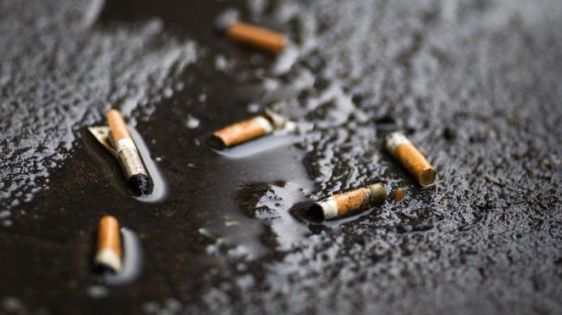
Streets in Wales are blighted by discarded cigarette butts, with 86% of roads strewn with smoking-related litter, a charity’s survey shows.
Discarded chewing gum was also seen on three-quarters of streets surveyed for Keep Wales Tidy, while dog fouling was found on one in 10.
Despite this, 96% of streets were graded as acceptable to the public.
Natural Resources Minister Carl Sargeant said “everybody” was responsible for keeping streets clean.
Keep Wales Tidy said smoking-related litter – which is predominantly made up of cigarette butts – was difficult to clean up.
It could also affect the environment and wildlife by contaminating water supplies with toxic chemicals, it added.
Chief executive Lesley Jones said: “I would emphasise that it isn’t just the responsibility of local authorities to clean up an area, but everyone who lives, works, visits a street, park, beach, city, town or village to keep it clean and create a good environment for all.”
Its research – published in the All Wales Report (How Clean are our Streets?) – was funded by the Welsh government.
MANILA, Philippines (AP) — Canadian Prime Minister Justin Trudeau says his country will remain a strong member of the campaign against the Islamic State group in Iraq and Syria.
Trudeau and President Barack Obama are speaking to reporters after their first formal meeting since Trudeau took office earlier this month. Trudeau ran on a promise to pull Canada’s fighter jets out of the U.S.-led air campaign against IS.
But Trudeau says Canada will keep doing “more than its part” to defend against IS. He has recently pledged to send more military trainers to Iraq as part of that effort.
Obama says Trudeau is a “great boost of energy” for Canada’s political landscape. He says he invited Trudeau for a White House visit that will hopefully come early next year.
Copyright 2015 The Associated Press. All rights reserved. This material may not be published, broadcast, rewritten or redistributed.
CANUCKS BANTER By Andrew Chernoff November 18, 2015
Four Game Losing Streak Going Home
Vancouver and Winnipeg entered the game tonight set on changing their fortunes and ending streaks of futility: Canucks on a 3-game losing streak; and Winnipeg, winless in 6-games.
Forward Alex Grenier was recalled from the Utica Comets Tuesday night and in the game against Winnipeg for his NHL debut. And Ryan Miller was back in net after a brief rest on the road trip.
The Jets scored first in the opening period, with a power play goal by Mark Scheifele (6). Winnipeg was 0-13 on their power play before that goal. The first period ended with the Jets up 1-0. Vancouver was 0-2 on the power play in the period. The Jets out hit Vancouver 17-9, and pressed the Canucks for 5-takeaways to one for Vancouver. The Canucks outshot Winnipeg 14-11.
The Canucks struck first in the second period with their only goal of the game, on the power play, by Daniel Sedin(7), to tie the game at 1-1. It was Vancouver’s 5th and last power play goal on the road trip. Winnipeg scored with less than three minutes in the period, on a goal by Drew Stafford(6). Winnipeg continued to out hit Vancouver, as they had 11-hits to 2-hits for Vancouver. Both teams had 5-takeaways and 2-giveaways in the middle period. Canucks out shot the Jets, 10-6.
Both teams came out in the final period with urgency, the Jets up 2-1. Each team had two power plays each, with neither team scoring with the man advantage. The Canucks had their chances but could not bury the puck for a timely goal, and began taking chances for the tying goal.
With less than three minutes left, the Jets burned the Canucks on the second goal of the game by Mark Scheifele(8), and then an empty net goal by Drew Stafford(7) for his second goal of the game, sealed Vancouver’s fate. Winnipeg out shot the Canucks in the final period, 17-6 and in the game, 34-30. Canucks out hit the Jets 5-2 in the period.
Rookie Alex Grenier had 15-shifts, and 8:52 TOI during the game (1rst: 7 shifts; 3:34 TOI; 2nd: 6 shifts;3:58 TOI); 3rd: 2 shifts; 1:20 TOI).
ROAD TRIP SUMMARY
Goals For: 18
Goals Against: 25
PPG For: 5-28
PPG Against: 9-27
Shots For: 234
Shots Against: 230
Record: 1-4-2
Short Handed Goals Against: 3
Short Handed Goals For: 0
Ryan Miller was held winless on the road trip in 5-games.
Jacob Markstrom had the only Canucks victory on the road trip.
GAME REVIEW
Statistics courtesy of the NHL, and the Vancouver Canucks, with thanks.
Employees who work long hours have a higher risk of stroke than those working standard hours; the association with coronary heart disease is weaker. These findings suggest that more attention should be paid to the management of vascular risk factors in individuals who work long hours.
Summary
Background
Long working hours might increase the risk of cardiovascular disease, but prospective evidence is scarce, imprecise, and mostly limited to coronary heart disease. We aimed to assess long working hours as a risk factor for incident coronary heart disease and stroke.
Methods
We identified published studies through a systematic review of PubMed and Embase from inception to Aug 20, 2014. We obtained unpublished data for 20 cohort studies from the Individual-Participant-Data Meta-analysis in Working Populations (IPD-Work) Consortium and open-access data archives. We used cumulative random-effects meta-analysis to combine effect estimates from published and unpublished data.
Findings
We included 25 studies from 24 cohorts in Europe, the USA, and Australia. The meta-analysis of coronary heart disease comprised data for 603 838 men and women who were free from coronary heart disease at baseline; the meta-analysis of stroke comprised data for 528 908 men and women who were free from stroke at baseline. Follow-up for coronary heart disease was 5·1 million person-years (mean 8·5 years), in which 4768 events were recorded, and for stroke was 3·8 million person-years (mean 7·2 years), in which 1722 events were recorded. In cumulative meta-analysis adjusted for age, sex, and socioeconomic status, compared with standard hours (35–40 h per week), working long hours (≥55 h per week) was associated with an increase in risk of incident coronary heart disease (relative risk [RR] 1·13, 95% CI 1·02–1·26; p=0·02) and incident stroke (1·33, 1·11–1·61; p=0·002). The excess risk of stroke remained unchanged in analyses that addressed reverse causation, multivariable adjustments for other risk factors, and different methods of stroke ascertainment (range of RR estimates 1·30–1·42). We recorded a dose–response association for stroke, with RR estimates of 1·10 (95% CI 0·94–1·28; p=0·24) for 41–48 working hours, 1·27 (1·03–1·56; p=0·03) for 49–54 working hours, and 1·33 (1·11–1·61; p=0·002) for 55 working hours or more per week compared with standard working hours (ptrend<0·0001).
Interpretation
Employees who work long hours have a higher risk of stroke than those working standard hours; the association with coronary heart disease is weaker. These findings suggest that more attention should be paid to the management of vascular risk factors in individuals who work long hours.
Funding
Medical Research Council, Economic and Social Research Council, European Union New and Emerging Risks in Occupational Safety and Health research programme, Finnish Work Environment Fund, Swedish Research Council for Working Life and Social Research, German Social Accident Insurance, Danish National Research Centre for the Working Environment, Academy of Finland, Ministry of Social Affairs and Employment (Netherlands), US National Institutes of Health, British Heart Foundation.
The world is on the cusp of a “post-antibiotic era”, scientists have warned after finding bacteria resistant to drugs used when all other treatments have failed.
Their report, in the Lancet, identifies bacteria able to shrug off colistin in patients and livestock in China.
They said that resistance would spread around the world and raised the spectre of untreatable infections.
Experts said the worrying development needed to act as a global wake-up call.
Bacteria becoming completely resistant to treatment – also known as the antibiotic apocalypse – could plunge medicine back into the dark ages.
Common infections would kill once again, while surgery and cancer therapies, which are reliant on antibiotics, would be under threat.
Key players
Chinese scientists identified a new mutation, dubbed the MCR-1 gene, that prevented colistin from killing bacteria.
It was found in a fifth of animals tested, 15% of raw meat samples and in 16 patients.
And the resistance had spread between a range of bacterial strains and species, including E. coli, Klebsiella pneumoniae and Pseudomonas aeruginosa.
There is also evidence that it has spread to Laos and Malaysia.
Prof Timothy Walsh, who collaborated on the study, from the University of Cardiff, told the BBC News website: “All the key players are now in place to make the post-antibiotic world a reality.
“If MRC-1 becomes global, which is a case of when not if, and the gene aligns itself with other antibiotic resistance genes, which is inevitable, then we will have very likely reached the start of the post-antibiotic era.
“At that point if a patient is seriously ill, say with E. coli, then there is virtually nothing you can do.”
Resistance to colistin has emerged before.
However, the crucial difference this time is the mutation has arisen in a way that is very easily shared between bacteria.
“The transfer rate of this resistance gene is ridiculously high, that doesn’t look good,” said Prof Mark Wilcox, from Leeds Teaching Hospitals NHS Trust.
His hospital is now dealing with multiple cases “where we’re struggling to find an antibiotic” every month – an event he describes as being as “rare as hens’ teeth” five years ago.
He said there was no single event that would mark the start of the antibiotic apocalypse, but it was clear “we’re losing the battle”.
‘Untreatable’
The concern is that the new resistance gene will hook up with others plaguing hospitals, leading to bacteria resistant to all treatment – what is known as pan-resistance.
Prof Wilcox told the BBC News website: “Do I fear we’ll get to an untreatable organism situation? Ultimately yes.
“Whether that happens this year, or next year, or the year after, it’s very hard to say.”
Early indications suggest the Chinese government is moving swiftly to address the problem.
Prof Walsh is meeting both the agricultural and health ministries this weekend to discuss whether colistin should be banned for agricultural use.
Prof Laura Piddock, from the campaign group Antibiotic Action, said the same antibiotics “should not be used in veterinary and human medicine”.
She told the BBC News website: “Hopefully the post-antibiotic era is not upon us yet. However, this is a wake-up call to the world.”
She argued the dawning of the post-antibiotic era “really depends on the infection, the patient and whether there are alternative treatment options available” as combinations of antibiotics may still be effective.
A commentary in the Lancet concluded the “implications [of this study] are enormous” and unless something significant changes, doctors would “face increasing numbers of patients for whom we will need to say, ‘Sorry, there is nothing I can do to cure your infection.'”

 CANUCKS BANTER By Andrew Chernoff November 18, 2015