
Kootenay Economy Appears To Be Gaining Strength, However Serious Concerns Remain


According to the 2014 BC-Checkup, a benchmark study of the province’s economy since 1999 by the Chartered Professional Accountants of BC (CPABC , the Kootenay economy appears to gaining strength, however serious concerns remain that raise more questions than answers.

In regards to the Kootenay development region, the report states:

“In its third year of recovery since the recession, the economy of the KDR appears to be gaining strength. The labour market continued to expand in 2013, and the overall employment level surpassed the prerecession high. The KDR achieved the highest rate of job creation in the province, led by service sector growth in trade, transportation and warehousing, and accommodation and food services employment. Likewise, the unemployment rate fell for the third straight year and is now the second lowest in BC. The continued shift towards full-time employment has improved purchasing power for some. Another positive development is the substantial drop in business bankruptcies.

There are, however, still some areas of apparent weakness in the KDR:

Population loss over the past few years suggests that the region is not an opportune place for all. This outflow may, in part, reflect the shift in labour market demand from goods-producing sector jobs towards service sector employment as individuals relocate to areas where opportunities better match their skills.

-The KDR’s high rate of consumer insolvencies confirms that not all residents have benefitted from labour market improvements.

-Also of concern is the Development Region’s high rate of youth unemployment. The tight job market makes it challenging for young people to remain in the region, and increases the risk of permanent loss of valuable human capital.

-While it is preferable that educational attainment of the KDR’s labour force advances at the same pace as the BC average, attainment levels generally correspond to regional job availability. The KDR labour market does not demand the same level of skills as some jurisdictions in the province.

Looking ahead to 2014, several large projects that have the potential to proceed—the Jumbo Glacier Resort, Teck’s water treatment facilities in Sparwood, the Bingay Main Coal Project, and Phase Two of Teck Coal’s Line Creek Mine—all promise to generate substantial employment and economic benefits in the East Kootenay Regional District. Rising housing starts in the US and demand from China means continued demand for BC lumber. On the supply side, the mountain pine beetle epidemic that has infested much of the wood in the BC interior is threatening the stock of harvestable timber. Interior mill production is slowing as mills scale back or close down.27 The KDR, however, has ample timber supply for its mills and may benefit from soaring prices in the next few years as overall BC production declines. A surplus of coal in world markets combined with slowing growth in China has further reduced coal prices during the first quarter of 2014. Some North American producers have already cut back production and staff. Teck anticipates that production at its coal mines will remain on track this year, but some workforce reductions at its Elk Valley operations are expected as the company is planning to trim its global workforce by 5% to remain competitive.28 It is anticipated that the five East Kootenay operations will remain busy throughout 2014.

However, the most recent seasonally adjusted, short-term trends in labour market indicators are not positive. Employment in the first quarter of 2014 pulled back sharply and is considerably lower than the same period last year. Stats Canada reports that 6,600 jobs were lost (-8.9%) in the KDR between December 2013 and March 2014, pushing the unemployment rate upwards to 7.8%. 29,30 The biggest losses occurred in the construction and trade industries.”

27 Jim Girvan, Murray Hall, Gerry Van Leeuwen, Alice Palmer and Russ Taylor, “BC Mountain Pine Beetle Epidemic: Big Industry Changes Expected by Mid-decade,” Wood Business, Aug 2012.
28 Sygutek, Lisa, “Teck Announces the Layoff of 600 Workers”, Crowsnest Pass Herald, April 23, 2014, Vol. 84 No. 16.
29 Stats Canada, Labour Force Survey Estimates, Employment by Economic Region and North American Industry Classifi cation System, Annual, Table 282-0061.
30 Stats Canada, Labour Force Survey Estimates, by Provinces, Territories and Economic Regions Based on 2006 Census Boundaries, Monthly, Table 282-0054.
More on Demographics, Demand, and Canada’s Falling Employment Rate

Posted by Jim Stanford May 11th, 2014   http://www.progressive-economics.ca

My post last week on the continuing decline in the employment rate in Canada (to below 61.5% in April, barely higher than the low point reached in the 2008-09 recession) has sparked some continuing discussion about the role of demographic change in explaining that decline (as opposed to a shortage of labour demand).

Is the decline in the employment rate due to weak labour market conditions, or is it due to the ageing of the workforce (as a result of which a larger share of the working age population consists of people in older age categories which normally have lower labour force participation and employment incidence)?

The answer, obviously, is “Both.”  The ageing of the Canadian workforce is a decades-old trend, it did not start in February 2008 (when the overall employment rate peaked at 63.8%).  Until then, the ageing of the workforce did not prevent the overall labour market from enjoying higher employment rates over time.  The downturn in the business cycle did start in 2008.  So it’s reasonable to conclude that this turn likely reflects cyclical (not structural) factors.

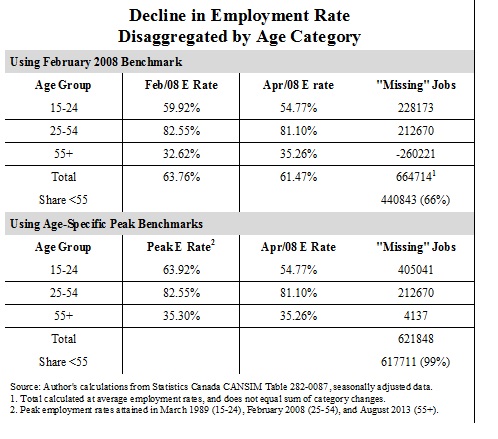
We can try to sort out the two forces at play by disaggregating the employment rate numbers by age category.  My methodology in analyzing the overall decline in the employment rate was to compare today’s rate to the pre-recession peak, and then estimate how much more employment would be required to get back to that pre-recession employment rate.  I interpreted that as a broad measure of the amount of new employment required to truly repair the damage from the recession.  That approach is certainly more reasonable than the argument made by the federal government that since absolute employment today is higher than it was before the recession, all the damage done by the recession has been repaired; this argument ignores 6 years of population growth which added over 2 million Canadians to the working age population.

Now let’s replicate my analysis, but disaggregating the employment rate data into broad age categories.  Young workers (15-24) have experienced the worst decline in employment incidence.  So-called “core” workers (25-54) have experienced a more modest decline.  Older workers (55 and over) have experienced a higher employment rate.  Whether this is good or bad depends on how many of these older workers are choosing to work longer for positive reasons, and how many have been compelled to stay in their jobs by reduced or less secure pension incomes.

Decline in Employment Rate

The first part of this table shows that for the two under-55 categories, a total of 441,000 additional jobs would be required to rebuild the two under-55 employment rates back to their respective February 2008 levels.  That represents two-thirds of the total 665,000 missing jobs I had estimated on the basis of the analysis of the aggregate 15+ employment rate.  (Because of the shift-share phenomena discussed above, the total “missing” jobs does not equal the sum of the age category “missing” jobs.)  In other words, two-thirds of the deterioration in the overall employment rate since 2008 can be ascribed to the deterioration of employment incidence among under-55 workers — and hence can’t be directly attributed to demographic change.  Perhaps the rest of the 665,000 jobs could be attributed to demographic ageing, offset somewhat by the rising employment incidence among the 55+ category.

Another approach, that would more closely replicate the spirit of my aggregate analysis, would be to separately locate the peak employment rate experienced within each age category, rather than using the peak employment rate for the aggregate 15+ labour force (which was February 2008).  After all, if we’re going to disaggregate current employment performance by age group, we may well wish to also disaggregate the parallel task of measuring the extent to which current employment falls below peak (or potential) employment incidence.  This exercise is summarized in the lower part of the table.

The peak employment rate for the “core” 25-54 age group was attained in February 2008, so there is no difference for that group.  The peak employment rate for young workers was attained back in 1989 (the employment rate for young workers in 2008 was still almost 4 percentage points below that peak, reflecting both higher youth unemployment in 2008 than 1989 and lower labour force participation, presumably due mostly to higher participation in post-secondary education — although PSE enrollment itself partly reflects weak employment opportunities).  The peak employment rate for the over-55 group was attained in August last year; even in this group the employment rate has declined in recent months.

Comparing the actual employment rate to the historical peak rate within each category, leads to a combined estimate of “missing” jobs of 622,000 positions — almost all of which were borne by the two under-55 age groupings (since older workers are experiencing close-to-peak employment rates).  That’s not hugely different from the 665,000 missing-job estimate I derived on the basis of the overall population.  The takeaway from this analysis: Even adjusting for the ageing of Canada’s workforce, the economy would need a total of 622,000 more jobs to bring up the employment rate (for each age category of worker) to its potential (based on peak attained employment rates).

I certainly accept that demographic change is part of the story of Canada’s falling employment rate.  That being said, however, I think the following take-away conclusions are valid:

  • The decline in the employment rate is due more to weak employment demand than to demographic change.

  • The decline in the employment rate is clearly visible in young and core workers.
  • Employment in Canada among workers under 55 is hundreds of thousands positions (from 441,000 to 618,000, depending on your choice of benchmark) below what it would be if previous peak balances between workers and jobs were re-attained today.
  • And since the pre-recession benchmark was not itself a position of full employment, the true problem of underutilization of labour in Canada is even greater.

Labour force participation among under-55 workers has also declined significantly (this is not reported in the table), and so far in 2014 has averaged its lowest levels in both age groups (15-24 and 25-54) since 2002.  Overall labour force participation (among all people 15+) is at its lowest level since 2001.  So the decline in labour force participation (like the decline in the employment rate) is mostly due to factors other than demographics (presumably, weak labour demand).

The phenomenon of rising participation and employment among older workers is an important one that needs lots more analysis.  Indeed, it is trickling over into the decline in employment rates among the youth and core age groups.  In a demand-constrained labour market, younger workers always bear a disproportionate share of the burden of un- and underemployment (reflecting last-hired first-fired effects, etc.).  Therefore, while much of the decline in employment incidence among under-55 workers reflects weak overall labour demand, some of it also reflects a redistribution of employment from younger to older workers.  This is a perverse result for many economic and social reasons, and should lead us to question policies (like postponing the retirement age to 67, and other restrictions on early retirement) which are helping push up employment rates among older workers.

Top seven reasons unions matter to young people

By Tria Donaldson   August 22, 2013   http://rabble.ca

Tria Donaldson is a youth activist with roots in the environmental movement, the labour movement, and Indigenous Rights. Tria is a senior Communications Officer at CUPE National, and on the board of rabble.ca.

Top seven reasons unions matter to young people

Young workers today face many challenges in the workplace.

Entering the workplace is the first challenge. The youth employment rate is almost double the national average, at 13.6 per cent. You hear stories all the time of new graduates who are unable to find work in their field. Unpaid internships and short term coop placements are the norm for many workers.

Job insecurity is rampant. Many young workers have to work two or three jobs to make ends meet. Part time and contract work is common.

Soaring housing prices, lack of affordable child care and crippling levels of student debt for graduates mean putting off starting a family for many, and struggling to make ends meet for others.

These were just some of the issues identified by young workers at the Canadian Union of Public Employees’ (CUPE) first ever young workers strategy session. The three day meeting brought together over 60 young people from all across Canada to have their voices heard and discuss getting young people involved in the labour movement.

There is a perception amongst union activists that young people today are apathetic and don’t care about unions, but the conversations over the three days show that young people get it and are ready to get involved.

The words below are taken directly from the young people from across Canada who participated in CUPE’s recent strategy session. They remind me of the vital work that trade unions do on behalf of all society.

1. Unions allow workers to become united and to mobilize and come together during times of collective agreements and negotiations. Unionization is important to raise the standard of living for its workers and for society and social programs.

2. Unions make life better for people everywhere. Even if you are not in a union, you enjoy things that have become the norm are there because unions have fought for that. Unions are there to raise everyone up — it should be a race to a top not a race to the bottom.

3. Unions help put fairness in the workplace. People know when they are not being treated fairly, and equate unions with fairness.

4. In a unionized workplace you have a voice and an advocate. Whether you are a worker with disability or from another group, you have voice.

5. A union is there to be strong and united and to be there for workers in their struggles.

6. We live in a global world. It is important that unions can do international solidarity work and stand up against human rights violations.

7. Unions are instrumental in fighting for workers right to safety in the workplace. It is new and young workers that are often hurt on the job, and unions push for their rights.

In a world where the role of unions is constantly questioned and attacked, these young workers spoke to the heart of the matter of why unions matter.

This meeting was part of CUPE’s ongoing work to engage young workers and honour the Year of the New and Young worker. For more information visit CUPE’s young worker webpage here.  

By the Numbers: Youth unemployment and underemployment in Canada, around the world || UFCW Canada – Canada’s Largest Private Sector Union

By the Numbers: Youth unemployment and underemployment in Canada, around the world || UFCW Canada – Canada’s Largest Private Sector Union.