
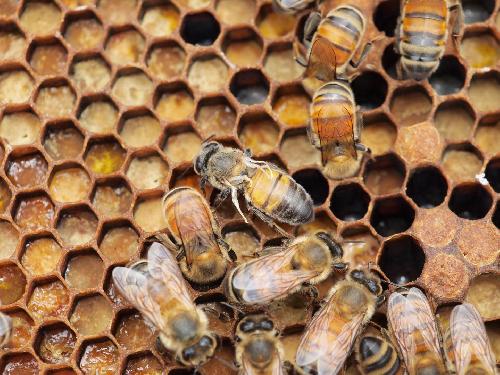
The spread of a disease that is decimating global bee populations is manmade, and driven by European honeybee populations, new research has concluded.
A study led by the University of Exeter and UC Berkeley and published in the journal Science found that the European honeybee Apis mellifera is overwhelmingly the source of cases of the Deformed Wing Virus infecting hives worldwide. The finding suggests that the pandemic is manmade rather than naturally occurring, with human trade and transportation of bees for crop pollination driving the spread.
Although separately they are not major threats to bee populations, when the Varroa mite carries the disease, the combination is deadly, and has wiped out millions of honeybees over recent decades. Varroa feed on bee larvae while the Deformed Wing Virus kills off bees, a devastating double blow to colonies. The situation is adding to fears over the future of global bee populations, with major implications for biodiversity, agricultural biosecurity, global economies, and human health.
The study was funded by the Natural Environment Research Council (NERC) and supported by a Royal Society Dorothy Hodgkin Fellowship. It involved collaborators from the universities of Sheffield, Cambridge, Salford and California, as well as ETH Zurich in Switzerland.
Lead author Dr Lena Wilfert, of the University of Exeter’s Centre for Ecology and Conservation, on the Penryn Campus in Cornwall, said: “This is the first study to conclude that Europe is the backbone of the global spread of the bee killing combination of Deformed Wing Virus and Varroa. This demonstrates that the spread of this combination is largely manmade – if the spread was naturally occurring, we would expect to see transmission between countries that are close to each other, but we found that, for example, the New Zealand virus population originated in Europe. This significantly strengthens the theory that human transportation of bees is responsible for the spread of this devastating disease. We must now maintain strict limits on the movement of bees, whether they are known to carry Varroa or not. It’s also really important that beekeepers at all levels take steps to control Varroa in their hives, as this viral disease can also affect wild pollinators.”
Researchers analysed sequence data of Deformed Wing Virus samples across the globe from honeybees and Varroa mites, as well as the occurrence of Varroa. They used the information to reconstruct the spread of Deformed Wing Virus and found that the epidemic largely spread from Europe to North America, Australia and New Zealand. They found some two-way movement between Europe and Asia, but none between Asia and Australasia, despite their closer proximity. The team also looked at samples from other species suspected of transmitting the disease, including different species of honeybee, mite and bumblebees, but concluded that the European honeybee was the key transmitter.
Professor Roger Butlin, Professor of Evolutionary Biology at the University of Sheffield, said: “Our study has found that the deformed wing virus is a major threat to honeybee populations across the world and this epidemic has been driven by the trade and movement of honeybee colonies.
“Domesticated honeybee colonies are hugely important for our agriculture systems, but this study shows the risks of moving animals and plants around the world. The consequences can be devastating, both for domestic animals and for wildlife. The risk of introducing viruses or other pathogens is just one of many potential dangers.”
Senior author Professor Mike Boots of Exeter and UC Berkeley concluded: “The key insight of our work is that the global virus pandemic in honeybees is manmade not natural. It’s therefore within our hands to mitigate this and future disease problems.”
Source: Bee virus spread manmade and emanates from Europe | Science Codex
 Andrew Phillip Chernoff