Canucks sign Markstrom to three-year extension

VancouverCanucksCANUCKS BANTER     By Andrew Chernoff    July 8, 2016

EDMONTON, AB – APRIL 6: Connor McDavid #97 of the Edmonton Oilers can’t get a shot past goaltender Jacob Markstrom #25 of the Vancouver Canucks on April 6, 2016 at Rexall Place in Edmonton, Alberta, Canada. The game is the final game the Oilers will play at Rexall Place before moving to Rogers Place next season. (Photo by Codie McLachlan/Getty Images)

Vancouver, B.C. – Vancouver Canucks General Manager Jim Benning announced July 7 that the Canucks have signed goaltender Jacob Markstrom to a three-year contract extension. The contract will carry an annual average value of $3.67 million and will run through the end of the 2019.20 season.

“Jacob is a talented, competitive goaltender with size and a proven ability to make big saves at crucial moments in a game,” said Jim Benning. “He set career highs in several statistical categories last season and two years ago led the Comets to their first Calder Cup Final. He’s motivated and wants to help his team win. We’re excited to have Jacob competing in a Canucks uniform for years to come.”

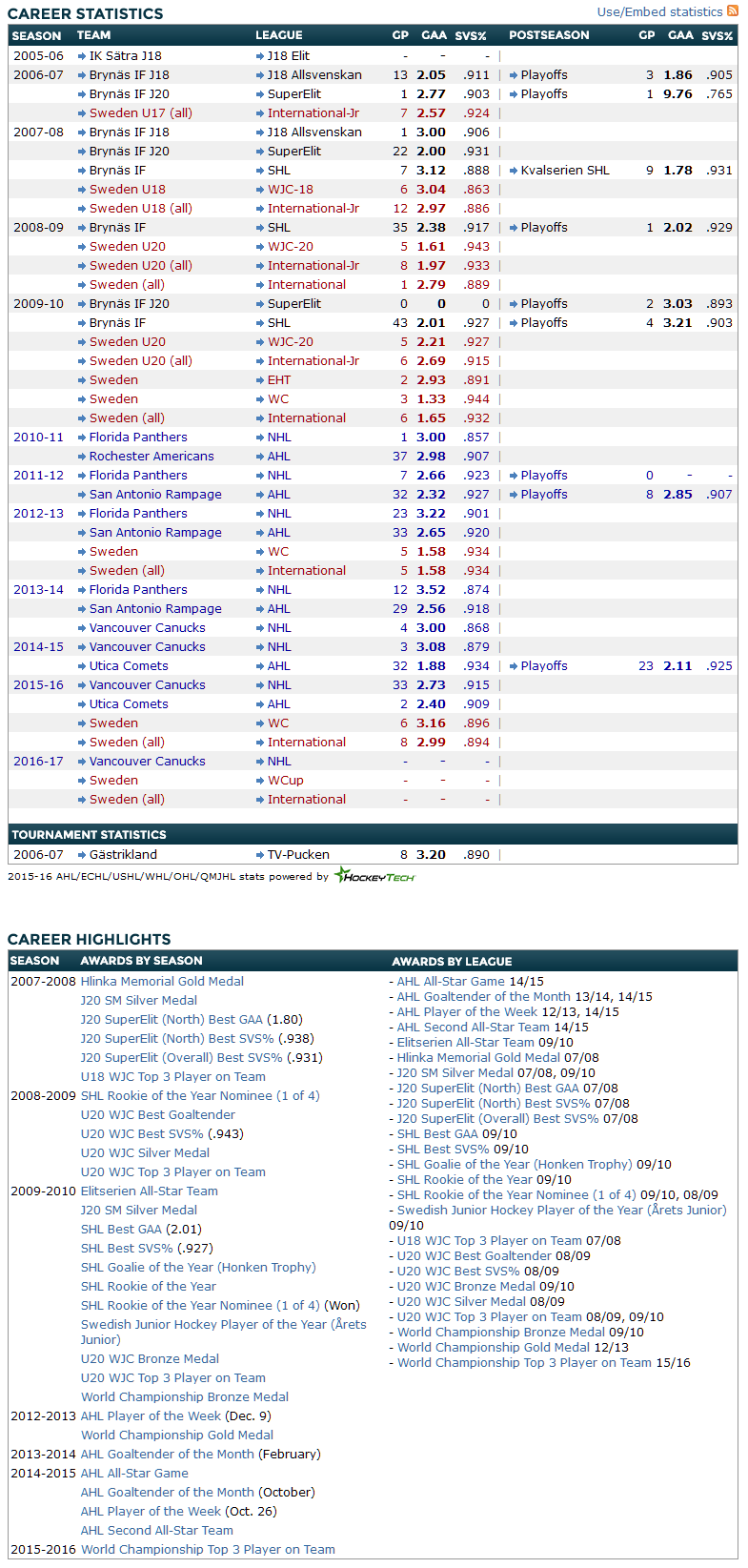
Markström is a tall goaltender that has a lot advantage of being big and making himself look even bigger in net. He is a skilled goaltender with great mental strength as one of his major characteristics. He is cool, despite having a strong winner’s instinct. Plays the butterfly style with a decent glove and has fine positioning and agility in net. What has been noticeable, however, is that he sometimes goes down too early and has problems getting up on his feet fast enough after a save. He could also work some with his rebound control, but overall Markström has plenty of raw qualities that makes him a very interesting prospect. http://www.eliteprospects.com

Appearing in his sixth NHL season in 2015.16, Markstrom established career highs for games played (33), starts (30), wins (13), shots against (988), saves (904) and minutes (1,848). The 26-year-old finished the season with a 2.73 goals against average, a .915 save percentage and set career-highs for most shots faced (48) and most saves made (47) in a single game on March 22, 2016 at Winnipeg. Markstrom also posted a record of 1-0-1 along with a 2.40 goals against average during a two game conditioning stint with the AHL Utica Comets to start the season. In 83 career NHL games split between Vancouver and Florida, the 6-6, 201-pound goaltender has a record of 26-42-9 along with a 3.00 goals against average and .904 save percentage.

On the international stage, the Gavle, Sweden native has represented his country in numerous tournaments including the IIHF World Championship in 2016, 2013 (gold) and 2010 (bronze) and at the IIHF World Junior Championship in 2010 (bronze) and 2009 (silver). He is also set to represent Team Sweden at the 2016 World Cup.

Markstrom was acquired by Vancouver from Florida alongside Shawn Matthias in exchange for Roberto Luongo and Steven Anthony on March 4, 2014. He was originally selected by Florida in the second round, 31st overall, at the 2008 NHL Entry Draft.

FireShot Screen Capture #319 - 'Eliteprospects_com - Jacob Markström' - www_eliteprospects_com_player_php_player=9787

Source: Canucks sign Markstrom to three-year extension

Vancouver Canucks GM Jim Benning Era Transaction Summary 

jim_benning

Trades:

-2014-15———–
Bonino, Sbisa, 1st (#24 – McCann), 3rd — Kesler, 3rd (#84 – Deven Sideroff)
Dorsett — 3rd (#85 – Keegan Iverson)
2nd — Garrison, 7th (204th – Jack Sadek), Costello
Vey — 2nd (#50 – Roland McKeown)
Acton — Lain
Pedan — Mallet, ’16 3rd
Clendening — Forsling
Conacher — Jeffrey
Baertschi — 2nd (#53 – Rasmus Andersson)

-2015-16———–
3rd (66th – Brisebois) and ’16 7th — Lack
7th (210th – Tate Olson) — McNally
Prust — Kassian, ’16 5th
’16 2nd — Bieksa
Sutter, ’16 3rd — Bonino, Clendening, ’16 2nd
Etem — Jensen, ’17 6th
Granlund — Shinkaruk
Larsen — ’17 5th
Futures — Fox

-2016-17———-
Gudbranson, ’16 5th — McCann, ’16 2nd, ’16 4th

Signings:

-2014-15-———
AHL – Biega, Jeffrey, O’Reilly, Sanguinetti, Andersson, Archibald, Cannata, Freisen, Zalewski
ELC – McCann, Virtanen, Subban, Stewart
Miller — 3 yrs, $6 mil per
Vrbata — 2 yrs, $5 mil per
Kassian — 2 yr, $1.75 per
Weber — 1yr, $850K
Tanev — 1yr, $2mil
Tanev — 5yr, $4.45 mil per
Vey — 1yr, $735K
Dorsett — 4yr, $2.65 mil per
Sbisa — 3 yr, $3.6 per
Kenins — 1yr, $600K
Sautner — 3 yr, $678K (ELC)
Hutton — 2 yr, $900K (ELC)

-2015-16————–
AHL – Fedun 1yr, $600K, Bachman 2yrs, $575K per, Jones 1yr, $600K, Grenier, 1yr, Witt
Baerstchi — 1yr, $900K
Vey — 1yr, $1 mil
Bartkowski — 1yr, $1.75 mil
Weber — 1yr, $1.5 mil
Markstrom — 2yrs, $1.55 per
Cracknell — 1 yr, $575K
Corrado — 1yr $600K
Clendening — 1yr $760K
Sutter — 5 yrs, $4.375 per
Brisebois — 3yr $734K (ELC)
Zalewski — 3 gm, $575K
Biega — 2 yrs, $750 per
Tryamkin — 2 yr, $925K (ELC)

2016-17—————-

AHL — Stecher — 2 yr, $925K (ELC), Demko — 3 yr, $925K (ELC), Garteig — 1 yr, $925K (ELC), Laplante — 3 yr, $837K (ELC), Nilsson — 1 yr, $575K (2-way), Chaput, Billens, Rendulic
Rodin — 1 yr, $950K
Granlund — 2 yr, $900K
Baertschi — 2 yr, $1.85 per
Etem — 1 yr, $775K
Eriksson — 6 yr, $6 mil
Larsen — 1 yr, $1.025 mil

Draft Class:

2014: Virtanen, McCann, Demko, Tryamkin, Forsling, Pettit, Stewart
2015: Boeser, Brisebois, Zhukenov, Neill, Gaudette, Jasek, Olson
2016: Juolevi, Lockwood, Candella, Stukel, Abols, McKenzie
2017: 1, 2, 3, 4 , , , 7
2018: 1, 2, 2, 3, 4, 5, 6, 7

14-15 turnover:

OUT:
Garrison, Kesler, Santorelli, Booth, Sestito, Dalpe, Schroeder, Welsh, Lain, Pelletier, Sauve, Ferriero, Mallet, Forsling
IN:
Vrbata, Miller, Bonino, Vey, Dorsett, Sbisa, McMillan, Baertschi, Sanguinetti, Pedan, Clendening, Conacher, Acton, Hamilton

15-16 turnover:

OUT:
Bieksa, Lack, Matthias, Richardson, Kassian, Bonino, Stanton, Clendening, Eriksson, Conacher, O’Reilly, Sanguinetti, McNally, McMillan, Defazio, Jensen, Corrado, Shinkaruk, Cracknell, Fox
IN:
Bartkowski, Prust, Sutter, Fedun, Bachman, Jones, Cracknell, Witt, Etem, Granlund, Larsen

16-17 Turnover:

OUT:
McCann, Higgins, Hamhuis, Kenins, Cannata, Weber, Vrbata, Vey, Blomstrand, Freisen, Fedun
IN:
Rodin, Stecher, Laplante, Gudbranson, Nilsson, Eriksson, Chaput, Billens, Rendulic

Source: Jim Benning Era Transaction Summary | Mod warning in OP – HFBoards

Kuzma: Benning bullish on fifth overall draft pick, but Canucks GM will listen to trade offers

VANCOUVER, BC – JANUARY 28: Pierre-Luc Dubois #18 of Team Orr skates up ice with the puck during the CHL/NHL Top Prospects Game January 28, 2016 at Pacific Coliseum in Vancouver, British Columbia, Canada. Photograph by: Jeff Vinnick , Vancouver Sun

BY BEN KUZMA JUNE 10, 2016

There are at least three forwards and three defencemen who could command interest when the Vancouver Canucks select fifth in the National Hockey League draft on June 24 in Buffalo.

There could be just as many trade offers to consider because the phone is ringing, and general manager Jim Benning and his staff are preparing for what is expected to be an active period before Auston Matthews is picked first overall.

The Canucks know they can land a foundation player — centre/winger Pierre-Luc Dubois, left winger Matthew Tkachuk or puck-moving defenceman Olli Juolevi, depending on what the Edmonton Oilers do with the fourth pick — but they could also make their club better now and in the future by moving the selection and getting a proven and young top-six player.

That’s plenty to ponder.

“Teams have been calling and enquiring about the fifth pick,” Benning said Thursday from the Canucks’ amateur scouting meetings in Whistler.

“We want to be prepared for any scenario that could come up at the draft. But depending on who’s there when we pick, we know we’re getting a good player. We’re not looking to move the pick, but I wouldn’t be doing my job if teams call and make offers for the pick and we didn’t consider the offers.

“We’re doing our due diligence. If we can move down and get a top-six player and a second-round pick, we have to keep our options open. I’m not saying we’re going to do anything, but we need to be prepared for any situation that may come up. But at the end of the day, if we go in and pick at No. 5, I’m real confident that we’re getting a piece that will help us win and be part of our future for a long time.”

The Canucks interviewed 70 players at the recent draft combine. Benning came away with a heightened level of satisfaction in how prospects conducted themselves, how articulate they were and how they were better prepared than even the previous year.

———————————————————-

Ben Kuzma tells Jeff Paterson about his recent chat with Canucks GM Jim Benning about the coming NHL Entry Draft. Listen here.

———————————————————-

That’s crucial. Playing the game is one thing, but being mentally mature and understanding the team concept at the pro level is crucial for impressionable players who dominate the junior ranks.

“It made me feel that we’re going to get a good player and a solid person,” added Benning, who noted that Tkachuk was really impressive in his interview with the Canucks.

Dubois and Tkachuk are of obvious interest as future first-liners because the Canucks need to formulate a succession plan for the eventual departure of Henrik and Daniel Sedin. It’s why a centre like the 6-foot-6 Logan Brown may pique their interest and why defencemen Mikhail Sergachev and Jake Bean merit some consideration.

The delicate dance of being more competitive now and retooling on the fly is easier said than done. The Canucks were active in the last draft at Florida when they showed interest in trading for Milan Lucic and then tried to land a second-round pick in 2015.

They thought they had one from San Jose in a possible Kevin Bieksa deal, but he wasn’t moved until the following week to Anaheim for a second-round pick in 2016. That pick was moved to Pittsburgh in the Brandon Sutter trade. The Canucks also tried to get a second-rounder for Eddie Lack, who was moved to Carolina at the last draft for third-round pick in 2015 and seventh-round pick in 2016.

The Canucks have first and third-round picks this year, but not a coveted second-round pick. They have identified their top 60 players for this draft and it’s imperative that the sixth through 30 picks are figured out in order of preference in case the round turns into the trade show.

The amateur meetings focus Thursday was also about making sure they’re all on the same page with what to do in the later rounds — especially the fifth, sixth and seventh where they could not only add depth, but find a diamond in the rough. In the fifth round, the Canucks selected Ben Hutton in 2012, Frank Corrado in 2011 and Bieksa in 2001. Joe Cannata was a sixth-round pick in 2009 and Jannik Hansen a ninth-rounder in 2004.

OF NOTE — The Canucks will hold pro-scouting meetings next week in advance of the buyout window and the plan for nine unrestricted free agents in the organization — including Dan Hamhuis — and which of seven restricted free agents to qualify. The Canucks expect to announce their training-camp location within the next two weeks.

bkuzma@postmedia.com

twitter.com/@benkuzma

Source: Kuzma: Benning bullish on fifth overall draft pick, but Canucks GM will listen to trade offers

Stagnating transit ridership has officials across Canada stumped

May 27, 2016

Cities across Canada are reporting stagnation and even declines in public transit ridership and officials candidly admit they aren’t exactly sure what’s going on.

Halifax, Montreal, Ottawa, Toronto, Saskatoon, Calgary and Vancouver are among the cities to report a levelling-off of ridership. The Toronto Transit Commission – which, like many other transit systems, had been on a steady ridership climb for years – recently reported that 2015 numbers fell short of expectations and 2016 may show a year-over-year decline.

The commission is warning of a potential $30-million budget shortfall.

The challenging ridership numbers come at an unprecedented moment for public transit in Canada. Cities are trying to cover the operating costs of existing transit systems at the same time as they rush to prepare ambitious expansion plans to capture the billions now on offer from federal and provincial infrastructure programs.

The federal government has said it will take a hands-off approach to doling out its infrastructure cash, transferring it to cities based on ridership and largely leaving it up to cities and provinces to decide on priority projects.

While the federal government is now willing to cover up to 50 per cent of the cost to build new transit lines and extensions, it will ultimately be up to municipalities to produce reasonable ridership forecasts or risk having to cover the operating shortfall for years to come.

“The overall trend we’re seeing in Canada and in the U.S. is ridership is stagnating or [showing] modest growth. That’s the trend,” said Patrick Leclerc, president and CEO of the Canadian Urban Transit Association, which is made up of transit operators from across the country. The association recently held its annual general meeting in Halifax, where ridership issues were discussed.

“The growth is not as strong as it was about five or six years ago. The last decade was major growth. Now it’s slowing down. We are doing the analysis to understand what is happening in each region,” he said.

Limited data on the reasons for the shift mean transit officials are left to speculate as to potential causes. The TTC’s analysis concluded that the slowing economy and employment were the main factors, as well as a recent fare increase.

Other potential factors raised by Canadian municipalities include lower gas prices, the rise of Uber and other ride-sharing services, more people walking and cycling to work and the possibility that more riders aren’t paying as streetcars and buses allow passengers to board rear doors with the expectation that they will tap their transit cards.

The general manager of OC Transpo, the City of Ottawa’s transit system, recently told the city’s transit commission that no one really knows the answer.

“Canada-wide, everyone is down,” said John Manconi earlier this month. “There’s all kinds of theories out there. We hear elasticity. We hear pricing. We hear this. We hear that. I think the best guesstimate anybody can give is a combination of things.”

Mr. Manconi said U.S. cities are reporting similar trends and that the turning point in the data occurred after 2012.

“It appears that, post-2012, everyone started to slide and it appears to be a combination of things. But nobody can pinpoint that it’s exactly this or that that has caused ridership to do what it’s doing,” he said. OC Transpo is promising to release an “aggressive, comprehensive” review of the situation in the coming weeks.

Bruce McCuaig, the CEO of Metrolinx, the Ontario agency responsible for the GO Transit commuter bus and rail system in the Greater Toronto and Hamilton Area, said he believes lower gas prices and slower economic growth are the main factors behind softer ridership numbers. He’s convinced though that the province’s ambitious, multi-billion dollar regional express-rail plan will grow ridership to 127 million per year by 2029, up from 65.7 million in 2015.

“We still feel very strongly that as we provide more service, that what we’ve experienced in the past will continue to occur here, which is we’ll open ourselves up to new markets and we’ll be successful in capturing those markets,” he said.

Mr. McCuaig and Metrolinx are also responsible for the $456-million Union Pearson Express rail line linking Toronto’s downtown to Pearson airport. Initial ridership numbers fell far short of expectations, forcing the agency to slash fares. Promises that the line would quickly become self-financing have been shelved, leaving taxpayers on the hook for a permanent annual subsidy.

Mr. McCuaig said forecasting ridership on that line was a challenge because it is not like GO Transit’s other lines that focus on commuters. However, the fact that ridership has more than doubled since fares were cut in March shows the importance of marketing and choosing the right price.

“Price, of course, matters and you need to make sure that you price the service appropriately,” he said. “When you price something at what I would consider to be a traditional transit fare, governments should expect that there’s going to be a need to provide a subsidy for those kind of services.”

McMaster University geography and earth sciences professor Chris Higgins, who specializes in the study of rapid transit systems, said cities need to carefully weigh the long term cost of expanded service.

“You’ve got to do the right things,” he said.

In addition to issues such as the economy and gas prices that are being raised by transit agencies, Dr. Higgins said he also suspects the demographic impact of his own generation – the millennials – may be a factor.

While many have observed that millennials have been less interested in cars, they may also be moving to the suburbs and driving more as they start to form families. Even if they stay close to transit, he said they may be working from home more or scaling back their hours as they raise young children.

“All these types of factors can combine in a blender, really, and manifest themselves in lower ridership,” he said. “Demographics are behind a lot of these things and tend to be forgotten.”

Source: Stagnating transit ridership has officials across Canada stumped – The Globe and Mail

Should Canucks fans be worried about Thatcher Demko?

Demko’s delay to sign in Vancouver has fans fretting

Daniel Wagner / Vancouver Courier
April 19, 2016

Thatcher Demko has proven pretty much everything he possibly can in the NCAA: he put up stunning statistics, broke Cory Schneider’s single season shutout record for Boston College, was a finalist for the Hobey Baker award, and won the Mike Richter award as the best goaltender in college hockey.

The only thing he didn’t accomplish was winning the NCAA Championship, getting knocked out in the semifinal of the Frozen Four by Quinnipiac. That unfinished business, along with the idea of finishing his education, may be why he’s seemed so uncertain about signing with the Canucks this offseason.

That uncertainty has Canucks fans understandably nervous. If Demko chooses to return to Boston College, then he could become an unrestricted free agent just a few short months after his season ends next year.

Heck, just look at the comments to our post about Thatcher Demko playing in the World Championships: it’s largely comments fretting over whether Demko should even be considered a Canucks prospect.

This year’s Hobey Baker winner, Jimmy Vesey, has informed the Nashville Predators, who drafted him in the 3rd round in 2012, that he won’t be signing with them. He’s not the only one; there have been others, with Canucks fans well aware of Justin Schultz, who chose to sign with the Edmonton Oilers rather than the Anaheim Ducks

To put it simply, the Canucks have until August 15th after Demko graduates to sign him. Otherwise, he goes to free agency.

Should we be worried about this actually happening? Is it likely that Demko doesn’t sign with the Canucks?

Let’s start with the idea of Demko heading back to make another run at the NCAA Championship. The issue is that the Eagles will be missing several key players from this past season’s team.

Defenceman Steve Santini and forwards Alex Tuch, Adam Gilmour, and Miles Wood have all signed with the teams that drafted them. They might be joined by Colin White and Ian McCoshen. Add in four graduating seniors, including captain Teddy Doherty, and half the team will be gone.

Boston College will be returning their leading scorer and their top scoring defenceman and Demko is good enough that he could carry the team on his back, but it doesn’t seem like the Eagles will be a favourite for the Frozen Four next year.

But even if Demko does return to Boston College for one more year, that doesn’t mean he’s heading to free agency.

The Canucks hold several advantages to signing Demko. The first is that they alone can sign Demko before the end of the NHL season next year. As long as Demko’s season ends in time, the Canucks can ink him to a deal and play him in a game or two, getting Demko a year closer to his next contract. That can mean a difference of millions of dollars, so it’s a significant carrot to dangle, and since there are set limits to entry-level contracts, it gives the Canucks the financial advantage.

Another advantage is that the Canucks have a clear path to Demko becoming a number one goaltender. There are limited job opportunities in the NHL for a goaltender, even one as highly regarded as Demko.

With Ryan Miller’s contract up at the end of next season, it seems likely that Demko could be in the NHL as a backup to Jacob Markstrom by 2017-18. From there, Demko just has to out-battle Markstrom for the starter’s role over the next few seasons. Ideally, Demko would sign now and get a full season in the AHL before hitting the big leagues, but it’s conceivable that he could make the jump directly.

In any case, there are very few obstacles in Demko’s path. The Canucks don’t have anyone else. With Joe Cannata a UFA and, at 26, hardly even a prospect any more, the Canucks don’t have any goaltenders other than Demko in the system.

So, barring the signing of another free agent goaltender (such as, say, Quinnipiac goaltender Michael Garteig who knocked Demko out of the Frozen Four this year and attended Canucks development camp in 2014) or Benning grabbing another goaltender in this year’s draft, Demko will stand alone in the Canucks prospect pool.

So why would he sign with another team, who would just have more goaltenders with whom to compete?

Pretty much every other team in the NHL has a deeper prospect pool in net than the Canucks. According to Hockey’s Future, the Florida Panthers have the most goaltending prospects, with a whopping seven. The Stars, Oilers, Sharks, Islanders, and Sabres each have six.

The only team other than the Canucks that has just one goaltending prospect is the Ducks, but they have the 22-year-old John Gibson signed through 2019 and will likely re-sign 26-year-old RFA Frederik Andersen to a long-term deal.

The Blackhawks and Kings have just two goaltending prospects, but they have Corey Crawford and Jonathan Quick signed through 2020 and 2023, respectively.

That’s the issue for Demko: most teams either have a solid number one or tandem in net or have blue chip goaltending prospects on the rise. There really isn’t a better situation for Demko than in Vancouver.

For example, the one team that you might think has a clearer path to a number one job than the Canucks: the Toronto Maple Leafs.

The Leafs traded away their best goaltender, James Reimer, keeping Jonathan Bernier, who was awful this past season. There’s a job opening for sure, but there’s also some serious competition for it.

The Leafs already had two young goaltending prospects—Garrett Sparks and Antoine Bibeau—and signed Kasimir Kaskisuo out of the NCAA to further crowd the crease. Sparks may have posted an ugly .893 save percentage in 17 games in the NHL, but he had a strong AHL season, while Bibeau posted a .909 save percentage in the AHL, but improved immensely at the end of the season.

That’s three goaltenders vying for the starting job, not to mention Bernier, who could have a bounceback season. Why would Demko want to forego a clear succession plan in Vancouver for the uncertainty of Toronto or some other team?

The Canucks also hold one other trump card: Demko’s dad.

The patriarch of the Demko clan is a fan of Vancouver after spending some time at UBC. He even confided in our own Harrison Mooney before his son got drafted that he was hoping the Canucks would pick him.

If the elder Demko holds any sway over the younger, Thatcher won’t be signing anywhere other than Vancouver.

© 2016 Vancouver Courier

Source: Should Canucks fans be worried about Thatcher Demko?