Vancouver empty homes tax would target Airbnb rentals 

New municpal tax would include secondary properties being booked on Airbnb

By Laura Kane, The Canadian Press

September 20, 2016

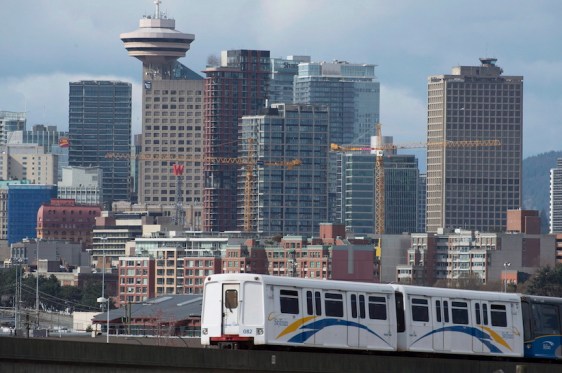
Vancouver’s proposed empty homes tax would include secondary properties being booked on the vacation rental website Airbnb, with the maximum fine for people who evade the levy set at $10,000.

New details of the tax emerged on Tuesday, when council voted to push ahead with public consultations. Mayor Gregor Robertson stressed the aim was to free up supply in the city’s crunched rental housing market.

“Ultimately, the goal is to get thousands of units back into rental housing at a time when it’s almost impossible to find a rental home,” Robertson told council.

The province granted Vancouver the authority to create the tax in July, months after a city-commissioned report found that about 10,800 homes were sitting empty, most of them condos.

Staff have been speaking with experts and researching other jurisdictions’ taxes and presented a report Tuesday with their suggested approach. The levy would be the first of its kind in Canada.

The report proposes that the tax be administered similarly to the British Columbia Home Owner Grant. A parcel of residential property that serves as a principal residence for an owner, long-term tenant or a friend or family member would not be taxed.

That means that secondary properties – such as investment condos – that are sitting empty or being rented out for short-term stays using sites like Airbnb would be subject to the tax.

Tsur Somerville, a University of British Columbia business professor, said it made sense to apply the empty homes tax to properties being used for short-term rentals, even though they’re not actually empty.

“In a city where accommodation is really, really scarce, the first priority should be housing people who live and work here,” he said in an interview.

The tax would not apply to people renting out their primary residences on Airbnb, or to basement suites, rooms or laneway homes that are either sitting empty or rented for short-term stays.

Airbnb said in a statement it’s committed to working with government to establish fair, sensible rules, including around taxation.

The city is also working on separate regulations for short-term rentals, with a report to council expected next month.

Public consultation on the empty homes tax will begin this fall, with a proposed bylaw introduced to council in November. The tax would be in place for the 2017 year, with the first payments in 2018.

There are many questions left to be settled through public talks, including whether secondary residences that are vacant only for part of the year should be exempt. The tax rate is also still being considered, with a current proposal of between 0.5 and 2 per cent of assessed value.

Penalties are also still being debated. The maximum fine the city can impose under its charter is $10,000, but it will consider a combination of the fine plus a higher tax rate for people who fail to self-declare or fraudulently declare, said Kathleen Llewellyn-Thomas, general manager of community services.

Robertson said the city has asked the province many times to increase the maximum fine.

The council vote was split 7-3, with councillors from the centre-right Non-Partisan Association opposed. Coun. George Affleck called the tax a “bureaucratic nightmare” and said the city should instead encourage the building of more townhomes and rowhomes.

The mayor dismissed the councillors’ concerns as “fear-mongering.” Residents will be asked to declare the status of their properties as part of the regular property tax process, with enforcement through random and targeted audits and response to complaints, Robertson said.

“I’d ask Coun. Affleck if he thinks the Home Owners Grant is a bureaucratic nightmare, or income tax is a bureaucratic nightmare,” he said.

Vancouver’s rental vacancy rate of 0.6 per cent is the lowest of any major city in Canada and its rents are the most expensive, housing planner Matthew Bourke said. If just 2,000 units became available for rent, the vacancy rate would lift to a healthy 3.5 per cent, Bourke said.

Tony Gioventu, executive director of the Condominium Home Owners Association of B.C., said condos built since 2010 do not have restrictions on rentals. Many of the vacant units are thought to be in new buildings in upscale neighbourhoods like Coal Harbour, he said.

But if those condos were rented out, they wouldn’t be “affordable housing,” he pointed out.

“They’d probably be rented out for $3,000 a month.”

Source: Vancouver empty homes tax would target Airbnb rentals – Macleans.ca
How good is the Vancouver Canucks’ prospect depth? | National Post

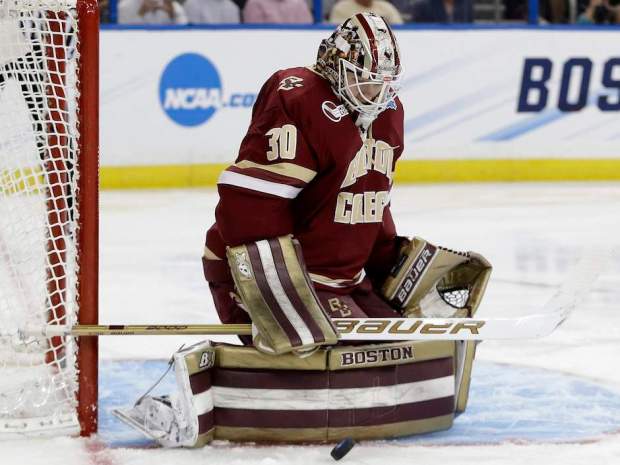
“I’ve developed well and have had some success and I’m a guy who has always stepped up to the next level when the challenge is calling,” Thatcher Demko said.

Patrick Johnston, Postmedia Network | August 30, 2016

It all depends on how you look at it.

At the top end, it’s strong.

But the list just isn’t that long.

That’s the conclusion reached by ESPN prospect guru Corey Pronman, who has the Canucks 13th overall in the latest edition of his prospect pool ranking.

There’s plenty of reason to be excited about the golden trio of Olli Juolevi, Thatcher Demko and Brock Boeser. One could be a top-end defenceman, another an elite starter in net and the third looks to have elite sniper written all over him. The 2018-19 Canucks could be a real hotshot team.

Juolevi’s hockey brain is his most notable asset, Iain Macintyre wrote in early July.

“I think it’s the same thing for your whole life: whether it’s on the ice or off the ice, you have to be confident,” Juolevi, 18, explained. “Be yourself. Don’t be fake or anything. If you know your strengths, you can use those. If you’re good at something, you can say that. But you also have to know you have to improve other things.”

Demko’s set to spend a season in Utica, working with goalie guru Rollie Melanson.

After he signed on with the Canucks, leaving behind a stellar record at Boston College, he told Ben Kuzma he’s ready to take on the challenge.

“I’ve developed well and have had some success and I’m a guy who has always stepped up to the next level when the challenge is calling,” added Demko. “I did get the opportunity to play at the world juniors against (Connor) McDavid, (Max) Domi and (Anthony) Duclair and that’s the closest I’ve been to the pro game. I expect faster guys and the pucks is going to be moving quicker.

“It’s just an adjustment period from a physical sense and just learning the grind of a pro schedule.”

And Boeser did everything you could imagine a college freshman could do, and then probably more.

He could have turned pro, especially with his father dealing with Parkinson’s and his mom working two jobs to support the family, but Boeser said he wanted to do another year of education. The Canucks’ cap planning benefits too. They save another entry-level contract year and you’d think they’d want to slot him right into the NHL. Boeser at 20 will surely be even better dynamite than he will be at 19. Muscle does matter.

“There’s definitely a thought about helping support them and getting some money,” Brock said. “But they also wanted me to go back to school and get another year under my belt, closer to a degree.

“It wasn’t that hard a decision. I think Vancouver and I were on the same page. Another year would really help me develop. I think I took a big step this year and I think I can take another step next year. (The Canucks) agreeing with me really helped. They didn’t push on me.

“I think it helps me build a relationship with them. It made it easier for me to make the decision to stay.”

The depth, though, isn’t much. The list has names like Gaunce, Pedan, Subban, Cassels, Sautner, Stecher, Brisebois and Zhukenov on it. Those are all interesting names — the first two have already played NHL games of course — but none of them screams possible star like Juolevi, Boeser and Demko do.

Source: How good is the Vancouver Canucks’ prospect depth? | National Post

CANUCKS & SPORTSNET ANNOUNCE 2016.17 BROADCAST SCHEDULE

Vancouver, B.C. – The Vancouver Canucks, in partnership with Sportsnet and Rogers, announced their 2016.17 regular season broadcast schedule today with the complete 82-game schedule set to air on Sportsnet.

Coverage kicks off with a national broadcast of the season opener versus the Calgary Flames on Hockey Night in Canada on Saturday, October 15th at 7:00 pm PST.

Canucks games will air nationally 24 times. Highlights from the national broadcast schedule include 17 Hockey Night in Canada matchups, one appearance on Scotiabank Wednesday Night Hockey and six Rogers Hometown Hockey Sunday matchups.

Sportsnet Pacific will broadcast 46 regional games with seven games airing on the Sportsnet ONE companion channel, Sportsnet Vancouver Hockey.

All regional broadcasts will feature play-by-play commentator John Shorthouse, former NHL goaltender and analyst John Garrett and rinkside reporter Dan Murphy. During Canucks home games, Murphy will host the broadcast panel live from Rogers Arena, while reporter Irfaan Gaffar will be at ice level delivering exclusive player interviews.

Visit canucks.com/scheduledownload to add the complete schedule to your desktop or mobile.

Every game will also be broadcast live on TSN 1040, the Canucks official radio broadcast partner.

Click here to see the complete game and broadcast schedule.

Source: CANUCKS & SPORTSNET ANNOUNCE 2016.17 BROADCAST SCHEDULE – Vancouver Canucks – News

Canucks Sign Defenceman Olli Juolevi to Three-Year Entry Level Contract

Juolevi_TW_OHL_1791.0.0

Olli Juolevi

VancouverCanucksCANUCKS BANTER   By Andrew Chernoff   August 6, 2016

Vancouver, BC – Vancouver Canucks General Manager Jim Benning announced Friday by press release, that the club signed defenceman Olli Juolevi to a three-year entry level contract.

olli

“Olli is a talented all-around defenceman with high hockey sense who will be a big part of our organization’s future,” said Jim Benning.

“He’s had an outstanding year, winning the Memorial Cup and World Junior gold. We look forward to seeing him continue his development and compete at the NHL level during training camp in September.”

Juolevi a well-rounded blueliner:

A competitive spark-plug, Olli Juolevi is a complete, all-around defenceman who can hem the opposition in their own end or make things difficult for the opposition at home; either way, he puts the pressure on and lays it on thick. A strong and balanced skater, he can rush the puck through the neutral zone with ease or backcheck with haste. Uses his size to his advantage, but knows his physical limits and plays within them. Instead of playing overly physical, he makes his presence felt by exhibiting his high-end playmaking ability and puck possession play. All-in-all, a well-rounded blueliner who thrives under pressure and can be trusted in all situations. (Curtis Joe, EP 2016)

Source: http://www.eliteprospects.com/

Juolevi, 18, finished third among Ontario Hockey League rookie defencemen in scoring in 2015.16, registering 42 points (9-33-42) in 57 games for the London Knights.

Skating in his first full season in North America, the 6-2, 182-pound defenceman also earned OHL Second All-Rookie Team and OHL Third All-Star Team honours.

During the 2016 playoffs, Juolevi registered 14 points in 18 games to help the Knights capture the OHL Championship. Named to the tournament All-Star Team, he then added seven points in four games to help the Knights capture their second Memorial Cup.

Prior to joining London, Juolevi appeared in 44 games in 2014.15 with Jokerit’s junior squad in Finland, registering 32 points (6-26-32). He was also named the league’s Best Defenceman, Rookie of the Year and selected to the First All-Star Team.

On the international stage, the Helsinki, Finland, native helped his country capture gold at the 2016 World Junior Championship where he led all defencemen with nine assists (0-9-9) and was named to the tournament All-Star Team.

Jason Botchford: Why Olli Juolevi still hasn’t signed with the Canucks

Vancouver Canucks draft choice Olli Juolevi is the only remaining 2016 top-10 pick waiting on a contract. Bruce Bennett / Getty Images

Jason Botchford   July 26, 2016   http://theprovince.com

At some point, the Canucks will sign their prized first-round draft pick, Olli Juolevi. It just might not be anytime soon.

Juolevi is the last signable player taken in the top 10 of the 2016 NHL Entry Draft without an entry-level contract. There are, of course, two players in that top 10 who have committed to college and won’t be signing contracts this year.

So, what gives with Juolevi? Those with connections to the talks say it’s not hard to figure out. Just look at the numbers. There are a couple of million of them in play here.

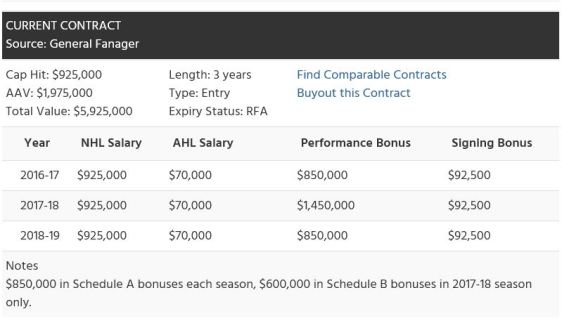
In signing entry-level deals, player agents can negotiate two types of bonuses, Schedule A and Schedule B. The maximum is US$850,000 per year for Schedule-A bonuses and every player in the top 10 signed for the max. That’s a lock for Juolevi.

The Schedule B maximum is $2 million in bonuses per year and only one player, Auston Matthews, got that. But every player in the top four had significant Schedule-B bonuses worked into their contracts.

Drafted at No. 4, Jesse Puljujarvi’s contract includes $1.65 million per year in potential Schedule-B bonuses. Interestingly, Matthew Tkachuk, who was taken by Calgary at No. 6, got none in his. That’s a significant drop-off in potential money. Guess who was sandwiched in the middle of those two on draft day?

Asked specifically if the Canucks were taking a hard line on Schedule B bonuses, Juolevi’s agent, Markus Lehto, would say only: “There have been discussions, but I don’t negotiate through the media.”

Asked about Juolevi’s contract status on TSN 1040 on Tuesday, Canucks president Trevor Linden suggested a timeline of a few weeks for a deal. Linden did appear to brush off concern about Juolevi’s contract status as no big deal, and he’s probably right.

But it’s worth mentioning that Toronto general manager Lou Lamoriello was criticized harshly by some when the Matthews talks lagged a bit. It was suggested then that Lamoriello risked alienating Matthews, while delivering a negative message to the rest of the league on how the Leafs treat their stars. Of course, Matthews was soon signed and all that talk was made to look pretty foolish.

Maybe more interesting was Linden’s suggestion that the most likely landing spot for Juolevi this fall is playing back in the OHL. Vancouver, and Lehto, believe the prospect isn’t eligible for the AHL this season. But he could play in Europe and, for whatever the reasons, the Canucks haven’t yet openly said it’s an option, even though it’s something that is being considered strongly by the Juolevi camp. Lehto said teams in both the Swedish and Finnish elite leagues have contacted him inquiring about the possibility of Juolevi playing there.

“All of the European teams see themselves as having a great development program,” Lehto said. “There is interest when they see a Finnish guy get drafted where he did and one who played really well at the U20 tournament, maybe the best defenceman in the tournament.

“Wouldn’t you think that kind of guy is very attractive? But what I’ve said all along, (Juolevi’s) priority is to make the Vancouver Canucks.”

That remains remotely possible. But if he doesn’t, wouldn’t there be more for Juolevi to gain playing in Europe against men in a high-quality league, rather than going to the OHL, where he’s accomplished about all he can accomplish, to play against a lot of teenagers? It’s at least something that should be considered while the Canucks are killing time before they sign Juolevi.

2016 NHL DRAFT TOP 10  — Annual average value of their contract

1. Auston Matthews, US$3.775 million.
2. Patrick Laine, $3.575m.
3. Pierre-Luc Dubois, $3.425m.
4. Jesse Puljujarvi, $3.425m.
5. Olli Juolevi, unsigned.
6. Matthew Tkachuk, $1.775m.
7. Clayton Keller — committed to college.
8. Alexander Nylander $1.775m.
9. Mikhail Sergachev $1.775m.
10. Tyson Jost — committed to college.

Schedule-B bonuses the team and the player can negotiate (maximum total is US$2 million per year)
1. Finishing in the top five for Hart, Norris, Selke and Richard.
2. Finishing in the top three for Calder and Lady Byng.
3. Making the first- or second-team all-star group.
4. Winning the Conn Smythe.
5. Finishing in the top 10 among defencemen in goals, assists or points.
6. Finishing in the top 10 in points-per-game (must play 42 games).
7. Finishing in the top 10 in average time-on-ice (must play 42 games).

Source: Jason Botchford: Why Olli Juolevi still hasn’t signed with the Canucks | The Province