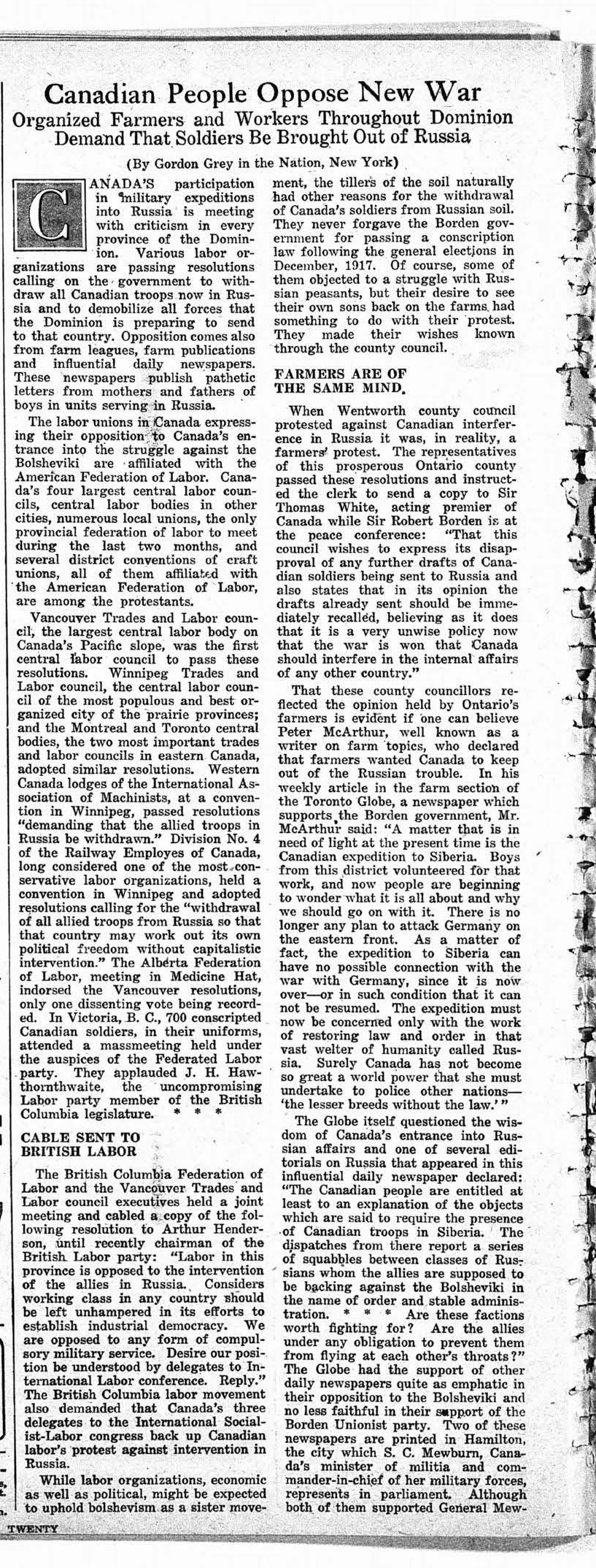
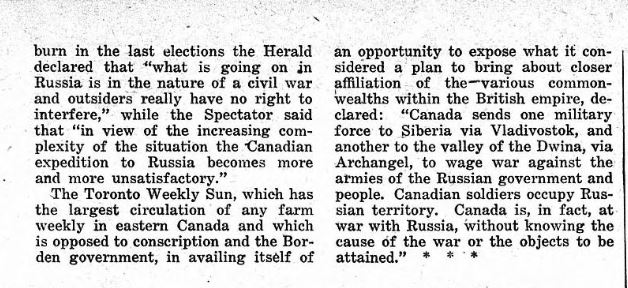
From: The Nonpartisan leader., February 24, 1919

Thursday, Oct. 15, 2015 FROM: http://www.hilltimes.com
 The Hill Times photograph by Jake Wright. Former chief electoral officer Jean-Pierre .Kingsley, pictured in this file photo, says the record number of registered third parties during this election campaign could be indicative of voter turnout.
By TIM NAUMETZ |
Published: Wednesday, 10/14/2015 9:34 pm EDT
PARLIAMENT HILL – A record number of unions, coalitions, democracy groups and individual electors have registered to advertise as third parties for or against political parties or candidates in the Oct. 19 general election, a sign one leading expert says means electors are aware “the stakes are high” as Prime Minister Stephen Harper and his Conservatives battle to hang on to power.
A total of 96 labour groups and unions, health and social advocates, nursing associations and electoral change lobbies who for the most part oppose Mr. Harper, along with a sprinkling of Conservative supporters, are registered as third parties with Elections Canada, nearly double the 55 third parties that registered for the 2011 federal election, when Mr. Harper won a majority government.
Elections Canada status as a registered third party gives each of the groups, associations or individuals the legal ability to spend up to $439,410 nationally, or $8,788 per electoral district, supporting or opposing candidates or parties or their policies and platforms.
“People are seeing that the stakes are high,” former chief electoral officer Jean-Pierre Kingsley said in an interview with The Hill Times as he commented on the record high in interest among groups, who for the most part are opponents or critics of the Conservative government, recent registrants as representatives of milk and dairy product farmers, supporters of strategic voting who want to ensure one of the opposition parties form government or advocates of electoral reform.
The 2006 election, when Mr. Harper first won power as prime minister, recorded the third highest number of registered third parties, a total of 78, on Elections Canada records going back to the June, 2004, election.
“I’m glad that we still have a third-party regime, so that people can actually do so in a meaningful way and we, the electors, can actually know who they are and whom they favour,” Mr. Kingsley said, referring indirectly to an unsuccessful court challenge Mr. Harper launched in 2000, when he was president of the right-wing National Citizens Coalition, against limits on third-party spending in election campaigns. Mr. Harper ultimately lost his Alberta court challenge in 2004 on a federal government appeal to the Supreme Court of Canada.
“I think it’s probably (also) due to the fact that it’s, well, initially a three-way race and a lot of people saw their advantage in joining as third parties,” said Mr. Kingsley, chief electoral officer from 1990 to December 2006.
Mr. Kingsley said the high rate of third-party registrations combined with a record surge in the number of advance voters for this election could be an indication of high turnout on Oct. 19 election day.
Elections Canada on Wednesday reported preliminary figures that show an estimated 3,633,422 electors cast ballots in four days of advance voting from Friday, Oct. 9, to Monday, Oct. 12, a 73 per cent increase from the 2,100,855 electors who cast ballots during advance voting in the 2011 election, despite reports of long delays due to the limited number of ballot boxes and personnel at many polling stations.
“I hope that it’s indicative, as we marry that [third party registration] with the much higher turnout at the advance polls, I hope that we see a real increase in the participation rate, which is hovering around 60 [per cent] and I especially hope that young people, aboriginal Canadians, will go to the election in droves; this election is about them as much as it is about anybody else really,” Mr. Kingsley said, acknowledging that the groups he mentioned were directly affected by stringent new controls the Conservatives put into place for registration at the polls and the kind of ID required to cast ballots.
“That [Conservative election law changes] is a direct impact on them, but as Canadians the impact is, whichever government comes in, the policies concerning them will be very different and it would behoove them to find out what that would be, and it behooves them to go and vote in accordance with what they think is in their best long term interest as Canadians,” Mr. Kingsley said.
Unions and umbrella labour groups accounted for the largest single component of the number of registered third parties for the October election, a total of 26, while another nine are advocates for electoral reform or strategic voting to try to ensure the Conservatives don’t win enough Commons seats to form a minority government.
Conservative supporters who have registered as third parties for the Oct. 19 election include Mr. Harper’s former conservative lobby group, the National Citizens Coalition, and the Canadian Shooting Sports Federation, a vocal opponent of the federal long gun registry that Mr. Harper and his government dismantled.
Opponents include Chicken Farmers of Canada, Dairy Farmers of Canada and UNIFOR, the auto workers’ union that, along with the farm groups, opposes the Harper government’s recent decision to take part in the Trans-Pacific Partnership trade agreement.
tnaumetz@hilltimes.com
The Hill Times
Three interesting advertisement illustrating the Power of Union is Strength.
An individual maybe brilliant and have strong core competencies but unless you are able to work in a TEAM and harness each others core competencies, you will always perform below par because there will always be situations at which you will do poorly and someone else does well.
May 16, 2014 By Gabriel Bako http://policyfix.ca
While the labour landscape has changed dramatically in Canada in the last 58 years, the legal framework has not. The labour relations framework that we use today in Canada was implemented in 1944 with PC-1003, and the Rand Formula in 1946. The models were based on the Wagner Act of 1935 that was implemented in the United States which gave important legal rights to organized workers. PC-1003 gives legal rights to unions to collectively bargain, represent, and organize workers and the Rand Formula gives the provisions for automatic dues check-offs.
It’s clear that these pieces of legislation are necessary to the viability of the labour movement, however there needs to be some updates. In 1944 organizing was radically different from today, as was the labour landscape. Industrial and manufacturing sectors are shrinking and today the largest employment growth is in the retail/service sector, accounting for 11.5 percent of all employment in Canada in 2011. These new jobs are mainly precarious and non-union, with fast food and mall jobs becoming more common. They usually pay minimum wage, lack stable hours, and provide few or no benefits. Even union retail/service workplaces jobs are becoming increasingly precarious. The push from non-union competitors sets the tone for how union retail/service workplaces operate their business. In today’s unionized retail/service sectors the employers intentionally hire young workers with the knowledge they aren’t well informed about their workplace rights. In addition, even in unionized retail/service workplaces the opportunity of full-time hours or even a guarantee of set hours is unlikely.
Unions are trying to organize the precarious non-unionized sector, but at the same time they’re finding it increasingly difficult just to protect their current members. Whether union or non-union, the retail/service sector is precarious, and this push comes from neoliberal policies that have become more normalized and mainstream in recent years.
The push from corporate elites to undermine labour legislation has resulted in the weakening of card-check legislation and automatic certifications, attempts to enact so called right to work, attacks on the Rand Formula, and more recently the assault on unions through attempts to impose onerous financial reporting regulations on unions and restrictions on their social justice activities.
This assault on workers is making it increasingly difficult for unions to expand into areas where they need to gain ground. For example, the growing retail sector is characterized by high-turnover and the ability to jump between workplaces, making it difficult for unions to organize. However if we want a healthy and sustainable labour movement we must find new ways to connect with the many young people who work in this sector.
Unions are realizing that they must organize these workers; it is critical for the viability of unions, but also for the workers. Despite the reality that Monday to Friday 9-5 jobs are a distant memory, unions can still achieve better scheduling provisions, fair wage increases, respect and dignity, benefits, and the right for workers to have a democratic, participatory role in their workplaces. Youth want to organize, and the unions want to organize them, but the labour relations framework doesn’t allow for this to happen effectively with the changes brought on through increases in retail/service jobs.
In today’s society young people want to take collective action against all kinds of injustice but are often doing this in non-traditional ways that are grassroots and association based; such as community coalitions, worker cooperatives, and employee associations, rather than through formalized structures such as unions. The problem is that under the current labour relations framework, these grassroots and association based structures don’t have any legal rights in terms of the employment relationship. Under these systems employees cannot formally negotiate collective agreements, and they can’t access grievance and arbitration procedures. Therefore unionization is still the best option for achieving workplace rights.
While unions want to have more inclusivity and broader representation they haven’t been able to work out some of the internal barriers that allow for this to occur. Their often hierarchal structures don’t always reflect the diversity of the labour market today. This allows for things to remain status quo, and active young people who would like to give voice to change aren’t always given the opportunity.
Unions must recognize that in order to work they must allow youth to take on participatory roles in all aspects of the union – organizing drives, negotiations, advisory and executive boards, and even take on staff positions. Unions must begin to reflect the workforce they’re looking to organize. There are some unions doing this, and it’s creating positive changes. Yet the biggest change that needs to occur is that young people and unions must come together to find ways for a new organizing model that is successful; perhaps the Wagner model isn’t it.
The challenge is great. The legislative changes required to give the labour movement the tools it needs to organize increasing numbers of precarious youth will only come about with a substantial sea change in our political landscape. Before this will happen, more youth must become engaged in politics and in the labour movement, and labour must increasingly reach out to youth.
Gabriel Bako is major in the Labour Studies Department at the University of Manitoba and a member of UFCW 832.
 Andrew Phillip Chernoff