
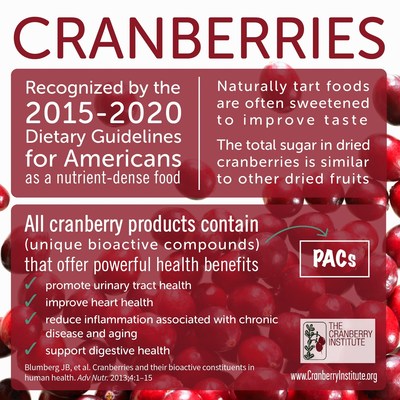
Scientists Agree that Cranberry Benefits May Extend to the Gut, Heart, Immune System and Brain

Investigations show that unique compounds in cranberry juice, dried cranberries and various cranberry extracts hold great potential for the entire body.

CARVER, Mass., July 19, 2016 /PRNewswire/ — While decades of cranberry research has found that regular consumption of cranberry products promotes urinary tract health, leading scientists studying the bioactive components of fruits and other foods reported that cranberries possess whole body health benefits.

In a July 2016 Advances in Nutrition supplement, Impact of Cranberries on Gut Microbiota and Cardiometabolic Health: Proceedings of the Cranberry Health Research Conference 2015, a team of international researchers reviewed the complex, synergistic actions of compounds that are uniquely cranberry. Their discussion led them to conclude that this berry may be more than just a tart and tangy fruit.

“It has been established that cranberries rank high among the berry fruits that are rich in health-promoting polyphenols,” notes lead author, Jeffrey Blumberg, PhD, of the Jean Mayer USDA Human Nutrition Research Center on Aging at Tufts University in Boston, MA.

“But now, recent investigations have shown that the cranberry polyphenols may interact with other bioactive compounds in cranberries that could protect the gut microbiota, and provide antioxidant and anti-inflammatory functions that benefit the cardiovascular system, metabolism and immune function.”

Recognition of the important role gut microorganisms play in human health has gained attention of scientists, reaching all the way up to the White House with the National Microbiome Initiative.

Emerging evidence has found that the gut microbiome may impact the health of the immune system and brain, as well as how the body balances energy and uses carbohydrates and fat.

Preliminary investigations with cranberries, some of which were performed in animal models, have revealed that cranberry bioactives show promise in helping to strengthen the gut defense system and protect against infection.

The effect of cranberry products on cardiovascular health and glucose management was also explained in the review. Authors of the paper described promising links between cranberry products and blood pressure, blood flow and blood lipids.

One study identified a potential benefit for glucose management with low-calorie cranberry juice and unsweetened dried cranberries for people living with type 2 diabetes. Benefits for heart health and diabetes management have been attributed to the antioxidant and anti-inflammatory effects of the polyphenols in cranberries.

Given the wide range of ways to consume cranberries – juice, fresh, sauce, dried, or as an extract in beverages or supplements – additional human studies will help determine all the ways that cranberries may influence health.

The scientific community and the cranberry industry agree – the impressive potential that cranberry bioactives may have on public health is worthy of further exploration.

“The bioactives in cranberry juice, dried cranberries and a variety of other cranberry sources have been shown to promote an array of beneficial health effects,” explains Dr. Blumberg.

“Given the complex nature and diversity of compounds found in berry fruits and how they interact with each other, I believe we have only scratched the surface when it comes to identifying the potential power of the cranberry.”

To read the proceedings in their entirety, the Advances in Nutrition supplement can be accessed here: Impact of Cranberries on Gut Microbiota and Cardiometabolic Health: Proceedings of the Cranberry Health Research Conference 2015.

Source: Scientists Agree that Cranberry Benefits May Extend to the Gut, Heart, Immune System and Brain

Fruit discovery could provide new treatments for obesity, type 2 diabetes and cardiovascular disease

May 12, 2016

A combination of two compounds found in red grapes and oranges could be used to improve the health of people with diabetes, and reduce cases of obesity and heart disease.

The find has been made by University of Warwick researchers who now hope that their discovery will be developed to provide a treatment for patients.

Professor Thornalley who led research said: “This is an incredibly exciting development and could have a massive impact on our ability to treat these diseases. As well as helping to treat diabetes and heart disease it could defuse the obesity time bomb.”

The research ‘Improved glycemic control and vascular function in overweight and obese subjects by glyoxalase 1 inducer formulation’ has been published in the journal Diabetes, and received funding from the UK’s innovation agency, Innovate UK. The project was a collaboration between the University of Warwick and University Hospitals Coventry and Warwickshire (UHCW) NHS Trust.

A team led by Paul Thornalley, Professor in Systems Biology at Warwick Medical School, studied two compounds found in fruits but not usually found together. The compounds are trans-resveratrol (tRES) – found in red grapes, and hesperetin (HESP) – found in oranges. When given jointly at pharmaceutical doses the compounds acted in tandem to decrease blood glucose, improve the action of insulin and improve the health of arteries.

The compounds act by increasing a protein called glyoxalase 1 (Glo1) in the body which neutralises a damaging sugar-derived compound called methylglyoxal (MG). MG is a major contributor to the damaging effects of sugar. Increased MG accumulation with a high energy diet intake is a driver of insulin resistance leading to type 2 diabetes, and also damages blood vessels and impairs handling of cholesterol associated with increased risk of cardiovascular diseases. Blocking MG improved health in overweight and obese people and will likely help patients with diabetes and high risk of cardiovascular disease too. It has already been proven experimentally that blocking MG improves health impairment in obesity and type 1 and type 2 diabetes.

Although the same compounds are found naturally in some fruits, the amounts and type required for health improvement cannot be obtained from increased fruit consumption. The compounds that increase Glo1 and are called a ‘Glo1 inducer’. Pharmaceutical doses for patients with obesity, diabetes and high risk of heart disease could be given to patients in capsule form.

Professor Thornalley increased Glo1 expression in cell culture. He then tested the formulation in a randomised, placebo-controlled crossover clinical trial.

Thirty-two overweight and obese people within the 18-80 age range who had a BMI between 25-40 took part in the trial. They were given the supplement in capsule form once a day for eight weeks. They were asked to maintain their usual diet and their food intake was monitored via a dietary questionnaire and they were also asked not to alter their daily physical activity. Changes to their sugar levels were assessed by blood samples, artery health measured by artery wall flexibility and other assessments by analysis of blood markers.

The team found that the highly overweight subjects who had BMIs of over 27.5 with treatment displayed increased Glo1 activity, decreased glucose levels, improved working of insulin, improved artery function and decreased blood vessel inflammation. There was no effect of placebo.

Professor Thornalley said: “Obesity, type 2 diabetes and cardiovascular disease are at epidemic levels in Westernised countries. Glo1 deficiency has been identified as a driver of health problems in obesity, diabetes and cardiovascular disease.”

“Diabetic kidney disease will be the initial target to prove effective treatment for which we are currently seeking commercial investors and partners. Our new pharmaceutical is safe and expected to be an effective add-on treatment taken with current therapy.

“The key steps to discovery were to focus on increasing Glo1 and then to combine tRES and HESP together in the formulation for effective treatment.

“As exciting as our breakthrough is it is important to stress that physical activity, diet, other lifestyle factors and current treatments should be adhered to.”

Professor Martin O Weickert, Consultant in Diabetes and Endocrinology at UHCW NHS Trust, and co-applicant for the grant, said: “We were really excited to participate in this study with Warwick Medical School, as taking part in world-leading research makes a real difference to our patients both now and in the future.

“As well as the positive effects for the UHCW patients who took part in the trial, we hope this study will lead to new treatments to help patients with diabetes and cardiovascular diseases all over the world.”

Prof. Thornalley and his team are now hoping manufacturers will want to explore the use of the compound as pharmaceutical products.

source: University of Warwick

Source: Fruit discovery could provide new treatments for obesity, type 2 diabetes and cardiovascular disease | Science Codex

New discoveries on the connection between nicotine and type 2 diabetes

Researchers at Lund University in Sweden have made two new discoveries with regard to the beta cells’ ability to release insulin. The findings can also provide a possible explanation as to why smokers have an increased risk of type 2 diabetes.

The study was conducted on mice and donated beta cells from humans, and is now published in the scientific journal Cell Reports.

The researchers have discovered that so-called nicotinic acetylcholine (nicotine-sensitive) receptors influence the normal release of insulin. They also show that a specific genetic alteration renders dysfunctional nicotine-receptors affecting the number of functional nicotine-sensitive receptors found in beta cells. A reduced number of functional receptors leads to a decrease in insulin secretion, thereby increasing the risk of developing type 2 diabetes.

“The receptors in the beta cells that stimulate the release of insulin are normally activated by the signal substance acetylcholine, but they can also be activated by nicotine. Never before has the importance of nicotine-sensitive receptors been shown in terms of the function of beta cells. Our research indicates that people who lack these receptors are at higher risk of developing type 2 diabetes”, says Isabella Artner, researcher at Lund University responsible for the study.

Isabella Artner and her colleagues have also discovered that the gene MafA (muscoloaponeurotic fibrosacoma oncogene family A) found in insulin-producing beta cells control the number of nicotine-sensitive receptors and thereby their ability to receive signals from the central nervous system.

“The effect that this single gene, MafA, alone has on insulin secretion was previously unknown, and nicotine receptors have never before been connected to type 2 diabetes”, says Isabella Artner, and continues:

“We know that smokers have an increased risk of developing type 2 diabetes, but the reason why has not been firmly established. Perhaps it has to do with the nicotine-sensitive receptors we describe. Our findings increase knowledge about the connection between smoking and type 2 diabetes.

Source: Lund University

Source: New discoveries on the connection between nicotine and type 2 diabetes | Science Codex

Gradual reduction of sugar in soft drinks without substitution as a strategy to reduce overweight, obesity, and type 2 diabetes: a modelling study

Summary

Background

Sugar-sweetened beverages are a major source of free sugar intake in both children and adults, and are an important contributor to obesity and obesity-related diseases, including type 2 diabetes. We proposed an incremental and stepwise reduction in free sugars added to sugar-sweetened beverages by 40% over 5 years without the use of artificial sweeteners and assessed the effect of the proposed strategy on energy intake and weight status.

Methods

In this modelling study, we used nationally representative data from the National Diet and Nutrition Survey rolling programme (NDNS RP) from 2008–12 and British Soft Drinks Association annual reports to calculate sugar-sweetened beverage consumption (both with and without fruit juices) and its contribution to free sugar and energy intake in the UK population. We then estimated the predicted reduction in energy intake resulting from the proposed strategy at an individual level. We further predicted the reduction in steady-state bodyweight for each adult using a weight loss model. By scaling up the distribution of the predicted bodyweight in the NDNS RP to the UK adult population, we estimated reductions in the number of overweight and obese adults, and the number of adults with type 2 diabetes.

Findings

A 40% reduction in free sugars added to sugar-sweetened beverages over 5 years would lead to an average reduction in energy intake of 38·4 kcal per day (95% CI 36·3–40·7) by the end of the fifth year. This would lead to an average reduction in steady-state bodyweight of 1·20 kg (1·12–1·28) in adults, resulting in a reduction in the prevalence in adults of overweight by 1·0 percentage point (from 35·5% to 34·5%) and obesity by 2·1 percentage points (from 27·8% to 25·7%). This reduction would lead to a reduction of roughly 0·5 million adults from being overweight and 1 million adults from being obese, which in turn would prevent about 274 000–309 000 incident cases of obesity-related type 2 diabetes over the two decades after the predicted reduction in bodyweight is achieved. If fruit juices were excluded from the category of sugar-sweetened beverages (because of potential challenges for reformulation), the corresponding reductions in energy intake and steady-state bodyweight would be 31·0 kcal per day (95% CI 28·6–33·7) and 0·96 kg (0·88–1·04), respectively. These reductions would result in a 0·7 percentage point (0·3 million) reduction in overweight and a 1·7 percentage point (0·8 million) reduction in obesity, which would in turn prevent about 221 000–250 000 cases of type 2 diabetes over two decades after the predicted reduction in bodyweight is achieved. The predicted effect was greater in adolescents, young adults, and individuals from low-income families (who consume more sugar-sweetened beverages).

Interpretation

An incremental reduction in free sugars added to sugar-sweetened beverages without the use of artificial sweeteners is predicted to reduce the prevalence of overweight, obesity, and type 2 diabetes. The proposed strategy should be implemented immediately, and could be used in combination with other approaches, such as taxation policies, to produce a more powerful effect.

Funding

None.

Source: Gradual reduction of sugar in soft drinks without substitution as a strategy to reduce overweight, obesity, and type 2 diabetes: a modelling study – The Lancet Diabetes & Endocrinology