UN monitoring mission eyes Site C dam impact on Wood Buffalo National Park

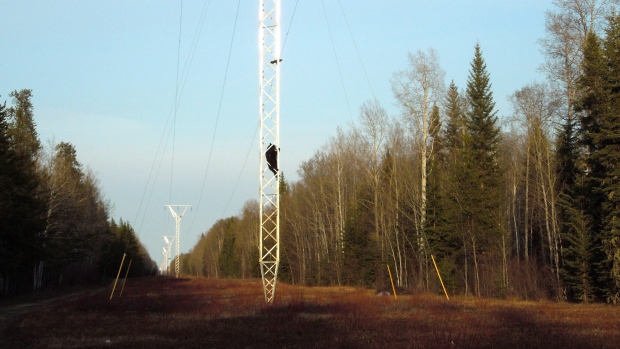
A bear climbs down after raiding a raven’s nest atop of power transmission tower in Wood Buffalo National Park in this Sunday May 10, 2015 handout image provide by hunter Linda Powell of O.F. Mossberg and Sons, Inc. (THE CANADIAN PRESS/HO)

By Bruce Cheadle, The Canadian Press

Sunday, September 25, 2016

OTTAWA — A United Nations monitoring mission to a world heritage site in northern Alberta appears likely to focus more attention on the contested Site C hydroelectric project next door in British Columbia.

Wood Buffalo National Park, a UNESCO world heritage site since 1983, is under review this week at the request of the Mikisew Cree First Nation, who petitioned the world body in 2014 to list the park as being under threat from various developments.

The park is at the convergence of the Peace and Athabaska rivers and is considered the largest freshwater boreal delta on the planet.

Conservationists and local First Nations are concerned about how two existing hydro dams on the Peace River are affecting the hydrology of the park — a problem they say will be compounded by B.C.’s massive Site C dam that’s going ahead on the Peace River.

The World Heritage Centre concluded in 2015 that a review of cumulative effects on Wood Buffalo National Park was warranted, and in the meantime asked that Canada not make any other development decisions that “would be difficult to reverse.”

Nonetheless, the Trudeau government issued federal fisheries permits this summer to allow construction to go ahead on Site C, which will dam an 83-kilometre long reservoir on the Peace River.

The 10-day “reactive monitoring mission” of Wood Buffalo by a committee of international UNESCO experts got underway Sunday, after being postponed earlier in the year due to the wildfires around Fort McMurray, Alta.

The park review opens a new front in the battle over Site C, which is already being challenged in Federal Court by two B.C. First Nations.

The federal permits quietly issued in late July further inflamed the debate, with Perry Bellgarde, the national chief of the Assembly of First Nations, publicly stating this month that the hydro project is not being handled in keeping with Canada’s constitution nor with the UN Declaration on the Rights of Indigenous Peoples.

Those concerns about indigenous consultation dovetail with the complaints over the management of Wood Buffalo National Park.

The World Heritage Committee’s decision to go ahead with the review noted “with concern the lack of engagement with indigenous communities in monitoring activities, as well as insufficient consideration of traditional ecological knowledge.”

Federal Environment Minister Catherine McKenna welcomed the UNESCO monitoring mission, which could only come with the invitation of the federal government.

“The government of Canada is committed to preserving our national parks, some of which are recognized World Heritage sites, and doing so in partnership with local communities, Indigenous peoples and other stakeholders,” McKenna said in a statement Friday.

Source: UN monitoring mission eyes Site C dam impact on Wood Buffalo National Park | CTV News

The Canadian Government’s Expenditure Plan for 2016-17

Get the report
The Government’s Expenditure Plan for 2016-17

Get the data

Main Estimates Figures. xlsx

Summary
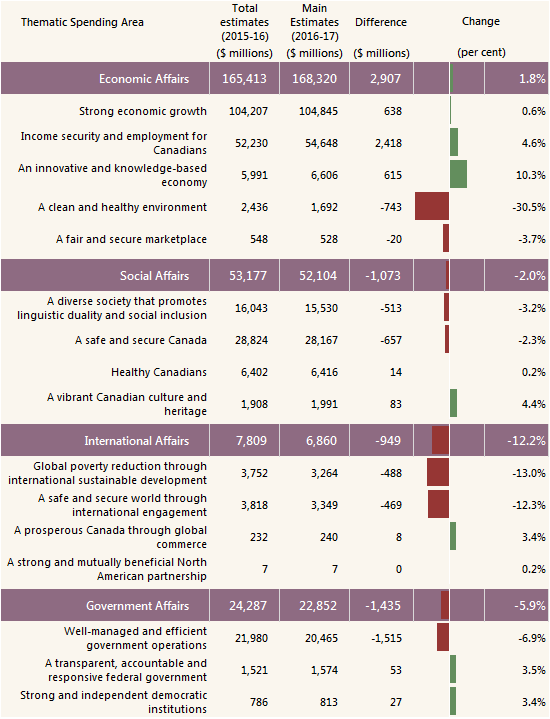
The Government’s Expenditure Plan and Main Estimates for 2016-17 outline $250.1 billion in budgetary spending authorities. This represents a decrease of approximately $550 million compared to total budgetary authorities outlined in 2015-16, mostly driven by decreases in direct program spending (DPS), partially offset by increases in major transfers to persons, and other levels of government.

The decline, in general, stems from the sun-setting of various initiatives, for example the remediation of contaminated sites. Some of these measures are likely to be re-announced sometime in the future. Associated with this are expectations of future requests for funds through the Supplementary Estimates process, later in the year.

The Government has also initiated a pilot project, providing parliamentarians the ability to approve Transport Canada’s grants and contributions at the program level. This move allows Parliament to provide greater scrutiny on the spending of funds, and builds on recent transparency initiatives, notably the TBS InfoBase and the publication of frozen allotments in Supplementary Estimates (C) 2015-16.

Spending by policy area

Source: The Government’s Expenditure Plan for 2016-17

Trudeau government facing bigger baseline deficits amid weaker economy

OTTAWA – The new Trudeau government will have to contend with bigger-than-expected baseline deficits in the coming years as it starts rolling out the large spending plans that helped it win power, the federal budget watchdog says.

The parliamentary budget office downgraded its economic projections for Canada on Tuesday, blaming the gloomier forecast on weaker growth, low commodity prices and shrinking revenues.

“It is worse than what we had expected, but it is not a disaster,” assistant parliamentary budget officer Mostafa Askari said Tuesday of Canada’s economic outlook.

“It’s a pause in the economic growth and as a result we have seen some deterioration in the fiscal picture for the government.”

The updated figures released by the budget office suggest it will be tougher for the Liberals to fulfil their election promise to balance the books by 2019-20, a goal they have said will follow three years of deficits.

But even those annual shortfalls are on track to grow bigger than expected, the report said.

For example, the Liberals pledged to run deficits of no more than $10 billion in each of the next two years by basing their forecasts on calculations made by the parliamentary budget office in July.

The budget office crunched those July numbers by updating government projections from April’s budget by recalculating them using downgraded Bank of Canada growth forecasts.

The latest PBO numbers, however, suggest the government’s fiscal starting point will be billions of dollars lower in those two years — by $3 billion in 2016-17 and by $4.7 billion in 2017-18. The result could mean deficits of nearly $13 billion in 2016-17 and more than $14 billion in 2017-18.

The Liberals have also said they would run a $5.7-billion shortfall in 2018-19 before delivering a $1-billion surplus in 2019-20 — but those projections are based on a combination of April’s Finance Department forecasts and the party’s own predictions.

The government has yet to say whether it will release a fiscal update before it tables its first budget since winning last month’s election.

The budget office said its predictions Tuesday do not take into account the fiscal impact of any measures in the Liberal government’s election platform.

The report Tuesday also updated the budget office’s own fiscal projections from April.

Back in April, the budget office said Ottawa would run a $1.1-billion surplus in 2015-16, break even in 2016-17 and post a $2.6-billion deficit in 2017-18. The spring forecast also projected shortfalls of $2.8 billion in 2018-19 and $2.5 billion in 2019-20.

The office is now forecasting a $1.2-billion surplus in 2015-16, but says it will be followed by four straight deficits that are on average $2.4 billion lower per year than its April projection.

It expects shortfalls of $3 billion in 2016-17, $4.7 billion in 2017-18, $5 billion in 2018-19 and $4.6 billion in 2019-20.

Source: Trudeau government facing bigger baseline deficits amid weaker economy: PBO | National Newswatch

Full list of Justin Trudeau’s cabinet—CBC NEWS

November 4, 2015   CBC News

http://www.ctvnews.ca/polopoly_fs/1.2642542.1446659515!/httpImage/image.jpg_gen/derivatives/landscape_620/image.jpg          The full list of Prime Minister Justin Trudeau’s new 31-member cabinet, in order of precedence, sworn in today at Rideau Hall in Ottawa (with their province in parenthesis):

  • Justin Trudeau (Quebec) – Prime Minister, Intergovernmental Affairs and Youth.
  • Ralph Goodale (Saskatchewan) – Public Safety and Emergency Preparedness.
  • Lawrence MacAulay (P.E.I.) – Agriculture and Agri-Food.
  • Stéphane Dion (Quebec) – Foreign Affairs.
  • John McCallum (Ontario) – Immigration, Citizenship and Refugees.
  • Carolyn Bennett (Ontario) – Indigenous and Northern Affairs.
  • Scott Brison (Nova Scotia) – Treasury Board President.
  • Dominic Leblanc (New Brunswick) – Leader of the Government in the House of Commons.
  • Navdeep Bains (Ontario) – Innovation, Science and Economic Development.
  • Bill Morneau  – Finance Minister
  • Jody Wilson-Raybould (B.C.) – Justice and Attorney General  of Canada.
  • Judy Foote (Newfoundland and Labrador) – Public Services and Procurement.
  • Chrystia Freeland (Ontario) – International Trade.
  • Jane Philpott (Ontario) – Health.
  • Jean-Yves Duclos (Quebec) – Families, Children and Social Development.
  • Marc Garneau (Quebec) – Transport.
  • Marie-Claude Bibeau (Quebec) – International Development and La francophonie.
  • Jim Carr (Manitoba) – Natural Resources.
  • Mélanie Joly (Quebec) – Heritage.
  • Diane Lebouthillier (Quebec) – National Revenue.
  • Kent Hehr (Alberta) – Veterans Affairs, and Associate Minister of National Defence.
  • Catherine McKenna (Ontario) – Environment and Climate Change.
  • Harjit Sajjan (B.C.) – National Defence.
  • MaryAnn Mihychuk (Manitoba) – Employment Workforce Development and Labour.
  • Amarjeet Sohi (Alberta) – Infrastructure and Communities.
  • Maryam Monsef (Ontario) – Democratic Institutions.
  • Carla Qualtrough (B.C.) – Sport, and Persons with Disabilities.
  • Hunter Tootoo (Nunavut) – Fisheries and Oceans, and Canadian Coastguard.
  • Kirsty Duncan (Ontario) – Science.
  • Patricia Hajdu (Ontario) – Status of Women.
  • Bardish Chagger (Ontario) – Small Business and Tourism.

Map          Map shows the regional distribution of ministers in the cabinet of Prime Minister Justin Trudeau. (CBC)

List of Cabinet Committees: cabinet-committees