
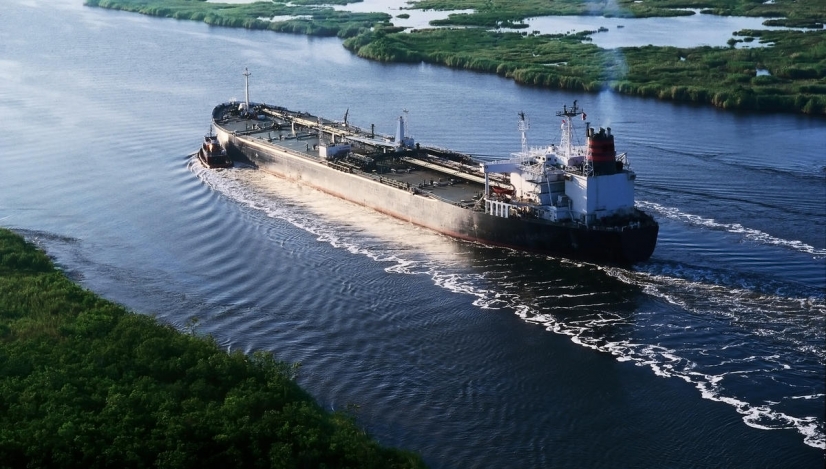
Image: NRDC
By James Wilt • Wednesday, July 27, 2016
You know you’ve got the attention of the fossil fuel industry when the Financial Post’s Claudia Cattaneo pens a dismissive column about your efforts.
On Tuesday, Cattaneo — recently dubbed “everyone’s favorite oil and gas shill” by American Energy News — bestowed the honour on a new report about TransCanada’s proposed Energy East pipeline, published by the Natural Resources Defense Council and 13 other environmental organizations including 350.org, Greenpeace and the Sierra Club.
“Canadian [sic] are also right to wonder why a deep-pocketed U.S. group with an army of lawyers is meddling in an all-Canadian pipeline project,” she opined in her 820-word column, shortly after insinuating the Natural Resources Defense Council “needed to conquer and make money off a new dragon” following the presidential veto of the Keystone XL pipeline in 2015.
The idea that Energy East only concerns Canadians is a curious perspective. But it’s certainly not a unique one.
The Energy East project, requiring 1,500 kilometers of new pipeline and the conversion of 3,000 kilometers of existing natural gas infrastructure in order to transport up to 1.1 million barrels of dilbit per day, has been heralded by many as a quintessentially Canadian project, comparable to the Canadian Pacific Railway in scope and significance. Even Rick Mercer argued for its construction.
Unlike the Kinder Morgan’s proposed Trans-Mountain Expansion, however, there’s been a fair bit of obfuscation about what the desired market is for the transported product.
That’s a key problem for a big picture defence of the project.
Some have contended that Energy East will transport products for consumption in Eastern Canada, helping to foster energy security by breaking a reliance on imports from the Middle East. Such a reality would indeed seem like an “all-Canadian pipeline project” and justify Cattaneo’s confusion about why U.S. organizations are getting involved in the battle.
But as the Natural Resources Defense Council’s new 24-page report (ominously titled “Tar Sands in the Atlantic Ocean“) sketches out, the U.S. has many, many reasons for concern: threats to marine mammals, vulnerable ecosystems and progress on climate change, for starters.
“From the U.S. perspective, [Energy East] is a huge project that right now feels as if it’s being snuck in,” says Josh Axelrod, a Washington, D.C.- based policy analyst at the Natural Resources Defense Council and co-author of the report in an interview.
”We’re worried if it remains on the down-low that our regulators will basically find out about dilbit tankers the day something goes wrong and will not be prepared for it. We would like to, at the very least, have them prepared, if not express their disapproval of the idea.”
Tankers Could Move 328 Million Barrels of Oil Per Year in U.S. Water
Axelrod’s quick to point out there’s “no compelling case” for the suggestion that Energy East is planned to transport oil for Canadians to use.
In TransCanada’s May 2016 consolidated application to Canada’s National Energy Board, the company estimated it would ship up to 281 tankers every year.
Axelrod says the proposed tanker configuration amounts to 900,000 barrels a day.
By the report’s estimates, tankers could move up to 328 million barrels of oil to refineries in New Jersey, Delaware, Louisiana and Texas: the U.S. Gulf Coast sports 25 refineries, 17 of which have a history of processing heavy oilsands crude.
Meanwhile, New Brunswick’s Irving refinery doesn’t have the capacity or even necessarily the desire to process dilbit (Axelrod adds the reversal of Enbridge’s Line 9B in September makes Energy East less useful to the Montreal refineries).
This matters a great deal. If TransCanada was intending to transport and sell dilbit to Canadian refineries for Canadian usage, it would indeed be odd for a report to call for a moratorium on tankers; Cattaneo strangely suggested in her column that the proposed ban is “a bit surprising given that oilsands tankers would be leaving from a Canadian port, making it harder to block by the U.S. administration.”
For at this point, the facts seem clear: tankers will be leaving a Canadian port and travelling through American waters with potentially catastrophic impacts in the case of a spill or accident.
Dilbit Spills Notoriously Difficult to Clean Up
The report points to two major incidents that have occurred in the past few years — the 2010 Enbridge spill in Michigan’s Kalamazoo River, and the 2013 ExxonMobil spill in Arkansas — as examples of the difficulties of containing and cleaning up a dilbit spill.
A 2016 report by the National Academy of Sciences emphasized that dilbit sinks in water and doesn’t biodegrade easily, making a spill far more disastrous than its conventional counterpart.
And that’s not even to speak of issues like ship strikes (when ships hit whales or other marine mammals), noise pollution or the accidental transportation of invasive species.
These are all issues that one would hope regulators would consider in their review of projects. But Axelrod says the National Energy Board (NEB) has “really flubbed this,” using a process that fails to consider cumulative impacts or acknowledge difficulties with cleaning up other dilbit spills.
“The NEB likes to make it seem like their processes are straightforward but they’ve really made it into a disaster,” he says. “There’s pro forma discussion of some of the impacts but a very limited scope.”
Energy East Exempted From Environmental Assessment Overhaul
There is still lots of time to correct such problems: the NEB’s consultation process will be continuing until 2018, while the very earliest Energy East could start transporting dilbit would be 2021.
But companies including TransCanada and Kinder Morgan have already been told by the federal government that “no project proponent will be asked to return to the starting line,” with the exception of the evaluation of their upstream greenhouse gas emissions.
“I hope it’s being used as a way to look at a project’s impacts on provincial and national climate goals and international commitments, and if that’s the case it could be a useful tool,” Axelrod says. “But it really misses a lot of the project’s climate impacts.”
And given the NEB will almost certainly approve the project — since 2012, the body has had to conduct environmental assessments and consultations, tasks that are far outside of its original mandate — that’s a problem the federal cabinet will have to confront.
Kinder Morgan’s Trans-Mountain pipeline expansion will be decided upon before Energy East. But that’s a far more complicated project due to dozens of unresolved First Nations land claims. The Alberta NDP also appears to have put more long-term hope in Energy East due to such factors.
But if Canada does end up approving Energy East — and, of course, depending on who’s elected as president of the United States — it may end up seeing a similar conclusion to what happened with the Keystone XL pipeline: pushed for by Canada and rejected by America due to potential impacts on environments and wildlife.
Maybe, by then, it will have all started to make sense for Cattaneo and her pals.
 Andrew Phillip Chernoff