

By Mark O’Hara
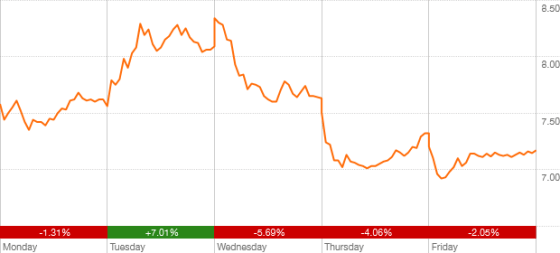
On November 13, 2015, Freeport-McMoRan (FCX) closed at $8.68. Although Freeport’s stock is down more than 25% so far in November, it is still trading ~12% above its 2015 lows. The year has been nothing short of a roller coaster ride for Freeport investors.

Stocks have been falling
The entire base metals space (XLB) has seen heightened volatility over the last six months or so. However, companies including Freeport-McMoRan, Teck Resources (TCK), and Glencore (GLNCY) have been more volatile as compared to some of their peers in this sector.
Teck Resources has seen its share price dwindle more than 65% this year. Teck Resources is the world’s second largest exporter of steelmaking coal. It is also North America’s largest coal producer, with the annual capacity to produce 28 million tons. Along with falling copper prices, Teck Resources has been hit by the reduced Chinese coal demand.
Freeport is not far behind, and its stock has fallen more than 62% this year. Southern Copper (SCCO) has not fallen much, as can be seen in the graph above. Please read Southern Copper: A Business Overview of a Copper Giant to learn more about SCCO.
Key drivers
There are several factors that would determine how Freeport-McMoRan could trade over the next few months. As Freeport is also involved in the energy exploration business, its stock price could also be guided by movement in energy prices. However, Freeport has announced that the company is looking at several “strategic alternatives” for the energy business, and a final decision has yet to be made.
The key driver, however, would be how copper prices play out in the coming months. In the next part of this series, we’ll explore what analysts think about copper prices.
Copper prices
Copper prices resumed their downside in November after remaining relatively strong in October. On November 13, 2015, the LME (London Metals Exchange) three-month copper contract closed at $4,810 per metric ton, losing more than 1% from the previous day’s closing.

So far in November, the LME three-month copper contract has lost ~6% and joined the ranks of other metals, including steel and aluminum, to hit fresh 2015 lows. The graph below shows the recent movement in copper prices.
How low can it get?
Goldman Sachs had earlier given a target of $4,800 per ton for copper by the end of December 2015. However, according to an October 8 Reuters report citing Max Layton, the head of European commodities research for Goldman Sachs, copper could even fall below $4,000 per metric ton.
A November 12, 2015, Reuters’ article, cited Axel Rudolph, technical analyst at London-based Commerzbank, who noted, “Copper is likely to extend losses in coming weeks to $4,397.”
Bears are back
Bears, it seems, are back full throttle in copper. The bearish sentiments surrounding copper faded somewhat a few weeks ago on supply cuts from Freeport-McMoRan (FCX) and Glencore (GLNCY). However, the goodwill failed to last beyond a month, and copper prices have resumed their downside.
While FCX and GLNCY have announced production cutbacks, diversified miners such as Rio Tinto (RIO) and BHP Billiton (BHP) don’t plan to cut their copper production. Both companies are among the low-cost copper producers, so it would make economic sense for these companies to keep mining copper from their mines.
Meanwhile, the concern has again shifted to the demand side of the equation. In the last week or so, there has been quite a bit of negative data from China, whether it is monthly trade data or credit activity. Pessimistic Chinese data is weighing heavily on copper prices. A stronger US dollar (UUP), on expectations of a possible Federal rate hike in December, is not helping copper’s cause, either.
Falling copper prices
As seen in the previous part of this series, copper prices have crashed to a fresh six-and-a-half-year low on concerns over the Chinese economy and a stronger US dollar. However, unlike other pure-play copper producers like Turquoise Hill Resources (TRQ) and Southern Copper (SCCO), Freeport-McMoRan’s (FCX) worries extend beyond falling copper prices. Together, Freeport and Newmont Mining (NEM) form ~4.1% of the Materials Select Sector SPDR ETF (XLB).

Lower energy prices
Freeport-McMoRan is also involved in the energy exploration business. In 3Q15, the company sold 1.0 billion pounds of copper, 23 million pounds of molybdenum, 13.8 MMBOE (or million barrels of oil equivalent), and 294,000 ounces of gold. Freeport has given a guidance of 13.3 MMBOE for 4Q15.
Energy exposure makes Freeport’s earnings sensitive to falling crude oil prices as well. The company’s energy operations generated an EBITDA (earnings before interest, taxes, depreciation, and amortization) of $0.3 billion in 3Q15. This is roughly one-third of Freeport’s 3Q15 consolidated EBITDA.
Sensitivity
According to Freeport-McMoRan, the company expects its 2016 EBITDA to fall by $215 million for every $5 per barrel fall in Brent oil prices. The company also expects its operating cash flows to be lower by $170 million for every $5 per barrel fall in Brent. Please note that the sensitivity is based only on the energy operations and does not account for diesel costs in Freeport’s copper operations.
Brent oil prices have fallen in the last couple of weeks, as can be seen in the graph above. Falling energy prices could weigh heavily on Freeport’s 4Q15 earnings.
Freeport noted that it is looking at “strategic alternatives” for its energy business. However, falling crude oil prices have only made things worse for Freeport’s plans.
Icahn lift
Freeport-McMoRan (FCX) jumped smartly in August after activist investor Carl Icahn disclosed his 8.5% stake in the company. Known as the “Icahn lift,” this phenomenon sometimes occurs after Icahn buys a stake in a company. The activist investor has a reputation for encouraging company management to make decisions that he perceives to be in the investors’ best interests.

Recent developments
The graph above shows some of the recent developments in Freeport-McMoRan after Icahn disclosed his stake. Currently, the activist investor holds two seats on Freeport’s board. In his statement following his representation on Freeport’s board, Icahn cited examples of companies like eBay (EBAY), Mentor Graphics (MENT), and Herbalife, whose “shareholder value has been greatly enhanced” after he won board representation.
Would it help?
To be fair, there’s not much that either Icahn or Freeport-McMoRan’s management can do when commodity prices are hovering at multiyear lows. For its part, the company has taken several aggressive measures, including mine closures and capital expenditure cuts. However, these can only help lessen the pain from falling commodity prices (COMT) (DBB).
Unfortunately for Freeport, even if it breaks off its energy assets, it would not be a smooth ride. Even Freeport’s core copper business is going through a rough patch on the back of a Chinese slowdown. To add to that, Freeport has a surging debt pile of $20.7 billion as of September 30, 2015. Freeport was looking to cut its debt next year. However, a continued slowdown in commodity prices could continue to pose challenges for Freeport’s optimistic 2016 plans.
Please read Freeport-McMoRan: Why the Current Rally Could be Unsustainable to learn more about the company’s outlook.
You can also visit Market Realist’s Copper page for the other recent developments in this industry.
Source: Freeport-McMoRan: A Roller Coaster Ride in November 2015 – Yahoo Finance
 Andrew Phillip Chernoff