Prime Minister to travel to Japan for an official working visit and to attend the G7 Leaders’ Summit

Fort McMurray, Alberta

13 May 2016

The Prime Minister, Justin Trudeau, today announced that he will travel to Japan to participate in the G7 Leaders’ Summit on May 26 and 27 in Ise-Shima. Prior to the Leaders’ Summit, and at the invitation of Prime Minister Shinzo Abe, Prime Minister Trudeau will participate in an official working visit from May 23-25.

While in Japan, Prime Minister Trudeau will have an audience with the Emperor and Empress of Japan, and will meet with Prime Minister Abe to reaffirm the close and growing ties between Canada and Japan across a broad range of areas of cooperation. The Prime Minister will also meet with leaders in the automotive sector to discuss ways to further promote trade and investment between Canada and Japan, all of this in an effort to create good-paying jobs for Canadians, strengthen the middle class, and work towards clean and sustainable economic growth.

During the G7 Leaders’ Summit, Canada will reaffirm its new approach to global engagement. The Prime Minister will highlight Canada’s resolve to work with its G7 partners on a number of key global issues, including the economy, trade, climate change, peace and security, development and women’s empowerment, which will all contribute to advancing the government’s priorities.

Quotes

“Japan is a long-standing and important partner for Canada. I look forward to meeting the Emperor and Empress of Japan.  During my meeting with Prime Minister Shinzo Abe, we will explore ways to deepen Canadian and Japanese ties on many levels, including trade, investment, peace and security, culture, education, environment, and science, technology and innovation.”
– Rt. Hon. Justin Trudeau, Prime Minister of Canada

“In this new era of Canada’s international engagement, I look forward to meeting my G7 counterparts to bolster collaboration on shared domestic and global priorities and challenges, including our work to build inclusive and sustainable economies and societies that support a strong middle-class.”
– Rt. Hon. Justin Trudeau, Prime Minister of Canada

Source: Prime Minister to travel to Japan for an official working visit and to attend the G7 Leaders’ Summit | Prime Minister of Canada

Trudeau’s Brave New Canada: The Globalist

A preview of Canada’s national and global agenda under its new government.

 https://encrypted-tbn3.gstatic.com/images?q=tbn:ANd9GcQbHUto8H4q6chkodX5WeRTvbe1oHuB6c-UN7ss9cspzgSPOU9p8A        By Beat Guldimann  October 27, 2015

In the days leading up to the Canadian federal election 2015, pundits and pollsters had gotten the basic result right when they predicted that Justin Trudeau’s Liberal Party would defeat Stephen Harper’s Conservatives.

What nobody saw coming was the landslide that got the Liberal Party 184 of a total of 340 seats in the House of Commons. That election result relegated the Conservatives to the role of Official Opposition — and it basically destroyed the leftist NDP.

Justin Trudeau, the man depicted by Conservative attack ads as not being ready to lead the country, leapt to a convincing victory. Obviously, Canadian voters didn’t share Mr. Harper’s concerns about Pierre-Elliott Trudeau’s offspring.

Trudeau ran on a message of positive change and restoring Canada’s historic values. His message resonated with voters. The next few weeks will demonstrate to Canadians and to the world what that translates into in real political action.

Here is a preview:

Fiscal Policy

One of the key promises in the Liberal campaign was to reduce the tax burden of the middle class and have the top earners in the country pay for it. Trudeau will no doubt push this through Parliament with his first budget.

Canada’s federal government will boost spending to fix public transit in the largest cities and move ahead with key infrastructure projects, for which the budget will go back into deficit for three years.

As long as this deficit is strategically used to only fund infrastructure, Canadians should not be too worried as the investment will indirectly create higher tax revenues and increase GDP in the future.

Style and Tone

Mr. Trudeau promised to run a more open Prime Minister’s Office (PMO) and to set a collaborative tone around the cabinet table. This is a welcome change to Mr. Harper’s iron fist approach and his reputation as a micro-manager.

Canadians can expect democratic debate to become more constructive and potentially a little less partisan over the next four years.

Mr. Trudeau even hinted to loosen party discipline and allow more votes in Parliament where MPs are allowed to vote their conscience rather than in fulfillment of party directives. This would be a highly welcome breath of fresh air on Parliament Hill.

Social Policy

Trudeau’s Liberals will bring the divisive debate around integration of immigrants and public phobia against all things Muslim back to the political center. They will almost certainly shut down the debate about hijabs that flared up during the election campaign.

Trudeau also promised to legalize marijuana for personal use. There is no indication yet as to when legislation to that effect will be slotted into the parliamentary process. However, it is highly probable that the term “pot roast” might be getting a new meaning in the foreseeable future.

Security

Expect Mr. Trudeau to attempt reaching a balance between public safety and civil liberties in the tradition of the Liberal Party of his father and Lester B. Pearson. Mr. Trudeau genuinely believes that keeping Canadians safe can be reconciled with freedom of expression and religion.

That notion was somewhat lost during the last legislature. The future will tell how the Liberal government will go about this balancing act.

Foreign Policy

Mr. Trudeau’s first call to a foreign leader was to President Obama, whom he advised that Canada’s CF-18s would soon be pulled from the Syrian theater of operations. This is a clear indication that Canada will take a less hawkish stance in its defense policy.

Canada will no doubt become somewhat gentler and kinder in its foreign policy and keep a distance from the United States — all while understanding that friendly relations with its big southerly neighbor are essential to Canadian interests.

Mr. Trudeau also might not necessarily keep the “best of friends” status that Mr. Harper held with Mr. Netanyahu as he takes a more balanced approach to dealing with the Middle East.

Under its new leadership, Canada will see a return to preferring diplomacy as the primary instrument in foreign policy. This said, nobody should expect Canadian diplomats to just be nice and apologize all the time.

Mr. Trudeau shares Mr. Harper’s dislike of Vladimir Putin and has promised to take an active role in opposing his intrusions and transgressions in Eastern Europe.

International Trade

Unlike his opponent Tom Mulcair, leader of the NDP, Mr. Trudeau has not criticized Mr. Harper for singing off on the Trans Pacific Partnership (TPP).

The new Canadian government will continue on the path that the Conservatives have paved and secure Canada’s place in international trade. This is wise, given that Canada’s economic future depends more on exports than is the case for most of its peers in the G7.

The next four years will be an interesting new chapter for Canada. Foreign leaders are well advised not to repeat the mistake made by Mr. Trudeau’s recent political opponents and to underestimate his skill and determination.

More on this topic:

Workers have become the prey: now a natural balance needs to be restored

Britain’s flexible labour market has denied workers the security and purchasing power necessary to keep the economy healthy

  • The Observer, Sunday 18 May 2014


    In his book Why Most Things Fail, the economist Paul Ormerod tells the story of the struggle between the arctic hare and its predator, the lynx. Statisticians in Canada found that when the population of hares was big and growing, the lynx thrived because there was plentiful prey. The population of lynx went up and they killed more and more hares. Eventually, there were too few hares left and the lynx starved. The population of lynx went down and the number of hares started to rise again.

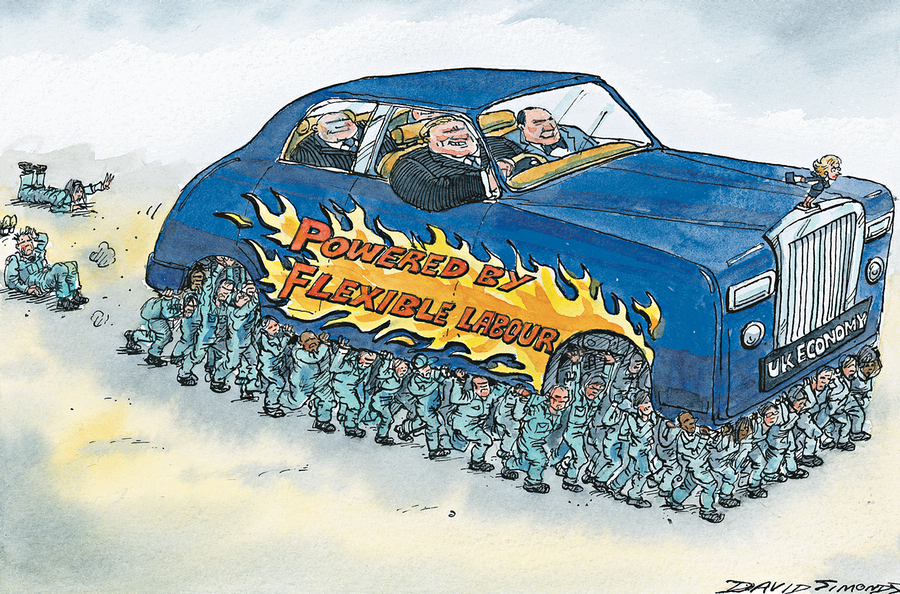
    This story has a bearing on the way the UK economy works. For the past 30 years, one of the big aims of policy has been to make the labour market more flexible. Trade unions have been curbed, industries have been privatised, welfare reformed and employment protection reduced. The balance of power between labour and capital has been tilted decisively in favour of the latter.

    The evidence of this is all around. There are 1.3m jobs on zero-hour contracts; wages can barely keep pace with price increases, even with unemployment coming down at a fair lick. Around 80% of the jobs created in the past year have been for the self-employed, with the suspicion that many of those “running their own business” are doing so involuntarily.

    This is the flexible labour market in action. It is what has distinguished the UK economy from some of the more heavily regulated economies in the rest of Europe. Supporters of the reforms of the past three decades say the flexible labour market is the reason the jobless rate is around half the average for the eurozone. Critics say that the smashing of organised labour and the triumph of management is bad for workers, bad for growth and ultimately bad for employers.

    Vince Cable can now be added to the list of those who wonder whether the labour market has become too flexible. The business secretary is right to pose the question because there are three big downsides to the way it works now.

    The first is that the taxpayer ends up subsidising low pay through the tax credits and benefits system. There are now more people in poverty who are working than are jobless.

    The second problem is that the loss of labour’s bargaining power has meant the share of national income taken by wages has fallen. That has created a problem of weak demand, which in the buildup to the financial crisis was solved by households taking on more debt. It was a period of rising house prices and equity withdrawal.

    When the crisis broke, individuals became more debt-averse. They started to pay off some of what they had borrowed and were reluctant to take out new loans. What needed to happen was for real wages to grow, since that would have allowed living standards to rise while indebtedness fell. Instead, real wages have fallen by 8%, and ultra-low interest rates have been required to get people borrowing again. Household debt is on the way back up again.

    The final problem is that the surfeit of cheap, insecure labour discourages investment. There is little inducement for firms to buy expensive new kit when demand rises, because they can always hire inexpensive labour that can be summarily dismissed later.

    What does all this mean? It means that in the long term there is a clear choice. Either the power of labour will be increased by full employment, stronger trade unions and collective bargaining or the flexible labour market will arrive at its ultimate destination: a form of capitalism that cannot function without excessive debt; is marked by low wages, low investment and low productivity; and which eventually ends up eating itself.

    Britain is well advanced down that road. As with the lynx, there is a price to be paid for slaughtering too many hares.

    Pay battle hots up

    As the weather gets warmer, so does the temperature at the annual shareholder meetings that take place at this time of year. Last week, investors at Hiscox, BG and ITV joined their peers at Pearson, Standard Chartered and AstraZeneca in registering their concerns about big bonuses. But a serious blow had yet to be landed.

    And then it finally happened. Vince Cable’s binding vote on remuneration policies claimed its first victim: the FTSE 250 engineering company Kentz. Based in Jersey, Kentz was not only the first to have its remuneration policy opposed but also have its remuneration report voted down at the same time.

    The significance? The vote on the remuneration report is one that has been in place for 10 years and covers pay that was handed out in the past. It is advisory. Companies can ignore it – but at their peril, as they risk a bad run with shareholders in the future. The vote on the remuneration policy is binding: it cannot be ignored and was introduced by the business secretary in October to cover the pay plans for the coming three years.

    For Kentz, which had managed to avoid putting its pay deals to a vote until this year by exploiting a loophole created by its registration in Jersey, it was a moment of shame.

    But it is one that has been narrowly avoided by others. The Lloyd’s of London insurer Hiscox, for instance, had a 42% vote against its remuneration policy. Standard Chartered had suffered a rebellion on a similar scale the week before.

    Little wonder, then, that HSBC took steps to head off a full-scale row over proposals to hand its chairman Douglas Flint up to £2.2m in shares at this week’s shareholder gathering.

    HSBC said Flint would be more likely get a smaller sum and only as a “one-off”: a valiant attempt to show it is listening to concerns. But shareholders may still ask if any bank chairman should be handed a bonus – as is being proposed here – for working to improve relationships with regulators. The HSBC vote will be one to watch.

    Engineering a manufacturing boom

    Celebrations to mark 175 years of train building in Derby were held last week at Bombardier’s factory, which is Britain’s oldest surviving rail plant.

    With his thoughts on the 2015 election, transport secretary and member for Derbyshire Dales Patrick McLoughlin pointed to the renewed optimism around Bombardier as a sign that the economy is now back on track.

    Yet the important contracts that have kept Bombardier’s historic Litchurch Lane works afloat did not come from the private sector, and were not the export orders that George Osborne craves. They were government-backed contracts. Had McLoughlin not signed off a £1bn deal to build trains for Crossrail back in February, it could have been 175 and out for Derby.

    This economy wasn’t sustained by Osborneomics but by the Keynesian stimulus of a public infrastructure scheme: digging the giant Crossrail tunnels under London. Good news for Derby, and the supply chain, but a long way from evidence of a sustainable manufacturing-led recovery.