
Light drinkers, and non-alcohol drinkers, should watch for fatty liver disease

May 24, 2016 – 8:02pm

People who have reduced enzyme activity to breakdown active aldehyde, i.e., those who become easily inebriated, are more likely to develop fatty liver disease even if they do not drink alcohol. This discovery was made by a clinical research team from Kumamoto University in Japan.

It is generally understood that fatty liver is triggered by alcoholism or heavy drinking. Recently, however, the number of patients with non-alcoholic fatty liver disease (NAFLD), a type of liver function disorder caused by increasing neutral fat in the liver that is caused by overeating and lack of exercise, has increased.

NAFLD is easily overlooked because of the lack of associated symptoms, and it is often only found when it has progressed to an advanced stage, such as cirrhosis., It is therefore important to detect it early so that preventative measure may be implemented.
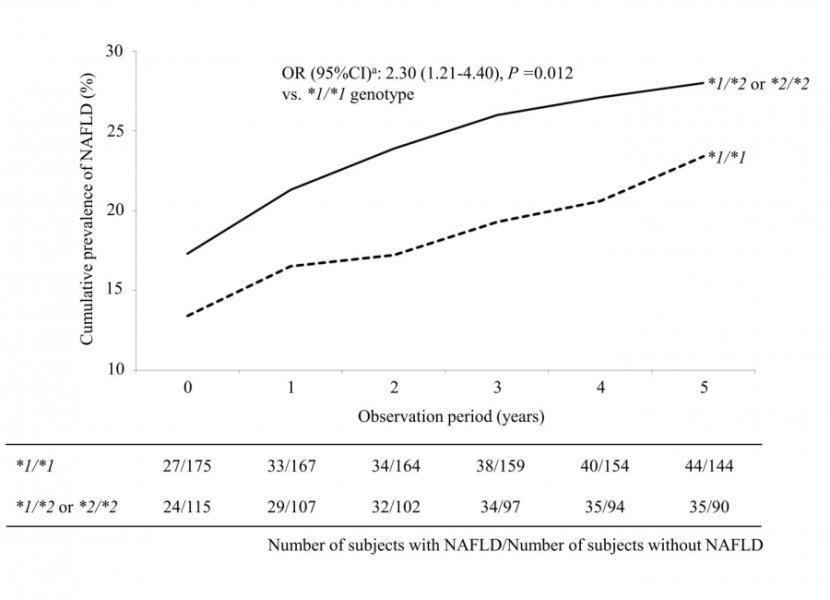
The risk of NAFLD was significantly higher in the ALDH2*2 allele carriers than in the non-carriers. Credit: Dr. Kentaro Oniki

When a person drinks, alcohol is changed to acetaldehyde in the liver. Acetaldehyde is toxic and contributes to sickness and hangovers in those who drink alcohol. Aldehyde dehydrogenase 2 (ALDH2) is a type of enzyme in stem cells that breaks down acetaldehyde and transforms it into other harmless substances. The action of the enzyme is determined genetically and affects the amount of alcohol that a person is able to consume without feeling sick.

Eastern Asia has an especially high population with low ALDH2 activity, in other words, light drinkers. Particularly in Japan where 40% of the people have low ALDH2 activity and 10% have no activity. People with low or no activity have a low risk of alcohol-related diseases, such as alcoholic fatty liver, because they drink little to no alcohol at all.

However, recent studies have reported that East Asian people with a genotype supporting low ALDH2 activity are at risk for cardiovascular disease. Further studies with mice found that ALDH2 activity reduced the accumulation of neutral fat in the liver and improved arteriosclerosis regardless of alcohol intake. Nevertheless, the association between the low activity ALDH2 genotype and NAFLD had not been made.

To determine that relationship, researchers of Kumamoto University began investigating the effects of various ALDH2 genotypes on NAFLD. A retrospective follow-up study of 341 Japanese health screening participants with no drinking habits was performed in the Japanese Red Cross Kumamoto Health Care Center. The researchers found that patients with a low activity ALDH2 genotype had a prevalence of NAFLD that was about twice as high as patients with a high activity genotype.

The patients’ gamma(γ)GTP, which is used in daily medical practice as an indicator of liver damage, was also assessed. A value of 25.5 IU/L is usually associated with the onset of NAFLD so the researchers focused on cases which had a combination of a low activity ALDH2 genotype and a γGTP level that was greater than 25.5 IU/L.

The results clearly showed that people with a low activity ALDH2 genotype who also had γGTP levels over 25.5 IU/L have a quadrupled risk of developing NAFLD compared to those with a high activity ALDH2 genotype and γGTP levels less than 25.5 IU/L. People who have a low activity ALDH2 genotype should be wary of developing NAFLD even if their γGTP levels are not very high.

“It is necessary for light or non-drinkers to pay attention to the possibility of NAFLD development,” said Assistant Professor Kentaro Oniki from Kumamoto University. “Even if you don’t drink much, it is recommended that you check your γGTP levels frequently to prevent NAFLD.”

Future research based on this study is expected to include treatment and early prediction of the disease.

source: Kumamoto University

Source: Even light drinkers should watch for fatty liver disease | Science Codex

Online therapy effective at treating depression and anxiety

HOLLYWOOD, Fla., May 12, 2016 – Doctors from the University of Pittsburgh showed that providing an online computerized cognitive behavioral therapy (CCBT) program both alone and in combination with Internet Support Groups (ISG) is a more effective treatment for anxiety and depression than doctors’ usual primary care. The preliminary findings were highlighted today at the annual meeting of the Society of General Internal Medicine (SGIM) in Hollywood, Florida.

The National Institutes of Mental Health-funded randomized trial, led by Bruce L. Rollman, M.D., M.P.H., professor of medicine and director of the Center for Behavioral Health and Smart Technology at the University of Pittsburgh, enrolled 704 depressed and anxious patients from 26 UPMC-affiliated primary care offices across western Pennsylvania.

Patients 18 to 75 years old were referred into the trial by their UPMC primary care physician between August 2012 and September 2014. Eligible and consenting patients were then randomized to one of three groups: care manager-guided access to the eight-session Beating the Blues CCBT program; care manager-guided access to both the CCBT program and a password-protected ISG patients could access 24/7 via smartphone or desktop computer; or usual behavioral health care from their primary care physician.

Over the six-month intervention, 83 percent of patients randomized to CCBT started the program, and they completed an average of 5.3 sessions. Seventy-seven percent of patients assigned to the ISG logged into the site at least once, and 46 percent provided one or more posts or comments.

Six months later, those patients randomized to CCBT reported significant improvements in their mood and anxiety symptoms and the more CCBT sessions patients completed, the greater the improvement in mood and anxiety symptoms.

Although patients randomized to both CCBT and ISG had similar overall improvements in mood and anxiety symptoms compared to patients randomized to only CCBT, secondary analysis revealed those who engaged more with the ISG tended to experience greater improvements in symptoms.

Several CCBT programs have proven as effective as face-to-face cognitive behavioral therapy at treating mood and anxiety disorders and are used by many patients outside the U.S., but CCBT remains largely unknown and underutilized within the U.S., Dr. Rollman said. ISG that enable individuals with similar conditions to access and exchange self-help information and emotional support have proliferated in recent years, but benefits have yet to be established in randomized trials.

“Our study findings have important implications for transforming the way mental health care is delivered,” Dr. Rollman said. “Providing depressed and anxious patients with access to these emerging technologies may be an ideal method to deliver effective mental health treatment, especially to those who live in areas with limited access to care resources or who have transportation difficulties or work/home obligations that make in-person counseling difficult to obtain. We hope that these findings will focus further attention on the emerging field of e-mental health by other U.S. investigators.”

Source: University of Pittsburgh Schools of the Health Sciences

Source: Online therapy effective at treating depression and anxiety | Science Codex

Obesity less dangerous than 40 years ago

May 11, 2016

New research from Denmark involving more than 100,000 individuals suggests that the excess risk of premature death associated with obesity has decreased over the past 40 years. All-cause mortality was higher in obese individuals than in normal weight individuals in 1976-78, but not in 2003-13.

Many try to lose weight to avoid diabetes and cardiovascular disease and hopefully live longer. This is often driven by recommendations from health care authorities and is further supported by the media and not least, by commercials often presenting normal weight or even thin people as ideal humans.

“The increased risk of all-cause mortality associated with obesity compared to normal weight decreased from 30% 1976-78 to 0% in 2003-13,” says principal investigator Dr. Shoaib Afzal, Herlev Hospital, Copenhagen University Hospital, Denmark.

This research has just been published in the Journal of the American Medical Association (JAMA).

What is the optimal BMI for lowest mortality?

The study also revealed changes in the BMI associated with the lowest all-cause mortality in three cohorts from Copenhagen, examined respectively in 1976-78, 1991-1994, and in 2003-2013 (all individuals were followed until 2014).

“The optimal BMI for the lowest mortality increased from 23.7 in 1976-78, through 24.6 in 1991-94, to 27 in 2003-13, while individuals with a BMI below or above the optimal value had higher mortality,” adds Shoaib Afzal.

“Compared to the 1970’s, today’s overweight individuals have lower mortality than so-called normal weight individuals. The reason for this change is unknown. However, these results would indicate a need to revise the categories presently used to define overweight, which are based on data from before the 1990’s” says senior author Clinical Professor Borge G. Nordestgaard, University of Copenhagen and Copenhagen University Hospital.

“Importantly, our results should not be interpreted as suggesting that now people can eat as much as they like, or that so-called normal weight individuals should eat more to become overweight. That said, maybe overweight people need not be quite as worried about their weight as before”, adds Nordestgaard.

Obesity and overweight are classified using Body Mass Index (BMI), calculated as weight in kilograms divided by height in meters squared. A BMI of 25-29.9 represents overweight, a BMI of 30 or greater represents obesity, while a BMI of 18.5-24.9 is considered normal weight. These categories are often used for recommendations on optimum weight.

Source: University of Copenhagen The Faculty of Health and Medical Sciences

Source: Obesity less dangerous than 40 years ago | Science Codex

Fairness at work can affect employees’ health

May 11, 2016

Employees’ experiences of fairness at work can impact on their health, according to a new study involving the University of East Anglia (UEA).

The researchers investigated whether perceptions of what they call ‘procedural justice’, such as the processes in place to decide on rewards, pay, promotion and assignments, are related to employees’ health.

They found that when perceptions of fairness changed, the self-rated health of employees also changed, for example those who experienced more fairness on average over the period studied reported better health.

The finding suggests that fairness at work is a crucial aspect of the psychosocial work environment and that changes towards greater fairness can improve employees’ health.

It was also found that changes in employees’ health are related to changes in fairness perceptions, indicating that the health status of employees may also affect how employees feel treated at work.

The study, which focused on more than 5800 people working in Sweden, was conducted by Dr Constanze Eib, a lecturer in organisational behaviour at UEA’s Norwich Business School, and researchers from Stockholm University. The results are published in the Scandinavian Journal of Work, Environment and Health.

Dr Eib said: “Our study provides a thorough examination of how fairness at the workplace and health of employees is related over time. The findings can help raise awareness among employers and authorities that fairness at work but also health is important to consider to increase satisfaction, well-being and productivity in the workplace and wider society.

“It is important to know about these issues as there may be things that can be done to improve perceptions of fairness at work. For example, making sure people feel their views are considered, they are consulted about changes and that decisions are made in an unbiased way.

“People who feel fairly treated are not only more likely to be motivated at work and go the extra mile for their organisation, but they are also more likely to be healthy, have an active lifestyle and feel positive.”

The study used data collected between 2008 and 2014 for the Swedish Longitudinal Occupational Survey of Health, which is conducted every two years and focuses on the associations between work organisation, work environment and health.

Participants were asked to rate their general state of health on a scale from one to five, one being ‘very good’ and five being ‘very poor’.

They were asked about their perception of fairness by saying to what extent they agreed or disagreed with seven statements relating to their organisation’s decision-making processes. These included ‘hear the concerns of all those affected by the decision’, ‘provide opportunities to appeal or challenge the decision’ and ‘all sides affected by the decision are represented’.

‘The influence of procedural justice and change in procedural justice on self-rated health trajectories: Results from the Swedish Longitudinal Occupational Survey of Health’, Constanze Leineweber, Constanze Eib, Paraskevi Peristera, and Claudia Bernhard-Oettel, is published in the Scandinavian Journal of Work, Environment and Health.

Source: University of East Anglia

Source: Fairness at work can affect employees’ health | Science Codex

Study: Smartphone alerts increase inattention — and hyperactivity

CHARLOTTESVILLE, Va., May 9, 2016 — Society’s increasingly pervasive use of digital technology may be causing ADHD-like symptoms even among the general population, according to a new study of college students presented this week in San Jose, California at the Human-Computer Interaction conference of the Association for Computing Machinery.

“Less than 10 years ago, Steve Jobs promised that smartphones ‘will change everything,'” said Kostadin Kushlev, a psychology research scientist at the University of Virginia, who led the study with colleagues at the University of British Columbia. “And with the Internet in their pockets, people today are bombarded with notifications – whether from email, text messaging, social media or news apps – anywhere they go. We are seeking to better understand how this constant inflow of notifications influences our minds.”

Kushlev said that recent polls have shown that as many as 95 percent of smartphone users have used their phones during social gatherings; that seven in 10 people used their phones while working; and one in 10 admitted to checking their phones during sex. Smartphone owners spend nearly two hours per day using their phones.

The researchers designed a two-week experimental study and showed that when students kept their phones on ring or vibrate, they reported more symptoms of inattention and hyperactivity than when they kept their phones on silent.

“We found the first experimental evidence that smartphone interruptions can cause greater inattention and hyperactivity – symptoms of attention deficit hyperactivity disorder – even in people drawn from a nonclinical population,” Kushlev said.

During Kushlev’s and his colleagues’ study, 221 students at the University of British Columbia drawn from the general student population were assigned for one week to maximize phone interruptions by keeping notification alerts on, and their phones within easy reach. During another week participants were assigned to minimize phone interruptions by keeping alerts off and their phones away. At the end of each week, participants completed questionnaires assessing inattention and hyperactivity. The results showed that the participants experienced significantly higher levels of inattention and hyperactivity when alerts were turned on.

The results suggest that even people who have not been diagnosed with ADHD may experience some of the disorder’s symptoms, including distraction, difficulty focusing and getting bored easily when trying to focus, fidgeting, having trouble sitting still, difficulty doing quiet tasks and activities, and restlessness.

“Smartphones may contribute to these symptoms by serving as a quick and easy source of distraction,” Kushlev said.

Kushlev emphasized, however, that ADHD is a neurodevelopmental disorder with a complex biological and environmental etiology.

“Our findings suggest neither that smartphones can cause ADHD nor that reducing smartphone notifications can treat ADHD,” he said. “The findings simply suggest that our constant digital stimulation may be contributing to an increasingly problematic deficit of attention in modern society.”

The silver lining is that the problem can be turned off.

“Importantly, we found that people can reduce the harmful effects of overstimulation by smartphones simply by keeping their phones on silent and out of easy reach whenever possible, thus keeping notifications at bay,” Kushlev said.

His research colleagues at the University of British Columbia are Jason Proulx, a senior research assistant, and Elizabeth W. Dunn, an associate professor of psychology.

Source: University of Virginia

Source: Study: Smartphone alerts increase inattention — and hyperactivity | Science Codex