‘Atomic Memory’ Device Uses Single Atoms to Store Information

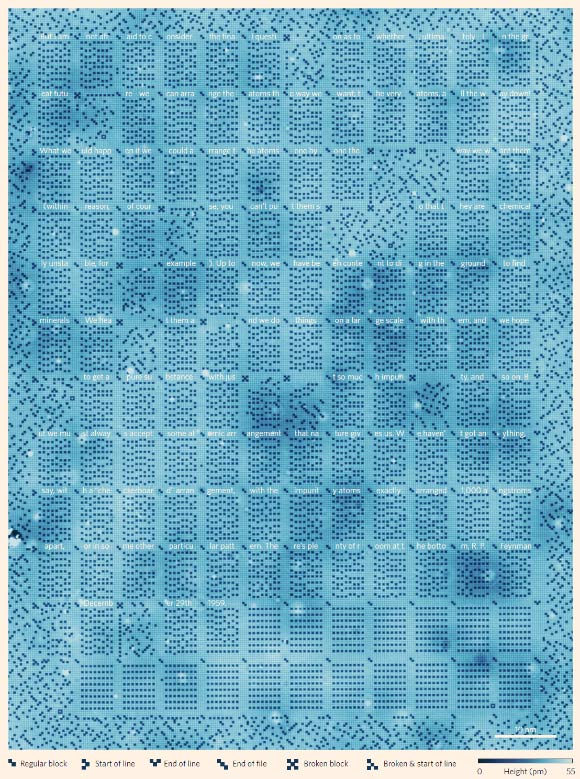
STM image (96 x 126 nm) of a 1,016-byte atomic memory, written to a passage from physicist Richard Feynman’s lecture ‘There’s plenty of room at the bottom.’ The various markers used are explained in the legend below the images. The memory consists of 127 functional blocks and 17 broken blocks. Image credit: F.E. Kalff et al.

An international group of researchers from Spain, Portugal and the Netherlands has demonstrated an atomic-scale memory device with a storage density of 502 Terabits per square inch (Tbpsi), outperforming state-of-the-art hard disk drives by three orders of magnitude.

July 19, 2016

“In theory, this storage density would allow all books ever created by humans to be written on a single post stamp,” said team leader Dr. Sander Otte, from the Kavli Institute of Nanoscience at the Delft University of Technology.

Dr. Otte and co-authors used a scanning tunneling microscope (STM), in which a sharp needle probes the atoms of a surface, one by one. With these probes scientists cannot only see the atoms but they can also use them to push the atoms around.

“You could compare it to a sliding puzzle. Every bit consists of two positions on a surface of copper atoms, and one chlorine atom that we can slide back and forth between these two positions,” Dr. Otte explained.

“If the chlorine atom is in the top position, there is a hole beneath it — we call this a 1.”

“If the hole is in the top position and the chlorine atom is therefore on the bottom, then the bit is a 0.”

“Because the chlorine atoms are surrounded by other chlorine atoms, except near the holes, they keep each other in place. That is why this method with holes is much more stable than methods with loose atoms and more suitable for data storage.”

The researchers organized their memory in blocks of 8 bytes (64 bits).

Each block has a marker, made of the same type of ‘holes’ as the raster of chlorine atoms.

These markers work like miniature QR codes that carry information about the precise location of the block on the copper layer.

The code will also indicate if a block is damaged, for instance due to some local contaminant or an error in the surface.

This allows the memory to be scaled up easily to very big sizes, even if the copper surface is not entirely perfect.

“In its current form the memory can operate only in very clean vacuum conditions and at liquid nitrogen temperature (77 degrees Kelvin), so the actual storage of data on an atomic scale is still some way off,” Dr. Otte said.

“But through this achievement we have certainly moved a big step closer.”

The team’s results were published this week in the journal Nature Nanotechnology.

_____

F.E. Kalff et al. A kilobyte rewritable atomic memory. Nature Nanotechnology, published online July 18, 2016; doi: 10.1038/nnano.2016.131

Source: ‘Atomic Memory’ Device Uses Single Atoms to Store Information | Nanotechnologies | Sci-News.com

Neuroscientists Release New Map of Human Cortex

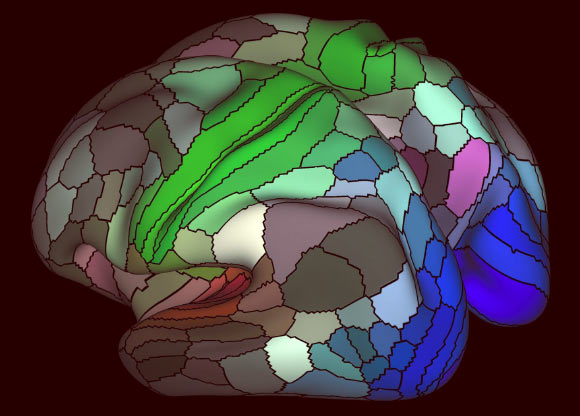
Matthew Glasser et al. discovered that our brain’s cortex is composed of 180 distinct areas per hemisphere. For example, the image above shows areas connected to the three main senses — hearing (red), touch (green), vision (blue) and opposing cognitive systems (light and dark). Image credit: Matthew Glasser / David Van Essen.

An international team of neuroscientists from the United States and Europe has mapped 180 distinct areas, including 97 that were previously unknown, in human brain cortex, or outer mantle.

The team, led by Washington University in St. Louis researchers Dr. David Van Essen and Dr. Matthew Glasser, has also developed software that automatically detects the ‘fingerprint’ of each of cortex areas in an individual’s brain scans.

“Using multi-modal magnetic resonance images from the Human Connectome Project (HCP) and an objective semi-automated neuroanatomical approach, we delineated 180 areas per hemisphere bounded by sharp changes in cortical architecture, function, connectivity, and/or topography in a precisely aligned group average of 210 healthy young adults,” the scientists said.

“We characterized 97 new areas and 83 areas previously reported using post-mortem microscopy or other specialized study-specific approaches.”

Earlier studies often used just one measure, such as examining postmortem tissue with a microscope. Uncertain delineation of cortex areas has sometimes led to shaky comparability of brain imaging findings.

“The situation is analogous to astronomy where ground-based telescopes produced relatively blurry images of the sky before the advent of adaptive optics and space telescopes,” Dr. Glasser said.

The team set out to banish this blurriness by using multiple, precisely aligned, magnetic resonance imaging (MRI) modalities to measure cortical architecture, activity, connectivity, and topography in a group of 210 healthy participants.

These measures – including cortex thickness, cortex myelin content, task and resting-state functional MRI (fMRI) – cross-validated each other.

The findings were, in turn, confirmed in an additional independent sample of 210 healthy participants.

Even though some cortex areas turned out to be atypically located in a small minority of subjects, the data-derived algorithms incorporated into the software were able to successfully map them.

While the study included fMRI scans of subjects performing tasks, the team determined that resting-state MRI techniques should suffice to map the areas in future studies using the tools they developed.

“Some areas may turn out to have further subdivisions or be subunits of other areas, in light of new data,” Dr. Van Essen said.

“The ability to discriminate individual differences in the location, size, and topology of cortical areas from differences in their activity or connectivity should facilitate understanding of how each property is related to behavior and genetic underpinnings,” Dr. Glasser added.

The team’s results were published online this week in the journal Nature.

_____

Matthew F. Glasser et al. A multi-modal parcellation of human cerebral cortex. Nature, published online July 20, 2016; doi: 10.1038/nature18933

Source: Neuroscientists Release New Map of Human Cortex | Neuroscience | Sci-News.com

Culture-Bound Syndromes: Entire Disease Category Your Doctor May Be Missing

Jumping Frenchmen of Maine, a rare disorder characterized by an unusually extreme startle reaction, is similar to Latah. It was first identified during the 19th century in Maine and Quebec among an isolated population of lumberjacks of French Canadian descent. This image shows a group of lumberjacks who have just downed a giant sequoia (California, 1905). Image credit: Library of Congress, Washington, DC

May 23, 2016 by Rafid Rahman

How is that possible?

A physician goes through four years of medical school, at least two-three years of residency (postgraduate medical training), and potential fellowships.

Why would a doctor not know about an entire category of disease?

Answer: Physicians, themselves, are confused about these mysterious diseases.

Let me elaborate.

Physicians are not always sure how to treat culture-bound syndromes, so the category may not be discussed in great detail until specialized training takes place. The classifications for these diseases are continuously under debate in the medical community.

In fact, the Diagnostic and Statistical Manual of Mental Disorders (DSM) – the standard classification of mental disorders in the United States – actually reclassified them in DSM-5 [1] in 2013 under ‘Cultural Concepts of Distress’ to more accurately describe the cultural influences.

Thus, doctors may easily overlook the category… making it imperative for patients to be knowledgeable about the existence of these peculiar diseases.

Metaphorically, physicians tend to look for horses instead of zebras when they hear hoof beats.

What does that mean?

The old adage signifies that physicians are trained to diagnose diseases in a pyramidal fashion. Treat the symptoms of the most common disease and move onto more rare, lesser-known diseases if the treatments don’t seem to work.

Although this method may seem like a guess-or-check system, physicians are rigorously trained in recognizing prevalent, difficult-to-treat diseases. I mean, they should be… right? They spend at least a decade of their lives learning basic sciences and clinical medicine!

So, the challenge remains… how to define culture-bound syndromes?

Ranging from diseases that include psychiatric, genetic, environmental, neurological, or even cultural origins, scientists have not been able to explicitly define the category of culture-bound syndromes. Moreover, the illnesses are included into this category because they are traditionally seen in specific cultures or locations of the world, and because the patients may present with a wide range of severity that may or may not include DSM listed symptoms for each disease.

Basically, this category of disease is a conglomeration of misfits that are not unified by common disease pathology or presentation as seen in traditional western medical classifications, but associated by clinically important cultural differences.

You may be asking right now… Why should I worry about culture-bound syndromes if I don’t live in that culture or location? I won’t be affected or get the disease, right?

Answer: Maybe, maybe not.

The reason why patients should know about the existence of this often overlooked treasure chest of diseases is for the same reason why it was recently reclassified under Cultural Concepts of Distress in DSM-5. Physicians, medical anthropologists, and other scientists have studied and come to the conclusion that the term ‘culture-bound syndrome’ may overemphasize the regional diagnosis of the disease, which may cause physicians worldwide to miss potential cases [2].

Which makes it particularly important for patients to be aware of this category of disease, so they can spark the discussion with their doctors, if their physicians are having a difficult time finding a solid diagnosis. Even if patients do not know specific diseases in the category, bringing up the topic with their puzzled physicians may give the doctors the extra hint they need to diagnose the appropriate disease and formulate the proper treatment plan.

What should patients do next?

Even though this potential hole in a physician’s training may make you want to run for the hills, be assured that your doctor has years of in-depth, expertise in many areas and there are always specialists in every field to help you out. So don’t drop everything and start reading WebMD just yet!

However, it is important to be familiar with at least a few diseases so you can better communicate with your physician.

Disease of Interest: Latah [3]

Latah is commonly presented in Southeast Asia and has been documented by European observers for more than a century.

The disease can be provoked with shock or acute fright, which results in social tics: imitative gestures, words, actions, obey commands, or situations where patients cannot control his or her emotions.

Disease of Interest: Gururumba [4]

Gururumba is more prevalent in New Guinea and describes the actions of a person, usually a married man, who burglarizes homes and takes items of little importance.

However, the person thinks the items are invaluable and he/she runs away for a period of time, but then returns without the items or knowledge of the event.

Disease of Interest: Amok [5]

Amok has been seen in various areas of Southeast Asia and Scandinavia and it usually presents as a violent, homicidal rage. Typically, the person does not pre-meditate the attack, nor does he or she usually remember it but insulting actions towards the Amok patient can provoke a ferocious episode.

Although this is not a comprehensive list, it gives patients an insight into the world of culture-bound syndromes, and maybe -just maybe- this knowledge will help a countless number of people bridge the gap of knowledge between the physician and patient.

_____

1. Culture concepts. In: American Psychiatric Association. Diagnostic and Statistical Manual of Mental Disorders, Fifth Edition. 2013. Washington, DC: American Psychiatric Association

2. Tseng W. 2006. From peculiar psychiatric disorders through culture-bound syndromes to culture-related specific syndromes. Transcult Psychiatry 43: 554-576

3. Bhidayasiri R. & Truong D.D. 2011. Startle syndromes. Handb Clin Neurol. 100: 421-430

4. Paniagua F.A. 2000. Culture-bound syndromes, cultural variations, and psychopathology. In: Cuéllar I, Paniagua FA, eds. Handbook of Multicultural Mental Health: Assessment and Treatment of Diverse Populations. New York: Academic Press; 140-141

5. Bartelsman M. & Eckhardt P.P. 2007. Mental illness in the former Dutch Indies — four psychiatric syndromes: amok, latah, koro and neurasthenia. Ned Tijdschr Geneeskd. 151: 2845-2851

Source: Culture-Bound Syndromes: Entire Disease Category Your Doctor May Be Missing | Medicine, Opinions | Sci-News.com

Neurotensin: Scientists Identify New Biomarker for High-Fat-Diet-Induced Obesity

Researchers have identified a potential new biological marker for the development of obesity, according to a study published online May 11, 2016 in the journal Nature.

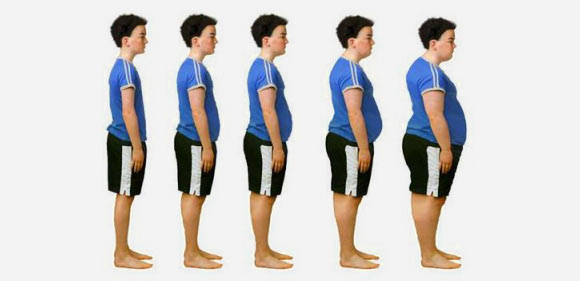
The new findings directly link neurotensin (NT) with increased fat absorption and obesity and suggest that NT may provide a prognostic marker of future obesity and a potential target for prevention and treatment. Image credit: University of Massachusetts Lowell.

May 13, 2016

Neurotensin, also known as NT or NTS, is a 13-amino-acid neuropeptide produced mainly in the gastrointestinal tract and central nervous system. It is released with fat ingestion and facilitates fatty acid absorption in the intestine.

Previous research has shown that NT can also stimulate the growth of various cancers and increased fasting levels of pro-NT (an NT precursor hormone) are associated with development of cardiovascular disease and breast cancer.

The new study, led by Dr. Mark Evers from the University of Kentucky, examined data from the Malmö Diet and Cancer Study, a population-based, prospective epidemiologic cohort of 28,449 men and women who were followed for an average of 16.5±1.5 years.

The analysis showed that obese and insulin-resistant subjects have significantly elevated levels of fasting pro-NT, and the risk of developing obesity was doubled in non-obese subjects who had fasting pro-NT at the highest concentrations compared to subjects with the lowest concentrations.

The study further used animal models to show that a deficiency in NT protects against obesity, insulin resistance and fatty liver disease associated with high fat consumption, thus identifying NT as a potential early marker of future obesity and a novel therapeutic target for this disease.

“Our findings have redefined how we view the role of NT,” Dr. Evers said.

“NT appears to be a metabolically ‘thrifty’ peptide which increases the absorption of ingested fats; however, with the abundance of fats in typical Western diets, NT can have a detrimental effect by contributing to increased obesity and related metabolic disorders.”

“Additionally, because NT can contribute to the growth of certain cancers and is now linked with obesity, increased NT may contribute to the higher incidence of certain cancers associated with obesity,” he added.

_____

Jing Li et al. An obligatory role for neurotensin in high-fat-diet-induced obesity. Nature, published online May 11, 2016; doi: 10.1038/nature17662

Source: Neurotensin: Scientists Identify New Biomarker for High-Fat-Diet-Induced Obesity | Medicine | Sci-News.com

Biologists Estimate that Earth is Inhabited by One Trillion Microbial Species

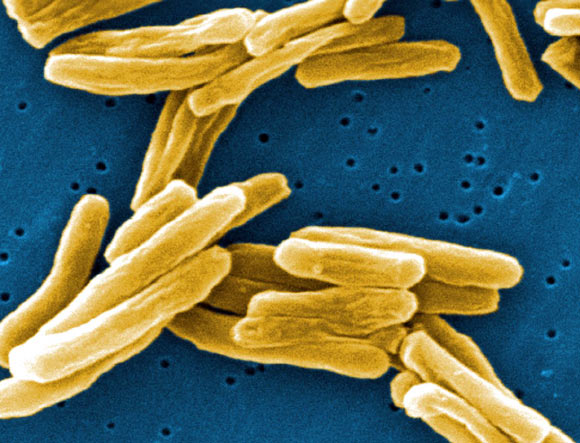
This colorized scanning electron micrograph shows Mycobacterium tuberculosis, gram-positive bacteria that cause tuberculosis. Image credit: Ray Butler / Centers for Disease Control and Prevention.

Our planet could contain roughly 1 trillion microbial species, with only 0.001% now identified, says a duo of scientists at Indiana University.

Dr. Kenneth Locey and Dr. Jay Lennon, both from the Indiana University’s Department of Biology, combined microbial, plant and animal community datasets from different sources, resulting in the largest compilation of its kind.

Altogether, these data represent over 5.6 million microscopic and nonmicroscopic species from 35,000 locations across all the world’s oceans and continents, except Antarctica.

“Our study combines the largest available datasets with ecological models and new ecological rules for how biodiversity relates to abundance,” Dr. Lennon said.

“This gave us a new and rigorous estimate for the number of microbial species on Earth.”

According to the team, older estimates were based on efforts that dramatically under-sampled the diversity of microorganisms.

“Before high-throughput sequencing, scientists would characterize diversity based on 100 individuals, when we know that a gram of soil contains up to a billion organisms, and the total number on Earth is over 20 orders of magnitude greater,” Dr. Lennon said.

The realization that microorganisms were significantly under-sampled caused an explosion in new microbial sampling efforts over the past several years.

“A massive amount of data has been collected from these new surveys. Yet few have actually tried to pull together all the data to test big questions,” Dr. Locey said. “We suspected that aspects of biodiversity, like the number of species on Earth, would scale with the abundance of individual organisms.”

“After analyzing a massive amount of data, we observed simple but powerful trends in how biodiversity changes across scales of abundance,” the scientists said.

“One of these trends is among the most expansive patterns in biology, holding across all magnitudes of abundance in nature.”

The study results, published in the Proceedings of the National Academy of Sciences, also suggest that actually identifying every microbial species on Earth is a huge challenge.

“The Earth Microbiome Project — a global multidisciplinary project to identify microscope organisms — has so far cataloged less than 10 million species. Of those cataloged species, only about 10,000 have ever been grown in a lab, and fewer than 100,000 have classified sequences,” Dr. Lennon said.

“Our results show that this leaves 100,000 times more microorganisms awaiting discovery — and 100 million to be fully explored. Microbial biodiversity, it appears, is greater than ever imagined.”

_____

Kenneth J. Locey & Jay T. Lennon. Scaling laws predict global microbial diversity. PNAS, published online May 2, 2016; doi: 10.1073/pnas.1521291113

Source: Biologists Estimate that Earth is Inhabited by One Trillion Microbial Species | Biology | Sci-News.com