
Canada set to open one of the world’s biggest diamond mines

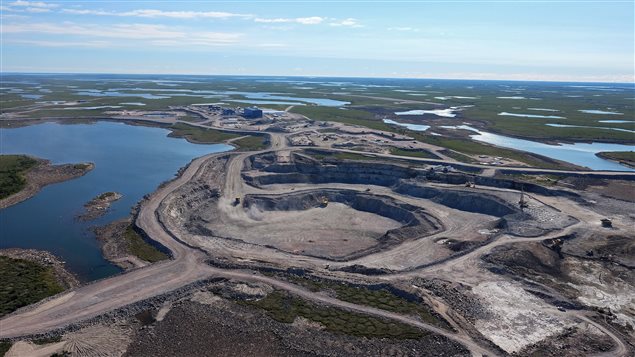
The Gahcho Kue diamond mine, located about about 280 kilometres northeast of Yellowknife in the Northwest Territories, is shown in a handout photo. Photo Credit: PC / THE CANADIAN PRESS/HO-De Beers Group of Companies

By Levon Sevunts, Radio Canada International

20 September, 2016

Canada is set to cement its position as one of the big players in the global diamond industry with the official opening of the Gahcho Kue diamond mine in the Northwest Territories today.

The mine, which sits in the tundra about 280 kilometres northeast of territorial capital of Yellowknife, is estimated to be one of the 10 biggest diamond mines in the world. It is expected to produce an average of 4.5 million carats a year over the life of the mine, according to De Beers Canada.

Gahcho Kue, a joint venture between De Beers Canada (51 per cent) and Mountain Province Diamonds (49 per cent), is the sixth diamond mine opened in Canada since BHP Billiton’s EKATI Mine in the Lac de Gras region, about 300 kilometres northeast of Yellowknife, started in 1998.

“It will be a very significant contributor to the NWT economy,” Kim Truter, CEO of De Beers Canada, told The Canadian Press.
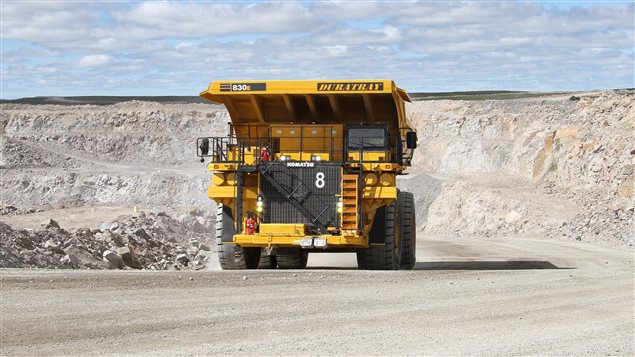
 A dump truck operates at the Gahcho Kue mine in the Northwest Territories in a handout photo. THE CANADIAN PRESS/HO-De Beers Group of Companies

A dump truck operates at the Gahcho Kue mine in the Northwest Territories in a handout photo. © PC/THE CANADIAN PRESS/HO-De Beers Group of Companies

A socio-economic impact report released by De Beers earlier this months estimated that the operation will provide $6.7 billion to the Canadian economy over its estimated life span of 12 years and has generated $440 million to the territory’s economy so far.

The mine supported more than 2,700 direct and indirect jobs in 2015, with employment at the site representing more than 10 per cent of employment in the NWT’s extractive industries, according to the report.

De Beers expects will need about 530 workers to operate.

Truter said the company has been working to share the benefits of Gahcho Kue with local First Nations and Métis, with impact benefit agreements signed with six groups in the area.

Market volatility

Canada’s diamond production is expanding at a time of growing volatility in the industry. Global sales of polished stones declined 2 per cent last year to $24.7 billion US as demand fell in emerging markets like India and China.

Lower prices and market instability meant a much bigger drop in the sales of rough diamonds, which dropped about 30 per cent to an estimated $13.7 billion US, forcing De Beers to close its Snap Lake diamond mine in December last year at a loss of more than 400 jobs.

But the company is banking on the purchasing power of the Millennial generation (those aged 15-34) who spent more than $25 billion US on diamond jewellery in 2015 in the four largest markets – the US, China, Japan and India, according to The Diamond Insight Report 2016.

“Most encouragingly, however, Millennials are still 10 years away from their most affluent life stage and the generation comprises more than 220 million potential diamond consumers in the four main markets,” said Bruce Cleaver, CEO, De Beers Group.

“The diamond industry therefore has a major opportunity on the horizon but it will only capitalise on it fully if it continues to innovate and invest across the value chain.”
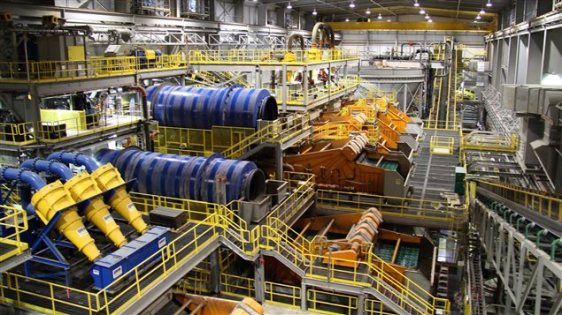
pc_160920_sg30d_rci-gahcho-kue-plant_sn635

An overall view of the priocessing plant at the Gahcho Kue mine in the Northwest Territories is shown in a handout photo. © PC/THE CANADIAN PRESS/HO-De Beers Group of Companies

Diamond superpower

Canada is a relative newcomer to diamond mining.

De Beers, the world’s leading diamond company, started prospecting for diamonds in Canada in the early 1960s. In 1987, a second year geology student Brad Wood who was working for De Beers stumbled upon kimberlite rocks, volcanic rocks that sometimes contain diamonds, while fishing on Attawapiskat River, in the James Bay lowlands of Northern Ontario. The site would eventually become today’s Victor Mine.

But it wasn’t until 1991, when two enterprising geologists, Stewart Blusson and Chuck Fipke, discovered large diamond deposits in the Lac de Gras region of the Northwest Territories that the word learned of Canada’s Arctic diamonds.

Diamond production at the Anglo-Australian mining giant BHP Billiton’s EKATI Mine in the Lac de Gras region, about 300 kilometres northeast of Yellowknife, started in 1998 (Fipke and Blusson, each hold a 10 per cent share in the EKATI Mine).

In 2003, Rio Tinto, another giant British-Australian mining and metals company, opened its Diavik Mine not far from EKATI.

And in 2008, De Beers opened its first Canadian mine at Snap Lake about 220 kilometres northeast of Yellowknife.

Ontario joined Canada’s diamond club in 2008, when De Beers started commercial diamond production at its Victor mine, about 90 kilometres west of the First Nations community of Attawapiskat, in northern Ontario.

And Quebec is expected to join Canada’s diamond producing club once the Renard Mine owned by Stornoway Diamonds becomes operational by the end of 2016.

In less than a decade, Canada was propelled to the diamond mining major leagues, becoming the world’s third-largest producer, behind Botswana and Russia, producing 15 percent of the world’s diamonds by value.

With files from The Canadian Press

Source: Canada set to open one of the world’s biggest diamond mines
Asia shares largely down on Tuesday hurt by iron ore – BBC News

Shares in Asia were largely in negative territory on Tuesday following declines in the US and as falling iron ore prices continued to hurt mining companies.

In Australia, the S&P/ASX 200 closed down 0.95% at 5,226.40.

Analysts said iron ore prices were continuing to move towards the decade low reached earlier this year.

The commodity is Australia’s biggest export and was trading at $44.20 a tonne in China on Monday.

Independent economist and commodities specialist Andy Xie has predicted that iron ore prices will fall below $40 a tonne before the end of the year.

He said prices could even sink as low as $30 for much of next year as demand from China continues to decline.

Three of the biggest iron ore producers recorded falls in their Sydney-listed shares. BHP Billiton closed down 1.8%, Rio Tinto fell 1.5%, while Fortescue Metals was the biggest loser, sinking 3.2%.

Japan’s Nikkei index spent much of the day flat but made gains late in the day to close up 0.23% at 19,924.89 points.

Shares in the country’s troubled electronics maker Sharp surged more than 35% at one point on reports its lenders may waive some of its debts.

Without citing sources, Kyodo News said a state-backed fund may invest in Sharp if Japanese lenders agreed to write off an unspecified amount of its debt.

Investors seem to shrug off fresh numbers released earlier on Tuesday that showed Japan’s manufacturing activity expanded in November as new orders and output increased.

The Markit/Nikkei Japan Flash Manufacturing Purchasing Managers Index (PMI) rose from 52.4 in October to 52.8 in November. A reading above 50 indicates expansion.

The PMI figure was the highest it had been since March last year – ahead of the introduction of the country’s sales tax.

Marcel Thieliant from Capital Economics said the reading suggested Japan’s economy had returned to growth this quarter.

“Today’s survey confirms that economic activity is on the mend. But with large amounts of spare capacity dampening price pressures, we still think that the Bank of Japan may have to step up the pace of easing in coming months,” he added.

In China, losses were extended for much of the day after new rules for the mainland’s stock exchanges aimed at limiting leveraged bets on the market and reducing speculative behaviour were introduced on Monday.

Investors were concerned over available liquidity ahead of the restart of initial public offerings.

The Shanghai Composite index was down as much as 1% but recovered ground later to stand 0.16% higher at 3,616.11 in afternoon trade.

Hong Kong’s Hang Seng index was down 0.44% at 22,568.23.

South Korea’s Kospi index closed up 0.63% at 2,016.29

Source: Asia shares largely down on Tuesday hurt by iron ore – BBC News

Freeport-McMoRan: A Roller Coaster Ride in November 2015

Market Realist
By Mark O’Hara

On November 13, 2015, Freeport-McMoRan (FCX) closed at $8.68. Although Freeport’s stock is down more than 25% so far in November, it is still trading ~12% above its 2015 lows. The year has been nothing short of a roller coaster ride for Freeport investors.

part 1

Stocks have been falling

The entire base metals space (XLB) has seen heightened volatility over the last six months or so. However, companies including Freeport-McMoRan, Teck Resources (TCK), and Glencore (GLNCY) have been more volatile as compared to some of their peers in this sector.

Teck Resources has seen its share price dwindle more than 65% this year. Teck Resources is the world’s second largest exporter of steelmaking coal. It is also North America’s largest coal producer, with the annual capacity to produce 28 million tons. Along with falling copper prices, Teck Resources has been hit by the reduced Chinese coal demand.

Freeport is not far behind, and its stock has fallen more than 62% this year. Southern Copper (SCCO) has not fallen much, as can be seen in the graph above. Please read Southern Copper: A Business Overview of a Copper Giant to learn more about SCCO.

Key drivers

There are several factors that would determine how Freeport-McMoRan could trade over the next few months. As Freeport is also involved in the energy exploration business, its stock price could also be guided by movement in energy prices. However, Freeport has announced that the company is looking at several “strategic alternatives” for the energy business, and a final decision has yet to be made.

The key driver, however, would be how copper prices play out in the coming months. In the next part of this series, we’ll explore what analysts think about copper prices.

Copper prices

Copper prices resumed their downside in November after remaining relatively strong in October. On November 13, 2015, the LME (London Metals Exchange) three-month copper contract closed at $4,810 per metric ton, losing more than 1% from the previous day’s closing.

So far in November, the LME three-month copper contract has lost ~6% and joined the ranks of other metals, including steel and aluminum, to hit fresh 2015 lows. The graph below shows the recent movement in copper prices.

How low can it get?

Goldman Sachs had earlier given a target of $4,800 per ton for copper by the end of December 2015. However, according to an October 8 Reuters report citing Max Layton, the head of European commodities research for Goldman Sachs, copper could even fall below $4,000 per metric ton.

A November 12, 2015, Reuters’ article, cited Axel Rudolph, technical analyst at London-based Commerzbank, who noted, “Copper is likely to extend losses in coming weeks to $4,397.”

Bears are back

Bears, it seems, are back full throttle in copper. The bearish sentiments surrounding copper faded somewhat a few weeks ago on supply cuts from Freeport-McMoRan (FCX) and Glencore (GLNCY). However, the goodwill failed to last beyond a month, and copper prices have resumed their downside.

While FCX and GLNCY have announced production cutbacks, diversified miners such as Rio Tinto (RIO) and BHP Billiton (BHP) don’t plan to cut their copper production. Both companies are among the low-cost copper producers, so it would make economic sense for these companies to keep mining copper from their mines.

Meanwhile, the concern has again shifted to the demand side of the equation. In the last week or so, there has been quite a bit of negative data from China, whether it is monthly trade data or credit activity. Pessimistic Chinese data is weighing heavily on copper prices. A stronger US dollar (UUP), on expectations of a possible Federal rate hike in December, is not helping copper’s cause, either.

Falling copper prices

As seen in the previous part of this series, copper prices have crashed to a fresh six-and-a-half-year low on concerns over the Chinese economy and a stronger US dollar. However, unlike other pure-play copper producers like Turquoise Hill Resources (TRQ) and Southern Copper (SCCO), Freeport-McMoRan’s (FCX) worries extend beyond falling copper prices. Together, Freeport and Newmont Mining (NEM) form ~4.1% of the Materials Select Sector SPDR ETF (XLB).


Lower energy prices

Freeport-McMoRan is also involved in the energy exploration business. In 3Q15, the company sold 1.0 billion pounds of copper, 23 million pounds of molybdenum, 13.8 MMBOE (or million barrels of oil equivalent), and 294,000 ounces of gold. Freeport has given a guidance of 13.3 MMBOE for 4Q15.

Energy exposure makes Freeport’s earnings sensitive to falling crude oil prices as well. The company’s energy operations generated an EBITDA (earnings before interest, taxes, depreciation, and amortization) of $0.3 billion in 3Q15. This is roughly one-third of Freeport’s 3Q15 consolidated EBITDA.

Sensitivity

According to Freeport-McMoRan, the company expects its 2016 EBITDA to fall by $215 million for every $5 per barrel fall in Brent oil prices. The company also expects its operating cash flows to be lower by $170 million for every $5 per barrel fall in Brent. Please note that the sensitivity is based only on the energy operations and does not account for diesel costs in Freeport’s copper operations.

Brent oil prices have fallen in the last couple of weeks, as can be seen in the graph above. Falling energy prices could weigh heavily on Freeport’s 4Q15 earnings.

Freeport noted that it is looking at “strategic alternatives” for its energy business. However, falling crude oil prices have only made things worse for Freeport’s plans.

Icahn lift

Freeport-McMoRan (FCX) jumped smartly in August after activist investor Carl Icahn disclosed his 8.5% stake in the company. Known as the “Icahn lift,” this phenomenon sometimes occurs after Icahn buys a stake in a company. The activist investor has a reputation for encouraging company management to make decisions that he perceives to be in the investors’ best interests.

part 3

Recent developments

The graph above shows some of the recent developments in Freeport-McMoRan after Icahn disclosed his stake. Currently, the activist investor holds two seats on Freeport’s board. In his statement following his representation on Freeport’s board, Icahn cited examples of companies like eBay (EBAY), Mentor Graphics (MENT), and Herbalife, whose “shareholder value has been greatly enhanced” after he won board representation.

Would it help?

To be fair, there’s not much that either Icahn or Freeport-McMoRan’s management can do when commodity prices are hovering at multiyear lows. For its part, the company has taken several aggressive measures, including mine closures and capital expenditure cuts. However, these can only help lessen the pain from falling commodity prices (COMT) (DBB).

Unfortunately for Freeport, even if it breaks off its energy assets, it would not be a smooth ride. Even Freeport’s core copper business is going through a rough patch on the back of a Chinese slowdown. To add to that, Freeport has a surging debt pile of $20.7 billion as of September 30, 2015. Freeport was looking to cut its debt next year. However, a continued slowdown in commodity prices could continue to pose challenges for Freeport’s optimistic 2016 plans.

Please read Freeport-McMoRan: Why the Current Rally Could be Unsustainable to learn more about the company’s outlook.

You can also visit Market Realist’s Copper page for the other recent developments in this industry.

Source: Freeport-McMoRan: A Roller Coaster Ride in November 2015 – Yahoo Finance