Seven Years Later, U.S. Recovery Remains Weakest of Post-World War II Era

Auto mechanic Joe Valenti changes a battery in a Honda Acura at his garage in Dormont, Pa. Valenti has been keeping his customer’s cars on the road since 1979. Average annual growth has slowed each business cycle since then. Photo: Gene J. Puskar/Associated Press

By Eric Morath  Jul 29, 2016  http://blogs.wsj.com

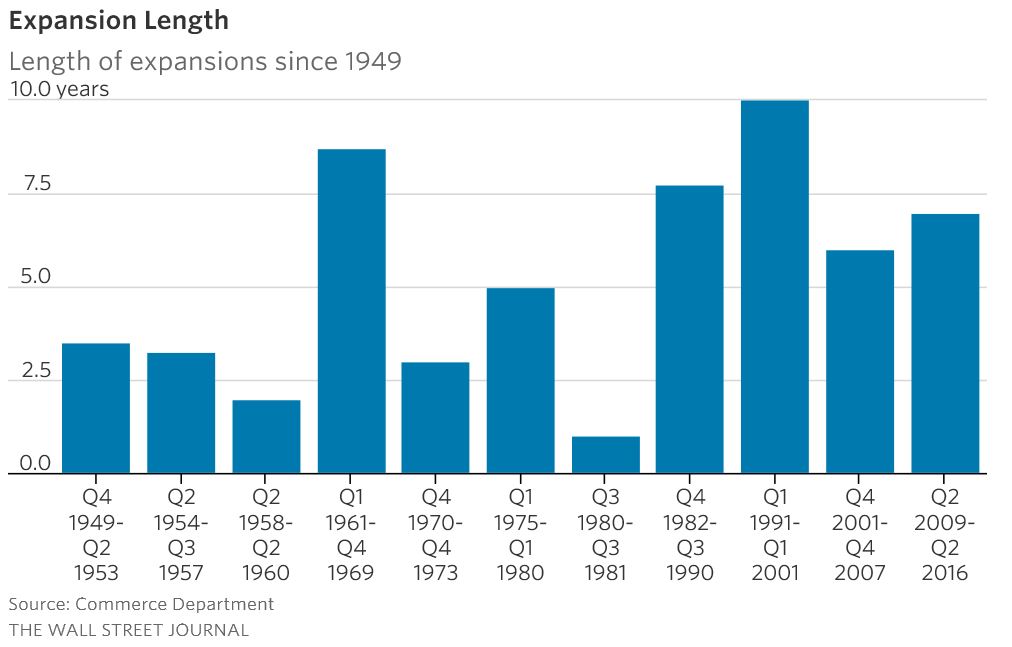
Even seven years after the recession ended, the current stretch of economic gains has yielded less growth than much shorter business cycles.

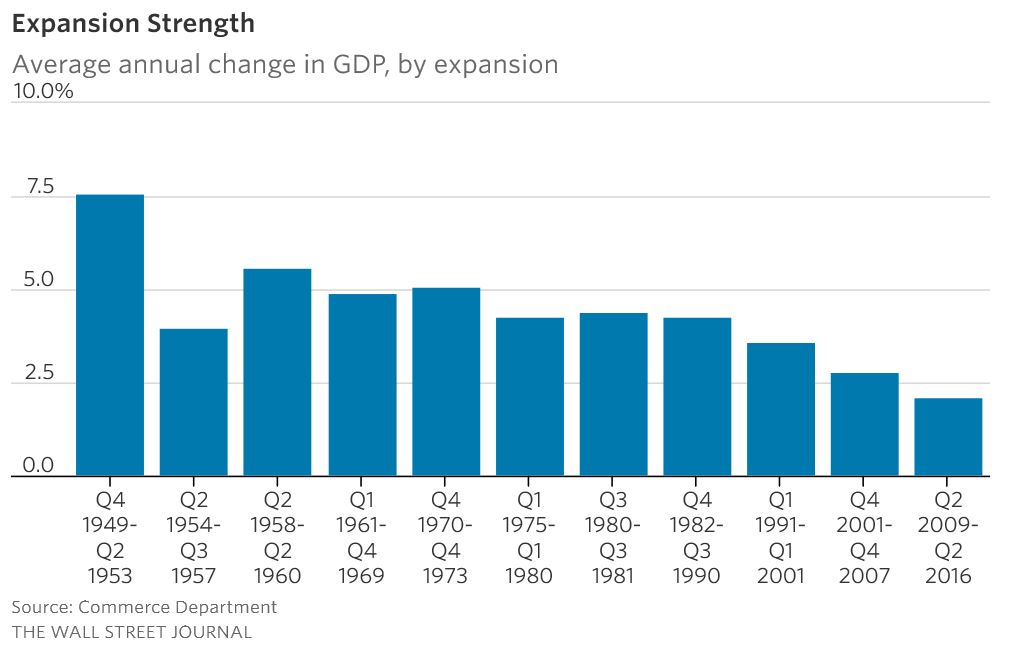
In terms of average annual growth, the pace of this expansion has been by far the weakest of any since 1949. (And for which we have quarterly data.) The economy has grown at a 2.1% annual rate since the U.S. recovery began in mid-2009, according to gross-domestic-product data the Commerce Department released Friday.

wsj1

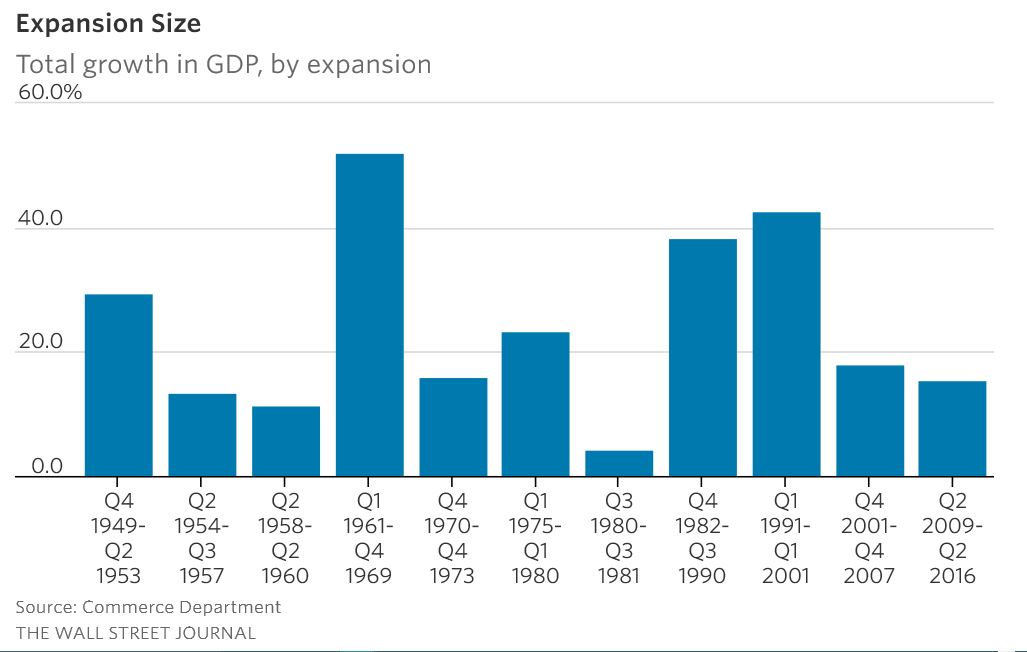
The prior expansion, from 2001 through 2007, was the only other business cycle of the past 11 when the economy didn’t grow at least 3% a year, on average. Total growth this expansion ranks just 8th of the past 11 cycles. The U.S. economy, at the end of June, was 15.5% larger than it was when the recession ended in 2009.

Canadian PM Trudeau and the loonie: What’s up?

Matein Khalid  http://www.khaleejtimes.com  October 26, 2015

The Canadian dollar’s strength may not last.(AFP)

Even though Trudeau is the son of a political legend Pierre Trudeau, he has no economic or diplomatic policy making experience.

So justin Pierre Trudeau is the new Premier Ministre of Canada. Stephen Harper’s decade in power as the Tory grand vizier in Ottawa was ultimately doomed by the oil shock, the commodities bust, the 2015 Canadian recession and voter discontent in Ontario, Quebec, Alberta and the Atlantic seaboard states. Even though Trudeau is the son of a political legend Pierre Trudeau, he has no economic or diplomatic policy making experience. Yet he will rule the first Liberal majority government in Ottawa since Jean Chretien in the late 1990s.

I can envisage higher public spending as Trudeau (and the electorate) does not share the Conservative Party’s commitment to a balanced budget or a Canadian combat role in the US led military coalition against Daesh in Iraq. This means tensions with Washington beyond the Keystone XL pipeline issue. Trudeau could even resurrect the ghost of his father’s Third Option in a world where China and Russia both challenge the US. All this reinforces my conviction, outlined in my October 12 KT column, that the Canadian dollar’s strength will not last.

So it did not surprise me that the loonie fell against 15 major currencies in Singapore trading the night Trudeau unseated Harper and entered the world stage. Once the Tories resorted to the xenophobic, anti-niqab campaign, I knew Harper had run out of ideas and political risk was going to rise in Canada even as oil prices and economic growth rates/mining capex fell. Trudeau’s C$60 billion infrastructure pledge (funded rise in deficits) and two shock Bank of Canada rate cuts, fiscal populism and higher US economic momentum means a lower loonie. So does the monetary policy divergence between the Yellen Fed and the Poloz Bank of Canada I expect will widen in 2016.

As a personal friend of former Liberal Prime Minister Jean Chretien and father of (a UAE dirham-financed) McGill undergrad, I will not disguise my pleasure at the election result and the softness of the Canadian dollar. Yet the free-fall in the Canadian dollar began in spring 2014 under the conservatives, when I recommended a loonie short at 1.06 (or 94 cents) against the US dollar.

Justin Trudeau will only add fiscal stimulus to Governor Poloz’s ultra-dovish monetary policies which have failed to use loonie depreciation to revive the Canadian economy. The yield on the 10-year Canadian Government bond is a miniscule 1.46 per cent at a time when Canada’s federal and provincial debt burden will only rise. In any case, the oil shock and $500 billion reserve falls in China will force sovereign wealth funds to jettison their holdings of Canadian government debt, which has historically been correlated with a rise in Federal budget deficits. A strategic put option on Canadian dollar government debt makes total sense since the yield on the 10-year Uncle Canuck note could well rise to two per cent or higher by late spring. Does Justin Trudeau’s proposed fiscal stimulus threaten Canada’s AAA credit rating? No.

Canada had the stablest banking system in the Western world in 2008 while Wall Street, the City of London and even the Bahnofstrasse/Paradeplatz went ballistic on subprime debt/credit derivatives. The commodity supercycle and China’s spectacular economic growth since 2001 was a financial windfall for Canada. Yet that was then and this is now. Canada is now in near recession, the commodities bust has just begun, epic consumer debt presages a housing crash, energy loans will gut banking profits and the loonie hit 12-year lows in September. Even though Alberta oil sands boast the world’s third-largest oil reserves, they are high-cost marginal producers who are toast during a global oil glut with no swing producer in either Riyadh or West Texas/North Dakota. Paradoxically, Harper’s “energy superpower” boast now haunts the loonie, since oil and gas is 25 per cent of Canadian exports. Other than the Norwegian kroner, the Canadian dollar is the ultimate Western world petrocurrency now, the political pendulum has shifted back from Alberta to the Liberal bastions of West Montreal.

Examining Harper’s record and spotting a fake economic recovery


Duncan Cameron

By Duncan Cameron    August 20, 2013   http://rabble.ca

Photo: Liam Richards/University of Saskatchewan/flickr

A new report from Citizens for Public Justice (CPJ) on job creation in Canada arrived just as the Prime Minister said Monday he intends the next election to be about jobs and the economy. As part of a study of poverty, CPJ has published a set of fact sheets on job creation in Canada since the 2008 recession. It looks at regional and generational differences, assesses job quality and measures newly created jobs against new job seekers.

Anyone who believes what Conservative cabinet ministers have been repeating about job creation in Canada should read the CPJ fact sheets.

Carol Goar of the Toronto Star identified the CPJ report as explaining why many Canadians are still experiencing the recession. The Canadian employment rate is down: the number of jobs created (950,000) has not increased as fast as the population (1.8 million). Unemployment is stuck at 1.4 million. When talking about the unemployed, the government does not include discouraged workers, people with part-time jobs looking for full-time work, temporary jobs, or the under-employed. Add them to the total, and the real unemployment rate is one out of ten out of work.

CPJ explain about 500,000 jobs are needed to get Canada back to where it was before the recession. Stronger job growth where resource prices are strong (Alberta, Saskatchewan, Manitoba) and in construction mask weaker job growth in services and manufacturing.

Employment trends are weakest for Aboriginal Canadians. Young Canadians suffer disproportionately from unemployment — about one in five is without work.

Sadly, paid work increasingly means precarious jobs: part-time, low-wage and unstable. Older workers are relying more and more on temporary work.

Policy analysts divide over what to do about a lackluster economy. Some want to leave the market alone, most think governments need to lead in order for it to recover.

Conservatives believe the marketplace works fine, and any problems can be fixed by allowing prices to adjust. Unemployment is explained by the failure of rates of pay to fall, because of minimum wages, unions, employment insurance, welfare and other market imperfections, which need to be eliminated or reduced.

The problem with this view is that rates of pay are falling — policies to reduce wages have been successful, increasing inequality as Stephen Gordon has shown in Maclean’s. For the Harper government, business-funded think-tanks, and other supporters of the market view, this just means wages have not fallen enough. More of the same is just what is needed.

Those unwilling to wait for the economy to correct itself will want to know how it can be improved.

In Canada the standard strategy for an underperforming economy is a currency devaluation, accompanied by fiscal tightening. Exports incomes increase, import increases are cut off, and the private sector leads the recovery.

Floating the Canadian dollar down used to only require lowering Canadian interest rates below U.S. rates. Unfortunately, the U.S. beat Canada to the interest rate bottom, with a “zero bound” rate, introduced to revive American capitalism.

Historically low rates do prevail at the Bank of Canada. This is supposed to encourage recovery, though without bringing a currency devaluation, it is hard to see how it is going to happen.

Former Bank of Canada Deputy Governor William White called low interest rates having one foot on the accelerator. With the Harper government curbing spending, White observed, Canada has the other foot on the brake.

This contradictory policy needs to be fixed. The obvious choice is for the government to take the foot off the brake and spend borrowed money for needed public investments in urban transit, retrofitting buildings to reduce energy use, recreation, culture, the arts, advanced education, child care, and straight job creation.

The Harper government is ideologically opposed to government spending, but expect it to consider taking its foot off the brake by lowering taxes. Another reduction in the GST would inject new money into the economy, for instance. And it would also be an excuse to reduce direct spending (and reduce wages) further down the road.

The Official Opposition have their work cut out for them just to expose the poor Canadian economic record, let alone engage Conservatives in a rational debate based on economic evidence.

Stephen Harper does not expect Canadians to discover that job performance has been poor and that the economy is not improving, while the standard of living for most Canadians is declining. He has announced plans to prorogue Parliament, cutting the fall session short. This will limit the time for parliamentary debate and the subjects raised by the opposition.

If the economy is going to be the ballot question in the next election, as Stephen Harper suggests, Citizens for Public Justice have afforded parliamentarians and all Canadians with what is needed to examine his government’s record.

Duncan Cameron is the president of rabble.ca and writes a weekly column on politics and current affairs.

Photo: Liam Richards/University of Saskatchewan/flickr

New Report: Unions Shield Workers—and States—Against Recession

Friday Jul 12, 2013 3:34 pm  http://inthesetimes.com

By Patrick James Drennan

Although the economy is improving, income inequality remains high in Illinois.   Neal Jennings/Flickr/Creative Commons)

A new report by Robert Bruno and Frank Manzo of the University of Illinois, The State of Working Illinois 2013: Labor in the Land of Lincoln, paints an all-too-familiar portrait of a state economy that has righted itself from free-fall to “tepid growth” but has yet to reach pre-recession levels. With decreased labor-force participation, nearly 10 percent unemployment, wage stagnation and the top 1 percent earning 635 percent more than the median employed worker, Illinois has a long way to go before true recovery.

But unlike other accounts of today’s economic woes, the authors don’t attribute the blame solely to the global financial collapse. The report’s findings strongly suggest that the decline of unionization has played a considerable role in the increase of income inequality in Illinois, which can in turn slow economic growth. The report also suggests that lags in union membership put a strain on the social safety net, sapping resources that could otherwise be invested to speed the state’s recovery.

The State of Working Illinois, released Tuesday, found the union membership among working-age Illinois residents has fallen from 20.6 percent in 2002 to 17.2 percent. The findings also suggest that this decline may have been a factor in pushing income inequality to extremes. The salary boost of belonging to a union worker—some $10,682 for workers making a median wage of $43,687—goes up for low-income workers. The bottom 25 percent of nonunion earners make an average of $15,471, while the bottom 25 percent of union earners makers $27,406. A similar gap appears in the bottom 10 percent of each group, with union workers earning an average of $14,685 and non-union workers earning an average of $3,701. The authors conclude that with the power to considerably boost incomes in the lowest brackets, unionization can prevent the lower-earning workers from descending into poverty.

At the other end of the spectrum, union gains are more modest: For the top 25 percent of union workers, incomes average $61,884, compared with $57,692 for nonunion workers. And, strikingly, the top 10 and 1 percent of nonunion workers actually make more than their unionized counterparts. Overall, this means that union wages are far more compressed than nonunion wages in the state, with a $100,319 discrepancy between the highest- and lowest-earning brackets of union workers, compared with a $296,404 gap among nonunion workers.

According to coauthor Frank Manzo, some degree of income inequality isn’t necessarily a bad thing. It can “encourage hard work, the acquisition of skills and education, and innovation.” But “when income inequality gets too high, like the levels we see today, it can negatively impact economic growth.” This is because “the ‘marginal costs’ of inequality—such as lower equality of opportunity and lower class mobility, declining middle and working class wages, higher chances of financial crises, and even decreased national happiness—are outweighing the ‘marginal benefits,’” Manzo explains.

Given this, the report’s findings indicate that higher unionization could help shrink Illinois’ income gaps and lead to economic growth.

There’s another way that unions can be a powerful agent to combat the detrimental effects of weak economies. Despite some improvement, Illinois workers still have only “somewhat more financial security and slightly higher prospects for finding a job” than during the darkest days of the recession. Even under these grim conditions, unionized workers generally have higher wages and have more financial security for their retirement—benefits that nonunion workers don’t always enjoy, rendering them more vulnerable to the dire effects of economic recession.

This means that lower unionization rates not only hurt workers, but also put a strain on Illinois’ social safety net. With union membership on the decline, the authors hypothesize that the growing ranks of nonunion workers are sapping public resources that could otherwise be used to boost the economy by, for instance, “subsidizing college education and investing in early childhood education programs”—investments that the authors suggest would improve Illinois’ long-term labor market prospects.

The authors conclude by recommending that Illinois help combat the decline of unionization. The state could, for example, require employers to post notices in every workplace detailing the “collective acts to improve pay, working conditions, and job-related problems that are lawful even if workers are not in a union” so that workers know it is their legal right to seek justice and improved working conditions.

Although the authors make clear that cooperation from the state—in the form of investments in public infrastructure, increases in the minimum wage and reforming the tax code—is vital for positive economic growth, The State of Working Illinois shows that unions can provide workers and economies with invaluable armor to withstand crises like the Great Recession.