
Biologists Estimate that Earth is Inhabited by One Trillion Microbial Species

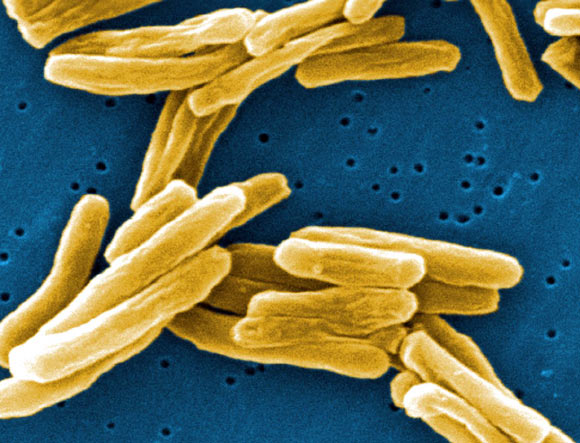
This colorized scanning electron micrograph shows Mycobacterium tuberculosis, gram-positive bacteria that cause tuberculosis. Image credit: Ray Butler / Centers for Disease Control and Prevention.

Our planet could contain roughly 1 trillion microbial species, with only 0.001% now identified, says a duo of scientists at Indiana University.

Dr. Kenneth Locey and Dr. Jay Lennon, both from the Indiana University’s Department of Biology, combined microbial, plant and animal community datasets from different sources, resulting in the largest compilation of its kind.

Altogether, these data represent over 5.6 million microscopic and nonmicroscopic species from 35,000 locations across all the world’s oceans and continents, except Antarctica.

“Our study combines the largest available datasets with ecological models and new ecological rules for how biodiversity relates to abundance,” Dr. Lennon said.

“This gave us a new and rigorous estimate for the number of microbial species on Earth.”

According to the team, older estimates were based on efforts that dramatically under-sampled the diversity of microorganisms.

“Before high-throughput sequencing, scientists would characterize diversity based on 100 individuals, when we know that a gram of soil contains up to a billion organisms, and the total number on Earth is over 20 orders of magnitude greater,” Dr. Lennon said.

The realization that microorganisms were significantly under-sampled caused an explosion in new microbial sampling efforts over the past several years.

“A massive amount of data has been collected from these new surveys. Yet few have actually tried to pull together all the data to test big questions,” Dr. Locey said. “We suspected that aspects of biodiversity, like the number of species on Earth, would scale with the abundance of individual organisms.”

“After analyzing a massive amount of data, we observed simple but powerful trends in how biodiversity changes across scales of abundance,” the scientists said.

“One of these trends is among the most expansive patterns in biology, holding across all magnitudes of abundance in nature.”

The study results, published in the Proceedings of the National Academy of Sciences, also suggest that actually identifying every microbial species on Earth is a huge challenge.

“The Earth Microbiome Project — a global multidisciplinary project to identify microscope organisms — has so far cataloged less than 10 million species. Of those cataloged species, only about 10,000 have ever been grown in a lab, and fewer than 100,000 have classified sequences,” Dr. Lennon said.

“Our results show that this leaves 100,000 times more microorganisms awaiting discovery — and 100 million to be fully explored. Microbial biodiversity, it appears, is greater than ever imagined.”

_____

Kenneth J. Locey & Jay T. Lennon. Scaling laws predict global microbial diversity. PNAS, published online May 2, 2016; doi: 10.1073/pnas.1521291113
Source: Biologists Estimate that Earth is Inhabited by One Trillion Microbial Species | Biology | Sci-News.com

Tiny water bears are huge DNA thieves: study


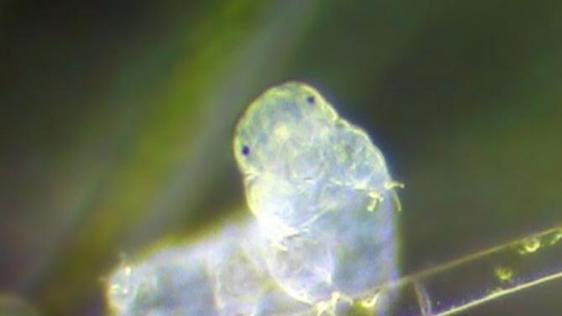
Washington (AFP) – The eight-legged water bear — a hardy, nearly microscopic animal  resembling its mammal namesake — gets a huge chunk of its DNA from foreign organisms such as bacteria and plants, scientists have revealed.

These genes, the researchers suggest, help the tiny animals, also known as moss piglets or tardigrades, survive in the harshest of environments.

Water bears, which live all over the world, are usually 0.020 inches (0.5 millimetres) long and move very slowly and clumsily on their multitude of legs.

These highly adaptable creatures can survive extreme temperatures.

Even after being stuck in a freezer at -112 degrees Fahrenheit (-80 Celsius) for 10 years, they can start moving around again about 20 minutes after thawing.

By sequencing these creatures’ genome, researchers from the University of North Carolina (UNC) at Chapel Hill were surprised to find that 17.5 percent — nearly a sixth — of the genome came from foreign organisms.

For most animals, less than one percent of their genome comes from foreign DNA.

The microscopic rotifer previously held the record, with eight percent of its genome coming from foreign DNA.

“We had no idea that an animal genome could be composed of so much foreign DNA,” said co-author Bob Goldstein of UNC’s College of Arts and Sciences.

“We knew many animals acquire foreign genes, but we had no idea that it happens to this degree.”

– New insight on evolution –

The study, published in Monday’s edition of the Proceedings of the National Academy of Sciences, also made unusual findings about how DNA is inherited.

Goldstein, first author Thomas Boothby and colleagues found that water bears obtain about 6,000 foreign genes mostly from bacteria, as well as plants, fungi and Archaea single-cell organisms.

“Animals that can survive extreme stresses may be particularly prone to acquiring foreign genes — and bacterial genes might be better able to withstand stresses than animal ones,” said Boothby, a postdoctoral fellow in Goldstein’s lab.

Indeed, bacteria have survived the most extreme environments on Earth for billions of years.

Water bears acquire foreign genes through horizontal gene transfer, a process by which species swap genetic material instead of inheriting DNA from parents.

“With horizontal gene transfer becoming more widely accepted and more well-known, at least in certain organisms, it is beginning to change the way we think about evolution and inheritance of genetic material and the stability of genomes,” said Boothby.

Researchers said the DNA likely gets inside the genome randomly but what remains allows water bears to survive in the most hostile environments.

Under intense stress, such as extreme dryness, the water bear’s DNA breaks up into small pieces, according to the research team.

Once the cell rehydrates, its membrane and nucleus housing the DNA temporarily becomes leaky and allows other large molecules to pass through easily.

They thus repair their own damaged DNA while also absorbing foreign DNA as the cell rehydrates, forming a patchworks of genes from different species.

“So instead of thinking of the tree of life, we can think about the web of life and genetic material crossing from branch to branch,” Boothby explained.

“So it’s exciting. We are beginning to adjust our understanding of how evolution works.”

Source: Tiny water bears are huge DNA thieves: study – Yahoo News