
Prime Minister of Canada concludes his visit to Tokyo | Prime Minister of Canada

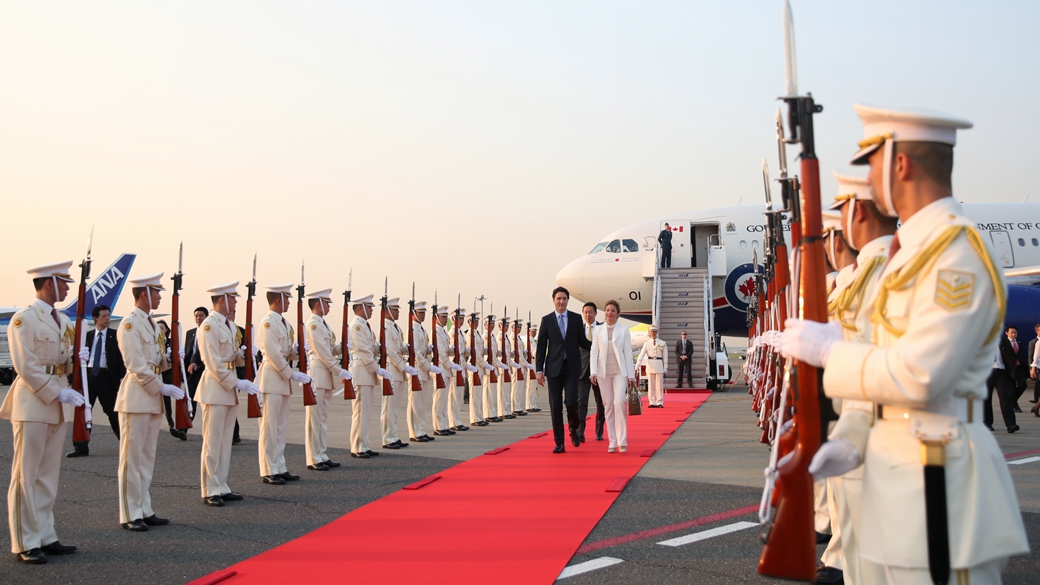
The Prime Minister Justin Trudeau and Mrs. Grégoire-Trudeau arrive in Tokyo, Japan.

Tokyo, Japan

24 May 2016

The Government of Canada has committed to deepen and renew its social and economic engagement with Asia, in order to better pursue Canada’s interests and values.

Today, the Prime Minister, Justin Trudeau, concluded his official working visit in Japan, which included an audience with the Emperor and Empress of Japan, and a meeting with Prime Minister Shinzo Abe.

While in Tokyo, the Prime Minister met with representatives of the automotive sector to underline that Canada is a great place to invest. He also took the opportunity to discuss trade opportunities, promote Canadian quality, and highlight Canada’s research and development capacity and innovation expertise. The automotive sector represents tremendous opportunities to create jobs, strengthen the middle class, and grow both countries’ economies.

During the meeting with Prime Minister Abe, the two leaders discussed a wide range of issues important to Canada and Japan, including the implementation of the Paris Agreement on climate change, global health initiatives, infrastructure for sustainable growth, and collaboration on Arctic science. Finally, they discussed the revitalization of the Canada-Japan Joint Economic Committee, an important forum to improve economic ties between Canada and Japan.

Quote

“Improving trade relations with Japan is a top priority of our government. The growing collaboration between Canada and Japan – on innovation and science – will contribute directly to our economic growth, and will benefit all Canadians.”

– Rt. Hon. Justin Trudeau, Prime Minister of Canada

Quick Facts

  • Prime Minister Trudeau last met with Prime Minister Abe on March 31, 2016 in Washington D.C.
  • Japan is among Canada’s top five bilateral merchandise trading partners.
  • This year marks the 40th anniversary of the Canada-Japan Joint Economic Committee (JEC), which began in 1976 based on the Japan-Canada Framework for Economic Cooperation.
  • The JEC focuses on priority areas of cooperation, including infrastructure, energy, science and technology, the business environment, promoting investment and tourism. A cooperative working group led by Global Affairs Canada and Japan’s Ministry of Foreign Affairs will monitor progress within these priority areas of cooperation to ensure that the framework is as effective as possible.
  • Canada and Japan are partners in numerous international groups and organizations including the G7, G20, APEC, the ASEAN Regional Forum, and the OECD.

Source: Prime Minister of Canada concludes his visit to Tokyo | Prime Minister of Canada

Full list of Justin Trudeau’s cabinet—CBC NEWS

November 4, 2015   CBC News

http://www.ctvnews.ca/polopoly_fs/1.2642542.1446659515!/httpImage/image.jpg_gen/derivatives/landscape_620/image.jpg          The full list of Prime Minister Justin Trudeau’s new 31-member cabinet, in order of precedence, sworn in today at Rideau Hall in Ottawa (with their province in parenthesis):

  • Justin Trudeau (Quebec) – Prime Minister, Intergovernmental Affairs and Youth.
  • Ralph Goodale (Saskatchewan) – Public Safety and Emergency Preparedness.
  • Lawrence MacAulay (P.E.I.) – Agriculture and Agri-Food.
  • Stéphane Dion (Quebec) – Foreign Affairs.
  • John McCallum (Ontario) – Immigration, Citizenship and Refugees.
  • Carolyn Bennett (Ontario) – Indigenous and Northern Affairs.
  • Scott Brison (Nova Scotia) – Treasury Board President.
  • Dominic Leblanc (New Brunswick) – Leader of the Government in the House of Commons.
  • Navdeep Bains (Ontario) – Innovation, Science and Economic Development.
  • Bill Morneau  – Finance Minister
  • Jody Wilson-Raybould (B.C.) – Justice and Attorney General  of Canada.
  • Judy Foote (Newfoundland and Labrador) – Public Services and Procurement.
  • Chrystia Freeland (Ontario) – International Trade.
  • Jane Philpott (Ontario) – Health.
  • Jean-Yves Duclos (Quebec) – Families, Children and Social Development.
  • Marc Garneau (Quebec) – Transport.
  • Marie-Claude Bibeau (Quebec) – International Development and La francophonie.
  • Jim Carr (Manitoba) – Natural Resources.
  • Mélanie Joly (Quebec) – Heritage.
  • Diane Lebouthillier (Quebec) – National Revenue.
  • Kent Hehr (Alberta) – Veterans Affairs, and Associate Minister of National Defence.
  • Catherine McKenna (Ontario) – Environment and Climate Change.
  • Harjit Sajjan (B.C.) – National Defence.
  • MaryAnn Mihychuk (Manitoba) – Employment Workforce Development and Labour.
  • Amarjeet Sohi (Alberta) – Infrastructure and Communities.
  • Maryam Monsef (Ontario) – Democratic Institutions.
  • Carla Qualtrough (B.C.) – Sport, and Persons with Disabilities.
  • Hunter Tootoo (Nunavut) – Fisheries and Oceans, and Canadian Coastguard.
  • Kirsty Duncan (Ontario) – Science.
  • Patricia Hajdu (Ontario) – Status of Women.
  • Bardish Chagger (Ontario) – Small Business and Tourism.

Map          Map shows the regional distribution of ministers in the cabinet of Prime Minister Justin Trudeau. (CBC)

List of Cabinet Committees: cabinet-committees


Canadian PM Trudeau and the loonie: What’s up?

Matein Khalid  http://www.khaleejtimes.com  October 26, 2015

The Canadian dollar’s strength may not last.(AFP)

Even though Trudeau is the son of a political legend Pierre Trudeau, he has no economic or diplomatic policy making experience.

So justin Pierre Trudeau is the new Premier Ministre of Canada. Stephen Harper’s decade in power as the Tory grand vizier in Ottawa was ultimately doomed by the oil shock, the commodities bust, the 2015 Canadian recession and voter discontent in Ontario, Quebec, Alberta and the Atlantic seaboard states. Even though Trudeau is the son of a political legend Pierre Trudeau, he has no economic or diplomatic policy making experience. Yet he will rule the first Liberal majority government in Ottawa since Jean Chretien in the late 1990s.

I can envisage higher public spending as Trudeau (and the electorate) does not share the Conservative Party’s commitment to a balanced budget or a Canadian combat role in the US led military coalition against Daesh in Iraq. This means tensions with Washington beyond the Keystone XL pipeline issue. Trudeau could even resurrect the ghost of his father’s Third Option in a world where China and Russia both challenge the US. All this reinforces my conviction, outlined in my October 12 KT column, that the Canadian dollar’s strength will not last.

So it did not surprise me that the loonie fell against 15 major currencies in Singapore trading the night Trudeau unseated Harper and entered the world stage. Once the Tories resorted to the xenophobic, anti-niqab campaign, I knew Harper had run out of ideas and political risk was going to rise in Canada even as oil prices and economic growth rates/mining capex fell. Trudeau’s C$60 billion infrastructure pledge (funded rise in deficits) and two shock Bank of Canada rate cuts, fiscal populism and higher US economic momentum means a lower loonie. So does the monetary policy divergence between the Yellen Fed and the Poloz Bank of Canada I expect will widen in 2016.

As a personal friend of former Liberal Prime Minister Jean Chretien and father of (a UAE dirham-financed) McGill undergrad, I will not disguise my pleasure at the election result and the softness of the Canadian dollar. Yet the free-fall in the Canadian dollar began in spring 2014 under the conservatives, when I recommended a loonie short at 1.06 (or 94 cents) against the US dollar.

Justin Trudeau will only add fiscal stimulus to Governor Poloz’s ultra-dovish monetary policies which have failed to use loonie depreciation to revive the Canadian economy. The yield on the 10-year Canadian Government bond is a miniscule 1.46 per cent at a time when Canada’s federal and provincial debt burden will only rise. In any case, the oil shock and $500 billion reserve falls in China will force sovereign wealth funds to jettison their holdings of Canadian government debt, which has historically been correlated with a rise in Federal budget deficits. A strategic put option on Canadian dollar government debt makes total sense since the yield on the 10-year Uncle Canuck note could well rise to two per cent or higher by late spring. Does Justin Trudeau’s proposed fiscal stimulus threaten Canada’s AAA credit rating? No.

Canada had the stablest banking system in the Western world in 2008 while Wall Street, the City of London and even the Bahnofstrasse/Paradeplatz went ballistic on subprime debt/credit derivatives. The commodity supercycle and China’s spectacular economic growth since 2001 was a financial windfall for Canada. Yet that was then and this is now. Canada is now in near recession, the commodities bust has just begun, epic consumer debt presages a housing crash, energy loans will gut banking profits and the loonie hit 12-year lows in September. Even though Alberta oil sands boast the world’s third-largest oil reserves, they are high-cost marginal producers who are toast during a global oil glut with no swing producer in either Riyadh or West Texas/North Dakota. Paradoxically, Harper’s “energy superpower” boast now haunts the loonie, since oil and gas is 25 per cent of Canadian exports. Other than the Norwegian kroner, the Canadian dollar is the ultimate Western world petrocurrency now, the political pendulum has shifted back from Alberta to the Liberal bastions of West Montreal.