Canada’s Trudeau sidesteps questions after extradition talks with China are revealed 

Canada says the talks, long-sought by Beijing, are unrelated to the recent release of a Canadian held by China for two years on spying charges.

Reuters

September 21, 2016

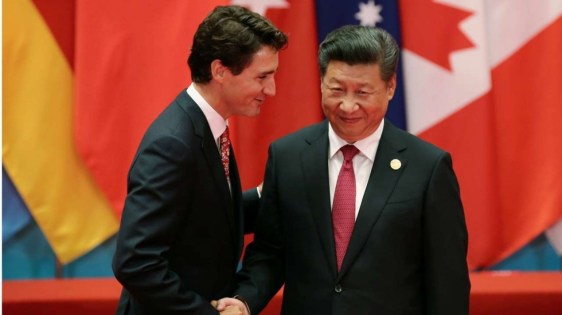
Canadian Prime Minister Justin Trudeau sidestepped questions on Tuesday on the sensitive topic of possible extraditions to China, saying Canada would stick to high standards when deciding whether to return Chinese citizens.

A statement posted on Trudeau’s website said his national security adviser went to Beijing last week and agreed to start talks about an extradition treaty as part of a security dialogue.

China, which wants the return of officials suspected of corruption who it says are hiding in Canada, has long pressed for such a treaty.

Some Western countries are reluctant to sign extradition deals with China, partly out of concern about the integrity of its judicial system and treatment of prisoners.

Some people convicted of corruption face the death penalty. Canada refuses to send people to countries without assurances they will not be executed.

“Extradition is certainly one of the things the Chinese have indicated they want to talk about,” Trudeau told a televised news conference at the United Nations.

“As everyone knows, Canada has very high standards in terms of extradition treaties in accordance with our values. But we’re happy to have a high-level security dialogue,” he said.

News of the Beijing meeting revived speculation Ottawa had made concessions to secure the return of Kevin Garratt, a Canadian citizen convicted of spying, whom China deported last week.

kevin-and-julia-garratt

Kevin Garratt, a Canadian held in China for two years on suspicion of spying, with wife after been freed and arriving in Vancouver on Thursday, September 16 in a diplomatic triumph for Prime Minister Justin Trudeau.

Canadian officials insist there was no deal, and that the Garratt release was unrelated to the extradition talks.

Garratt’s release was widely seen as a triumph for Trudeau, who visited Beijing earlier this month in a bid to seal closer economic ties. Chinese Premier Li Keqiang arrives in Canada on Wednesday for the start of a three-day trip.

The opposition Conservative Party, long suspicious of China’s human rights record, accused Trudeau of abandoning Canadian principles.

“Does the prime minister not understand that our openness to China should be about encouraging China to adopt our values for human rights, as opposed to us giving in to China’s?” interim party leader Rona Ambrose told the House of Commons.

China does not have extradition treaties with the United States, Australia or Canada, which according to state media are the most popular destinations for suspected economic criminals from China.

A number of suspects wanted by China are known to reside in Canada.

They include the Vancouver-based property developer Michael Ching Mo Yeung, who is wanted by China for alleged embezzlement and concealing stolen funds.

Ching, who is seeking refugee status in Canada, is wanted under the name Cheng Muyang. He is the son of Cheng Weigao, the former Communist Party secretary of Hebei province who was expelled from the party for corruption and died in 2010.
Source: Canada’s Trudeau sidesteps questions after extradition talks with China are revealed | South China Morning Post

Prime Minister to travel to Japan for an official working visit and to attend the G7 Leaders’ Summit

Fort McMurray, Alberta

13 May 2016

The Prime Minister, Justin Trudeau, today announced that he will travel to Japan to participate in the G7 Leaders’ Summit on May 26 and 27 in Ise-Shima. Prior to the Leaders’ Summit, and at the invitation of Prime Minister Shinzo Abe, Prime Minister Trudeau will participate in an official working visit from May 23-25.

While in Japan, Prime Minister Trudeau will have an audience with the Emperor and Empress of Japan, and will meet with Prime Minister Abe to reaffirm the close and growing ties between Canada and Japan across a broad range of areas of cooperation. The Prime Minister will also meet with leaders in the automotive sector to discuss ways to further promote trade and investment between Canada and Japan, all of this in an effort to create good-paying jobs for Canadians, strengthen the middle class, and work towards clean and sustainable economic growth.

During the G7 Leaders’ Summit, Canada will reaffirm its new approach to global engagement. The Prime Minister will highlight Canada’s resolve to work with its G7 partners on a number of key global issues, including the economy, trade, climate change, peace and security, development and women’s empowerment, which will all contribute to advancing the government’s priorities.

Quotes

“Japan is a long-standing and important partner for Canada. I look forward to meeting the Emperor and Empress of Japan.  During my meeting with Prime Minister Shinzo Abe, we will explore ways to deepen Canadian and Japanese ties on many levels, including trade, investment, peace and security, culture, education, environment, and science, technology and innovation.”
– Rt. Hon. Justin Trudeau, Prime Minister of Canada

“In this new era of Canada’s international engagement, I look forward to meeting my G7 counterparts to bolster collaboration on shared domestic and global priorities and challenges, including our work to build inclusive and sustainable economies and societies that support a strong middle-class.”
– Rt. Hon. Justin Trudeau, Prime Minister of Canada

Source: Prime Minister to travel to Japan for an official working visit and to attend the G7 Leaders’ Summit | Prime Minister of Canada

Prime Minister announces action on Alberta wildfires


OTTAWA, May 11, 2016 /CNW/ – The Government of Canada will stand shoulder to shoulder with the people of Fort McMurray in the wake of the devastating Northern Alberta wildfires.

The Prime Minister, Justin Trudeau, today announced the creation of a new ad hoc Cabinet committee to coordinate federal efforts to help the thousands of Canadians affected by the wildfires that raged through Northern Alberta in May of 2016.

The Ad Hoc Committee on Northern Alberta Wildfires will meet as required to consider and coordinate federal contributions to recovery and rebuilding efforts for those affected by the May 2016 Northern Alberta wildfires.


Chair                 

The Honourable Kent Hehr

Vice-Chair           

The Honourable Patricia A. Hajdu

Members           

The Honourable Ralph Goodale

The Honourable Navdeep Singh Bains

The Honourable Jane Philpott

The Honourable Jean-Yves Duclos

The Honourable James Gordon Carr

The Honourable MaryAnn Mihychuk

The Honourable Amarjeet Sohi


The ad hoc Cabinet committee will hold its first meeting on May 12, 2016, and will complement the ongoing efforts on the ground coordinated through the Government Operations Centre.

The people of Fort McMurray can count on the full support of this government. We will weather this storm together – and together, we will rebuild.

Quotes

“The new ad hoc Cabinet committee is part of our work to address both the urgent and long term needs of communities affected by the Northern Alberta wildfires. We are working closely with Alberta Premier Notley and local authorities to coordinate recovery and rebuilding efforts for the many thousands who have been displaced and left homeless.”
– The Rt. Hon. Justin Trudeau, Prime Minister of Canada

“Canadians across the country have responded with generosity to the appeal by the Canadian Red Cross. The pledges made until the end of May will be matched by both the Government of Canada and the Government of Alberta. Canadians helping others – no matter the distance that separates them – is what this country is all about. I would especially like to thank the brave first responders who have worked tirelessly to fight this fire. We are committed to help the people of Fort McMurray and the surrounding area rise out of this disaster.”
– The Rt. Hon. Justin Trudeau, Prime Minister of Canada

Quick Facts

  • As part of its initial response, the Government of Canada will match every dollar donated to the Canadian Red Cross in support of the Fort McMurray relief effort. The commitment will apply to individual charitable donations made within Canada; it will be backdated to May 3rd, 2016; and, it will continue until May 31st, 2016. There will be no financial cap on the federal government’s contribution.

Associated Links


SOURCE Prime Minister’s Office

For further information: PMO Press Office: 613-957-5555, This document is also available at http://pm.gc.ca

RELATED LINKS
http://pm.gc.ca/

Source: Prime Minister announces action on Alberta wildfires

Prime Minister welcomes Twenty-Third Annual Report on the Public Service of Canada 

Toronto, Ontario
6 May 2016

The Prime Minister, Justin Trudeau, Friday welcomed the Twenty-Third Annual Report to the Prime Minister on the Public Service of Canada from Michael Wernick, the Clerk of the Privy Council, Secretary to the Cabinet, and Head of the Public Service.

The report outlines the Clerk’s priorities and expectations of the Public Service for the coming year, and emphasizes the need to improve mental health and well-being in the workplace, and boost efforts to attract, retain, and develop talented public servants.

The report also highlights a number of success stories from the past year that made a real difference in the lives of Canadians, including efforts to:

  • Work with partners at all levels – international, federal, provincial, territorial, and municipal – to bring Syrian refugees to Canada, and help them resettle as quickly as possible;
  • Help move goods across the longest international border, at a rate of over $1 million per minute; and,
  • Process 82 per cent of all tax returns electronically, making tax filing faster and easier for Canadians.

The report is available on the Clerk of the Privy Council’s website: www.clerk.gc.ca/report.

Quote

“A modern, professional Public Service plays a vital role in our democracy. The Clerk is taking important steps to renew this important institution. By working together, I am confident that we can build an even better, more capable, and effective Public Service – one that addresses the needs and expectations of the Canadians we serve.”

– Rt. Hon. Justin Trudeau, Prime Minister of Canada

Quick Facts

  • Michael Wernick was appointed the 23rd Clerk of the Privy Council and Secretary to the Cabinet on January 22, 2016, by the Prime Minister to help the government deliver its agenda and to renew the Public Service.
  • The Annual Report to the Prime Minister on the Public Service of Canada—a requirement under section 127 of the Public Service Employment Act—was first introduced in 1992.
  • The Public Service of Canada is the country’s largest employer, with approximately 257,000 employees. It is also the country’s most diverse workforce, including administrative, scientific, engineering, medical, and enforcement professionals, among others.

Source: Prime Minister welcomes Twenty-Third Annual Report on the Public Service of Canada | Prime Minister of Canada

Canada to announce plan to resettle 25,000 Syrian refugees

Prime Minister Justin Trudeau will announce Tuesday his plan to resettle 25,000 Syrian refugees and he says all 10 of Canada’s provincial premiers support bringing that many in.

Trudeau hasn’t backed down from a pledge to bring 25,000 Syrian refugees to Canada by Dec. 31 despite pushback by some following the deadly attacks in Paris.

Details of how the refugees will be brought over and where they will be housed are expected to be announced Tuesday.

“Everyone agrees that Canada must do more and must welcome 25,000 refugees,” Trudeau said after meeting with provincial leaders late Monday.

Tuesday’s announcement is sure to raise alarm in the U.S. where many Republican governors have said they don’t want any Syrian refugees.

Trudeau said robust security screening continues to be a high priority.

Quebec Premier Phillipe Couillard said accepting refugees and immigrants is part of Canadian tradition.

“There was no one sitting at the table that is not interested in seeing refugees come,” Ontario Premier Kathleen Wynne said.

Immigration Minister John McCallum said he spoke to Canada’s big city mayors about how they can help resettle the refugees.

Canada has long prided itself on opening its doors wider than any nation to asylum seekers. In times of crisis in decades past, Canada resettled refugees quickly and in large numbers. It airlifted more than 5,000 people from Kosovo in the late 1990s, more than 5,000 from Uganda in 1972 and resettled 60,000 Vietnamese in 1979-80. More than 1.2 million refugees have arrived in Canada since World War II.

Former Conservative Canadian Prime Minister Stephen Harper, who lost the Oct. 19 election to Trudeau, had declined to resettle more Syrian refugees, despite the image of a drowned 3-year-old boy washed up on a Turkish beach focusing global attention on the refugee crisis stemming from the civil war. The boy had relatives in Canada and the refugee crisis became a major campaign issue.

Brad Wall, the Conservative premier of Saskatchewan province, said he has problems with the deadline of Dec. 31 for security reasons, but believes Canada should welcome the refugees.

More than 4 million Syrians have fled their country since the conflict began in 2011.

Source: Canada to announce plan to resettle 25,000 Syrian refugees | Fox News