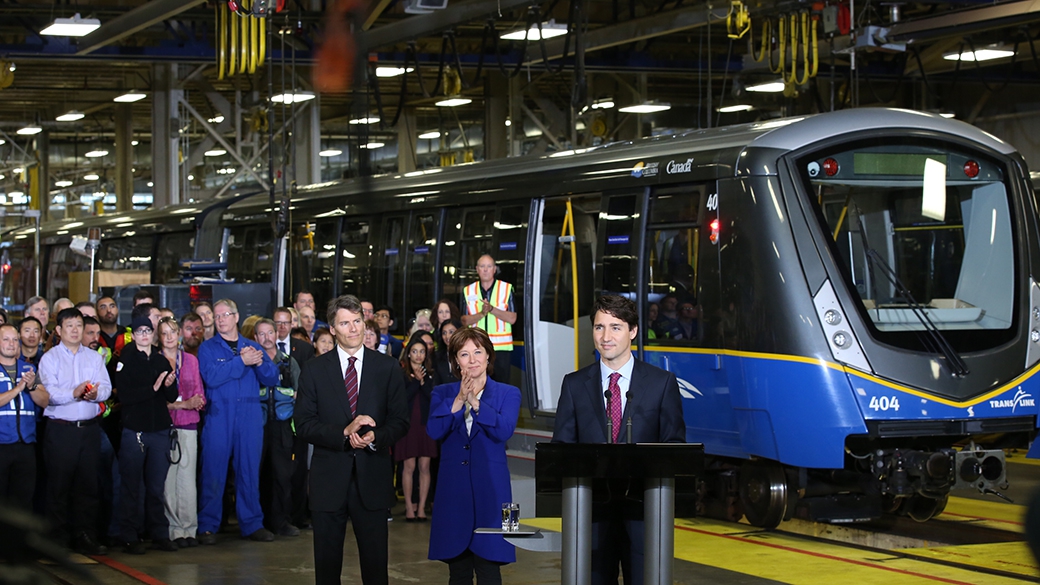
Prime Minister announces new infrastructure agreement with British Columbia 

Prime Minister Justin Trudeau makes an announcement regarding transit funding in British Columbia.

Burnaby, British Columbia

16 June 2016

The Government of Canada remains committed to making significant investments in infrastructure that will improve our public transit systems, strengthen Canadian communities, and help grow the economy.

Today, the Prime Minister, Justin Trudeau, and Premier Christy Clark announced that an agreement has been reached that will result in more than $900 million being invested – by the Government of Canada, British Columbia, and municipalities – in public transit projects across the province.

The agreement made today will reduce congestion and commute times, so that Canadian families can spend less time on the road, and more time with their loved ones. The investments will be used to expand bus lanes, add new railcars to the SkyTrain, and deliver the fixes that our transit systems have needed for decades.

Investing in public transit creates good, well-paying jobs that can help the middle class grow and prosper today. When well-planned infrastructure makes it easier for middle class Canadians to get to work on time, bring their kids to soccer practice, or go to the grocery store, the entire economy benefits.

Quotes

“Canadians have asked us to reduce congestion and commute times in their cities. This investment in public transit will help the people of British Columbia get home to their loved ones faster. It will also help to grow the middle class by improving business flows in municipalities while reducing environmental damage.”
Rt. Hon. Justin Trudeau, Prime Minister of Canada

“British Columbia is leading Canada, and as our economy continues to grow, transit infrastructure needs to keep pace. This investment will help meet rising demand, ease congestion, lower our carbon footprint, and enhance our quality of life.”
Hon. Christy Clark, Premier of British Columbia

Quick Facts

  • This funding is part of the first phase of Investing in Canada, the Government of Canada’s historic $120-billion plan to support infrastructure across the country over the next 10 years.
  • Phase 1 of Investing in Canada will provide over $10 billion in immediate investments to support public transit systems, green infrastructure projects, and social infrastructure projects. Details on Phase 2 of Investing in Canada will be announced over the next year.
  • Phase 1 funding provided under the Public Transit Infrastructure Fund will be managed through agreements between the Government of Canada and provincial and territorial governments.
  • Under the agreement made today, the Government of Canada has made its funding retroactive to April 1, 2016, so projects can proceed without delay to help ensure a productive construction season this year.
  • The investment announced today – $460 million from the Government of Canada’s new Public Transit Infrastructure Fund, and $308 million from the Province of British Columbia – will help make sure that public transit is keeping pace with the rapid growth of British Columbia. Funding will modernize public transit systems – including the SkyTrain and SeaBus services, as well as the rapid transit and provincial bus systems – to help move people and commerce more efficiently through B.C. municipalities.

Associated Links

Source: Prime Minister announces new infrastructure agreement with British Columbia | Prime Minister of Canada

Statement by the Prime Minister of Canada on the International Day of United Nations Peacekeepers 

Ottawa, Ontario
29 May 2016

The Prime Minister, Justin Trudeau, today issued the following statement on the International Day of United Nations Peacekeepers:

“Today, we salute United Nations peacekeepers, past and present, who have dedicated their lives to the pursuit of peace, safety, and freedom for others. They have greatly sacrificed to provide hope and security for the most vulnerable persons around the globe.

“Peacekeeping has a deep connection to Canadian values and leadership. The first UN peacekeeping mission came about in large part due to the efforts of Lester B. Pearson, our fourteenth Prime Minister, and the leadership of UN Forces Commander E.L.M. “Tommy” Burns. Together, their actions during the Suez Crisis of 1956 marked the beginning of Canada’s identity as a peacekeeping country.

“Since then, UN peace operations have evolved from separating belligerents and monitoring cease fires to protecting vulnerable populations and working to establish the conditions for durable peace. As conflicts have grown in intensity and complexity, so too have the risks for UN peacekeepers who put their lives on the line for the safety of others.

“On behalf of all Canadians, I commend UN peacekeepers for their selfless work and tremendous contributions to the advancement of global peace and human rights. We will continue working with the UN to promote peace and the resolution of serious conflicts around the world.”

Source: Statement by the Prime Minister of Canada on the International Day of United Nations Peacekeepers | Prime Minister of Canada

Prime Minister attends the G7 Summit in Ise-Shima

Ise-Shima, Japan
27 May 2016

The Government of Canada remains committed to creating jobs, strengthening the middle class, and helping those working hard to join it. When the majority of middle class Canadians feel confident about their future – and their families’ future – the whole country benefits.

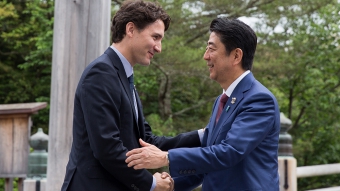
Today, the Prime Minister, Justin Trudeau, concluded the G7 Leaders’ Summit in Ise-Shima, Japan. Following the Summit, the G7 leaders issued a joint-declaration where they committed to tackle major global challenges such as the need to promote sustainable economic growth that benefits all citizens, not just the wealthiest one per cent.

While in Ise-Shima, Prime Minister Trudeau shared Canada’s proactive approach to bolster economic growth by making strategic investments in infrastructure and clean technologies – investments that will support good, well-paying jobs and strengthen the middle class. He underscored the need to improve growth around the world, but also stressed the need to question who the growth is going to benefit.

The G7 leaders also discussed pressing foreign policy and security challenges, including Russian interference in Ukraine, the fight against the Islamic State of Iraq and the Levant (ISIL), and the global migration crisis. The Prime Minister highlighted the need for G7 solidarity to refrain from paying ransom to terrorist groups.

During the Summit, the Prime Minister also supported Japan’s decision – as host country of the Summit – to place a particular focus on women’s empowerment and health. He shared Canada’s commitment to advancing gender equality and advancing women’s rights, and he encouraged his G7 counterparts to demonstrate leadership in the context of the Fifth Replenishment Conference of the Global Fund to Fight AIDS, Tuberculosis and Malaria, which will be held in Montreal in September 2016.

Quote

“For Canada, we know what made us successful in the past – a strong middle class. At the G7 this week, we had the opportunity to sit down with some of our closest international partners and discuss ways to not only improve global economic growth, but to also make sure that growth benefits all our citizens, not just a select few.”
– Rt. Hon. Justin Trudeau, Prime Minister of Canada

Quick Facts

  • The Leaders of the G7 – united by common values of freedom and democracy, and respect for human rights and the rule of law – come together each year to discuss issues of domestic and global concern. The G7 includes Canada, France, Germany, Italy, Japan, the United Kingdom and the United States. Representatives of the European Union also attend meetings.
  • The G7 presidency rotates annually among country members. Japan holds the G7 presidency in 2016, and will be followed by Italy in 2017 and Canada in 2018.
  • G7 Leaders also took part in discussions with the Leaders of Laos, Indonesia, Vietnam, Bangladesh, Sri Lanka, Papua New Guinea, and Chad, who had been invited by Japan to discuss shared challenges.
  • G7 ministerial-level meetings are also held each year to build on the Leaders’ agenda. Japan has convened a total of 10 G7 ministerial meetings in 2016.

Associated links

Source: Prime Minister attends the G7 Summit in Ise-Shima

Prime Minister to travel to Japan for an official working visit and to attend the G7 Leaders’ Summit

Fort McMurray, Alberta

13 May 2016

The Prime Minister, Justin Trudeau, today announced that he will travel to Japan to participate in the G7 Leaders’ Summit on May 26 and 27 in Ise-Shima. Prior to the Leaders’ Summit, and at the invitation of Prime Minister Shinzo Abe, Prime Minister Trudeau will participate in an official working visit from May 23-25.

While in Japan, Prime Minister Trudeau will have an audience with the Emperor and Empress of Japan, and will meet with Prime Minister Abe to reaffirm the close and growing ties between Canada and Japan across a broad range of areas of cooperation. The Prime Minister will also meet with leaders in the automotive sector to discuss ways to further promote trade and investment between Canada and Japan, all of this in an effort to create good-paying jobs for Canadians, strengthen the middle class, and work towards clean and sustainable economic growth.

During the G7 Leaders’ Summit, Canada will reaffirm its new approach to global engagement. The Prime Minister will highlight Canada’s resolve to work with its G7 partners on a number of key global issues, including the economy, trade, climate change, peace and security, development and women’s empowerment, which will all contribute to advancing the government’s priorities.

Quotes

“Japan is a long-standing and important partner for Canada. I look forward to meeting the Emperor and Empress of Japan.  During my meeting with Prime Minister Shinzo Abe, we will explore ways to deepen Canadian and Japanese ties on many levels, including trade, investment, peace and security, culture, education, environment, and science, technology and innovation.”
– Rt. Hon. Justin Trudeau, Prime Minister of Canada

“In this new era of Canada’s international engagement, I look forward to meeting my G7 counterparts to bolster collaboration on shared domestic and global priorities and challenges, including our work to build inclusive and sustainable economies and societies that support a strong middle-class.”
– Rt. Hon. Justin Trudeau, Prime Minister of Canada

Source: Prime Minister to travel to Japan for an official working visit and to attend the G7 Leaders’ Summit | Prime Minister of Canada

Statement by the Prime Minister of Canada on Israel Independence Day 

STATEMENT BY THE PRIME MINISTER OF CANADA ON ISRAEL INDEPENDENCE DAY

Ottawa, Ontario

12 May 2016

The Prime Minister, Justin Trudeau, today issued the following statement in celebration of Yom Ha’atzmaut:

“Today, we celebrate the 68th anniversary of the founding of the State of Israel with our Israeli friends and Jewish communities, both here in Canada, and around the world.

“The State of Israel is a thriving and vibrant country, which Canada is proud to call a close partner and steadfast ally.

“Canada and Israel unite in their people-to-people ties, shared values, respect for democracy, and growing trade relationship. I look forward to continuing to strengthen our strong friendship.

“Although today is a joyous day, let us also reflect on the threat that Israel and its people continue to face throughout the world in the form of terrorist attacks, acts of anti-Semitism, and religious intolerance. Canada stands with Israel and will continue to promote peace and stability in the region.

“On behalf of Sophie and our children, I wish everyone celebrating Israel’s Independence Day a Yom Ha’atzmaut Sameach. Shalom.”

Source: Statement by the Prime Minister of Canada on Israel Independence Day | Prime Minister of Canada