Cost Estimate for Bill S-209: An Act to amend the Official Languages Act (communications with and services to the public)

17 August 2016

Get the report
Bill_S-209

Summary
This private member’s Bill amends Part IV (Communications with and services to the Public) of the Official Languages Act. The objective of this legislation is to better align the Regulations of the Act with the “fundamental purpose of the Official Languages Act, which is to enhance the vitality and protect the rights of official language minority communities”.    It requires an increase in the availability of bilingual federal services and communications by broadening the basis for determining whether there is significant demand.  It does this by requiring services to those members of the public who are able to communicate in the minority official language rather than only those whose First Official Language Spoken is the minority official language.

The number of new bilingual offices will increase from 1,984 to 3,648, which includes new Canada Post points of service.  The incremental cost of the implementation of the provisions related to the ability to communicate in the minority language contained in Bill S-209 is approximately $146 million for one-time expenses, and approximately $9 million ongoing, for the federal government.  The cost to Canada Post is over and above this amount and is not available for public release.

Source: Cost Estimate for Bill S-209: An Act to amend the Official Languages Act (communications with and services to the public)

Cost Estimate for Bill C-261: An Act to amend the Canadian Forces Superannuation Act and the Royal Canadian Mounted Police Superannuation Act (increase of allowance for survivors and children)

17 August 2016

Get the report

Bill_C-261

Summary
Upon the death of a contributing member of the Regular Canadian Forces (CF), certain members of the Reserve Forces, as well as members of the Royal Canadian Mounted Police (RCMP), who at the time of death were entitled to an annuity or an annual allowance, the survivor and children of these contributing members are eligible for an immediate annual allowance.

The purpose of this enactment is to increase the allowance given to the survivors and children of CF or RCMP contributors from 50% to 70% of the contributor’s annuity or allowance.

The changes proposed by Bill C-261 will results in an incremental increased pension liability of $5.046 billion for the regular CF pension plan, $7 million for the Reserves CF pension plan, and $1.32 billion for the RCMP pension plan. The annual servicing costs will increase by $112.55 million for the regular CF pension plan, $910,000 for the reserves CF pension plan, and $39 million for the RCMP pension plan.

Incremental Cost of Raising the survivor benefit to 70%

Increase in Actuarial Liability at 2015-03-31 ($Million)
CF Regular CF Reserve RCMP
Active Members 1,447.0 5.70 540.0
Pensioners 2,342.0 1.10 536
Current widows(ers) 1,257.0 0.20 244
Total 5,046.0 7.00 1,320.00
Increase in annual Current Service Cost at 2015-03-31 ($ millions)
CF Regular CF Reserve RCMP
Government 112.55 0.91 39.00
Members 0.00 0.00 0.00
Total 112.55 0.91 39.00

Source: Cost Estimate for Bill C-261: An Act to amend the Canadian Forces Superannuation Act and the Royal Canadian Mounted Police Superannuation Act (increase of allowance for survivors and children)

Fiscal Sustaintability Report 2016 – Clarification and Additional Information

7 July 2016

FSR 2016 – Clarification and Additional Information

In response to the 29 June 2016 commentary “Why Canada’s long-term fiscal prospects are not a hot mess” by A. Yalnizyan (available at:http://behindthenumbers.ca/2016/06/29/why-canadas-long-term-fiscal-prospects-are-not-a-hot-mess/), this blog post provides clarification and additional information related to our 2016 Fiscal Sustainability Report.

Fiscal sustainability

The concept of sustainability in our reports is based on the government’s (infinite horizon) inter-temporal budget constraint. This constraint requires that the present value of future revenues must equal the present value of future program spending and the current level of debt—the government cannot run a Ponzi scheme where the debt ultimately grows faster than the interest rate.

We would argue that this concept is tied to “affordability” in the sense of income = expenditure. Over time, in present value terms, the stream of revenues (income) must cover the future stream of program spending and the interest on the existing debt (expenditure). If the stream of future revenues does not cover the future stream of program spending and interest on the existing debt, then debt will follow an explosive path and so will debt servicing.

However, to put this concept into practice we use a finite horizon (but over a very long timeframe—75 years) budget constraint and therefore need to make an assumption about the level of debt at the end of the horizon. Based on other studies, we chose to use the level of debt that would be consistent with achieving a debt-to-GDP ratio at the end of the horizon equal to the current level. However, we do not indicate that this is the “right” level. Indeed, this is a technical assumption and we should be more careful to describe it as such.

That said, while this might seem like a crucial assumption, given the length of our time horizon, it really isn’t. Table 8-5 in our report shows our fiscal gap estimates assuming an endpoint debt-to-GDP ratio of 100%. Tripling (almost) the federal debt ratio assumption from 33.7% to 100% increases federal fiscal room from 0.9% of GDP in our baseline estimate to 1.7% of GDP. Tripling (almost) the subnational debt ratio from 32.5% to 100% decreases the fiscal gap from 1.5% of GDP to 1.0% of GDP. Under the alternative debt ratio endpoint assumptions, it is still the case that the federal (subnational) fiscal structure is sustainable (unsustainable). As the commentary rightly notes, this is all about the trajectory of the debt-to-GDP ratio—sustainability simply means that the debt ratio can’t explode over the long term.

Subnational government health spending

The commentary’s description of the approach we take to project subnational health spending is not correct. Note 9 in our report provides a brief description but it probably isn’t sufficiently clear (previous reports provided more detail). Essentially, there are 3 main drivers in our projection of health spending:  nominal GDP; “ageing”; and excess cost. We assume that there is a 1:1 relationship between growth in health spending and growth nominal GDP. The ageing component of our projection weights per capita health spending by age group (in 2013) by projected age group shares in the population. So, the first 2 drivers are indeed “forward-looking” and not based on growth rates over the past 30 years.

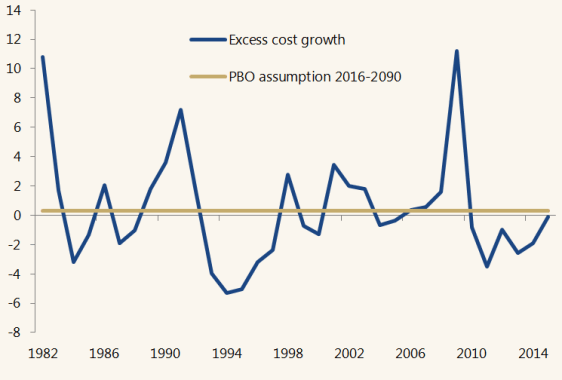
The excess cost component in our projection is, however, based on the average growth observed over 1982-2015. Over the historical period, excess cost is calculated residually—the growth in health care spending that exceeds growth in nominal GDP and “ageing”. In our baseline projection, we do assume that growth in excess cost will be the same as it was, on average, over 1982-2015. Our estimates suggest that there is some mean-reversion in excess cost growth. While excess cost growth has been negative since 2010, it appears to be edging higher, returning to our assumed level (Figure 1). (N.B. The commentary notes that since 2012, “things seem to be changing” with respect to trends in health care spending. While growth in health spending, based on CIHI data, decelerated in 2012 and 2013, CIHI numbers for 2014 and 2015 are CIHI forecasts (which we believe are based on governments’ main estimates/appropriations.)

Figure 1:  Excess cost growth in subnational government health spending, 1982-2015 (%)
Sources:  Canadian Institute for Health Information; Statistics Canada; and Parliamentary Budget Officer.

Like everyone else, we don’t know what excess cost growth will be over the next 30 years. Mean reversion for excess cost growth seems reasonable to us for a baseline. We do consider an alternative scenario in which excess cost growth is zero (Table 8-4), however, this does not change our conclusion about the (un)sustainability of the subnational sector.

Immigration

By construction, population growth feeds into both our revenue and spending projections.

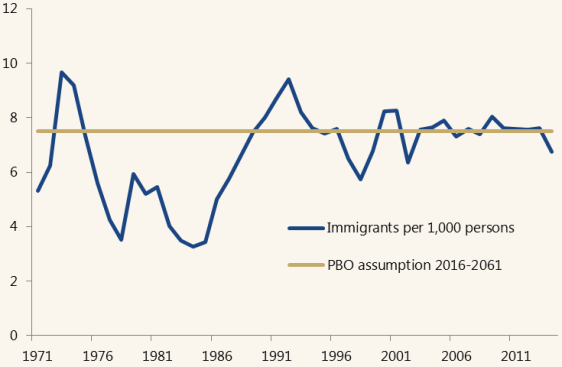
Over the projection, our assumption about the immigration rate is taken from Statistics Canada’s medium population projection (http://www.statcan.gc.ca/pub/91-620-x/91-620-x2014001-eng.pdf) and is not simply the average observed over the past 30 years. Indeed, our assumption is very close to recent immigration rates (Figure 2).

Figure 2:  Immigration rate, 1971-2014
Sources:  Statistics Canada and Parliamentary Budget Officer.

Moreover, in our sensitivity analysis, we do consider a younger or “lower cost” population projection where the immigration rate is 9 immigrants per 1,000 persons (compared to 7.5 in our baseline). Under the lower cost population scenario, federal fiscal room increases from 0.9% to 1.3% of GDP and the subnational fiscal gap falls from 1.5% to 1.1% of gap (Table 8-1). However, our conclusion about federal and subnational sustainability is not changed under this alternative scenario.


Related posts

  • 28 June 2016

    This report extends PBO’s medium-term analysis to assess the fiscal sustainability of Canada’s federal government, subnational governments and public pension plans.

Source: Fiscal Sustaintability Report 2016 – Clarification and Additional Information

Fiscal and Economic Impacts of Curtailing the Planned Tax Cut for Small Businesses

Get the report
Fiscal and Economic Impacts of Curtailing the Planned Tax Cut for Small Businesses.PDF

Summary
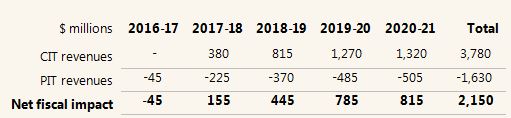
PBO estimates that the Budget 2016 decision to defer reductions in the small business tax rate will reduce federal revenues by $45 million in 2016-17, and increase revenues by $155 million in 2017-18 rising to $815 million in 2020 21 (Summary Table 1).  The initial reduction in revenues reflects timing differences in the tax reference years related to the filing deadlines for personal and corporate income tax returns.

Summary Table 1 – Fiscal impact of changes to the small business tax rate

PBO estimates that by 2020-21, Budget 2016 changes to the small business tax rate will reduce real GDP by $300 million (0.015 per cent) and the level of employment by about 1,240 jobs created or maintained (Summary Table 2).

Summary Table 2 – Economic impact of changes to the small business tax rate

Source: Fiscal and Economic Impacts of Curtailing the Planned Tax Cut for Small Businesses

Budget 2016: Key Issues for Parliamentarians

Get the report
Budget 2016: Key Issues for Parliamentarians.pdf

Summary
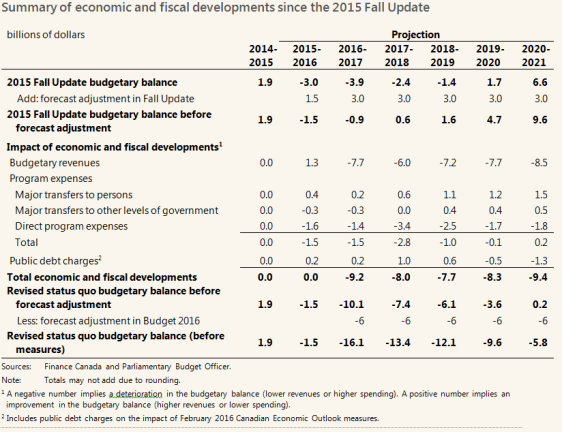
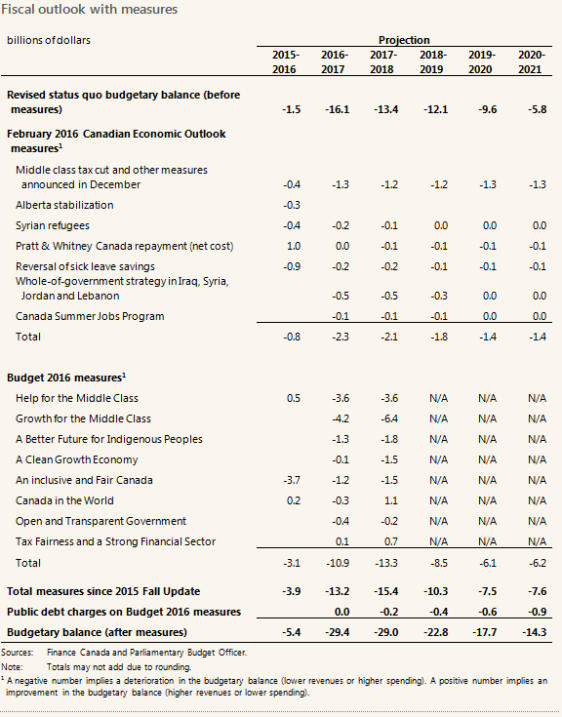
The presentation of the fiscal plan

The Government has made changes to the presentation of its fiscal plan that have made it more difficult for parliamentarians to scrutinize public finances.

  • The Government did not provide detailed tables that identify the impact of changes to its adjustment to the private sector forecast and the effect of policy measures.
  • Budget 2016 shortened the time horizon of cost estimates from 5 years to 2 years.
  • Key fiscal information is being released outside of the budget and Fall Update with no reconciliation between the main documents.

To maintain consistency with past presentation practices, PBO has attempted to compile the standard fiscal planning tables for Budget 2016. However, PBO is unable to provide completed tables due to the lack of information provided in Budget 2016. PBO requested the necessary data from Finance Canada in order to publish completed tables for parliamentarians.

The Government’s adjustment to private sector economic assumptions

Budget 2016 highlights that the use of private sector economic forecasts for fiscal planning “introduces an element of independence in the Government’s fiscal forecast.” However, in Budget 2016, the Government judged it appropriate to lower the private sector forecast of nominal gross domestic product (GDP)—the broadest single measure of the tax base—by $40 billion per year over 2016 to 2020. This forecast adjustment translates into a fiscal impact of $6 billion annually over 2016-17 to 2020-21.

Based on historical experience, PBO believes that the $40 billion per year forecast adjustment to the February 2016 private sector forecast of nominal GDP in 2016 and 2017 is excessive. Indeed, based on the past performance of private sector forecasters, it is likely that the actual outcome for nominal GDP in 2016 and 2017 will exceed the levels used for fiscal planning purposes, resulting in smaller-than-expected budgetary deficits in 2016-17 and 2017‑18, all else being equal.

PBO believes that the Government’s adjustments to the private sector forecast (particularly when the adjustments are excessive and always in the same direction) erode the “element of independence” that is introduced into the fiscal plan by using the average private sector forecast.

PBO is, however, encouraged by the inclusion of alternative growth scenarios in Budget 2016 to gauge the sensitivity of the fiscal track. Budget 2016 also commits the Government to develop alternative growth scenarios and their fiscal implications, communicating the analysis “to Canadians as projections are updated.”

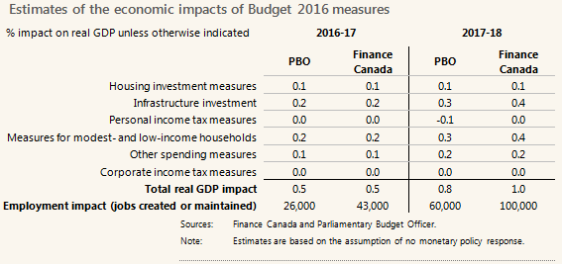
Finance Canada’s estimates of the economic impacts of Budget 2016 measures

Finance Canada has provided estimates of the economic impacts of measures contained in Budget 2016 based on its macroeconomic and fiscal model. However, unlike previous analyses, Finance Canada did not conduct an external assessment of its estimates. For instance, in Budget 2009, to gauge the sensitivitiy of its estimates, Finance Canada asked private sector organizations to calculate comparable fiscal multipliers.

To provide parliamentarians with an independent estimate of the economic impacts of Budget 2016 measures, PBO has used its own macroeconomic and fiscal model. On balance, these estimates are somewhat smaller than Finance Canada’s.

PBO’s estimates assume that measures in Budget 2016 will be implemented as scheduled and as targeted. Aside from the uncertainty surrounding fiscal multiplier estimates, differences in timing (for example by lapsing funds) or in the targeted sector would impact these results.

Source: Budget 2016: Key Issues for Parliamentarians