
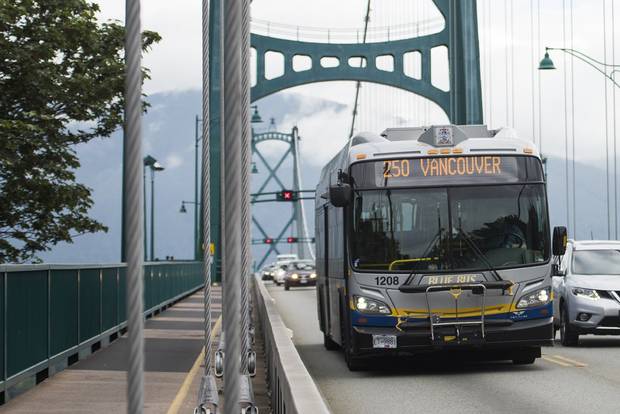
Stagnating transit ridership has officials across Canada stumped

May 27, 2016

Cities across Canada are reporting stagnation and even declines in public transit ridership and officials candidly admit they aren’t exactly sure what’s going on.

Halifax, Montreal, Ottawa, Toronto, Saskatoon, Calgary and Vancouver are among the cities to report a levelling-off of ridership. The Toronto Transit Commission – which, like many other transit systems, had been on a steady ridership climb for years – recently reported that 2015 numbers fell short of expectations and 2016 may show a year-over-year decline.

The commission is warning of a potential $30-million budget shortfall.

The challenging ridership numbers come at an unprecedented moment for public transit in Canada. Cities are trying to cover the operating costs of existing transit systems at the same time as they rush to prepare ambitious expansion plans to capture the billions now on offer from federal and provincial infrastructure programs.

The federal government has said it will take a hands-off approach to doling out its infrastructure cash, transferring it to cities based on ridership and largely leaving it up to cities and provinces to decide on priority projects.

While the federal government is now willing to cover up to 50 per cent of the cost to build new transit lines and extensions, it will ultimately be up to municipalities to produce reasonable ridership forecasts or risk having to cover the operating shortfall for years to come.

“The overall trend we’re seeing in Canada and in the U.S. is ridership is stagnating or [showing] modest growth. That’s the trend,” said Patrick Leclerc, president and CEO of the Canadian Urban Transit Association, which is made up of transit operators from across the country. The association recently held its annual general meeting in Halifax, where ridership issues were discussed.

“The growth is not as strong as it was about five or six years ago. The last decade was major growth. Now it’s slowing down. We are doing the analysis to understand what is happening in each region,” he said.

Limited data on the reasons for the shift mean transit officials are left to speculate as to potential causes. The TTC’s analysis concluded that the slowing economy and employment were the main factors, as well as a recent fare increase.

Other potential factors raised by Canadian municipalities include lower gas prices, the rise of Uber and other ride-sharing services, more people walking and cycling to work and the possibility that more riders aren’t paying as streetcars and buses allow passengers to board rear doors with the expectation that they will tap their transit cards.

The general manager of OC Transpo, the City of Ottawa’s transit system, recently told the city’s transit commission that no one really knows the answer.

“Canada-wide, everyone is down,” said John Manconi earlier this month. “There’s all kinds of theories out there. We hear elasticity. We hear pricing. We hear this. We hear that. I think the best guesstimate anybody can give is a combination of things.”

Mr. Manconi said U.S. cities are reporting similar trends and that the turning point in the data occurred after 2012.

“It appears that, post-2012, everyone started to slide and it appears to be a combination of things. But nobody can pinpoint that it’s exactly this or that that has caused ridership to do what it’s doing,” he said. OC Transpo is promising to release an “aggressive, comprehensive” review of the situation in the coming weeks.

Bruce McCuaig, the CEO of Metrolinx, the Ontario agency responsible for the GO Transit commuter bus and rail system in the Greater Toronto and Hamilton Area, said he believes lower gas prices and slower economic growth are the main factors behind softer ridership numbers. He’s convinced though that the province’s ambitious, multi-billion dollar regional express-rail plan will grow ridership to 127 million per year by 2029, up from 65.7 million in 2015.

“We still feel very strongly that as we provide more service, that what we’ve experienced in the past will continue to occur here, which is we’ll open ourselves up to new markets and we’ll be successful in capturing those markets,” he said.

Mr. McCuaig and Metrolinx are also responsible for the $456-million Union Pearson Express rail line linking Toronto’s downtown to Pearson airport. Initial ridership numbers fell far short of expectations, forcing the agency to slash fares. Promises that the line would quickly become self-financing have been shelved, leaving taxpayers on the hook for a permanent annual subsidy.

Mr. McCuaig said forecasting ridership on that line was a challenge because it is not like GO Transit’s other lines that focus on commuters. However, the fact that ridership has more than doubled since fares were cut in March shows the importance of marketing and choosing the right price.

“Price, of course, matters and you need to make sure that you price the service appropriately,” he said. “When you price something at what I would consider to be a traditional transit fare, governments should expect that there’s going to be a need to provide a subsidy for those kind of services.”

McMaster University geography and earth sciences professor Chris Higgins, who specializes in the study of rapid transit systems, said cities need to carefully weigh the long term cost of expanded service.

“You’ve got to do the right things,” he said.

In addition to issues such as the economy and gas prices that are being raised by transit agencies, Dr. Higgins said he also suspects the demographic impact of his own generation – the millennials – may be a factor.

While many have observed that millennials have been less interested in cars, they may also be moving to the suburbs and driving more as they start to form families. Even if they stay close to transit, he said they may be working from home more or scaling back their hours as they raise young children.

“All these types of factors can combine in a blender, really, and manifest themselves in lower ridership,” he said. “Demographics are behind a lot of these things and tend to be forgotten.”

Source: Stagnating transit ridership has officials across Canada stumped – The Globe and Mail
Canadian PM Trudeau and the loonie: What’s up?

Matein Khalid  http://www.khaleejtimes.com  October 26, 2015

The Canadian dollar’s strength may not last.(AFP)

Even though Trudeau is the son of a political legend Pierre Trudeau, he has no economic or diplomatic policy making experience.

So justin Pierre Trudeau is the new Premier Ministre of Canada. Stephen Harper’s decade in power as the Tory grand vizier in Ottawa was ultimately doomed by the oil shock, the commodities bust, the 2015 Canadian recession and voter discontent in Ontario, Quebec, Alberta and the Atlantic seaboard states. Even though Trudeau is the son of a political legend Pierre Trudeau, he has no economic or diplomatic policy making experience. Yet he will rule the first Liberal majority government in Ottawa since Jean Chretien in the late 1990s.

I can envisage higher public spending as Trudeau (and the electorate) does not share the Conservative Party’s commitment to a balanced budget or a Canadian combat role in the US led military coalition against Daesh in Iraq. This means tensions with Washington beyond the Keystone XL pipeline issue. Trudeau could even resurrect the ghost of his father’s Third Option in a world where China and Russia both challenge the US. All this reinforces my conviction, outlined in my October 12 KT column, that the Canadian dollar’s strength will not last.

So it did not surprise me that the loonie fell against 15 major currencies in Singapore trading the night Trudeau unseated Harper and entered the world stage. Once the Tories resorted to the xenophobic, anti-niqab campaign, I knew Harper had run out of ideas and political risk was going to rise in Canada even as oil prices and economic growth rates/mining capex fell. Trudeau’s C$60 billion infrastructure pledge (funded rise in deficits) and two shock Bank of Canada rate cuts, fiscal populism and higher US economic momentum means a lower loonie. So does the monetary policy divergence between the Yellen Fed and the Poloz Bank of Canada I expect will widen in 2016.

As a personal friend of former Liberal Prime Minister Jean Chretien and father of (a UAE dirham-financed) McGill undergrad, I will not disguise my pleasure at the election result and the softness of the Canadian dollar. Yet the free-fall in the Canadian dollar began in spring 2014 under the conservatives, when I recommended a loonie short at 1.06 (or 94 cents) against the US dollar.

Justin Trudeau will only add fiscal stimulus to Governor Poloz’s ultra-dovish monetary policies which have failed to use loonie depreciation to revive the Canadian economy. The yield on the 10-year Canadian Government bond is a miniscule 1.46 per cent at a time when Canada’s federal and provincial debt burden will only rise. In any case, the oil shock and $500 billion reserve falls in China will force sovereign wealth funds to jettison their holdings of Canadian government debt, which has historically been correlated with a rise in Federal budget deficits. A strategic put option on Canadian dollar government debt makes total sense since the yield on the 10-year Uncle Canuck note could well rise to two per cent or higher by late spring. Does Justin Trudeau’s proposed fiscal stimulus threaten Canada’s AAA credit rating? No.

Canada had the stablest banking system in the Western world in 2008 while Wall Street, the City of London and even the Bahnofstrasse/Paradeplatz went ballistic on subprime debt/credit derivatives. The commodity supercycle and China’s spectacular economic growth since 2001 was a financial windfall for Canada. Yet that was then and this is now. Canada is now in near recession, the commodities bust has just begun, epic consumer debt presages a housing crash, energy loans will gut banking profits and the loonie hit 12-year lows in September. Even though Alberta oil sands boast the world’s third-largest oil reserves, they are high-cost marginal producers who are toast during a global oil glut with no swing producer in either Riyadh or West Texas/North Dakota. Paradoxically, Harper’s “energy superpower” boast now haunts the loonie, since oil and gas is 25 per cent of Canadian exports. Other than the Norwegian kroner, the Canadian dollar is the ultimate Western world petrocurrency now, the political pendulum has shifted back from Alberta to the Liberal bastions of West Montreal.

Federal Election 2015: Voting Records Are Made To Be Broken: LET’S DO IT!!!—Just Saying….

October 19, 2015          Andrew Phillip Chernoff                Just Saying….

Image result for federal election 2015 voteJust-saying

“Paradigm Shift” Needed In Ottawa

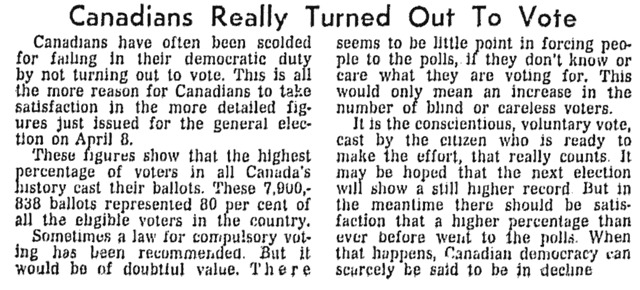
 On April 8, 1963, Canadians set a record unequaled or bettered since, with the highest percentage of voters in history when 80 per cent of all eligible voters in 1963 cast their ballots.

From: The Montreal Gazette – May 13, 1963:

canadalargestvote

Elections Canada reported on Oct. 14th, 2015:
According to the preliminary figures, some 3.6 million electors voted at the advance polls in this general election. This is a 71% increase from the 2,100,855 electors who voted in advance in the 2011 general election.

So far, Canadians from coast-to coast-to coast are going to the polls in record numbers.

Indeed, Canadian democracy can scarcely be said to be in decline it seems, as has been reported recently.

Let’s make this “paradigm shift” happen in Ottawa, David Herle, principal partner at The Gandalf Group, a Toronto-based research and consulting company, urges because Canadians need to feel connected to Parliament and Parliament needs to be seen as relevant to their lives, he outlined in the article, Democracy and the decline of Parliament,  published May 2, 2013.

“Only then can we begin to close the gap between voters and our political institutions with the goal of ultimately strengthening our democracy.”  Herle continued.

Star columnist Bob Hepburn who interviewed Herle for the article, started out by introducing his readers to Herle this way:

Since his days as Paul Martin’s campaign chairman ended, David Herle has given a lot of thought to the state of our democracy and the increasing disconnect between Parliament and Canadians.

And the more Herle studies the issue, the more the former prime minister’s strategist worries.

“There’s a growing gap that could have serious long-term implications for the health of our democracy” from voter turnout to policy formation, Herle says over coffee one recent afternoon in downtown Toronto.

“Voters look at Ottawa these days and feel the issues being debated up there have no impact on their daily lives,” he says.

“There’s also a serious decline in what people expect from government. As well, they’ve stopped looking to government for help and for the most part they don’t think it matters who is in power.”


Hepburn stated in the article that a poll in Fall 2012, “suggested barely 27 per cent of Canadians believe Ottawa is dealing with issues we really care about.”

Most people are worried about daily issues, such as their children’s education, looking after aging parents and getting decent health care. But other than writing cheques to the provinces, Ottawa has opted out of health care, education, transportation and other issues that affect our normal lives.

There are no bold new ideas emerging from Ottawa today that will engage Canadians and make them feel that what happens in Parliament really does play a role in their lives.

No longer is there serious talk in Ottawa of programs that would affect most Canadians directly, such as a national child care strategy, a national plan for big cities or an agreement for natives along the lines of the Kelowna Accord signed by Martin.

Instead, there is a narrow set of issues that Prime Minister Stephen Harper is pursuing and for the most part the opposition parties are adhering to them.

Because voters have stopped looking to Parliament for help, Ottawa has stopped responding to their needs, Herle believes.

Well, Canadians are engaged in this federal election.

The early voting poll results indicated that in resounding fashion.

Whether it is to solidify the Harper’s Conservatives hold on Canada, or to make a statement that change is on the way with an exclamation point; Canadians are alive and well, and have risen to affect what kind of Parliament will play a role in their lives.

The implications for democracy are huge in this federal election when so many Canadians have believed already it was not a waste of time to try to make a difference or to attempt at creating meaningful change through their democratic right to vote.

https://i0.wp.com/canadians.org/sites/default/files/publications/HowToVote-General.jpg

According to Hepburn, Herle is not alone in voicing similar concerns:

Conservative MP Michael Chong (Wellington-Halton Hills), writing in Policy Options magazine in 2010, predicted that “if Parliament is becoming increasingly irrelevant to Canadians and is not central to public debate in Canada, then public policy will be determined in an increasingly non-democratic fashion.”

Chong suggested that reforming question period, the insult-laden daily shouting match that is the only reference most Canadians have with politics, is a necessary first step to restoring Parliament’s relevance. He called for improved decorum, more time both for questions and answers and a requirement that ministers actually respond to questions directed at them.

Chong is correct about the possible consequences for democracy and the role of Parliament. That’s because if voters have given up on Parliament, it means they have lost faith in politicians to look after their interests.

To not exercise your  constitutional right to vote and support a democratic Canadian government, would as Herle suggests,  “provide the ruling party with enormous leeway to abuse parliamentary traditions and procedures.”

Let’s introduce fresh air into our parliament and federal government and take back what is ours as Canadians: our right to decide; thereby beginning to, as Hepburn writes, “… close the gap between voters and our political institutions with the goal of ultimately strengthening our democracy.”

Just Saying……..

…..What’s that??….Who won???…..Who won, what??……Ohhhhhh……

The 1963 federal election resulted in the defeat of the minority Progressive Conservative (Tory) government of Prime Minister John Diefenbaker

The Liberal Party of Lester Pearson ran on a platform promising that, if elected, they would begin their term with “60 Days of Decision” on questions such as introducing a new Canadian flag, reforming health care, and a public pension plan, along with other legislative reforms.

Despite winning 41% of the vote, which is usually sufficient for ensuring the election of a majority government, the Liberals fell five seats short of their target. The Liberals formed a minority government that was dependent on the support of the social democratic New Democratic Party (NDP) in order to pass legislation.

The social-democratic NDP had been formed in 1961 by a socialist party, the Co-operative Commonwealth Federation, and by the Canadian Labour Congress. The 1963 election was the second vote contested by the NDP. The party won slightly fewer votes, and two fewer seats, than they had received in the 1962 election. They were again disappointed by the failure of their new partnership with the labour movement to produce an electoral breakthrough, particularly in the province of Ontario, which has the largest population and the largest number of seats in the House of Commons.

Social Credit was unable to increase its representation in western Canada, and lost four of its Quebec seats – this despite gaining a slightly better share of the vote compared to 1962. Indeed, 1963 represented the highest share Social Credit would ever get. The continuing lop-sided result led to a split in the party when Thompson refused to step aside so that Caouette could become party leader. Caouette and his followers left the Social Credit Party to sit as a separate social credit caucus, the Ralliement des créditistes.=>https://en.wikipedia.org/wiki/Canadian_federal_election,_1963

Anybody see what I see…..I mean….does history really repeat itself???  Of course not….the 1963 Conservatives had a minority government….but a minority government is possible, is it not????? Who will it be….Check back on Tuesday, October 20, 2015.