Canada set to open one of the world’s biggest diamond mines

The Gahcho Kue diamond mine, located about about 280 kilometres northeast of Yellowknife in the Northwest Territories, is shown in a handout photo. Photo Credit: PC / THE CANADIAN PRESS/HO-De Beers Group of Companies

By Levon Sevunts, Radio Canada International

20 September, 2016

Canada is set to cement its position as one of the big players in the global diamond industry with the official opening of the Gahcho Kue diamond mine in the Northwest Territories today.

The mine, which sits in the tundra about 280 kilometres northeast of territorial capital of Yellowknife, is estimated to be one of the 10 biggest diamond mines in the world. It is expected to produce an average of 4.5 million carats a year over the life of the mine, according to De Beers Canada.

Gahcho Kue, a joint venture between De Beers Canada (51 per cent) and Mountain Province Diamonds (49 per cent), is the sixth diamond mine opened in Canada since BHP Billiton’s EKATI Mine in the Lac de Gras region, about 300 kilometres northeast of Yellowknife, started in 1998.

“It will be a very significant contributor to the NWT economy,” Kim Truter, CEO of De Beers Canada, told The Canadian Press.

 A dump truck operates at the Gahcho Kue mine in the Northwest Territories in a handout photo. THE CANADIAN PRESS/HO-De Beers Group of Companies

A dump truck operates at the Gahcho Kue mine in the Northwest Territories in a handout photo. © PC/THE CANADIAN PRESS/HO-De Beers Group of Companies

A socio-economic impact report released by De Beers earlier this months estimated that the operation will provide $6.7 billion to the Canadian economy over its estimated life span of 12 years and has generated $440 million to the territory’s economy so far.

The mine supported more than 2,700 direct and indirect jobs in 2015, with employment at the site representing more than 10 per cent of employment in the NWT’s extractive industries, according to the report.

De Beers expects will need about 530 workers to operate.

Truter said the company has been working to share the benefits of Gahcho Kue with local First Nations and Métis, with impact benefit agreements signed with six groups in the area.

Market volatility

Canada’s diamond production is expanding at a time of growing volatility in the industry. Global sales of polished stones declined 2 per cent last year to $24.7 billion US as demand fell in emerging markets like India and China.

Lower prices and market instability meant a much bigger drop in the sales of rough diamonds, which dropped about 30 per cent to an estimated $13.7 billion US, forcing De Beers to close its Snap Lake diamond mine in December last year at a loss of more than 400 jobs.

But the company is banking on the purchasing power of the Millennial generation (those aged 15-34) who spent more than $25 billion US on diamond jewellery in 2015 in the four largest markets – the US, China, Japan and India, according to The Diamond Insight Report 2016.

“Most encouragingly, however, Millennials are still 10 years away from their most affluent life stage and the generation comprises more than 220 million potential diamond consumers in the four main markets,” said Bruce Cleaver, CEO, De Beers Group.

“The diamond industry therefore has a major opportunity on the horizon but it will only capitalise on it fully if it continues to innovate and invest across the value chain.”

pc_160920_sg30d_rci-gahcho-kue-plant_sn635

An overall view of the priocessing plant at the Gahcho Kue mine in the Northwest Territories is shown in a handout photo. © PC/THE CANADIAN PRESS/HO-De Beers Group of Companies

Diamond superpower

Canada is a relative newcomer to diamond mining.

De Beers, the world’s leading diamond company, started prospecting for diamonds in Canada in the early 1960s. In 1987, a second year geology student Brad Wood who was working for De Beers stumbled upon kimberlite rocks, volcanic rocks that sometimes contain diamonds, while fishing on Attawapiskat River, in the James Bay lowlands of Northern Ontario. The site would eventually become today’s Victor Mine.

But it wasn’t until 1991, when two enterprising geologists, Stewart Blusson and Chuck Fipke, discovered large diamond deposits in the Lac de Gras region of the Northwest Territories that the word learned of Canada’s Arctic diamonds.

Diamond production at the Anglo-Australian mining giant BHP Billiton’s EKATI Mine in the Lac de Gras region, about 300 kilometres northeast of Yellowknife, started in 1998 (Fipke and Blusson, each hold a 10 per cent share in the EKATI Mine).

In 2003, Rio Tinto, another giant British-Australian mining and metals company, opened its Diavik Mine not far from EKATI.

And in 2008, De Beers opened its first Canadian mine at Snap Lake about 220 kilometres northeast of Yellowknife.

Ontario joined Canada’s diamond club in 2008, when De Beers started commercial diamond production at its Victor mine, about 90 kilometres west of the First Nations community of Attawapiskat, in northern Ontario.

And Quebec is expected to join Canada’s diamond producing club once the Renard Mine owned by Stornoway Diamonds becomes operational by the end of 2016.

In less than a decade, Canada was propelled to the diamond mining major leagues, becoming the world’s third-largest producer, behind Botswana and Russia, producing 15 percent of the world’s diamonds by value.

With files from The Canadian Press

Source: Canada set to open one of the world’s biggest diamond mines

People are mad about this photo of a London, Ont., officer using his cell phone while driving — but it’s legal

Hala Ghonaim, Postmedia Network  Published: July 19, 2016      Updated: July 20, 2016

This London police officer was spotted on the phone while behind the wheel of his cruiser Sunday at Wonderland Road and Oxford Street. in London, Ont.

Londons finest talking on his cell phone while driving!

He was in his car, with one hand on the wheel, the other holding a cellphone to his ear, a London police badge on his shoulder.

It’s an image that went viral on social media Sunday, gathering more than 3,500 shares on Facebook, after getting posted online.

“Nobody will ever take distracted driving seriously if the public continue to see this,” said Natasha Anseeuw, who was passing through London at the time of the incident.

She noticed the officer on his cellphone at about 1 p.m. Sunday at the intersection of Wonderland Road and Oxford Street.

A passenger in her car snapped the photo, saving Anseeuw $500 to $1,000 in fines if she had pulled out her own cellphone.

If convicted of distracted driving, a driver may be fined as much as $1,000 fine and get up to three demerit points. Drivers who endanger others because of any distraction, including eating on the road, may face a $2,000 fine, six demerit points, a jail term of six months, and a two-year licence suspension, under the Highway Traffic Act.

However, the same doesn’t apply to the officer in the photo.

“There is an exemption for law enforcement officers when it comes to hand-held devices in relation to using them while on duty,” Const. Sandasha Bough reminded Londoners in a reply to concerned citizens who reached out to police regarding the online post.

Police officers aren’t the only ones who are given the green light. Several government officials, park wardens, conservation officers, and emergency workers also are exempt from the hands-free cellphone law.

London police are allowed to use hand-held devices during rare circumstances, such as connecting with officers regarding description information of a child during an Amber Alert, said Bough.

“Yes, we’re trying to multi-task and we do it on a daily basis,” she said. “But we still encourage our (officers) to pull off the roadway and park their vehicles.”

Bough said London police have not contacted the officer in the photo to determine the urgency of the phone call.

Regardless of the exemption, Anseeuw isn’t convinced.

“People learn from example. Monkey see, monkey do,” she said.

Source: People are mad about this photo of a London, Ont., officer using his cell phone while driving — but it’s legal

Former Nisei Greenwood BC Hockey Goalie Remembers Internment Camp Hockey 

By Mel Tsuji   JANUARY 25, 2013  http://jccabulletin-geppo.ca

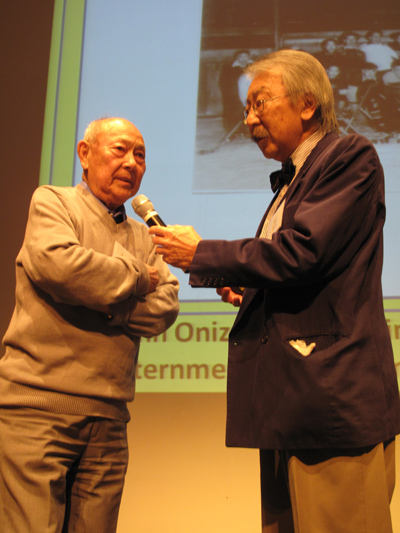
John Onizuka admitted he was very surprised to be honoured at the 50th anniversary celebration last year of the Canadian Japanese Hockey League.

At 85, the retired pharmacist was a long way from his hockey-playing days in Greenwood, BC. He was 14 years of age at the time when he and his family were among the 1,200 Japanese Canadians uprooted from their homes in Vancouver and interned at the then ghost-town of Greenwood.

Yes, you read right. John, or Yuki as he was known then, learned to play hockey in that isolated community.   \

“There was already an indoor rink there, but with natural ice,” he said. “The mayor of Greenwood fixed it up for us young kids because he was so happy about getting 1,200 JCs to his town.”

John recounted those days after he was contacted to be part of the Toronto-based league’s 50th anniversary, because the special night was also to be a “Celebration of Hockey” in the JC community.

He wasn’t able to reach any of his Greenwood team-mates at the time¸ but they soon found about the event and though they’re now well into their eighties several of his hockey-playing buddies showed up for an unexpected mini-reunion.

“I hadn’t seen them since those days, so it was nice to get together,” he said.

The anniversary gathering brought together many of Toronto’s hockey oldtimers, who started playing the game in the 1946-47 period in Toronto, after being released from internment camps and arriving with their families in Ontario.

Over 200 former players and their families came to mark the 50th anniversary of the founding of the Canadian Japanese Hockey League, a four-team league that is still going strong today in Toronto.

But as things turned out, the CJHL, as it’s known today, wasn’t the first for JC players. Newly-arrived Nisei teenagers found the colder, winter temperatures in Toronto better suited than BC for outdoor shinny games. And those informal get-togethers led to the formation of their NHL, the Nisei Hockey League that played on the outdoor rinks of Alexandra and Riverdale Parks in the mid-1940s.

The players who started JC hockey in Toronto were the same skaters from Greenwood, including John Onizuka, who went on to play a year in the newly-formed Nisei League then had to give it up to concentrate on his pharmacy studies at the University of Toronto.

John credits his hockey career to the mayor of Greenwood, W.E. McArthur Sr. who, he said, enthusiastically rebuilt the town’s hotels, stores, businesses and especially the hockey rink.

“He was happy because the town had died in the 1930s, when the copper boom went bust,” he said. “So the JCs brought money, business and new prosperity to the town. It also brought jobs to JCs, who worked in the sawmills, which happened to be owned by the mayor.”

Just before the JCs were bussed to Greenwood, the town only had about 200 residents, down drastically from about 10,000 to 20,000 at the turn of the 20th century.

After the Mayor refurbished the local rink, John joined many other JC teens to take up the game of hockey. “It was surprising how fast the fellows picked up skating,” he said. “I wasn’t a very good skater and because of this I tried goal.”

He said he can’t remember how he got goalie equipment, but thinks because he played goal in lacrosse, he must have used the same equipment for hockey.

He said after the Nisei players learned how to play the game and wanted to get more involved, they decided to make up two teams and join the local “hakujin” (white Greenwood players) league. “There was enough equipment to go around and they really enjoyed playing with us,” he says.

Eventually, John remembers the Nisei playing local teams from nearby towns. There are very few accounts of JCs playing hockey during the internment years, but John’s memories coincide with the scenes in the CBC movie, The War Between Us, that showed a Nisei team from an internment camp playing a local Caucasian team.

John said he played about three years in the Greenwood league, then left with his family in 1945 to move to Ontario.

Source: Former Goalie Remembers Internment Camp Hockey – The Bulletin

NOTE:

On February 4, 2015, John Onizuka peacefully passed away at the age of 87 surrounded by his loving family at Mackenzie Health Hospital in Toronto, Ontario.

Raising low-wage workers out of poverty: What is the government doing?

By Jenny Carson   August 21, 2013  http://rabble.ca

Photo: Bob Simpson/flickr

That there has been a dramatic rise in the number of working poor in Canada is incontestable. In 2013, one in ten Canadians earn minimum wages, more than double the number ten years ago; half of those workers are in Ontario. A recent study conducted jointly by McMaster University and United Way Toronto found that barely half of all workers in the GTA-Hamilton area are employed in permanent full-time positions that provide benefits and a modicum of job security.

The explosion of precarious or insecure employment and the subsequent growth in income inequality are the result of both long and short-term changes in the labour market. The outsourcing of good-paying manufacturing jobs to the developing world, the expansion of the low-wage service sector, reckless Wall Street spending and the assault on unions have all contributed to the current plight of the working class. But also important is the erosion of state support for collective bargaining and basic employment protections.

Governments at all levels have abdicated their responsibility to balance corporate and worker interests to maintain a healthy and balanced economy. The consequences for workers — in the form of shrinking wages, increased job insecurity and declining health — have been disastrous.

It is with cautious optimism then that we should greet recent municipal, provincial and federal-level efforts to address worker poverty and income inequality. On July 19, Toronto City Council voted 28-3 to update the City’s Fair Wage Policy. First established in 1893, the Fair Wage Policy requires contractors and suppliers for the city to pay their workers the prevailing market wages and benefits in their field of employment or, for unionized fields, union rates. The policy was designed to protect workers from unscrupulous contractors trying to underbid their competitors by paying their workers less than the prevailing wage rates, and to enhance the city’s reputation as an ethical employer. However, because the rates had not been updated since 2003, until last month many of the city’s “fair wages” fell below the Ontario minimum wage of $10.25 an hour.

The July 19 vote to update the fair wage rates reveals that a majority of councilors understand that is bad policy for the city, as an employer, to add to the growing ranks of the working poor (this excludes councilors like Denzil Minnan-Wong who sees as any kind of wage control as “social engineering”) Under the new rates, contractors providing janitorial services for the city must pay their workers at least $12.43 an hour. Cleaners in the private sector in contrast almost always earn minimum wages.

Unfortunately, however, a fair wage is not a living wage, which the Canadian Centre for Policy Alternatives estimates to be $17.76 an hour in Toronto (a living wage covers the cost of basic necessities such as shelter, food, clothing and transportation). The city’s fair wage rate for cleaners would barely raise a worker out of poverty and, if she or he were supporting a family as is often the case, would in fact leave them in poverty. This then is only a first step if the city truly wants to be an ethical employer.

On July 19 City Council also agreed to devise a “job quality assessment tool” against which any jobs being contracted out would be measured. The basic idea behind this initiative is to ensure that the city is not turning good jobs into bad jobs through the contracting-out process. As well as considering wage levels, the tool will include other criteria such as worker health and safety, skills and training opportunities, working conditions and other factors which determine job quality. Ideally, the job quality assessment tool, which will be considered by Council at the end of this year, will provide some protection for city workers who will no doubt face another round of privatization pressure as Mayor Ford runs for re-election in 2014. How successful this initiative will be depends on whether workers and their unions are given a voice in its formulation and implementation, and it’s not yet clear if they will be.

At the provincial level, the Wynne government recently announced the creation of a minimum wage advisory panel that will consider how to calculate increases to Ontario’s minimum wage. The six-member panel, chaired by University of Toronto Industrial Relations and Human Resources professor Anil Verma includes representatives from labour, business and youth, the latter of whom are disproportionately represented among low-wage and precariously employed workers.

The minimum wage in Ontario has been frozen at $10.25 for the last three years, and will remain so for at least the next six months as the panel conducts public consultations and studies how other jurisdictions calculate minimum wage rates. Anti-poverty activists are justifiably angry that it has taken the Liberals more than two years to set up the panel, and wonder why, unlike many other provinces, Ontario does not provide automatic annual minimum wage increases pegged to inflation. Ontario Labour Minister Yasir Naqvi’s assertion that we need a “made-in-Ontario” solution raises more questions than answers.

Yet once again there is reason to be hopeful that this initiative will help low-wage workers, many of whom are newcomers to Canada climb out of poverty and contribute to the economic recovery we so desperately need (remember, low-wage workers tend to spend every cent they earn in the local economy). The panel will most certainly recommend a wage increase and, perhaps just as importantly, develop a more predictable formula for raising the minimum wage in the future (in the past this has been done on an arbitrary, ad hoc basis that resulted in a nine-year wage freeze under the Conservatives). Only time will tell whether the panel’s political masters, whoever they might be next spring support a progressive overhaul of the system.

Despite the chilly climate for workers on Parliament Hill, there may also be reason to hope for change at the federal level. Next spring NDP Member of Parliament for Toronto Davenport Andrew Cash will introduce a private member’s bill to expand EI access to part-time and self-employed workers and to eliminate the use of unpaid interns. Cash has a personal as well as professional interest in the issue as someone who spent most of his adult life precariously employed in the creative sector. His bill would modernize a program that no longer reflects the employment realities of many Canadians, and make it harder for employers to engage in unethical and often illegal practices such as hiring workers as “independent contractors” so as to avoid obligations under employment law. It would also reform a pension system that currently consigns large numbers of elderly Canadians to poverty.

Cash understands that legislative changes to EI are only part of the solution. He envisions a multi-pronged approach that includes affordable daycare (along the lines of Quebec), social programs to fight poverty, and decent and affordable public transit. While the chances of Cash’s bill passing under a Conservative government are next to zero, his laudable initiative has the potential to start a public dialogue about how the EI system is failing Canadian workers. It is also, as Cash explains, an issue which “spans the employment silos and class divides” that traditionally divides workers. His bill has the potential to mobilize a broad cross-section of the working class, from journalists to taxi drivers to computer programmers. Its long-term success depends in large part on whether this mobilization takes place.

Together, these initiatives reveal that government (or at least some within government) is finally beginning to heed worker and progressive demands for action that will stem the alarming growth of job precarity and worker poverty in Canada.

It is far from clear whether any of these initiatives will lead to real change for workers, but collectively they suggest that at least some of our elected officials understand that government has a stake in creating a more equitable society.   

Jenny Carson is Associate Professor in the Department of History at Ryerson University.

Photo: Bob Simpson/flickr