Back To The Future: Canada’s Future From The Past=> The Five Eyes

The United Kingdom – United States of America Agreement (UKUSA, /juːkuːˈsɑː/ ew-koo-SAH)[1][2] is a multilateral agreement for cooperation in signals intelligence between the United Kingdom, the United States, Canada, Australia, and New Zealand. The alliance of intelligence operations is also known as Five Eyes.[3][4][5][6][7] In classification markings this is abbreviated as FVEY, with the individual countries being abbreviated as GBR, USA, CAN, AUS, and NZL respectively.[8]

Emerging from an informal agreement related to the 1941 Atlantic Charter, the secret treaty was renewed with the passage of the 1943 BRUSA Agreement, before being officially enacted on 5 March 1946 by the United Kingdom and the United States. In the following years, it was extended to encompass Canada, Australia and New Zealand. Other countries, known as “third parties”, such as West Germany, the Philippines and several Nordic countries also joined the UKUSA community.[9][10]

Much of the sharing of information is performed via the ultra-sensitive STONEGHOST network, which has been claimed to contain “some of the Western world’s most closely guarded secrets”.[11] Besides laying down rules for intelligence sharing, the agreement formalized and cemented the “Special Relationship” between the UK and the USA.[12][13]  

Due to its status as a secret treaty, its existence was not known to the Prime Minister of Australia until 1973,[14] and it was not disclosed to the public until 2005.[13] On 25 June 2010, for the first time in history, the full text of the agreement was publicly released by Britain and the United States, and can now be viewed online.[9][15] Shortly after its release, the seven-page UKUSA Agreement was recognized by Time magazine as one of the Cold War‘s most important documents, with immense historical significance.[13]

Currently, the global surveillance disclosure by Edward Snowden has shown that the intelligence-sharing activities between the First World allies of the Cold War are rapidly shifting into the digital realm of the Internet.[16][17][18

The Five Eyes are cooperating with various 3rd Party countries in at least two groups:

  • The “Nine Eyes”, consisting of the Five Eyes plus Denmark, France, the Netherlands and Norway.
  • The “Fourteen Eyes”, consisting of the same countries as the Nine Eyes plus Germany, Belgium, Italy, Spain and Sweden.[44] The actual name of this group is SIGINT Seniors Europe (SSEUR) and its purpose is coordinating the exchange of military signals intelligence among its members.[45]

In 2013, Canadian federal judge Richard Mosley strongly rebuked the Canadian Security Intelligence Service (CSIS) for outsourcing its surveillance of Canadians to overseas partner agencies. A 51-page ruling says that the CSIS and other Canadian federal agencies are illegally enlisting U.S. and British allies in global surveillance dragnets, while keeping domestic federal courts in the dark.[56][57][58]

NSA’s relationship with Canada’s CSEC                                                      
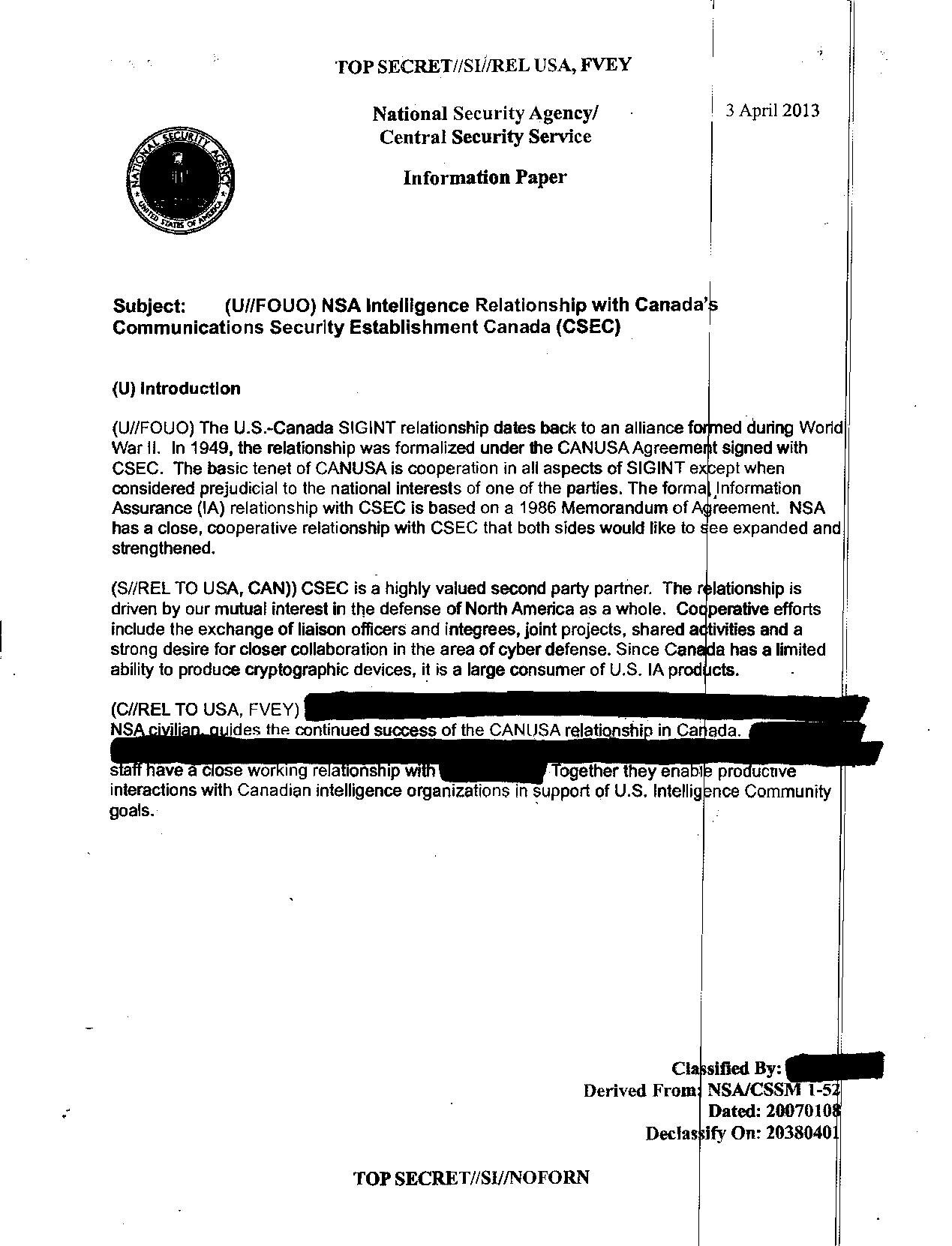
 

https://upload.wikimedia.org/wikipedia/commons/thumb/3/3c/NSA_Canada_relationship.pdf/page1-1269px-NSA_Canada_relationship.pdf.jpg


https://upload.wikimedia.org/wikipedia/commons/thumb/3/3c/NSA_Canada_relationship.pdf/page2-1269px-NSA_Canada_relationship.pdf.jpg

NSA document on a joint espionage operation with Canada’s CSEC agency during the G8 and G20 summits in Toronto in 2010

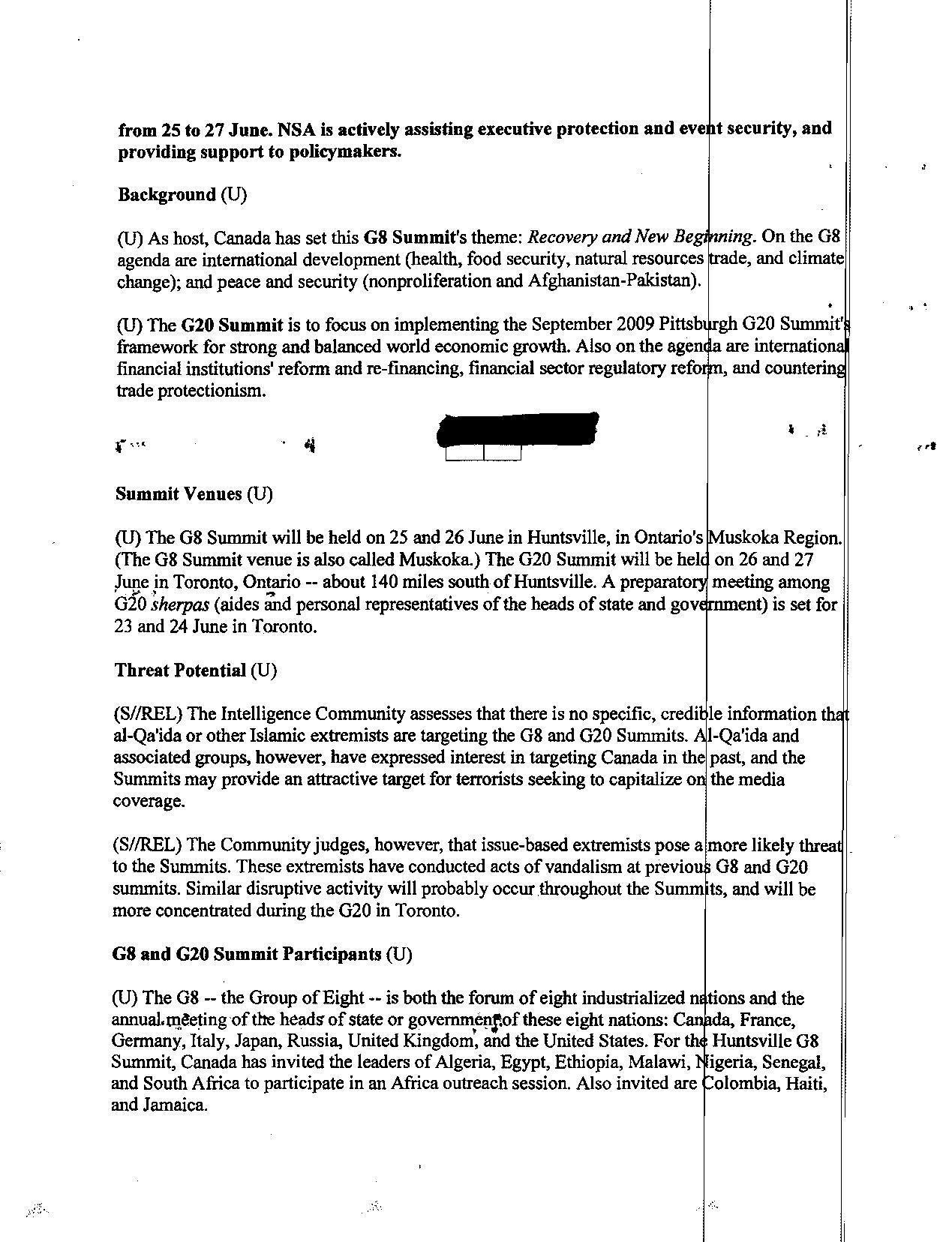
https://upload.wikimedia.org/wikipedia/commons/thumb/b/b2/NSA_Canada_G8_G20.pdf/page1-1266px-NSA_Canada_G8_G20.pdf.jpg


https://upload.wikimedia.org/wikipedia/commons/thumb/b/b2/NSA_Canada_G8_G20.pdf/page2-1269px-NSA_Canada_G8_G20.pdf.jpg

https://upload.wikimedia.org/wikipedia/commons/thumb/b/b2/NSA_Canada_G8_G20.pdf/page3-1266px-NSA_Canada_G8_G20.pdf.jpg

https://upload.wikimedia.org/wikipedia/commons/thumb/b/b2/NSA_Canada_G8_G20.pdf/page4-1269px-NSA_Canada_G8_G20.pdf.jpg

Push To Have New Zealand Cut Lose From Trans- Pacific Partnership Agreement

Groser and Key must reject ongoing US assault on Pharmac in the TPPA

Posted on September 11, 2013 by Admin2    http://www.nznotforsale.org/

New Picture (6)

‘There are further reports that the US informally proposed a two-tier approach to pharmaceuticals during the recent Brunei round’, said Professor Jane Kelsey, referring to an article in Inside US Trade published yesterday.

The US continues to target the availability of generic medicines on which the Pharmac system relies.

The revised US proposal would give Malaysia, Vietnam, Peru and Brunei more flexibility on the grounds they are non–OECD countries – even though Brunei’s per capita GDP is over US$50,000 and New Zealand’s is US$28,800.

Those countries would still have to accept stricter intellectual property rules than they have now and may eventually have to accept the extreme version the US wants to impose on the TPPA countries that are part of the OECD.

‘This two-tier approach does not mean they suddenly have a conscience about the impact of the TPPA on access to affordable medicines in poorer countries of the TPP’, said Professor Kelsey.

‘The US is clearly using the TPPA to establish a “gold standard” for its drug companies across the OECD’, according to Professor Kelsey. ‘They don’t give a damn about what that means for access to affordable medicines and the sustainability of our public health system or that of any other country.’

New Zealand, along with Australia, Chile, Canada, Malaysia and Singapore have reportedly made a much more conservative counter-proposal.

This counter-proposal is likely to be discussed at the forthcoming ‘intersessional’ meeting on intellectual property in Mexico from 23 September to 2 October and probably at the meeting of chief negotiators immediately before that in Washington.

‘The US may tactically hold back the discussion of its own proposal until after that meeting. They can then elevate it directly to the level of ministers and leaders when they meet in Bali during APEC in early October and in Brunei immediately after that for ASEAN’, Professor Kelsey observed. ‘Ominously, the US is expected to chair those meetings.’

‘Trade Minister Groser and Prime Minister Key must stand firm behind the New Zealand negotiators. They cannot give way to US demands and still claim to have defended Pharmac’s “fundamentals’’.’


TPPA goes into overdrive and underground

Moves to get the Trans-Pacific Partnership Agreement (TPPA) to the point of sign-off by the end of the year went into overdrive at the round just ended in Brunei, according to Professor Jane Kelsey who was present as a ‘stakeholder’ for the final few days.

Only the most problematic chapters met in Brunei. They included intellectual property (which discussed patents on medicines), state-owned enterprises, environment, investment and market access for goods, including agriculture.

New Picture (20)

Most other chapters are ‘closed’. That means the technical work is complete and ready for political deals on the controversial matters that remain unresolved.

‘Some countries report that little progress was made in Brunei. But that should not lull anyone into complacency’, Professor Kelsey warned.

‘While many negotiators were exhausted and some were incredulous about concluding their chapter by the end of the year, the politicians seem determined.’

‘To have any chance of pulling off an outcome, groups negotiating some chapters will have to meet every month between now and December.’

Detective work indicates that informal ‘inter-sessional’ meetings on six chapters* are scheduled within the next four weeks – all in North America.

‘“Inter-sessional” is a misnomer’, says Professor Kelsey, ‘because they are not planning any more formal sessions. There will be no access for the media or stakeholders to these smaller meetings.’

‘Past inter-sessionals have been shrouded in secrecy to ensure we can’t find out what’s happening and we don’t have access to those negotiators who see value in talking with us.’

‘The last three years of the TPPA have been widely condemned for their lack of transparency. The process is now going further underground’.

The chief negotiators will apparently meet in Washington DC from 22-24 September, with the US in the chair. They will report to their trade ministers who meet on the margins of APEC in Bali in early October.

The ministers are expected to begin the political horse-trading then. They will report, in turn, to their leaders who are in Bali on 6-7 October for APEC and immediately after that in Brunei for the ASEAN summit. Obama will apparently chair their meetings.

‘It remains to be seen what they can settle by December. The US is expected to table a new text on patents for medicines. There are rumours that this aims to divide and rule its opponents and could leave New Zealand out in the cold.’

‘But the biggest obstacle to a deal is the US-driven chapter on state-owned enterprises, where discussions on the text have barely begun. A new version that combines US and Australian proposals is beset with political, conceptual and technical problems. Almost no progress was made on it in Brunei.’

New Picture (21)

‘Finishing in December may mean the Obama administration has to give this chapter away’, Professor Kelsey speculated. ‘Yet the SOE chapter has been a centrepiece of their sales pitch to Congress on the TPPA. Without it, Congress may refuse to give the President “fast track” authority and retain their power to pick apart any final deal.’

‘There are still many twists and turns to go in these negotiations. The problem is that we will have even less chance to know what they are and what political deals are being made to eliminate them.’

* These appear to be labour (especially on enforcement) in Ottawa; intellectual property (including patents for medicines) Mexico City; e-commerce (including privacy and data protection) San Francisco; investment (mainly schedules of exclusions), location unknown; technical barriers to trade (labelling and technical standards) Mexico City; legal issues (including medical pricing and tobacco) Washington DC.