
Tag Archives: new democrats
Federal Election 2015: Voting Records Are Made To Be Broken: LET’S DO IT!!!—Just Saying….
October 19, 2015 Andrew Phillip Chernoff Just Saying….

“Paradigm Shift” Needed In Ottawa
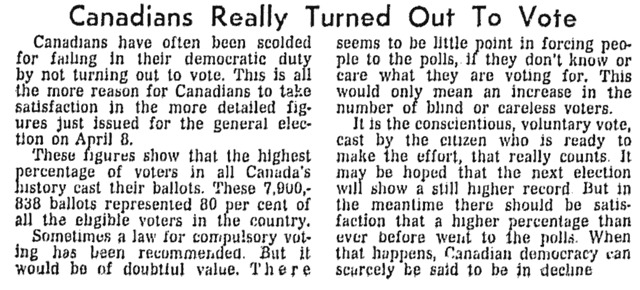
On April 8, 1963, Canadians set a record unequaled or bettered since, with the highest percentage of voters in history when 80 per cent of all eligible voters in 1963 cast their ballots.
From: The Montreal Gazette – May 13, 1963:
Elections Canada reported on Oct. 14th, 2015:
According to the preliminary figures, some 3.6 million electors voted at the advance polls in this general election. This is a 71% increase from the 2,100,855 electors who voted in advance in the 2011 general election.
So far, Canadians from coast-to coast-to coast are going to the polls in record numbers.
Indeed, Canadian democracy can scarcely be said to be in decline it seems, as has been reported recently.
Let’s make this “paradigm shift” happen in Ottawa, David Herle, principal partner at The Gandalf Group, a Toronto-based research and consulting company, urges because Canadians need to feel connected to Parliament and Parliament needs to be seen as relevant to their lives, he outlined in the article, Democracy and the decline of Parliament, published May 2, 2013.
“Only then can we begin to close the gap between voters and our political institutions with the goal of ultimately strengthening our democracy.” Herle continued.
Star columnist Bob Hepburn who interviewed Herle for the article, started out by introducing his readers to Herle this way:
Since his days as Paul Martin’s campaign chairman ended, David Herle has given a lot of thought to the state of our democracy and the increasing disconnect between Parliament and Canadians.
And the more Herle studies the issue, the more the former prime minister’s strategist worries.
“There’s a growing gap that could have serious long-term implications for the health of our democracy” from voter turnout to policy formation, Herle says over coffee one recent afternoon in downtown Toronto.
“Voters look at Ottawa these days and feel the issues being debated up there have no impact on their daily lives,” he says.
“There’s also a serious decline in what people expect from government. As well, they’ve stopped looking to government for help and for the most part they don’t think it matters who is in power.”
Hepburn stated in the article that a poll in Fall 2012, “suggested barely 27 per cent of Canadians believe Ottawa is dealing with issues we really care about.”
Most people are worried about daily issues, such as their children’s education, looking after aging parents and getting decent health care. But other than writing cheques to the provinces, Ottawa has opted out of health care, education, transportation and other issues that affect our normal lives.
There are no bold new ideas emerging from Ottawa today that will engage Canadians and make them feel that what happens in Parliament really does play a role in their lives.
No longer is there serious talk in Ottawa of programs that would affect most Canadians directly, such as a national child care strategy, a national plan for big cities or an agreement for natives along the lines of the Kelowna Accord signed by Martin.
Instead, there is a narrow set of issues that Prime Minister Stephen Harper is pursuing and for the most part the opposition parties are adhering to them.
Because voters have stopped looking to Parliament for help, Ottawa has stopped responding to their needs, Herle believes.
Well, Canadians are engaged in this federal election.
The early voting poll results indicated that in resounding fashion.
Whether it is to solidify the Harper’s Conservatives hold on Canada, or to make a statement that change is on the way with an exclamation point; Canadians are alive and well, and have risen to affect what kind of Parliament will play a role in their lives.
The implications for democracy are huge in this federal election when so many Canadians have believed already it was not a waste of time to try to make a difference or to attempt at creating meaningful change through their democratic right to vote.

According to Hepburn, Herle is not alone in voicing similar concerns:
Conservative MP Michael Chong (Wellington-Halton Hills), writing in Policy Options magazine in 2010, predicted that “if Parliament is becoming increasingly irrelevant to Canadians and is not central to public debate in Canada, then public policy will be determined in an increasingly non-democratic fashion.”
Chong suggested that reforming question period, the insult-laden daily shouting match that is the only reference most Canadians have with politics, is a necessary first step to restoring Parliament’s relevance. He called for improved decorum, more time both for questions and answers and a requirement that ministers actually respond to questions directed at them.
Chong is correct about the possible consequences for democracy and the role of Parliament. That’s because if voters have given up on Parliament, it means they have lost faith in politicians to look after their interests.
To not exercise your constitutional right to vote and support a democratic Canadian government, would as Herle suggests, “provide the ruling party with enormous leeway to abuse parliamentary traditions and procedures.”
Let’s introduce fresh air into our parliament and federal government and take back what is ours as Canadians: our right to decide; thereby beginning to, as Hepburn writes, “… close the gap between voters and our political institutions with the goal of ultimately strengthening our democracy.”
Just Saying……..
…..What’s that??….Who won???…..Who won, what??……Ohhhhhh……
The 1963 federal election resulted in the defeat of the minority Progressive Conservative (Tory) government of Prime Minister John Diefenbaker.
The Liberal Party of Lester Pearson ran on a platform promising that, if elected, they would begin their term with “60 Days of Decision” on questions such as introducing a new Canadian flag, reforming health care, and a public pension plan, along with other legislative reforms.
Despite winning 41% of the vote, which is usually sufficient for ensuring the election of a majority government, the Liberals fell five seats short of their target. The Liberals formed a minority government that was dependent on the support of the social democratic New Democratic Party (NDP) in order to pass legislation.
The social-democratic NDP had been formed in 1961 by a socialist party, the Co-operative Commonwealth Federation, and by the Canadian Labour Congress. The 1963 election was the second vote contested by the NDP. The party won slightly fewer votes, and two fewer seats, than they had received in the 1962 election. They were again disappointed by the failure of their new partnership with the labour movement to produce an electoral breakthrough, particularly in the province of Ontario, which has the largest population and the largest number of seats in the House of Commons.
Social Credit was unable to increase its representation in western Canada, and lost four of its Quebec seats – this despite gaining a slightly better share of the vote compared to 1962. Indeed, 1963 represented the highest share Social Credit would ever get. The continuing lop-sided result led to a split in the party when Thompson refused to step aside so that Caouette could become party leader. Caouette and his followers left the Social Credit Party to sit as a separate social credit caucus, the Ralliement des créditistes.=>https://en.wikipedia.org/wiki/Canadian_federal_election,_1963
Anybody see what I see…..I mean….does history really repeat itself??? Of course not….the 1963 Conservatives had a minority government….but a minority government is possible, is it not????? Who will it be….Check back on Tuesday, October 20, 2015.
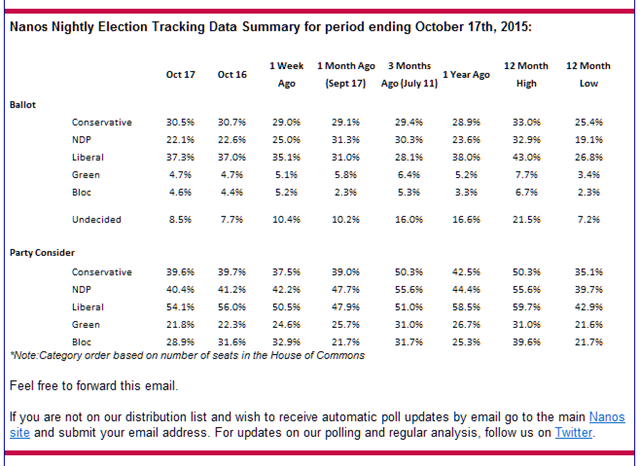
Nanos Nightly Ballot Tracking: Liberal (37.3%), Conservative (30.5%), NDP (22.1%), Green (4.7%) – Three-day Tracking Ending October 17th
Liberal seven point advantage continues over closing weekend
- National Ballot – Tracking over the closing weekend has the Liberals with a seven point advantage over the Conservatives. The Liberals have 37.3% support, the Conservatives 30.5%, the NDP 22.1%, and the Greens are at 4.7% nationally.
- One Month Change – Compared to a month ago, the Liberals are up six points, the NDP are down nine points, and the Conservatives are up two points. The Liberals have been the primary beneficiaries of the decline in NDP support over the course of the campaign and over the past month the Liberal – NDP trend lines have been mirror images of themselves.
- Larger Sample – Please note that today’s three day rolling average is based on 2,000 interviews (800 interviews Saturday, 800 interviews Friday and 400 interviews Thursday).
- Last Report – Nanos will continue to do tracking today (Sunday) and will release its last election survey this evening ahead of the Elections Canada deadline. No new polling can be released on Election Day but polls released prior to Election Day can be reported on Election Day (Section 328 of The Canada Elections Act).
The team at Nanos in conjunction with Klipfolio have launched our new live political data portal where you run the numbers you want and can explore the trends and data you need. This is part of our campaign, not only to provide the most reliable data to Canadians but to let them use it as they wish. We were the first to do nightly tracking and now we are the first research organization to post live public opinion data for Canadians.
We were the first to do nightly tracking and now we are the first research organization to post live public opinion data for Canadians. Here’s the link to check it out
To view the detailed tracking stats please visit our website.
Methodology
A national random telephone (land + cell) survey using live agents of 1,200 Canadians is conducted by Nanos Research throughout the campaign over a three day period. Each evening a new group of 400 eligible voters are interviewed. A double sample of 800 interviews, per night, were conducted on Friday and Saturday. Today’s daily tracking figures are based on a three-day rolling sample comprised of 2,000 interviews. To update the tracking a new day of interviewing is added and the oldest day dropped. The margin of error for a survey of 2,000 respondents is ±2.2%, 19 times out of 20.
The respondent sample is stratified geographically and by gender. The data may be weighted by age according to data from the 2011 Canadian Census administered by Statistics Canada. Percentages reported may not add up to 100 due to rounding. The research has been registered with the Marketing Research and Intelligence Association of which Nanos is a member.
Results are based on the three day calling window October 15 to 17, 2015. The research was commissioned by CTV News and The Globe and Mail.
49th Parallel Has Canadians Confused About Voting In Federal Elections In Canada….Just Saying….
October 15, 2015 Andrew Chernoff

It has occurred to me that one of the reasons most Canadians have no logic or reason behind their voting in federal elections is that most Canadians live near the Canada-U.S. border.
And some do not vote at all, then grumble and complain for four more years like they had no way to influence which federal party would be the government of Canada. That is why it is so important to vote.
An estimated 75 percent of Canadians live within 161 kilometers (100 miles) of the U.S. border, according to http://travel.nationalgeographic.com.
According to CBC News, 90 Per cent of Canadians who live within 160 kilometres of the U.S. border as of 2009, http://www.cbc.ca/news/canada/by-the-numbers-1.801937.
About four-fifths of the population lives within 150 kilometres (93 mi) of the contiguous United States border.[200] Approximately 80 percent of Canadians live in urban areas concentrated in the Quebec City–Windsor Corridor, the British Columbia Lower Mainland, and the Calgary–Edmonton Corridor in Alberta.[201, according to https://en.wikipedia.org/wiki/Canada.
I for one will admit I have followed U.S. politics closely since the summer of 1972 when my family moved from Kitimat, B.C. to Midway B.C. and I had access to NBC, ABC and CBS, and became educated in their political system and it is striking.
When I lived in Kitimat B.C. and Ocean Falls B.C. (where I was born) the main television station was CBC and it was Canadian politics I became acquainted with and watched from time to time, due to my parents, unless I went outside to play and be a kid.
You can’t blame all those Canadians from being unduly influenced by our Southern neighbours, especially when it comes to politics and voting in elections. There are great differences between U.S. and Canadian political systems when voting.
Here is a brief explanation of some differences between the United States and Canada:
From: http://www.parl.gc.ca:
- In the United States, the president, the senators and the representatives are elected for different periods, it can happen, and often does, that the president belongs to one party while the opposing party has a majority in either the Senate or the House of Representatives or both. So for years on end, the president may find his or her legislation and policies blocked by an adverse majority in one or both houses. The president cannot appeal to the people by dissolving either house, or both: he or she has no such power, and the two houses are there for their fixed terms, come what may, until the constitutionally fixed hour strikes.
- The Canadian prime minister did not appear in the written Constitution until 1982. It still contains not one syllable on prime ministerial qualifications, the method of election or removal, or the prime minister’s powers (except for the calling of constitutional conferences). Nor is there anything on any of these matters in any Act of Parliament, except for provision of a salary, pension and residence for the person holding the recognized position of first minister. Everything else is a matter of established usage, of “convention.” There is nothing in any law requiring the prime minister or any other minister to have a seat in Parliament; there is just a custom that he or she must have a seat, or get one within a reasonable time. There is nothing in any law to say that a government that loses its majority in the House of Commons on a matter of confidence must either resign (making way for a different government in the same House) or ask for a fresh general election.
- While the United States has a republic form of government, Canada has a a constitutional monarchy developed in the United Kingdom, where the democratically elected parliaments, and their leader, the prime minister, exercise power, with the monarchs having ceded power and remaining as a titular position.
- In Canada, all important legislation is introduced by the government, and all bills to spend public funds or impose taxes must be introduced by the government and neither house can raise the amounts of money involved. As long as the government can keep the support of a majority in the House of Commons, it can pass any legislation it sees fit unless an adverse majority in the Senate refuses to pass the bill (which very rarely happens nowadays). If it loses its majority support in the House of Commons, it must either make way for a government of another party or call a fresh election. If it simply makes way for a government of a different party, then that government, as long as it holds its majority in the House of Commons, can pass any legislation it sees fit, and if it loses that majority, then it, in its turn, must either make way for a new government or call a fresh election. In the United States, president and Congress can be locked in fruitless combat for years on end. In Canada, the government and the House of Commons cannot be at odds for more than a few weeks at a time. If they differ on any matter of importance, then, promptly, there is either a new government or a new House of Commons.
In Canada, when a federal political party forms government, the political leader of that political party automatically becomes the prime minister. There is no separate election in Canada to elect a prime minister like there is in the United States.
In Canada, pollsters ask Canadians who they would prefer as prime minister, like it matters: the prime minister is the horse or donkey, and the rest of those that are elected follow along.
The prime minister as leader of that cart literally is along for the ride….Well o.k., I may have simplified it a little….. Still, that successful party leader literally rides the coattails of his/her party elected members of parliament to the powerful position of prime minister. And that is the short of it.
Instead of the winning federal party determining a leader of the government from their ranks that have been elected, the parties at a convention of the federal party, elect a person who will lead their party into an election and if successful, that person will then as leader of the party, become Canada’s prime minister.
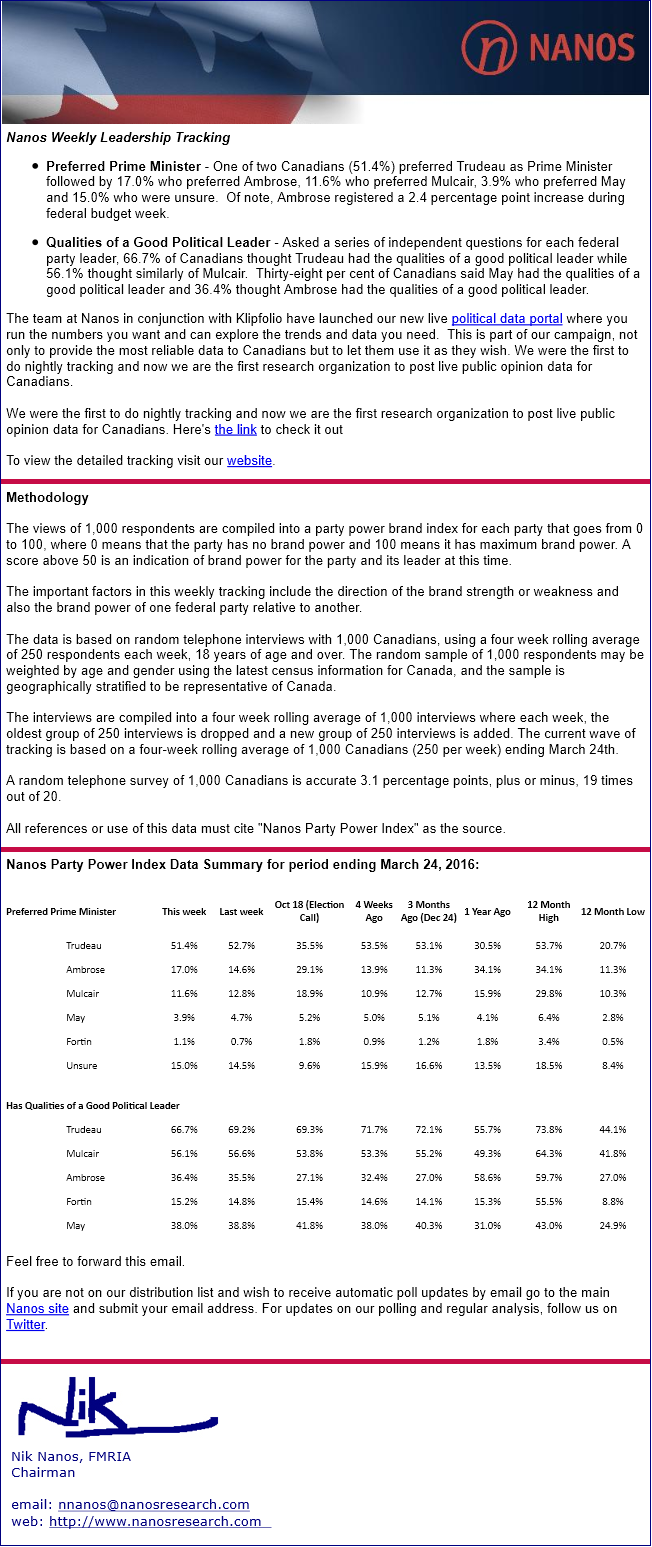
Nanos Research recently asked Canadians in a poll who they preferred for prime minister. The results were Trudeau was the choice of 33.0% Canadians followed by Harper at 28.8%, Mulcair at 19.9%, May at 6.4%, Duceppe at 1.8% and 10.3% of Canadians were unsure. (Three-day tracking: Oct 10, 11 & 13/15)
What happens if you like the political party but not the leader? Most Canadians have little or no say in the election of a future prime minister of a federal political party, even though all Canadians have an opportunity to vote for a political party in a federal election.
It’s all about voting strategy, eh?
Which is more important to Canadians:
- The attraction of the federal party leader in determining who to vote for;
- Or, the federal party policies and platform in an election, damn the leader?
- And to make things more interesting, your vote is only cast for the party representative in your federal constituency: what if you don’t believe that party candidate is the best person to represent your constituents? Is that important?
- Or, are you voting for the federal party leader using the constituent candidate of that party as the leaders’ proxy?
- Or, are you in effect voting the federal party when you vote for that particular party candidate not caring whether the person is the best person or not, to represent your constituency?
So, Canadians don’t vote separately for a federal political party and prime minister. And I will throw this in just to create more frustration: Canadians do not elect Senators that take part in Canada’s political system. The prime minister appoints those sitting federal government politicians; or non-sitting as it turns out most of the time.
I sincerely believe that the 80-90 per cent of all Canadians that live within 100 miles of the Canada-U.S. border have been brainwashed by too much of a political romance with United States politics because it is more appealing, entertaining, logical and sensible.
Canadians may say, may claim, they understand, when they vote, why they voted the way they did, and what it means, or could mean, or hope it meant…..but do they…..I mean….it isn’t as easy as putting an “X” by my constituency candidate is it? What if I like the candidate but not the party? And should I vote for the “right party” so the constituency has a member of parliament that is part of the party in power because the constituency can get things it needs much easier than not? And who is the “right party”? Like, what if it is a minority government? Did I waste my vote: depends why I voted I guess……
God, a lot to think about…….sure do…….this is interfering with my enjoyment of the start of the Vancouver Canucks road to the NHL playoffs in 2016…..the Toronto Blue Jays back in the MLB playoffs after 22-years…..and of course, what is happening with those B.C. Lions……
And don’t get me started on the NFL……or the 2015-2016 television season.
Oh, hell…..where is my two-sided coin….heads I will pick…..and tails I will pick….nope will not work…..need two coins to get the three main federal political parties……good though……cause I can include the federal Green party….so….on the second coin…..heads I will pick….and tails I will pick…..then I will have a playoff with the two winners on a third and separate coin……heads I will pick…..and tails I will pick……WOOHOO….HOUSTON WE HAVE A WINNER…..
It is a secret ballot of course, so I am unable to disclose my choice in my constituency of British Columbia Southern Interior because I haven’t voted yet…..I live on the West Coast….Think of it….My vote could be the difference maker in this nail bitter of an election……..Have to keep that choice close to my chest….Don’t want to spoil the suspense and drama of it all….Just saying…..
 Andrew Phillip Chernoff
