 JASON BOTCHFORD
Published on: April 16, 2016
If you were ever looking to find out what a 22-year-old gets up to on the Friday after signing his first pro contract, look no further than Troy Stecher.
The North Dakota communications major was in school, late into Friday afternoon, as committed to finishing his college education as he is to the Canucks.
Stecher signed a two-year entry-level contract with Vancouver this week, and is a promising right-shot defenceman whose presence in the organization should alleviate some of the residual angst over the Canucks pointlessly losing Frankie Corrado in the fall.
Stecher was supposed to be the Canucks slam-dunk college free-agent this spring. He’s from here, and grew up in Richmond. His parents live here, and there was a time when his dad, Peter, had Canucks season tickets. He even was a part of a Canucks development camp in 2014.
But despite any perceived advantages, the Canucks got a big win in signing Stecher, and it was far closer to not happening than most people have assumed.
“It was really close at the end,” Stecher admitted. “We had it down to five, and we narrowed it down to Vancouver after that. It was a long process.
“Being my hometown, it was an added benefit.”
The hometown kid signed by the hometown team makes for a wonderful story, and an easy one too. But don’t be naive. It’s not the entire reason he signed.
Stecher, who is bright, mature, thoughtful and impressively serious, understands math and the situation in Vancouver. Would the signing have happened with the right-shot 22-year-old Corrado in the organization still?
Maybe, but, maybe not.
“Obviously you’re going to do your due diligence and your homework,” he said.
Anyone could have assessed the Canucks as a team desperately in need of a young, right-shot defenceman who has an NHL shot, can make a power-play dance and someone who can skate.
And, boy, can Stecher skate.
For that, he credits his father for pointing out he had short, choppy strides when he was a young teen, and for a Tsawwassen hockey school, where he worked out with Brendan Gallagher and turned those short, choppy strides into something that, at times, made him look like a running antelope in the NCAA this season.
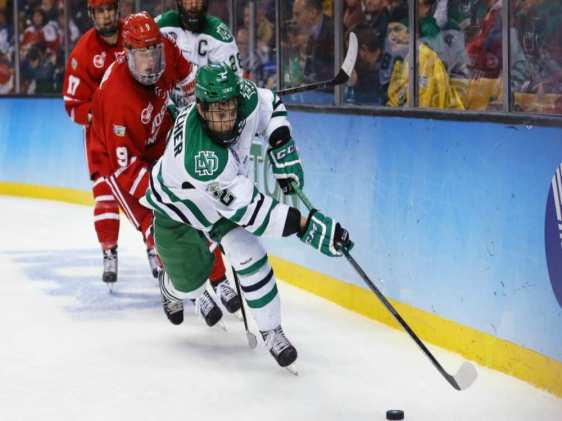
Watching some of his games, there’s Yannik Weber in him. Stecher is grittier and faster, but has that same dynamic offensive potential. And, at 5-foot-10-and-a-half is essentially the same size.
Generally, defencemen under six-feet are thought to be undersized. But Stecher counters that by pointing out the three defencemen he models his game after, Dan Boyle, Duncan Keith and the Minnesota Wild’s Jared Spurgeon, who are all successful NHL blueliners and all on the smaller side of the league.
“It doesn’t matter who you are, every player has obstacles they have to overcome,” Stecher said.
It has provided a nice incentive for him, as he said part of the reason trained those long hours to improve his skating was because of that label he wasn’t big enough.
Stecher’s breakout season for North Dakota saw him go from 13 points to 29. He was the sixth-most productive defenceman in college hockey, and that was like chum in the water for NHL teams.
There had been rumours even last year the NHL was interested in him after passing him over in three consecutive drafts because of his size, and output, which wasn’t impressive until this season.
His best line this week after signing was when he essentially said that if he were a Canucks fan he’d be jacked about the progress of his North Dakota teammate Brock Boeser.
He wasn’t talking about how many goals Boeser scored, which was pretty remarkable. Instead, he was speaking to how Boeser handles himself off the ice.
Thing is, Stecher is much like Boeser, the Canucks’ 2015 first-round pick. They are both dedicated, clean-living kids who, if they can make it, have the character to fit right into an organization currently led by two of the classiest players in the league, the Sedin twins.
For an example, Stecher is passing on an opportunity to play in Utica this season, something Ben Hutton did at the end of last year on an amateur tryout deal which didn’t impact his contract situation.
Stecher is staying in school in part because he doesn’t want to lower his grades, which would negatively impact North Dakota’s score in the NCAA’s academic progress rate program.
Low APR scores can result in NCAA penalties such as scholarship reductions and postseason bans.
“I never want a situation where something I did leads the coach to tell someone ‘Sorry, you can’t be a part of this’ because there was a cut,” Stecher said. “You need to leave the program in good standing if you leave early. I didn’t want to jeopardize the programs.”
It does sound like something a Sedin would say, doesn’t it?
jbotchford@postmedia.com
twitter.com/botchford
Source: Signing Troy Stecher was no slam dunk for Canucks | Vancouver Sun

 Andrew Phillip Chernoff