How Much Longer Should the Canucks Keep Their AHL Franchise in Utica? | CanucksArmy

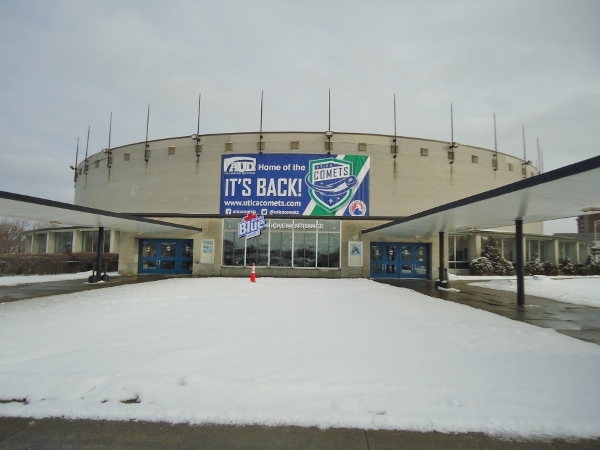
Utica Aud side entrance (600x450) (1)

Jeremy Davis      July 13 2016   Canucks Army

On Monday the Montreal Canadiens announced that they would be relocating their American Hockey League franchise from its current location in St. John’s, Newfoundland to Laval, Quebec, a suburb of Montreal. During the press conference in which the move was announced, Canadiens general manager Marc Bergevin listed the proximity of the NHL and AHL franchises as a chief reason for the move.

The Canadiens are far from the first team to do this. It’s another in a growing list of AHL-NHL partnerships that involves either sharing an arena or close proximity to each other. The benefits are clear: it would ease their ability to track the progress of their minor pro prospects as well as give feedback and instruction. Which begs the question: How long can the Canucks afford to keep their AHL franchise in Utica?

Jim Benning and the Canucks management team has been steadfast in their intention to leave their minor league affiliate in Utica, a town of a little over 60,000 people in upstate New York. This likely starts with loyalty: the Canucks have three seasons remaining on the six-year pact they made with Utica in the summer of 2013.

Beyond that, anyone who follows the Utica Comets knows that Vancouver has plenty more to like about the state of its farm team, starting with its fanbase. The city of Utica has completely embraced the Comets and has flocked to game after game providing what has been called a college-like atmosphere in the Utica Memorial Auditorium. They’re riding a sellout streak that dates back to the latter half of the 2014-15 season. Canucks management has also praised the facilities in Utica, suggesting that the workout and training areas that the prospects get to use are nearly NHL quality. Trevor Linden said this of their affiliation with Utica last summer:

“Our situation in Utica is special. It’s a great spot,” Linden said. “The one thing that we love is that we have six, seven teams within a two hour drive. The practice time and ability to rest between games is significant. The support they get in Utica, the guys love playing there. The dressing room the weight facility is NHL caliber. At this point we’re really happy there.”

That being said, Utica is still over 3,600 kilometres away from the city of Vancouver, and that is a path travelled quite frequently.

Every NHL team has its fair share of injuries, but the Canucks gruelling travel schedule has made them particularly susceptible to them – last season they were among the most affected teams in the league in terms of minutes lost (though their man games lost were closer to the middle of the pack).

It’s one of the main reasons that more and more teams are setting up affiliates in their own backyards. In the last two seasons, the AHL has seen a massive restructuring, as they added five teams in California – the first AHL teams on the west coast – belonging to the three California NHL organizations, as well as Calgary and Edmonton. San Jose formed the closest relationship with its affiliate: the NHL San Jose Sharks and the AHL’s San Jose Barracuda share the same arena.

This is not unusual: prior to the 2015-16 season, the Winnipeg Jets moved their affiliate, then located in Newfoundland, into their home arena, resurrecting the Manitoba Moose. The Toronto Maple Leafs’ AHL affiliate, the Marlies, also share a city with their parent club, though they play out of their own arena. Within the last month or so, the Arizona Coyotes moved their AHL club to Tucson, Arizona, causing the staff here at Canucks Army to reevaluate the situation.

The distance between Vancouver and Utica is not only something that NHL teams are moving on from, it’s the longest distance between an NHL city and its affiliate in the league – and it isn’t close. The 3,686 kilometres between the cities is more that one and a half times the next longest distance.

Vancouver and Utica are also the only pair that are three time zones apart (marked by a red bar), while only three others are even a single time zone apart (marked by yellow bars), with the other 26 pairs being in the same time zone.
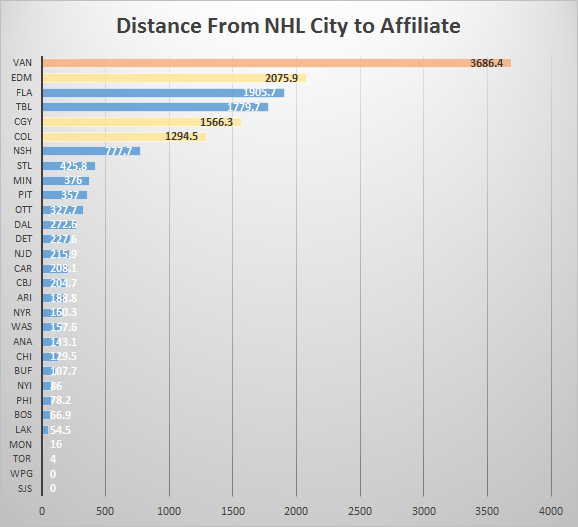
Distance From NHL City to Affiliate

Source: Google Maps (Direct distance, not travel distance)

We’ve all heard about the effect an eastern road swing has on players, and many of us are personally familiar with the difficulties of working through different time zones. In their current situation, if the Canucks were on a homestand, or playing a series of games strictly in their division, any prospects that they call up from Utica would be forced to endure that feeling that Canucks players get when they have to go on a road trip through the Eastern time zone.

Canucks management has stated before that the Comets’ location in New York makes them convenient for call-ups while the team is out east, but the flaws in logic there are readily apparent. While the long eastern swings do seem to attract a disproportionate share of injuries, the Canucks are playing less than a dozen games a year within 500 kilometres of Utica.

Conversely, they play 41 games in Vancouver by default, another six to eight in California, and a dozen more in the next time zone over. The convenience of having call ups available in Vancouver vastly outweighs having them near the eastern metropolises.

The Canucks made 56 roster moves last year involving players going between the AHL and the NHL. We can see the distribution in the following graph, which charts the number of roster moves made within one day of a game, sorted by the time zone in which the game was played.
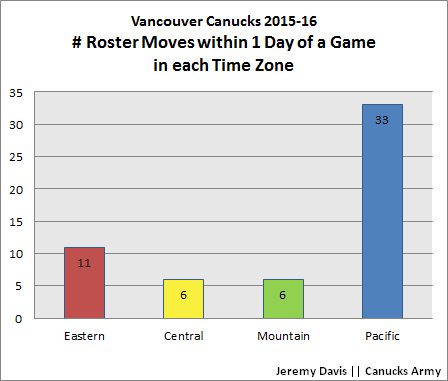
Roster Moves Within 1 Day of a Game

Source: Pro Sports Transactions

Lost in all of the chatter about the distance between NHL and AHL franchises is the fact that the Canucks signed an affiliation agreement with the Alaska Aces of the ECHL last month, after using the Kalamazoo Wings as their partner for the last several seasons. Alaska is a dreadful place for a franchise to be based out of at the best of times, given the travel to reach opponents, but having prospects going from Alaska to New York when transferring between the ECHL and AHL and then New York to British Columbia when transferring from the AHL to the NHL is just insanity; and it’s not like anyone ever gets called up from the ECHL to the NHL.

However, most call-ups from the AHL to the NHL result in another call up from the ECHL to the AHL to replace a missing player. Imagine if the Canucks had an AHL franchise somewhere in the lower mainland. A call up from the AHL to the NHL could be a drive across town, while the replacement player flies the 2,300 kilometres from Anchorage, Alaska (which is still admittedly inconvenient) to replace the call-up. Instead of that relatively painless process, the Canucks have to receive a Comet from 3,600 kilometres away, and then the Alaskan player has to travel a ridiculous 5,153 kilometres to Utica. That is, unless the Comets decide to just sign players to tryout contracts to avoid that hassle, which they will undoubtedly prefer to do, which also means that any prospects that find themselves relegated to the ECHL this year will have to work that much harder to get out of there.

POTENTIAL LANDING SPOTS

The Canucks have several different options if they wanted to relocate their subsidiary closer to home. Down the highway lies the Abbotsford Entertainment Center in the hometown of Jake Virtanen. The Center has been empty since the Abbotsford Heat vacated the arena following the 2013-14 season. Before moving their new purchased AHL franchise, the Peoria Rivermen, to Utica, the Canucks attempted to negotiate a deal with the city of Abbotsford that would involve the Canucks moving their franchise into the Abbotsford Entertainment Centre, and the Abbotsford Heat relocating to Utica instead.

That deal fell through, somehow. It would have been a major win for all parties – the Heat were running large deficits year after year, unable to fill the 7,000 seat arena with a bunch of Vancouver fans that had little interest in watching prospects of the Calgary Flames. Certainly a team full of Canucks prospects would have drawn bigger crowds, especially with Travis Green as the coach — the man could turn a dozen sacks of meat and potatoes into a competitive hockey club. Also among the reasons that the Abbotsford Heat struggled so mightily was the travel – of course, that was before the inclusion of five California teams. The return of the Manitoba Moose and a new team in Tucson, Arizona means there will be seven AHL teams within 2,200 kilometres of Abbotsford next season. Back when Heat were in town, Des Moines, Iowa was the closest city at 2,382 kilometres away.

Another option is the more recently vacated Pacific Coliseum. The home of the WHL’s Vancouver Giants for the past 15 seasons (who will play out of the Langley Events Center next season) and the former home of the Vancouver Canucks is certainly large enough to house an AHL team, though it could use a bit of a facelift. Finally, the farm team could share residence of Rogers Arena with the parent, as San Jose and Winnipeg are doing. Scheduling an extra 38 home games would certainly be tricky, but that’s what computer algorithms are for. The Canucks considered this option in 2013 as well, but due to AHL by-laws, they were not allowed to set up an AHL franchise that close to the Abbotsford. There are no such roadblocks at this point.

Update: Since I saw this in the comments, I thought I’d make a couple of additional suggestions that I forgot to get into the published article. While the AHL has established a western conference that includes five teams in California and one in Arizona, the north-south distant from Vancouver is still a bit of a pain. While I think having a team in the Lower Mainland is the ideal situation from the perspective of parent club interaction, there are other compromises that could be available. For instance, finding another market in California would allow travel between AHL and NHL that is shorter than the current set up and stays in the same time zone, as well as reducing day to day travel for the AHL club.

The California teams are currently playing a reduced schedule of 68 games instead of 76, with the standings sorted by points percentage rather than overall points. As more teams are added in the west (Tucson next season, and a hypothetical Vancouver affiliate would make seven teams in the Pacific/Mountain time zones), the need for this dismisses. As it is, the Western teams play an increased amount of games against each other. Between these two scheduling tweaks, the travel/game-to-rest ratio roughly equalizes to that of the Eastern conference.

Similarly, you could set up an AHL franchise in Portland, Oregon or Tacoma/Seattle, Washington, both of which could likely sustain NHL clubs let alone AHL clubs. The choice between B.C., Washington, Oregon and California gives the Canucks a lot of flexibility in terms of which type of distance they feel is more important, NHL to AHL travel, or AHL day to day travel. But in this case, all options are within the Pacific time zone and reduce the effect of time zone changes and cross continental travel for call ups.

I think it’s important to remember that while you do indeed want your AHL players to feel rested, it’s also extremely unfair for prospects like Brendan Gaunce and Alex Grenier to have to deal with jet lag while they’re on their first NHL call ups – stints that if they perform poorly in could affect the rest of their careers.

Any of these options would eliminate travel required for call-ups when the Canucks are playing at home, and lessen it in a lot of cases when they are playing on the road. All this is saying nothing of the benefit that minor pro prospects like Jordan Subban, Ashton Sautner and Curtis Valk could gain from being a stone’s throw away from the Canucks training staff when they return to AHL action this fall, not to mention new Comets like Thatcher Demko, Troy Stecher, and Carl Neill.

This Canucks management regime has been insistent that simply being around NHL players is beneficial to the development of young prospects, so being exposed to NHL players by sharing facilities would undoubtedly foster some extra development.

The Canucks’ loyalty to Utica is admirable. Surely they feel they owe the city that has grown to love their farm team to at least complete their current contract. However, there are benefits that are up for grabs as soon as the Canucks are able to move their farm team closer to home, if the Canucks could get out of the contract they made with Utica. Even if they were resigned to riding the current deal out, it makes no sense to extend it beyond its current expiration, especially as plenty of other teams in the NHL continue to take advantage of closer affiliates. I’ve been a huge fan of Utica to this point, but the distance between the cities is just too vast, and the benefits associated with a having an affiliate located within the greater Vancouver area are simply too good to turn down.

Source: How Much Longer Should the Canucks Keep Their AHL Franchise in Utica? | CanucksArmy

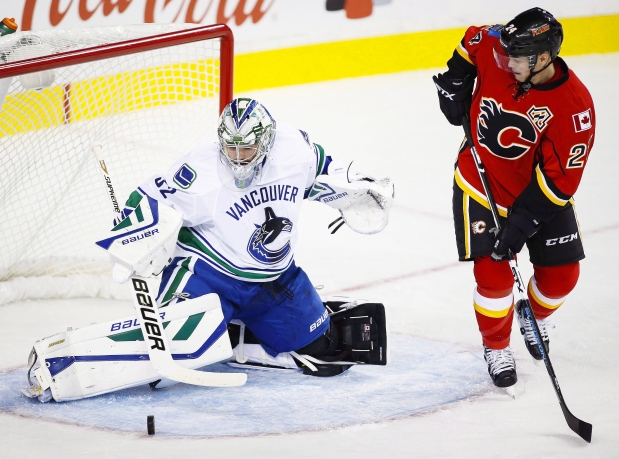
Canucks Have Signed Goaltender Richard Bachman To A One-Year, Two-Way Contract Extension

VancouverCanucksCANUCKS BANTER     By Andrew Chernoff    July 13, 2016

11421703

Vancouver, B.C. – Vancouver Canucks General Manager Jim Benning announced today that the Canucks have signed goaltender Richard Bachman to a one-year, two-way contract extension.

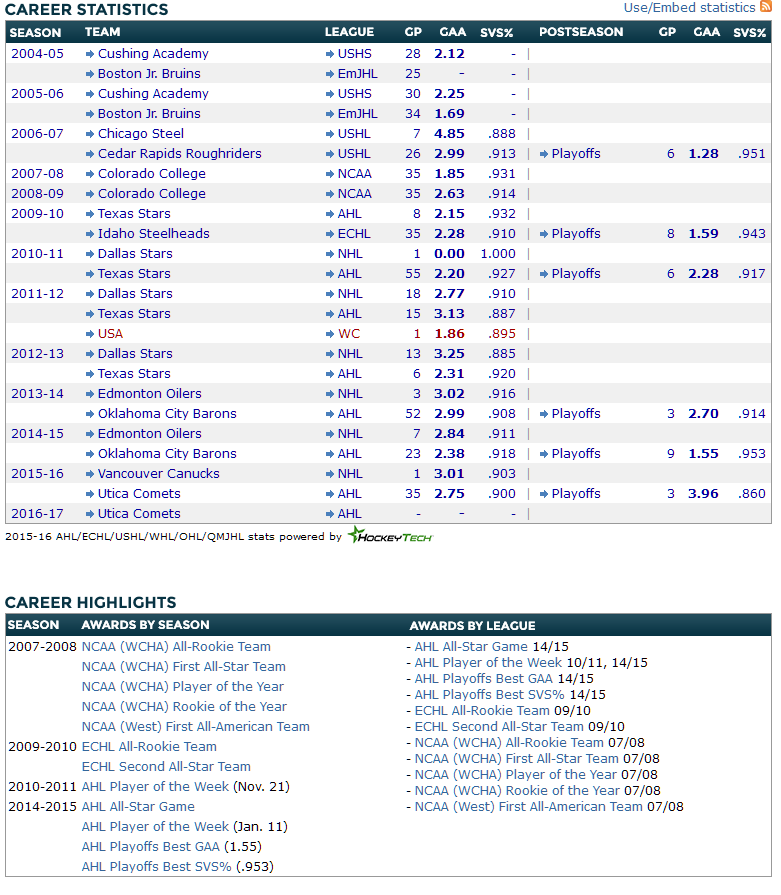
Bachman is set to make $575,000 for 2016-17 on his present one-way contract with the Canucks, and his extension for 2017-18 is a two-way contract which he will receive a pay out $650,000 at the NHL level and $450,000 at the AHL level, according to generalfanager.com

Bachman, 28, spent the 2015.16 season with the AHL Utica Comets, posting a record of 17-12-5 along with a 2.75 goals against average and .900 save percentage. He also made his debut with the Canucks last season, registering a win on October 30, 2015 at Arizona. The 5-10, 183-pound goaltender has played in 43 career NHL games, amassing a record of 18-14-2, a 2.93 goals against average and a save percentage of .904.

On the international stage, the Salt Lake City, Utah native represented the United States at the 2012 IIHF World Hockey Championship, earning a win in his only start. Prior to his professional career, Bachman played two seasons at Colorado College. He was named WCHA Player and Rookie of the Year, NCAA Rookie of the Year and NCAA West First Team All-American with a record of 25-9-1, four shutouts, and program-record GAA (1.85) and save percentage (.931).

Bachman was signed by Vancouver as a free agent on July 1, 2015. He was originally selected by Dallas in the fourth round, 120th overall, at the 2006 NHL Entry Draft.

FireShot Screen Capture #320 - 'Eliteprospects_com - Richard Bachman' - www_eliteprospects_com_player_php_player=11987

NHL shouldn’t wait on results of AHL experiment to end fighting 

The AHL is putting new rules in place to cut back on fights. (JIM MCISAAC/GETTY IMAGES)

Pat Leonard   NEW YORK DAILY NEWS  Friday, July 8, 2016

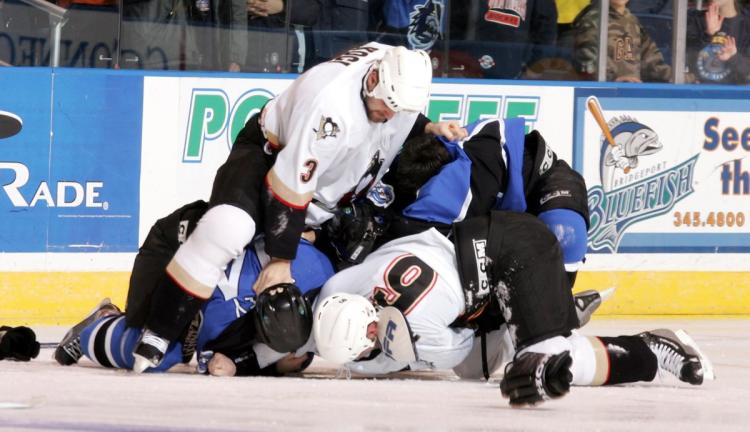
The American Hockey League, the NHL’s primarily U.S.-based feeder league, passed new rules at its most recent Board of Governors meeting to clamp down on fighting.

Players who fight before, at, or immediately following a face-off will be ejected with an automatic game misconduct. During the AHL regular season, players will be suspended one game apiece for their 10th fight of the season, all the way through their 13th bout, until a two-game suspension kicks in for fights 14 and up.

Everyone is already asking why NHL commissioner Gary Bettman continues to allow fighting at the sport’s highest level, why he chooses even to champion its existence rather than oppose its presence or, at the very least, say nothing at all.

But now there is another question, because the NHL typically monitors new measures applied in the AHL before considering adding them to its own rule book:

Why should the NHL need to wait to see the results of these new AHL rules before acting?

Bettman has plenty of reason to ban fighting from hockey entirely already. All of this tip-toeing around officially abolishing the practice just feels tired and futile.

In May, the NHL had its motion to dismiss a lawsuit from former playersdenied, in the face of accusations that the league failed to warn, inform and adequately care for them while glorifying violence that leads to head trauma.

In the face of this litigation — and despite improved science and increased knowledge about the debilitating effects of repeated head trauma, concussionsand the degenerative brain disease CTE — Bettman nevertheless told Sports Illustrated recently that fighting “has been a part of the game, it does act a thermostat in the game” and contended “your question presumes that it should be eliminated, and that isn’t necessarily the case.

“Fighting may help prevent other injuries,” Bettman added.

Why he keeps fighting for fighting, though, is beyond me.

First of all, banning fighting would not necessarily imply the NHL is guilty as charged in this lawsuit of infractions in the past – unless the league has something to hide, of course.

Secondly, Bettman’s continued comments on the subject — including his 2015 assertion that there is “no evidence” linking concussions and CTE — are ignorant and insensitive to the findings of new science and the identification of the brain disease in late NHL players such as former enforcer Bob Probert.

Third, fighting is increasingly irrelevant in today’s NHL already, even in the AHL compared to the old days.

The NHL’s more-recently adopted “instigator” rule often deters players (they’ve told me themselves) from taking any sort of retribution they may desire, since the penalty would be too costly to that game’s outcome.

Clubs are more reticent to encourage the violence, since every win and point matters even more in a league with so many teams in the playoff hunt due to the NHL’s cherished baby, its competitive balance. They can’t afford to sacrifice games just to settle a score with a hated rival.

And with the NHL’s salary cap so restrictive and the game of hockey so much faster, most teams can’t afford anymore to pay or play a player who is strictly an enforcer anyway. A sort of natural selection has weeded out this type of hockey breed from the highest level of the game.

So why not just stamp it out for good and eliminate unnecessary risk to players’ health?

The NHL was policed by the Broad Street Bullies back in the 1970s. I remember Philadelphia Phantoms AHL games at the Spectrum in the 1990s when they barely needed a puck on the ice there were so many brawls.

But as a CBC article pointed out recently, Rockford’s Michael Liambas led the AHL with fighting majors with 20 last season, while in the NHL only four players reached the 10-fight threshold: Colorado’s Cody McLeod (12), Vancouver’s Derek Dorsett (11), former Islander and new Maple Leaf Matt Martin (11) and Shark/Canadien Mike Brown (10).

Even Bettman said that “fighting is at the lowest level … in the history of the game.” The only problem is, he is using that as an argument for keeping fighting in hockey. On the contrary, that is one of the best reasons to say goodbye to the glove-dropping altogether.

Granted, the NHL’s ever-faster, ever-more physical high-speed collisions can be even more dangerous for players than some fights. But the time for parsing these details and statistics and defending fighting’s place in the game of hockey is over.

From an image standpoint, at least, the always-booed Bettman should at least understand how much better he and the NHL would look if he simply stepped up and banned fighting, announcing that in a sport so inherently high-risk there is no need to put these men in increased danger.

He seems determined, though, to make the fighting issue a hill he will die on — when what he should really do is, well, lock it out.

_____________________________________________

Pat Leonard

Pat Leonard is in his fifth season on the Rangers/NHL beat. He has worked at the Daily News since May 2010. Pat graduated from the University of Notre Dame in 2006.

Source: NHL shouldn’t wait on results of AHL experiment to end fighting – NY Daily News

Canucks have to do more than knock on the door of the NHL playoffs….Just Saying….

By Andrew Chernoff    January 1, 2014    Just-saying

Back on September 11, in this column, on the Vancouver Canucks and the upcoming 2013-2014 season titled Tortorella Has To Be True To His Coaching Style, I wrote:

I am not confident that they have the speed, finesse, the toughness or the depth to match or better most of the teams in their division or in the league at this point of training camp.

I will hold my thoughts of how well the Canucks might size up against the teams in their division, and whether they will make the playoffs until they have played their first month.

My pessimistic side says to wait until the end of January, 2014 to see if the Canucks take a nosedive and their more often than not “seasonal slump” or whether they defy the odds and play at least .500 or better and make a strong playoff run to finish the season on a high note.

I will not wait that long. I will give it 15 games.

Well, I have given it more than 15 games. I have given it until the end of 2013 before making further comment on the Canucks chances and how well the team sizes up against teams in their own division and whether they are a playoff contending team.

Obviously, I under estimated the Canucks, who as of this writing are twelve games above .500 and would have a playoff position today if the playoffs started, as a wildcard team.

So????? How have the Canucks faired:

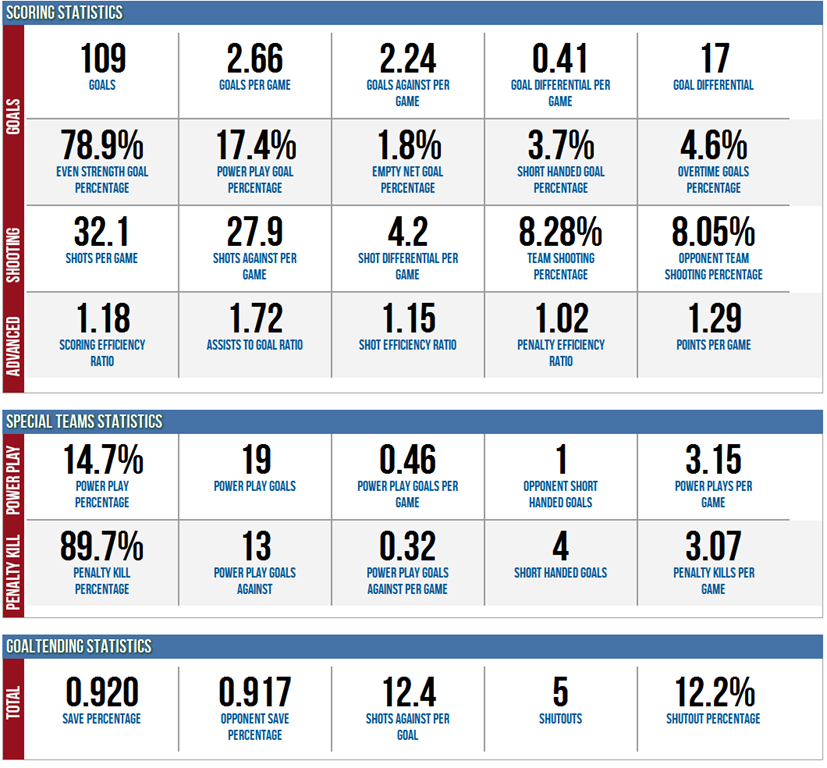
CANUCK TEAM CHARTS

image

image

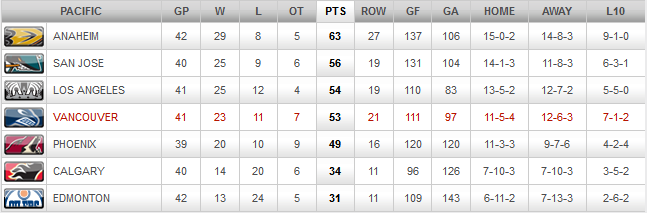
Vancouver Canucks record as of morning of January, 2014:

image

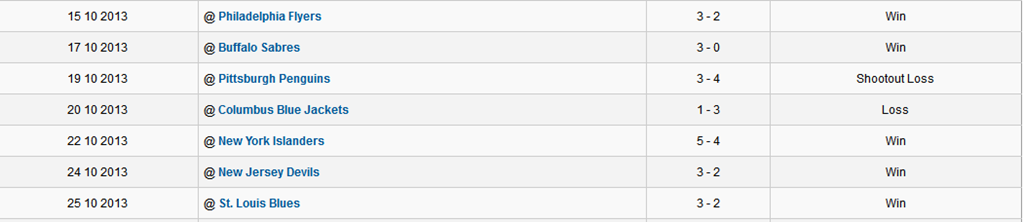
On that October 2013 road trip I said in my September 11, 2013 column:

Canucks will play seven road game stretch on the road from October 15 to October 25 which will indicate what their mettle is and how well forged they are as a competitive team and excelling at that high level of expectation or not.

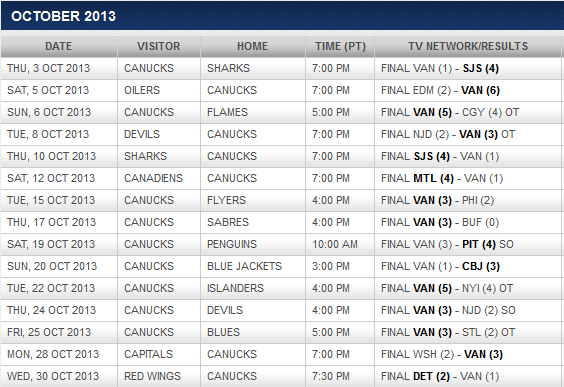
So?? How’d they do? As you can see by the chart below they had 5 wins, 1 overtime loss and 1 regulation loss for 11 points out of a possible 14 points on the 7 game road trip.

image

The Canucks showed that they were more than prepared for the seven game road trip, and more than impressed, and made a success of their first month of the season.

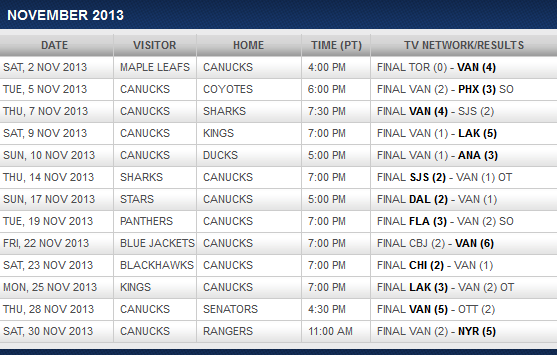
November was not so pleasant, and provided some adversity and struggles, that impacted the Canucks from having a winning month.

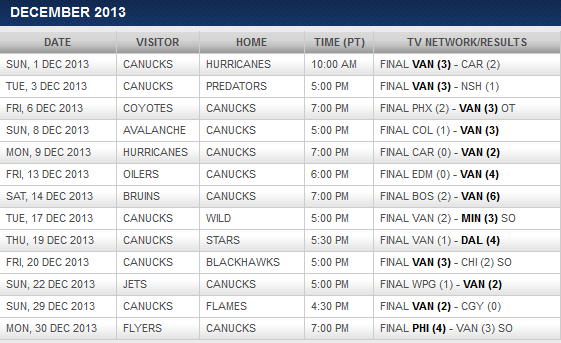
December showed the team come together under the system of their new coach and rack up 10 wins and 1 loss in 13 games for 22 points, putting Vancouver squarely in the hunt for a playoff position at the half way point of the season.

THE CANUCKS LAST HALF OF THE 2013-2014: MY THOUGHTS

So, stats aside, I am left with a three part question: what do the Canucks have to do, what does the future hold for the Canucks and how will it figure in the Canucks success the second half of the season?

Well, it won’t take long to get the answer to the first part of the question. It is simple and quickly answered.

As Iain MacIntyre, Vancouver Sun columnist, in his article Canucks second half must be equal to the first pointed out:

Despite a series of December injuries, including a broken jaw to front-line winger Alex Burrows and a strained groin suffered by starting goalie Roberto Luongo, the Canucks had a brilliant month, which gave them a good opening half of the National Hockey League season. Now, they need a second half that’s equally strong.

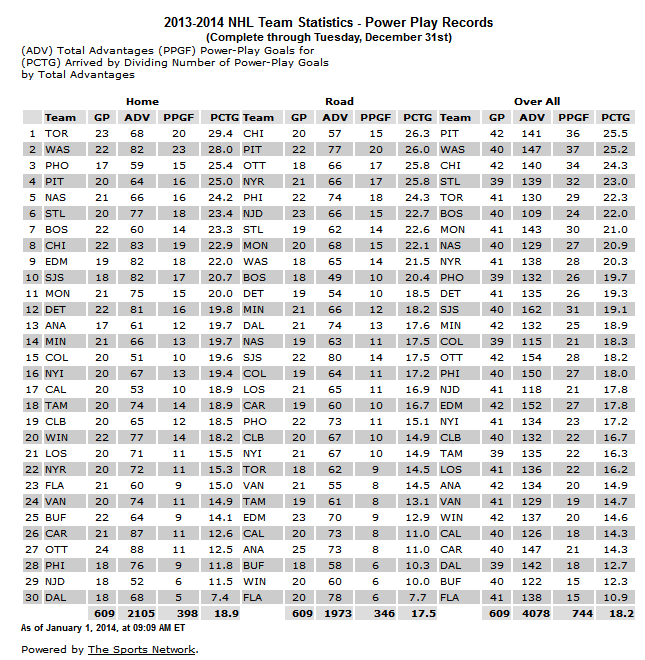
A healthy defence would help. So would a power play, which was 0-for-4 against the Flyers and, except for one three-week surge, has had awful results all season.

But, really, there is little for which to fault the Canucks through the first three months of the season, except for taking much of the fall to learn new coach John Tortorella‘s go-go-go system.

“I think we understand how we play and everybody is comfortable with that,” Tortorella said just before the game. “Some of the most important things when you get into the second half of the year and into playoffs – if we’re fortunate enough to get there – is situational play. I talk about it a lot. Everybody asks me: What’s situational play? There are a lot of things. It’s so many things.

“It’s how you win games. Understanding how to get momentum back on your side, how to keep it on your side. Third periods – down by a goal, up by a goal. All those things have to become second nature and we’ve still got a lot of work to do in that area.”

Apparently so.

I concur with Mr. MacIntyre, and that answers the first part of the question.

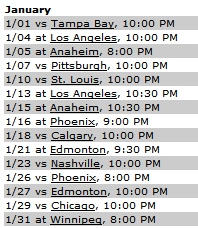
As for the second part of the question, we won’t have to wait long as January, like October, presents a big challenge for the Canucks, especially in their first eight games:

image

As you can see by the schedule for January, the Canucks first eight games have some strong opponents, with five games on the road and three at home.

My comments in my column on September 11, I repeat here for the first eight games of 2014, with some slight revision:

Canucks will play eight games from January 1 to January 16 which will indicate what their mettle is and how well forged they are as a competitive team and excelling at that high level of expectation or not, after a one week rest at the Christmas break and a shootout loss on December 30 against the Philadelphia Flyers at home.

I think Iain MacIntyre would agree. I quote from his article previously quoted above:

So December, 2013, with injuries and travel and four back-to-backs was pretty remarkable.

It gives the Canucks an eight-point cushion in the Western Conference playoff race.

“We realized at the time, when we started winning, we had to get on a roll or we were going to be out of the playoffs,” Sedin said. “And a lot of points out of the playoffs. We climbed back in, and now we need to keep going.

“The feeling we have right now is a great feeling. We feel we’re going to win every game. For sure, we’ve won games because of this mindset.”

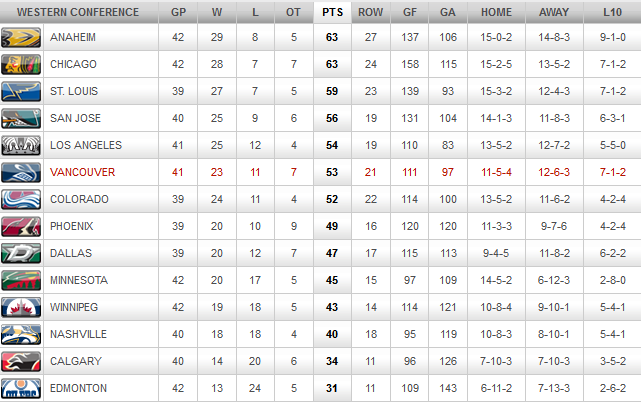
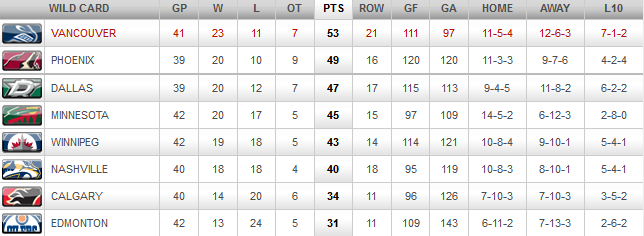
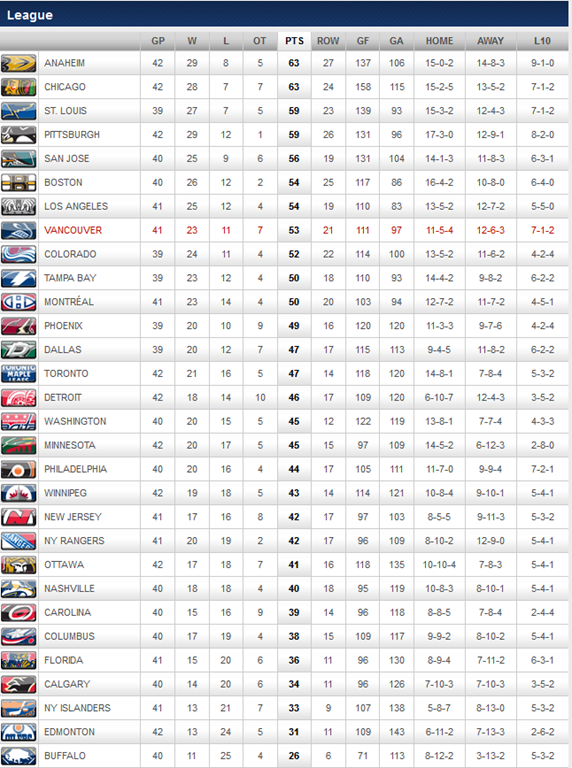
But confidence and positive energy got them only one point on Monday, giving the 23-11-7 Canucks 53 through 41 games. Their second half starts Wednesday with a New Year’s Day game against the Tampa Bay Lightning. Vancouver’s six games after that are against Stanley Cup contenders: the Los Angeles Kings (twice), Anaheim Ducks (twice), Pittsburgh Penguins and St. Louis Blues.

We’re going to know more about the Canucks two weeks from now, and they’re going to know more about themselves.

Luongo, who had a lengthy practice session Monday morning, should be the first injured player back. Edler, out since Dec. 3, may be ready by the middle of the month.

What else do the Canucks need in the second half?

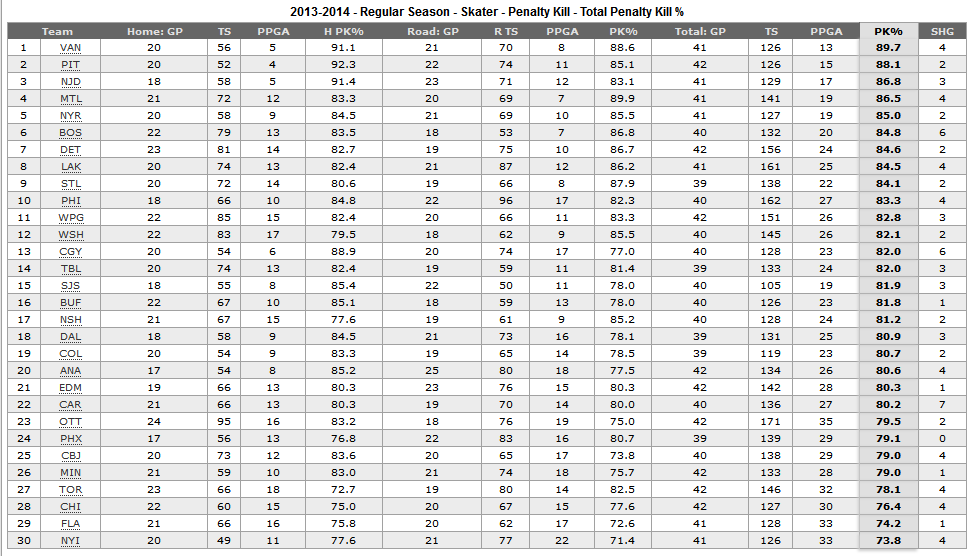
“More Decembers,” defenceman Dan Hamhuis, who played a staggering 32:30 on Monday, said. “We just have to build off what we’re doing. Our penalty kill has been great, but we’d like better results for our power play. Our goaltending has been great. We just have to continue to play good defence and find small ways to get better.

“You get a new coaching staff with new systems and new ways to play, and a run like this really solidifies everyone’s belief in our style of play and our identity.”

The third part of the question, how will the first two parts of the question figure in the Canucks success the second half of the season?

The Canucks need, as already stated, but emphasized here, need to keep playing as they are, improving as they make a playoff run. That won’t be easy, as the teams they are chasing are playing just as well as they are, and secondly, an Winters Olympic break is coming up.

The conclusion to the Olympic break will test the Canucks, coaches and players alike, to play well enough to make a last push, to not just make the playoffs, but do so with impact, excelling at a high level, being a legitimate threat to go deep into the playoffs.

The Stanley Cup challengers they face in January will give them a few answers as to where they are, what they lack and what they need to do.

In conclusion, with the Canucks game against Tampa Bay just minutes away:

John Tortorella has to do what he does best and which helped Tampa Bay to its first Stanley Cup—be the best coach he can be and get the most out of his players, letting every player know that he is boss,

The players are paid to execute the plan and perform as professionals. Tortorella must be accountable for being outcoached and for misjudgements regarding his assessments regarding each players abilities, capabilities, to execute the plan that he has developed to make the Canucks successful in all areas; and the players must be accountable for not executing that coaching plan, and playing up to that high level of expectation.

The Canucks have to do more than knock on the door of the NHL playoffs. They have to kick it in and live in it like they own it, with a passion only found on the streets, made for hockey on ice. And then the ultimate prize—–the Stanley Cup—–will be theirs.

Just saying…..

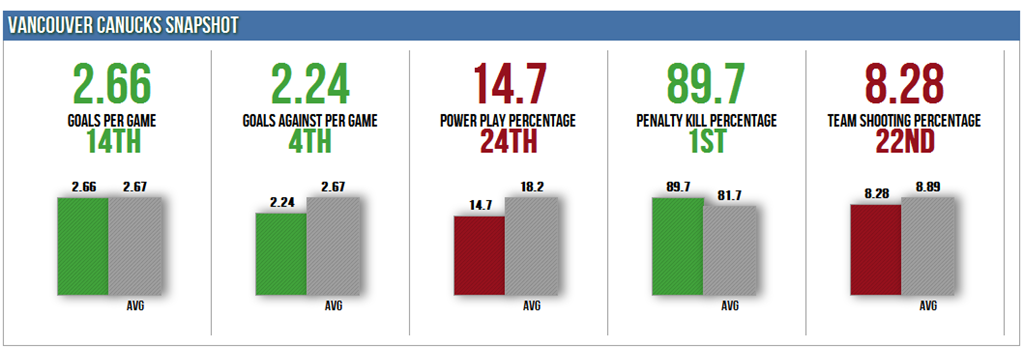
The following is a summary of where the Canucks are relative to the league, and play in the two conferences:

Canucks record in October, 2013: 9–5–1 (Home: 3–3–0 ; Road: 6–2–1)

image

Canucks record in November, 2013: 4–5–4 (Home: 2–2–3 ; Road: 2–3–1)

image

Canucks record in December, 2013: 10–1–2 (Home: 6–0–1 ; Road: 4–1–1)

image

Western Conference Standings: as of morning of January 1, 2014:

image

Western Conference-Wild Card Race: as of morning of January 1, 2014:

image

League Standings: as of January 1, 2014 @ 1 pm PST:

image

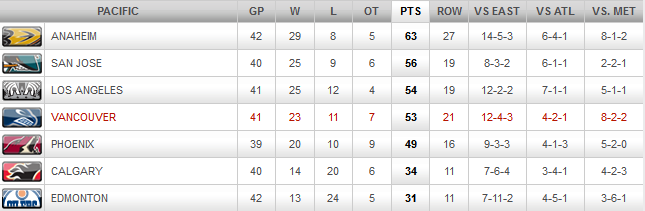
Canucks Against Eastern Conference: as of morning of January 1, 2014:

image

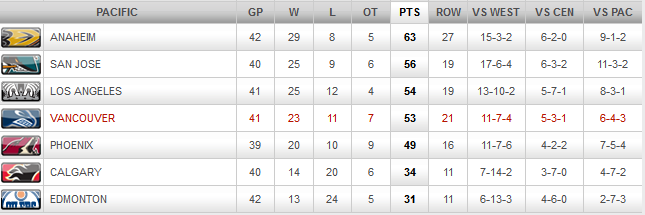
Canucks Against Western Conference: as of morning of January 1, 2014:

image

image

image

image