
Andrew Phillip Chernoff

The Outer Limits To The Inner Depths

Ingestible Tiny Robots Can Now Save Your Life

 http://www.seeker.com   Sept 16, 2016

Scientists make robots in all sizes, but did you know some are so small we can ingest them? Just how small can robots get?

“Take two robots and call me in the morning.”

Thanks to rapid advances in nanotechnology, it’s entirely possible that at someday soon, some wiseacre doctor will say these words. In today’s tag-team edition of DNews, Trace Dominguez and Julian Huguet investigate the realm of medical nanobots.

In broad terms, medical nanobots refer to very tiny machines that you can swallow, inject into your bloodstream, or otherwise introduce to the body.

These bots are designed to practice medicine from the inside, as it were, and we’re closer than you might think to deploying thisscience fiction technology.

For instance, in 2015 scientists from MIT devised an ingestible origami robot that folds itself down to the size of a pill.

The origami design not only allows the bot to get small, it provides a method of locomotion while inside the body.

The researchers ran a series of experiments using a simulated human stomach and esophagus, and a set of external magnets to guide the bot along the stomach wall.

The MIT bot was able to retrieve a “swallowed” button battery and even patch a wound within the fake stomach.

To keep pace in their ongoing bicoastal rivalry, scientists from University of California ran a similar experiment with tiny bots just 20 micrometers in length.

When fed to a mouse, these machines shot off towards the stomach’s walls and embedded themselves in the lining to deliver medicine. It was the first instance of a nanobot being used on a living animal.

Over in Europe, meanwhile, researchers from ETH Zurich have invented robots so small that three billion of them can fit into a teaspoon.

The design team hopes the bots will someday be injected directly into your eye, where they can swim through the vitreous humor and poke the blood vessels to break up blood clots.

Amazing, right? Yeah, you first.

For more details and squirm-inducing examples, check out the video here from Trace and Julian. Or for a macro take on the subject, click on over to our investigation of robots in space.

— Glenn McDonald 

Source: Ingestible Tiny Robots Can Now Save Your Life – Video
‘Atomic Memory’ Device Uses Single Atoms to Store Information

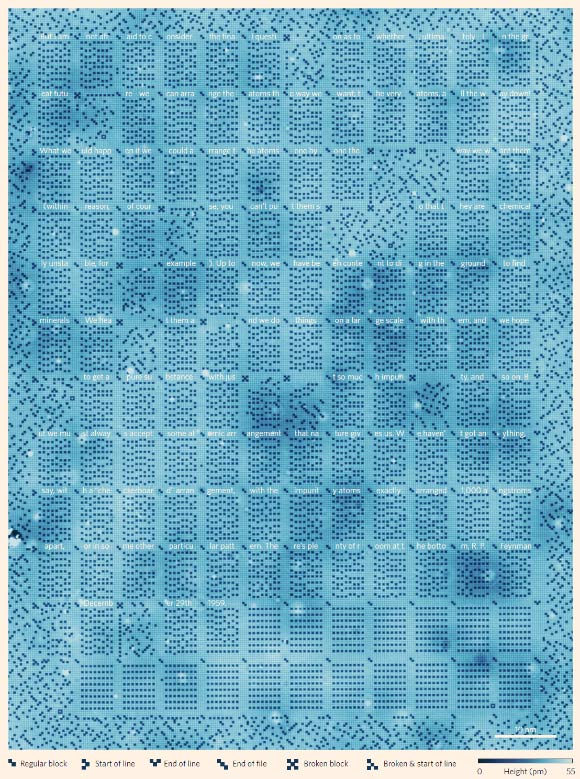
STM image (96 x 126 nm) of a 1,016-byte atomic memory, written to a passage from physicist Richard Feynman’s lecture ‘There’s plenty of room at the bottom.’ The various markers used are explained in the legend below the images. The memory consists of 127 functional blocks and 17 broken blocks. Image credit: F.E. Kalff et al.

An international group of researchers from Spain, Portugal and the Netherlands has demonstrated an atomic-scale memory device with a storage density of 502 Terabits per square inch (Tbpsi), outperforming state-of-the-art hard disk drives by three orders of magnitude.

July 19, 2016

“In theory, this storage density would allow all books ever created by humans to be written on a single post stamp,” said team leader Dr. Sander Otte, from the Kavli Institute of Nanoscience at the Delft University of Technology.

Dr. Otte and co-authors used a scanning tunneling microscope (STM), in which a sharp needle probes the atoms of a surface, one by one. With these probes scientists cannot only see the atoms but they can also use them to push the atoms around.

“You could compare it to a sliding puzzle. Every bit consists of two positions on a surface of copper atoms, and one chlorine atom that we can slide back and forth between these two positions,” Dr. Otte explained.

“If the chlorine atom is in the top position, there is a hole beneath it — we call this a 1.”

“If the hole is in the top position and the chlorine atom is therefore on the bottom, then the bit is a 0.”

“Because the chlorine atoms are surrounded by other chlorine atoms, except near the holes, they keep each other in place. That is why this method with holes is much more stable than methods with loose atoms and more suitable for data storage.”

The researchers organized their memory in blocks of 8 bytes (64 bits).

Each block has a marker, made of the same type of ‘holes’ as the raster of chlorine atoms.

These markers work like miniature QR codes that carry information about the precise location of the block on the copper layer.

The code will also indicate if a block is damaged, for instance due to some local contaminant or an error in the surface.

This allows the memory to be scaled up easily to very big sizes, even if the copper surface is not entirely perfect.

“In its current form the memory can operate only in very clean vacuum conditions and at liquid nitrogen temperature (77 degrees Kelvin), so the actual storage of data on an atomic scale is still some way off,” Dr. Otte said.

“But through this achievement we have certainly moved a big step closer.”

The team’s results were published this week in the journal Nature Nanotechnology.

_____

F.E. Kalff et al. A kilobyte rewritable atomic memory. Nature Nanotechnology, published online July 18, 2016; doi: 10.1038/nnano.2016.131

Source: ‘Atomic Memory’ Device Uses Single Atoms to Store Information | Nanotechnologies | Sci-News.com