Comparison of Federal Election Results to Nanos Estimates

b5ad68c8-9ced-4798-b6a2-6a4139d994a4

An election is a torture chamber for politicians, voters and pollsters – and rightly so. 

At Nanos we take very seriously our responsibility as a research firm and the trust Canadians place in our numbers. In addition to the exceptional coverage by our clients — CTV News and the Globe and Mail, and Bloomberg News — the Nanos numbers were cited by virtually all major media outlets in Canada and several international ones such as by The Associated Press, The Wall Street Journal, The Washington Post, the Los Angeles Times, the Guardian Newspaper in the UK and the BBC.

Over the course of the election, the Nanos numbers were also a central part of the dialogue on social media.  For example, our polling was cited in 55.2 million tweets during the campaign.

A review of our tracking in Canada’s 42nd federal election suggests that the Nanos track record of reliability in national and provincial elections continues from strength to strength.  Our approach of using random land- and cell-line samples with live agents, in our opinion, remains the most consistently robust means of measuring opinion.

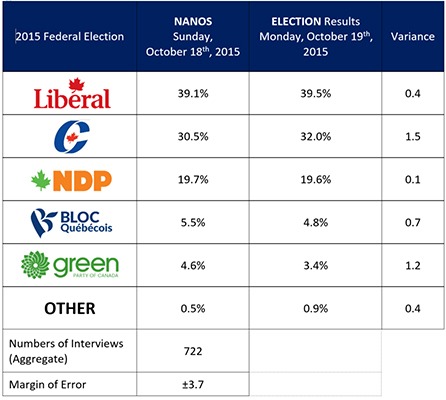
Here is a comparison of the election results to the Nanos data using the Election Canada data as of 1:20 am ET.

89f4e9e3-ab45-4088-bde4-b7bc2596e9a6

As you can see, this contributes to the Nanos track record which is among the most consistently accurate for national and provincial elections in Canada. 

For this federal election, Nanos accurately called the winner in all regions, the results for every party were well within the margin of error and accurately forecast the Liberal victory.

Nanos Nightly Ballot Tracking: Liberals win popular support – Canadians to decide how many seats they get (October 18th only)

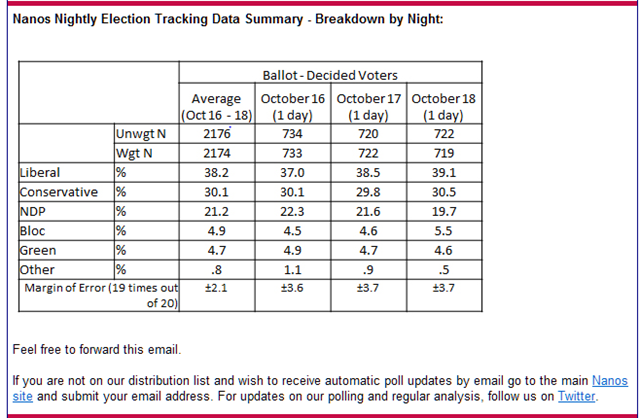
Sunday Only Numbers: Liberals 39.1%, Conservatives 30.5%, NDP 19.7%, Green Party 4.6%, Bloc 5.5%, Other 0.5%

Hope all is well.  To follow are the results of the last round of tracking that we have conducted on behalf of CTV News and The Globe and Mail.  Some key observations from a research standpoint on this election.

This was an election about change – The level of totally undecided opinion in the Nanos tracking was lower than usual throughout the campaign, but the proportion of Liberal-NDP switchers was exceptionally high.  This suggests that many Canadians had decided they were not voting for the Conservatives but were open to voting for either the Liberals or the NDP.

  • Who is the agent of change – The first 66 days of the campaign, much of which was characterized by a tight three-way race, was about Canadians contemplating who would be the agent of change. Once the numbers started breaking in favour of the Liberals, NDP change-driven support shifted to the Liberals and a two-horse race emerged.
  • Holiday weekend shift – Holidays in elections are often key junctures of opinion formation and this election was one of them.  Entering the Thanksgiving long weekend, it was a two-way race between the Liberals and Conservatives.  After it, the Liberals had the advantage which they maintained throughout the close of the campaign.
  • Impact of a long campaign – This longer-than-usual campaign benefitted the Trudeau Liberals. At the 37-day point, there was a three-way race without the change sentiment coalescing around  any one opposition party, resulting in a vote split between the Liberals and NDP.  The longer campaign allowed Trudeau to incrementally demonstrate he was not as risky as the Conservatives suggested.
  • Conservative ad campaign a bust – The longer campaign allowed Trudeau’s daily performance to invalidate the Conservative attack ads.  Also of note, the research suggested that the Conservatives were strong on fiscal issues, such as controlling government spending but not on their plan for the economy.  The Liberals significantly improved on this measure throughout the campaign.  One Conservative ad campaign pillar (“He’s just not ready”) was invalidated, while the other pillar (economic security) did not resonate.
  • Tom Mulcair and the New Democrats – Beneath the numbers for top ballot and preferred Prime Minister, the research suggests that Tom Mulcair’s personal brand remains strong (qualities of a good political leader question) and the proportion of Canadians that would consider voting NDP is still significant.  The NDP in this election was squeezed in a change movement manifested through the Liberals and Justin Trudeau.
  • Minority or majority – Nanos does not do seat projections.  Our focus is to estimate the popular support and to understand the dynamic of the campaign.  The research points to a Liberal victory. The magnitude of that victory — whether it be a minority, a strong minority or a majority government — will be decided by Canadians.
  • Nanos popular support projection – During the election, we ran a three-day rolling average of political sentiment of 1,200 Canadians (400 a night).  For the last three nights we doubled our sample to 800 Canadians a night.  In the table below we present the individual results for Friday, Saturday and Sunday as well as the three day average. In past elections we have found the Sunday numbers have best captured the political mood on election day.
  • Range of Support – Please note that estimates of popular support involve an upper and lower statistical range of outcomes (plus or minus, 19 times out of 20) which are detailed in the table below.

The team at Nanos in conjunction with Klipfolio have launched our new live political data portal where you run the numbers you want and can explore the trends and data you need.  This is part of our campaign, not only to provide the most reliable data to Canadians but to let them use it as they wish. We were the first to do nightly tracking and now we are the first research organization to post live public opinion data for Canadians.

We were the first to do nightly tracking and now we are the first research organization to post live public opinion data for Canadians. Here’s the link to check it out 

To view the detailed tracking stats please visit our website.

Methodology

A national random telephone (land + cell) survey using live agents of 1,200 Canadians is conducted by Nanos Research throughout the campaign over a three day period.  Each evening a new group of 400 eligible voters are interviewed. To update the tracking a new day of interviewing is added and the oldest day dropped. A double sample of 800 interviews, per night, were conducted on Friday, Saturday and Sunday.

The last day is based on a one day sample of 800 interviews. The margin of error for a survey of 800 respondents is ±3.5%, 19 times out of 20.

The respondent sample is stratified geographically and by gender.  The data may be weighted by age according to data from the 2011 Canadian Census administered by Statistics Canada.  Percentages reported may not add up to 100 due to rounding.  The research has been registered with the Marketing Research and Intelligence Association of which Nanos is a member.


image

Nanos Nightly Leadership Tracking – Preferred PM: Trudeau (35.5%), Harper (29.1%), Mulcair (18.9%), May (5.2%) – Three-day Tracking Ending October 18th

Nanos Nightly Election Tracking Highlights (3-day tracking ending October 18th)

Trudeau closes campaign ahead of Harper as preferred Prime Minister

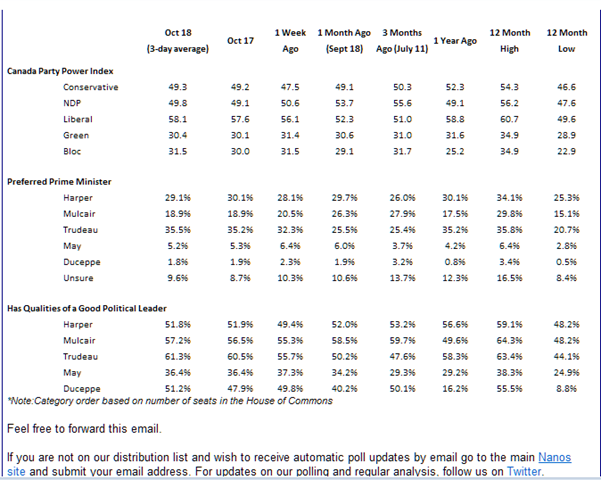
  • Leadership – Asked who they preferred as Prime Minister 35.5% said Trudeau, 29.1% said Harper, 18.9% said Mulcair, 5.2% said May, 1.8% said Duceppe and 9.6% of Canadians were unsure.
  • Nanos Party Power Index – The Index which is a composite of a series of questions including ballot preferences and impressions of the leaders had the Liberals at 58.1 out of a possible 100 points, the NDP with 49.8 points, the Conservatives with 49.3 points, the Greens with 30.4 points, and the BQ with 31.5 points in Quebec.

The team at Nanos in conjunction with Klipfolio have launched our new live political data portal where you run the numbers you want and can explore the trends and data you need.  This is part of our campaign, not only to provide the most reliable data to Canadians but to let them use it as they wish. We were the first to do nightly tracking and now we are the first research organization to post live public opinion data for Canadians.

We were the first to do nightly tracking and now we are the first research organization to post live public opinion data for Canadians. Here’s the link to check it out 

To view the detailed tracking visit our website.

Methodology

A national random telephone (land + cell) survey using live agents of 1,200 Canadians is conducted by Nanos Research throughout the campaign over a three day period.  Each evening a new group of 400 eligible voters are interviewed. A double sample of 800 interviews, per night, were conducted on Friday, Saturday and Sunday. Today’s daily tracking figures are based on a three-day rolling sample comprised of 2,400 interviews.  To update the tracking a new day of interviewing is added and the oldest day dropped. The margin of error for a survey of 2,400 respondents is ±2.0%, 19 times out of 20. 

The respondent sample is stratified geographically and by gender.  The data may be weighted by age according to data from the 2011 Canadian Census administered by Statistics Canada.  Percentages reported may not add up to 100 due to rounding.  The research has been registered with the Marketing Research and Intelligence Association of which Nanos is a member.

Results are based on the three day calling window October 16 to 18, 2015. The research was commissioned by CTV News and The Globe and Mail.

Nanos Nightly Election Tracking Data Summary for period ending October 18th, 2015:

image

Seven of ten Canadians say it’s time for a change – CTV News/Globe and Mail/Nanos Survey

17/10/2015

Time for a change hits 71% – Trust in Trudeau to manage economy rises

The latest CTV News, Globe & Mail, Nanos survey suggests that the proportion of Canadians wanting change in the last weekend of the election has increased and also that the view that a Trudeau win would have a positive impact on the economy.  Also of note:

  • Time for a Change – The proportion of Canadians who think it is time for a change on the closing weekend of the election rose from 67 to 71 percent.  The appetite for change is stronger among women (76 per cent) compared to men (67 per cent).
  • Election Outcome Impact on Economy – Although a minority opinion among Canadians, the top choice for positive impact on the economy was a Liberal majority.  This view has doubled since July.  After citing a Liberal majority, 23 per cent of Canadians said a Conservative majority would be best for the economy. This view was unchanged since July.
  • Election Outcome Most Satisfying – The election outcome most frequently cited as causing satisfaction for voters was a Liberal majority (28 per cent) followed by a Conservative majority (21 per cent) and a NDP majority (19 per cent).
  • Trust to Manage the Economy – Thirty one per cent of Canadians trust Trudeau to manage the economy (up 13 points since July 2015), 29 per cent trust Harper to manage the economy (down two points since July), 22 per cent trust Mulcair to manage the economy (down nine points since July).
  • Party Victory Impact on Economy – Longitudinal tracking suggests that a Liberal victory is most likely to been as having a positive impact on the economy (59 per cent positive/somewhat positive the last weekend of the economy compared to 42 per cent positive/somewhat positive in July). Canadians are more likely to think that a Conservative victory will have negative or somewhat negative impact on the economy than a positive or somewhat positive impact.

The team at Nanos in conjunction with Klipfolio have launched our new live political data portal where you run the numbers you want and can explore the trends and data you need.  This is part of our campaign, not only to provide the most reliable data to Canadians but to let them use it as they wish. We were the first to do nightly tracking and now we are the first research organization to post live public opinion data for Canadians.

We were the first to do nightly tracking and now we are the first research organization to post live public opinion data for Canadians. Here’s the link to check it out

The full survey results can be found by visiting our website.

Methodology
Nanos conducted an RDD dual frame (land- and cell-lines) hybrid telephone and online random survey of 1,000 Canadians, 18 years of age or older, between October 15th and 16th, 2015 as part of an omnibus survey. Participants were randomly recruited by telephone using live agents and administered a survey online. The sample included both land- and cell-lines across Canada. The results were statistically checked and weighted by age and gender using the latest Census information and the sample is geographically stratified to be representative of Canada. Canadians without internet access or telephone lines were excluded by default.

Individuals randomly called using random digit dialling with a maximum of five call backs. The margin of error for a random survey of 1,000 Canadians is ±3.1 percentage points, 19 times out of 20.

The data presented in this research is part of a joint project by CTV, The Globe and Mail and Nanos Research.

Note: Charts may not add up to 100 due to rounding.

Nanos Nightly Ballot Tracking: Liberal (37.0%), Conservative (30.7%), NDP (22.6%), Green (4.7%) – Three-day Tracking Ending October 16th

Nanos Nightly Election Tracking Highlights (3-day tracking ending October 16th)

Federal Liberals maintain six point lead over Conservatives

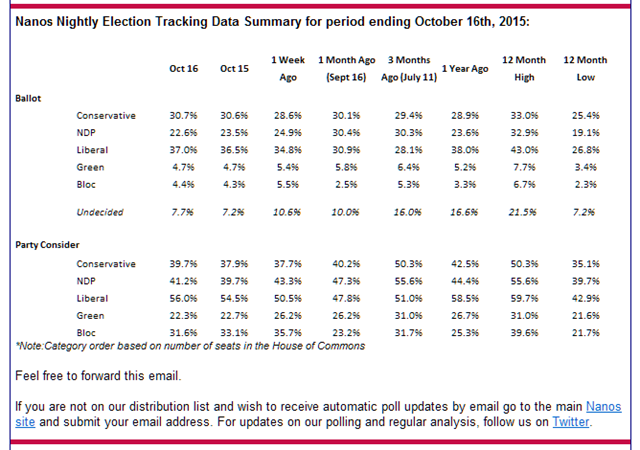
  • National Ballot – The latest Nanos nightly tracking has the Liberals at 37.0% support followed by the Conservatives at 30.7%, the NDP at 22.6%, and the Greens at 4.7%.
  • Accessible Vote – Asked a series of independent questions for each federal party, 56.0% of Canadians would consider voting for the Liberals, 41.2% would consider the NDP, 39.7% would consider the Conservatives, 22.3% would consider the Greens and 31.6% would consider the BQ (Quebec only).
  • Sample Enhancement – Readers should note that on Friday the nightly sample was doubled to 800 live interviews with a total three day rolling average of 1,600 voters (400 on Wednesday, 400 on Thursday and 800 on Friday). 

The team at Nanos in conjunction with Klipfolio have launched our new live political data portal where you run the numbers you want and can explore the trends and data you need.  This is part of our campaign, not only to provide the most reliable data to Canadians but to let them use it as they wish. We were the first to do nightly tracking and now we are the first research organization to post live public opinion data for Canadians.

We were the first to do nightly tracking and now we are the first research organization to post live public opinion data for Canadians. Here’s the link to check it out 

To view the detailed tracking stats please visit our website.

Methodology

A national random telephone (land + cell) survey using live agents of 1,600 Canadians is conducted by Nanos Research throughout the campaign over a three day period.  Each evening a new group of 400 eligible voters are interviewed with an additional 400 interviews conducted on Friday.  The daily tracking figures are based on a three-day rolling sample comprised of 1,600 interviews.  To update the tracking a new day of interviewing is added and the oldest day dropped. The margin of error for a survey of 1,600 respondents is ±2.5%, 19 times out of 20.

The respondent sample is stratified geographically and by gender.  The data may be weighted by age according to data from the 2011 Canadian Census administered by Statistics Canada.  Percentages reported may not add up to 100 due to rounding.  The research has been registered with the Marketing Research and Intelligence Association of which Nanos is a member.
Results are based on the three day calling window October 14 to 16, 2015. The research was commissioned by CTV News and The Globe and Mail.

image