
By Andrew Phillip Chernoff
Source: The Greenwood Ledge, Greenwood, B.C., July 18, 1907
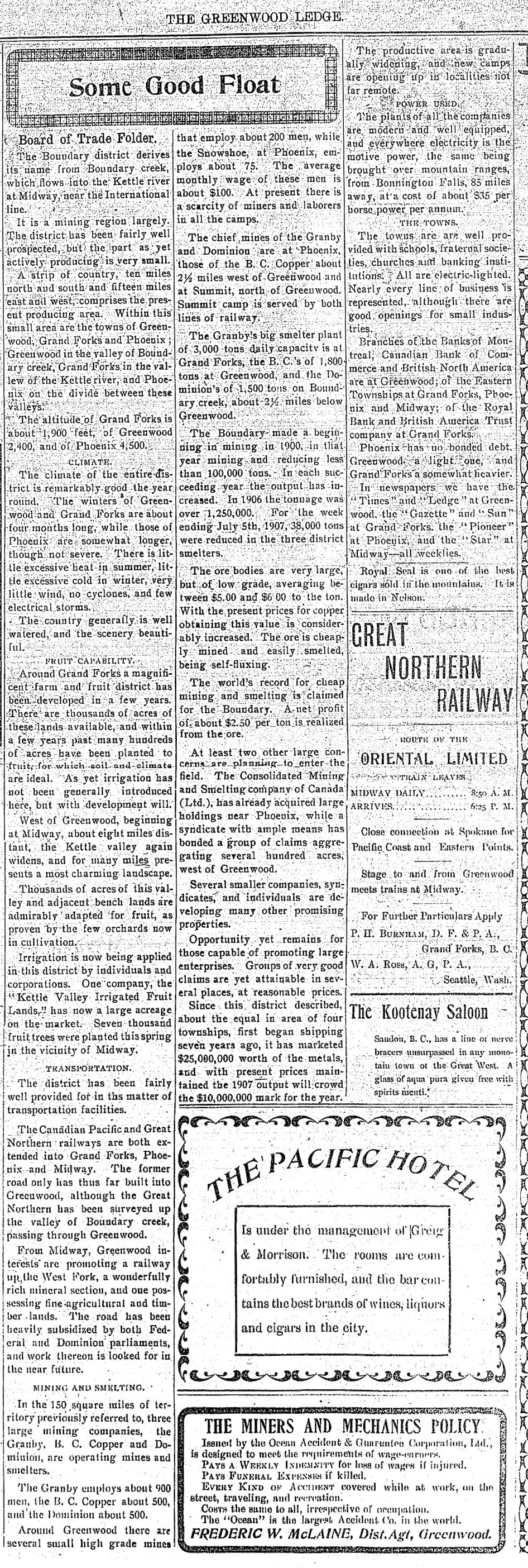
Greenwood Ledge, Greenwood, B.C., July 18, 1907

By Andrew Phillip Chernoff
Source: The Greenwood Ledge, Greenwood, B.C., July 18, 1907
Greenwood Ledge, Greenwood, B.C., July 18, 1907
From: http://www.museevirtuel-virtualmuseum.ca
“Midway is on the Map to Stay” 1903-08-29 The Dispatch Newspaper, Midway, B.C.

Credits: Kettle River Museum, Midway, B.C.
“Midway Becoming a Railway Centre” From:The Province, August 8, 1905
“…Jas. Dallas has about completed his hotel, and yesterday the foundation was laid for another commodious hostelry for L.A. Manly, formerly of Grand Forks. Wellwood & McPherson are fitting up a building on Seventh Street for a similar purpose.
The Eholt Trading Company has opened a general store and several sites have been sold to outside parties who, as soon as building can be erected, will engage in the same business…
Black Bros. who recently purchased the Oakland Hotel, are putting up an addition. G.D. Cunningham has let the contract for a large store building on Fifth Street; and the Thomas Drug Co. Ltd. Which has been in business for a long time here, is contemplating building a new store to accommodate its increased stock.
G.A. Evans of Grand Forks, with enterprising zeal, has brought in a newspaper plant, and will today issue the first number of the Midway Star.
J.F. Roger, the hustling stage man, is running stages between here and Phoenix and on to the Similkameen, and will in a few days have a line between here and Curlew.”
From: http://www.museevirtuel-virtualmuseum.ca
The roundhouse crew at Eholt B.C. Circa 1900

Credits: Courtesy of Stanley Bubar

Credits: Kettle River Museum, Midway, B.C.

Credits: Kettle River Museum, Midway, B.C.

Credits: Courtesy of Stanley Bubar
 Picture from: http://itsmysite.com/bchistory/
BACKROUND
Boundary Falls is a medium sized waterfall on Boundary Creek, a tributary of the Kettle River. It is located within a small canyon a little over halfway between Midway & Greenwood, beside the town which was named after the falls, Boundary Falls.
Boundary Falls is about 40 feet in height. It is located a couple hundred feet below the head of a small canyon that Boundary Creek enters as it passes by the town of Boundary Falls. The falls are easily viewed from the canyon rim & one can even reach the base of the falls by carefully climbing down the steep canyon walls. One can also reach the brink of the falls with relative ease. From:
Remains of an old dam which generate power from the city of Greenwood can be found about 100 feet upstream from the falls’ brink.
Boundary Falls was settled in 1890 by a large flock of miners. There were lots of mining opportunities in the area so the miners started building a smelter which they finished in 1901. In 1902 though, the smelter was “blown in” by high operating costs, coke shortages, financial difficulties & low copper prices.
In 1907, the smelter officially closed & was eventually forgotten. Today, only slag piles remain of what was once a pretty good sized refining & power generating settlement. From: http://en.wikipedia.org/wiki/Boundary_Falls_%28British_Columbia%29
The Sunset Smelter at Boundary Falls
BCC was not alone in its appreciation of the Boundary Creek region’s potential. On June 28th, 1900, under the presidency of William Price in Québec City and capitalized to $500,000, the Standard Pyritic Smelting Company came into being. It immediately began building a smelter at the Boundary’s falls, not five miles downstream from Anaconda. Poorly capitalized and owning no mines, Standard Pyritic was in trouble from the start, and just before the first of its 300 ton-per-day furnaces was blown in on June 19th, 1902, the company sold the project to the Montreal and Boston Copper Company, Limited (M&B), and voted itself into extinction on the 27th of April, 1903.
M&B had started life as The Canadian Coal Company, Limited, incorporated by an Act of the Nova Scotia legislature on March 11th, 1898. It soon became interested in the Boundary district and bought the Sunset group of claims – the Sunset, the Crown Silver, the and the Florence Fraction – which the Honourable A.W. Ogilvie’s Montreal Boundary Creek Mining Company, Limited, had accumulated in the Deadwood’s valley. Financially exhausted, on October 22nd, 1900, it reorganized itself into the Montreal and Boston Copper Company, Limited, with a capitalization of $500,000 and the vice-president of the Great Northern Railway, H.H. Melville, as president. Unfortunately, within a month of buying the Standard Pyritic’s smelter, a coal miners’ strike in the Crow’s Nest Pass cut off M&B’s coke supplies and killed the furnace fires for nine weeks, crippling cash flow. With the help of its three largest investors by far; J.B. Elmendorf of New York, and E.W. Farwell and S.F. Morey of Montréal, M&B increased its capitalization to $3 million and began upgrading what thenceforth was known as the “Sunset” smelter. In 1903 alone M&B spent some $60,000 to eliminate the technological glitches which impaired the ability of the Sunset’s furnaces to process the local ores, and buy a locomotive and a fleet of 5-ton side-dump slag cars. That year the Sunset digested 110,000 tons of ore to extract some 1500 tons of copper, 1.75 tons of silver and 160,000 dollars’ worth of gold. Having had to shut down their operation in December of 1903 when their main source of ore, the Snowshoe mine up on Phœnix Mountain, suspended operations, the directors of the M&B realized they needed secured supplies or ore. To do that they required cash and got it in 1904 by reorganizing the M&B as the Montreal and Boston Consolidated Mining and Smelting Company, Limited. From their new pool of capital they immediately spent $70,000 to buy another furnace and install a Bessemerizing plant at Sunset so that it could convert matte to blister itself rather than paying Anaconda to do it, and began buying and developing local mines. One of those properties they acquired belonged to a company whose fate would become intimately linked with the Sunset, the Dominion Copper Company.
The Dominion Copper Company, Limited (DCC), was incorporated in Toronto on April 29th, 1899 by the Canadian senator and businessman, George Albertus Cox, and some of his associates including Mackenzie, Mann and Company of Toronto. It hurriedly assembled the Brooklyn group of claims on Phœnix Mountain – Brooklyn, Stemwinder, Idaho, Rawhide, Standard, and Montezuma – and drew up plans to raise a smelter, signing a construction agreement on November 3rd, 1900. By the time DCC was able to arrange its financing, however, three other smelters were already a-building in the District, and in 1901, with ore piling up on the Brooklyn’s dump, DCC stopped mining and cancelled its Agreement.
The M&B bought the Brooklyn group and DCC’s mining charter in 1904 and began redeveloping the Brooklyn-Stemwinder and Rawhide mines. Redevelopment, however, interrupted ore output, and M&B treated only 31,000 tons in the Sunset smelter that year, down some 70,000 tons from 1903. With little cash coming in, on May 20th of 1905, having acquired the Athelstan – Jackpot group at Wellington Camp on Phœnix, the Lancashire Lass and the Morrison claims, M&B’s finances snapped when copper prices slipped. It defaulted on its payments to DCC and all work ceased.
Judging the Sunset operation to be viable if only it had a cash reserve to see it through the occasional downturn, Dominion Copper’s management determined to recapitalize their company to invest heavily in the Boundary District. On June 26th, 1905, a syndicate of American investors headed by Samuel Newhouse of Salt Lake City, Utah, agreed to buy a sizeable portion of the $1 million in bonds offered by a reorganized Dominion Copper Company, Limited. With its new money, DCC cleared M&B’s debts and took over its assets, as well as buying outright or gaining control over the Brooklyn, the Stemwinder, the Rawhide, the Idaho group, the Athelstan, the Jackpot Fraction, the Mountain Rose, the Morrison and the Sunset group. In August, as the Sunset’s plant was being refurbished, mining was recommenced. Smelting began again when one furnace was blown in at the end of November, the matte being sent to Anaconda for conversion to blister until Sunset’s Bessemerizing plant became operational. The next spring, on February 12th, 1906, DCC offered $5,000,000’s worth of shares to the market and revealed that it intended to double the Sunset’s capacity to 1400 tons by installing a Giroux hot blast-type furnace. It did not, but managed to treat 218,000 tons with its original furnaces. By 1907 the Brooklyn-Idaho group and the Rawhide mine on Phœnix were sending up to 1,000 tons a day to the Sunset smelter, while the Sunset mine adjacent the Mother Lode contributed a further 100 tons, with other mines also sending ore. Before it was shut down that October after the Wall Street Panic of 1907, the Sunset had treated 153,500 tons.
The Sunset smelter stood silent for the first six months of 1908 as its management wrestled with its fate. It had barely commenced operations in July when the Great Fire in the Crowsnest Pass cut off its coal supply. Having treated but 23,000 tons, the Sunset shut down as DCC prepared to again reorganize. On December 9th, 1908, the company mortgaged its smelter, but spent little of the money on refurbishing the plant.
On June 11th, 1909, three days after a memorandum of association was signed, the New Dominion Copper Company came into existence under the presidency of R.C. Spinks. Headquartered in Vancouver, the new company acquired the assets of DCC which was dissolved on August 17th, 1910. New Dominion did no work in 1909 and by the time that it had moved its registered office to Greenwood on September 13th, 1910, 64% of its stock was owned by BCC which began managing the Sunset operation in tandem with the Anaconda. That year BCC finally completed a 5.4 mile-long Byron C. and Royal N. Riblet-designed aerial tram between its Lone Star mine just over the Boundary in Washington State and the Sunset smelter in hopes that the latter could be re-engineered to treat the Mine’s alumina and silica-rich copper ore. After three years of struggling with the Sunset’s obsolete equipment, in 1913 BCC announced that it would add both water and oil floatation concentrators supplied by the Mineral Separation Company of San Francisco in hopes that the old plant would be able to process the Lone Star’s output and maybe the complex ores that the company was sampling from Copper Mountain at Princeton. The investment was apparently shelved and the plant likely dismantled for scrap early in the Great War for the Sunset Smelter is mentioned never again in the reports of the Minister of Mines. In his article, “Medicine Hat to Vancouver” in the March, 1945, issue of Agricultural and Industrial Progress in Canada, G.M. Hutt mentions that the Sunset’s shell still stood.
Above historical information from: http://www.crowsnest-highway.ca
 Andrew Phillip Chernoff