Leave no one behind in CPP expansion: Mark Hancock

June 16, 2016

A growing number of business and financial sector voices with histories of strong opposition to expanding the Canada Pension Plan have suddenly accepted that our public, not-for-profit, pension system should grow. Their newfound support, however, comes with many caveats. Their strategy now focuses on ensuring any expansion of the CPP is overly narrow and extremely modest.

Various Chambers of Commerce, financial industry lobby groups, and the Canadian Life and Health Insurance Association argue that CPP expansion should: 1) not apply to low-income workers, 2) only apply to some middle-income workers and 3) not be the focus for new saving among higher-income earnings, who, in their view, are presumably better served by the for-profit private pension system. The small number of workers remaining who would be affected would only see a “modest” increase to CPP benefits.

These carve-outs would have significant consequences.

All workers currently participate on an equal basis in the CPP. Adding new exceptions for workers at certain income levels would make it more complicated and costly to operate the plan. More contributions would be used to pay administrative and compliance costs instead of being invested. A simple universal expansion of CPP is the more efficient solution.

Cutting low-income workers out of CPP expansion will also encourage employers to game the system. If new CPP contributions and benefits only applied on earnings above $27,500 as some are suggesting, employers would have yet another incentive to offer lower-wage, lower-hours jobs – keeping total earnings below this threshold would keep payroll costs down. This would lead to a new incentive to split full-time positions into precarious part-time positions. Canada’s governments should not be encouraging precarious employment by building these incentives into the CPP. Canadian workers deserve more good jobs and our governments should be fighting to keep them.

If Finance Ministers are concerned with the retirement prospects of low-income Canadians, CPP expansion should not be carved up. Low-income Canadians would see their retirement incomes rise like others under a bigger CPP. If Finance Ministers are concerned about the impact of the GIS clawback on these workers, they should address that particular mechanism rather than undermine the universal CPP.

Polling shows Canadians of all income levels, including low-income Canadians, strongly support CPP expansion. This federal government clearly campaigned on commitment to expand the CPP without reference to any new caveats.

As the salespeople for many for-profit private retirement products, Canada’s insurance industry has a long track record in lobbying against CPP reform.  Canadians pay the highest mutual fund fees in the world in their RRSPs and these companies like it that way.

The insurance industry ran a massive campaign that tried to kill the CPP before it was born in the 1960s. The Canadian labour movement, on the other hand, was rightly skeptical that most workers would be able to achieve a pension plan at work, leading to our call for CPP benefits to be set at a much higher level. A middle ground was ultimately chosen, establishing a public pension plan with overly modest benefits. Political leaders at the time believed workplace pension plans would grow – enough to fill the gap left by the modest CPP. This hasn’t happened, and the basic benefit target of the CPP remains basically the same as when it was established.

Unions pushed for a doubling of CPP benefits in the 1980s,as the private pension system was not working for most Canadian workers. The insurance industry and other business groups successfully quashed CPP expansion, arguing that workplace pension coverage and private savings vehicles would grow and expand over coming decades.

These business groups were proven spectacularly wrong. Workplace pension coverage has been on a decline ever since. It’s no surprise we are facing a retirement crisis.

If we had listened to the insurance industry in the 1960s, we wouldn’t have a CPP today. If we hadn’t listened to them in the 1980s, Canadian baby boomers would be retiring with bigger CPP benefits today, instead of the justified anxiety of the retirement insecurity our failed system has left them with. The picture for their children looks even bleaker – unless something is done today.

Our Finance Ministers should reflect on this history next week as they weigh the latest, flawed advice from the insurance industry about CPP.

The labour movement’s message has been simple for the past 50 years: the CPP works very well in terms of coverage, benefit security and inflation protection. Its only flaw is that its benefits are too modest. It should be expanded for all Canadian workers. Relying too heavily on our private, for-profit retirement system has not and will not work for most Canadians.

Canadians are overwhelmingly behind the simple idea of setting aside a bit more today for a decent and secure retirement. Our Finance Ministers have an obligation to listen to Canadians, and universally expand the CPP.

Mark Hancock is national president of the Canadian Union of Public Employees. Representing over 635,000 members across the country, it is Canada’s largest union.

Home

Source: Leave no one behind in CPP expansion: Mark Hancock

Asbestos ban is a good start but we need a registry, says Hancock | CUPE

May 11, 2016

Following Prime Minister Justin Trudeau’s announcement that the federal government is “moving forward on a ban” of asbestos, CUPE National President Mark Hancock reiterated CUPE’s call for a comprehensive ban of the deadly substance.

“Asbestos is killing CUPE members. It’s been a serious hazard for decades. We’re happy to hear the government is moving on this issue, and we want to see them do the right thing by introducing a comprehensive ban,” said Hancock.

A comprehensive ban means, among other measures:

  • Banning the use, export and import of all asbestos-containing materials
  • Establishing an expert panel to make recommendations for implementation of the ban
  • Creating registries of cases of asbestos-related diseases and buildings used by the public that contain asbestos.

The Canadian Labour Congress has a detailed description of what a comprehensive ban would look like here.

“The government has to do more than just say ‘we’re banning it.’ We need to find out exactly where it is, so workers can take the appropriate actions to protect themselves from exposure. We need to prevent exposures, and support workers who have been exposed. It’s about protecting workers and protecting Canadians,” said Hancock.

Trudeau made the announcement on Tuesday at a building trades unions policy conference in Ottawa. No details or timetables for imposing a ban have been released. In April, CUPE joined the CLC in lobbying the federal government about implementing a comprehensive ban, and sent a letter to the prime ministeron the issue.

CUPE has been calling for a full ban of asbestos for decades, but successive governments have been slow to act and sometimes even worked counter to the cause, despite overwhelming evidence of the serious harm caused by exposure. Every year approximately 2,000 Canadians die from asbestos-related diseases.

Learn more about asbestos here.

Source: Asbestos ban is a good start but we need a registry, says Hancock | Canadian Union of Public Employees

CUPE marks the Day of Mourning, calls for asbestos ban | Canadian Union of Public Employees

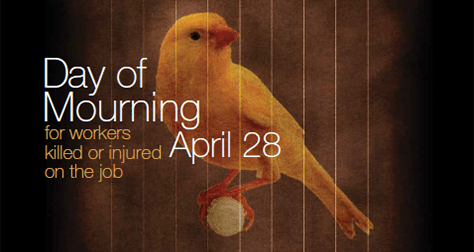
Every year, on April 28, workers around the world mark the Day of Mourning for workers killed or injured on the job.

It’s an important day for us to remember those we’ve lost and renew our resolve to make our workplaces safer.

Approximately 1,000 workers die each year in Canada from exposure to work-related hazards.

This year we honour these CUPE members who lost their lives at work since the last Day of Mourning:

William Miller, 56, CUPE 4705, City of Greater Sudbury, Ontario

Paul Barao, 60, CUPE 2544, Peel District School Board, Ontario

Thierry Leroux, 26, CUPE 5153, Council of the Anishinabe Nation of Lac-Simon, Quebec

Claude Davidson, 48, CUPE 3333, Réseau de Transport de Longueuil, Quebec

Mike McNeil, 61, CUPE 1259, Glades Lodge Nursing Home, Nova Scotia (on leave)

Jody Taylor, 43, CUPE 1004, City of Vancouver, BC

Day of Mourning ceremonies are being held across the country. Find an event in your region.

CUPE National President Mark Hancock and National Secretary-Treasurer Charles Fleury will attend a ceremony in Victoria, BC.

“On April 28 we mourn these six CUPE members, and all the other workers who’ve been injured or killed. It’s a terrible loss that we refuse to accept as being part of the job. All workers should be able to come home healthy and safe at the end of a shift,” said Hancock.

The Strategic Directions document passed at CUPE National Convention made 2016 CUPE’s Year of Health and Safety.

“Ensuring the health and safety of workers is at the heart of the work of our union—it’s part of our core values,” Hancock continued.

“When convention delegates made 2016 the year of health and safety, they gave us a great opportunity to put renewed focus on this important issue.”

To mark the Day of Mourning this year, CUPE is renewing its call for a full ban on the use, import and export of asbestos in Canada. While the former Conservative government stood in the way of progress on the issue, Hancock says the Liberals have a chance to do things differently.

“The Harper government showed a repeated disregard for the health and safety of Canadians. This Liberal government now has an opportunity to show that they do care—that the lives of countless workers across Canada matter to them,” said CUPE National President Mark Hancock.

“It’s time to catch up with the rest of the world. On April 28, we’re calling on the Trudeau government to ban the import, export and use of asbestos in Canada.”

Hancock reiterated this demand in a letter to the prime minister. And on April 19,CUPE members participated in lobbying organized by the CLC, where a full asbestos ban was among the items up for discussion.

There are lots of other things happening as part of the Year of Health and Safety. Most CUPE divisions are holding a health and safety conference in 2016. CUPE will be providing educational materials and staff assistance to each division putting together a conference.

CUPE has also launched the new Health and Safety Learning Series. Modelled after the successful Steward Learning Series, the new Health and Safety Learning Series will include a nine-hour introductory course and a selection of three-hour modules.

Of course, important work is happening every day in our locals. That’s why each month we’re profiling aCUPE member about their health and safety activism at work. And for locals that want to recognize their own local activists, CUPE is offering a special certificate, for free, on our website. Order one and celebrate an activist in your local today.

Source: CUPE marks the Day of Mourning, calls for asbestos ban | Canadian Union of Public Employees

CUPE stands in solidarity with Paris, Beirut

In response to shocking and disturbing violence that took place last week, including the events in Paris on November 13 and in Beirut on November 12, CUPE National President Mark Hancock spoke out on behalf of CUPE members.

“Our thoughts and condolences go out the family and friends of those killed and injured,” said Hancock. “Our thoughts are also with the first responders and health care workers who are on the front lines of the fight against terrorism. We thank them for their work, leadership and dedication in such difficult times.”

CUPE pledged its solidarity with the people of France, Lebanon, and all those around the world affected by senseless violence.

“We deplore these acts of violence,” said CUPE National Secretary-Treasurer Charles Fleury. “We will continue to work for peace and call on our government to end military aggression abroad, and on the international community to ensure that democracy and human rights prevail over violence and fear.”

Source: CUPE stands in solidarity with Paris, Beirut | Canadian Union of Public Employees

Mark Hancock Elected National President Of CUPE

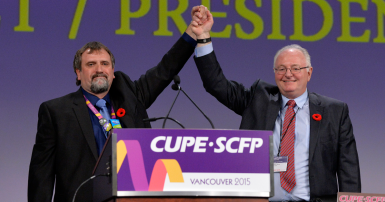
Mark Hancock has been elected the national president of the Canadian Union of Public Employees. Over 2,100 delegates, representing CUPE locals from across the country, elected Hancock to lead Canada’s largest union. The vote took place at CUPE’s 27th biennial national convention taking place this week in Vancouver.

“I will do my best each and every day for all our members across this great country. I am so honoured to be your national president,” said Hancock to convention delegates, after being elected. Hancock, who has been president of CUPE’s British Columbia division since 2013, won on the first ballot, defeating Fred Hahn, currently president of CUPE Ontario.

Source: Mark Hancock elected national president of CUPE