
Conference to Develop a National Framework on Lyme Disease

OTTAWA, May 15, 2016 /CNW/ – The Honourable Jane Philpott, Minister of Health, will be providing opening remarks at the Conference to Develop a National Framework on Lyme Disease.

More information on the Lyme Disease Conference can be found online.

Date
May 16, 2016

Time
Registration: 8:00 am ET9:00 am ET
Opening Remarks: 9:05 am ET
Media Availability: 9:30 am ET

Location
Government of Canada Conference Centre
111 Sussex Drive, Ottawa ON
Terrace Level – Algonquin Room

RELATED LINKS
http://www.phac-aspc.gc.ca

This conference is mandated by the Federal Framework on Lyme Disease Act.The conference’s aim is to develop a framework that will help prevent and reduce Lyme disease-related health risks to Canadians. It will focus on:

  • medical surveillance for tracking:
    • incidence rates
    • associated economic costs
  • standardized educational materials:
    • for use by Canadian public health providers
    • to increase national awareness
  • guidelines and best practices regarding:
    • treatment
    • prevention
    • identification
    • management

On behalf of the Minister of Health, the Public Health Agency of Canada will open the conference. Participants will include:

  • provincial and territorial health ministers
  • stakeholders, including representatives of:
    • patient groups
    • the medical community

Planning activities

We started a number of planning activities to help us develop the framework and to support the conference.

Online consultation

A 30-day online consultation was launched on June 1, 2015. Its purpose was to collect feedback from Canadians who expressed an interest in contributing to the framework.

A summary report from the consultation will be made available online after the conference.

Best Brains Exchange workshop

In late June 2015, a Best Brains Exchange 1-day workshop was held. Workshop participants included:

  • clinicians
  • academics
  • researchers
  • policy makers

These experts reviewed the effectiveness of current Lyme disease testing to identify needed changes.

The workshop outcomes will be posted when they become available.

Planning committee

A planning committee was formed to organize the conference with help from the:

  • Canadian Lyme Disease Foundation
  • Association of Medical Microbiology and Infectious Disease Canada

Members include:

  • Gregory W. Taylor
    Chief Public Health Officer, Public Health Agency of Canada
  • Daniel Gregson
    Past-President, Association of Medical Microbiology and Infectious Disease Canada
  • Jim Wilson
    President and Founder, Canadian Lyme Disease Foundation
  • George Chaconas
    Canada Research Chair, Molecular Biology of Lyme Borreliosis
  • Gwen Barlee
    National Policy Director, Spokesperson for the Wilderness Committee
  • Marguerite Glazer
    Association Québécoise de la maladie de Lyme
  • Vett Lloyd
    Professor of Biology, Mount Allison University
  • Ralph Hawkins
    Associate Professor of Medicine, University of Calgary
  • Richard Rusk
    Central Medical Officer of Health Services, Communicable Disease Control, Manitoba Health
  • Marc Ouellette
    Scientific Director, Canadian Institutes of Health Research
  • Joel Kettner
    Professor, University of Manitoba
  • Gerald Evans
    Chair of the Division of Infectious Diseases, Professor in the Departments of Medicine, Biomedical and Molecular Sciences, and Pathology and Molecular Medicine, Queen’s University

Planning committee updates are posted here when they become available.

Conference overview and agenda

The conference will take place May 15 to 17, 2016, at the Government Conference Centre in Ottawa (111 Sussex Drive). It is open to the public.

The agenda is now available online.

To follow the conversation on social media, be sure to use #LymeConference. You can also follow us on Twitter at:

Source: Public Health Agency of Canada – Notice to the media – Conference to Develop a National Framework
Lyme Disease: Learn The Basics, What It’s All About

Lyme disease, and Lyme-carrying ticks are of serious concern with each passing year.

Lyme Basics

Lyme disease (often misspelled as “Lime” or “Lymes”) is an inflammatory infection that spreads to humans through tick bites.

Lyme is a borreliosis caused by borrelia bacteria, which commonly infects woodland animals like mice or deer. Ticks pick up the bacteria by biting infected animals, and then pass it on to their human hosts. The are many strains or genospecies of borrelia that cause Lyme disease (borreliosis) in humans just as there are many strains of the flu virus that cause flu symptoms in humans, with some strains more virulent than others.

3 stages of Lyme (often blurred together quite rapidly)

Stage 1: Early infection (first few days after infection)
Stage 2: Infection spreads (days to weeks following infection)
Stage 3: Chronic Lyme (days to weeks after infection if left untreated, or not properly treated, for months/years after infection)

Lyme disease is most treatable during Stage 1. As time passes, both treatment and diagnosis become more difficult. Symptoms worsen during each stage of infection, ranging from flu-like symptoms to neurological illnesses, including paralysis. With chronic Lyme disease there is not one system of the body that can be unaffected… this includes various hormone production as well.

Lyme disease is on the rise in Canada. Decrease your risk of infection by taking preventative action and learning more about Lyme.

Tick ID & Removal

Canada is home to many species of ticks, but the Ixodes Tick – more often known as the “black-legged” or “deer” tick – is the most common Lyme-carrier.

Ixodes ticks…

  • Have hard-shelled brown and black bodies, but appear greyish when engorged and some times are confused with a skin tag
  • Have 8 legs as adults, but baby ticks have only 6
  • Are 1–5 mm long, but adults can grow up to 20 mm when feeding

Protect your family from Lyme. Learn how to identify various tick species and how to properly remove them if bitten.

Identifying ticks  Safe tick removal

Symptoms

Early treatment of Lyme disease is critical, however Lyme is very difficult to diagnose because symptoms vary from person to person. There are over 100 known symptoms of Lyme disease.

Common symptoms include:

  • Developing a rash, sometimes shaped like a “bull’s eye” mark.
  • Initial flu-like symptoms, such as: fever, headache, nausea, jaw pain, light sensitivity, red eyes, muscle aches and neck stiffness.

While some Lyme victims experience immediate symptoms after infection, others may have none for many months.

Learn the symptoms

Source: Lyme Basics | CanLyme – Canadian Lyme Disease Foundation

A tick that feeds on birds may increase the range of Lyme disease

89V+1316790532

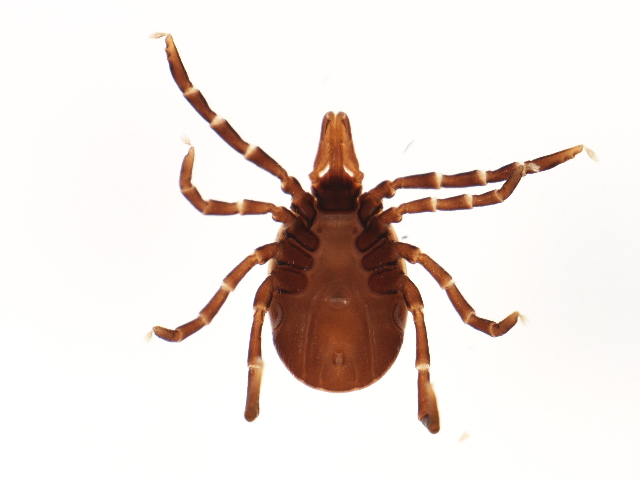
Ixodes affinis

Blacklegged ticks (Ixodes scapularis) are the primary vector of Lyme disease to humans, but researchers at Old Dominion University in Virginia are focusing on another tick, Ixodes affinis, even though it doesn’t bite people.

In their paper published in the Journal of Medical Entomology, “New records of Ixodes affinis parasitizing avian hosts in southeastern Virginia,” Erin Heller and co-authors document Ixodes affinis parasitizing five songbird species on which it had not previously been recorded. This is important because birds are able to travel long distances, and bring tick hitchhikers with them.

As the range of Ixodes affinis expands northwards and overlaps more with that of the human-biting blacklegged tick, the authors predict that having two competent tick vectors may increase transmission of the pathogen throughout the system and lead to an increase in the number of Lyme disease cases in humans.

This study adds to a growing body of evidence that indicates that in order to understand the spread of Lyme disease, researchers must consider the ecology of all of its various hosts and vectors. Ixodes affinis and its various feathered hosts may prove to play a significant part in the story of this potentially debilitating disease.

Source: Entomological Society of America

Source: A tick that feeds on birds may increase the range of Lyme disease | Science Codex