
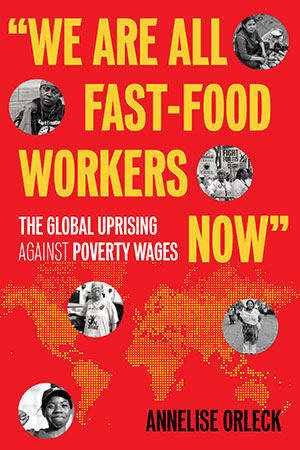
“We Are All Fast-Food Workers Now” The Global Uprising Against Poverty Wages

978-080708177-8

March 11, 2018

The story of low-wage workers rising up around the world to demand respect and a living wage.

Tracing a new labor movement sparked and sustained by low-wage workers from across the globe, “We Are All Fast-Food Workers Now” is an urgent, illuminating look at globalization as seen through the eyes of workers-activists: small farmers, fast-food servers, retail workers, hotel housekeepers, home-healthcare aides, airport workers, and adjunct professors who are fighting for respect, safety, and a living wage.

With original photographs by Liz Cooke and drawing on interviews with activists in many US cities and countries around the world, including Bangladesh, Cambodia, Mexico, South Africa, and the Philippines, it features stories of resistance and rebellion, as well as reflections on hope and change as it rises from the bottom up.

From: www.beacon.org

To Download, click link below:

We_Are_All_Fast-Food_Workers_Now_by_Annelise_Orlec

P.S.

This is my first post on my blog in almost two years, and I felt strongly about sharing this book, that chronicles the global fight of many low income earners for respect, safety and a living wage.

I dare you to be challenged; I dare you to confront your beliefs, your consciousness.

We are all by nature activists for ourselves, in our work, with our friends, family and in the community, in one way or another. Whether it is going for a bank loan for a new car, selling ourselves for a promotion at work, or a new job; casting our vote in a local, provincial or federal election.

I dare you to learn; I dare you to have your personal values and philosophy impacted, about a subject you may be ignorant of, know a little of or be well versed in——-because knowledge is power, and the pen is mighter than the sword——to coin two cliches.

Peace and out.

Advocate for low-wage economy rebutted

By Ken Georgetti, Vancouver Sun September 6, 2013

Re: The union disadvantage, Sept. 4 Terence Corcoran appears to be all for a low-wage Canadian economy.

He suggests workers are better off employed at $8 an hour rather than unemployed at $15. He fails to mention that the majority of Canadians stuck in low-wage jobs are employed by large, highly profitable corporations.

Corcoran is silent on record high corporate profits and the compensation of CEOs. He also fails to mention studies showing these corporations can well afford to pay decent, family-supporting wages.

He neglects to acknowledge the cost to our society of low-wage employers who fail to provide decent pensions and benefits. Decent wages are about fairness and economic growth. The IMF, the OECD and credible economists point to weak domestic demand as a principal constraint on that growth. They argue for measures to stimulate demand; the U.K. is the most recent country to come in for criticism for its austerity policies.

When the real wage paid to low-and middle-income workers increases, it means more money spent in the local economy and businesses. That creates jobs locally rather than having record profits hoarded by big corporations, or being invested abroad in low-wage economies.

Ken Georgetti President, Canadian Labour Congress, Ottawa

Large, Profitable Companies Employ Most Minimum-Wage Earners

George Zornick    http://www.thenation.com

If you’ve ever had a conversation about the minimum wage with friends and family, you invariably hear an argument about how raising it would hurt small businesses.

There is compelling academic research that increasing the minimum wage doesn’t dramatically impact employment levels, but a new study released today underscores another important point—most people earning minimum wage work for large, profitable corporations.

The National Employment Law Project looked at Census data from 2009–11 and found that 66 percent of low-wage workers are employed by large businesses with over 100 employees. Moreover, it found that the fifty largest employers of low-wage workers have all recovered from the recession and are in strong financial positions:

  • 92 percent were profitable last year.

  • 78 percent have been profitable for the last three years.

  • 75 percent have higher revenues now than before the recession, and 73 percent have higher cash holdings.

  • 63 percent have higher operating margins than before the recession.

Also, the study found that at these fifty firms, executive compensation averaged $9.4 million, and they have returned $174.8 billion to shareholders in dividends or share buybacks in the past five years.

Low-wage workers are concentrated in the service industry, and dominate the following sectors:

You can guess from looking at that list who the biggest abusers of low-wage labor are. Walmart, for example, employs 1.4 million Americans, and a vast majority of them at wages under $10 per hour. The highest-paid executive, however, earned over $18.4 million last year. Other key offenders are Yum! Brands (Taco Bell, Pizza Hut, KFC), McDonald’s, Target, Sears, Doctor’s Associates Inc (Subway), TJMaxx and Burger King.

Amazingly, one in four American jobs pays less than $10 per hour (26 percent), according to the study. And it’s not just those workers who suffer—big businesses that pay collectively pay millions of workers low wages set a basement for the rest of the wage scale and depress earnings above $10, too.

As we noted last month, some Congressional Democrats have joined forces with Ralph Nader to pass a bill that would raise the minimum wage to $10 per hour immediately, and then index it to the Consumer Price Index after one year.

But they are unlikely to find many allies on the other side of the aisle. This week, Representative Sean Duffy, a Tea Party star, was taped getting in a Jetta and driving away from a constituent asking him for help in raising the minimum wage:

Another, Representative Bill Young of Florida, somewhat oddly told a constituent asking about the minimum wage to “get a job” before walking away: