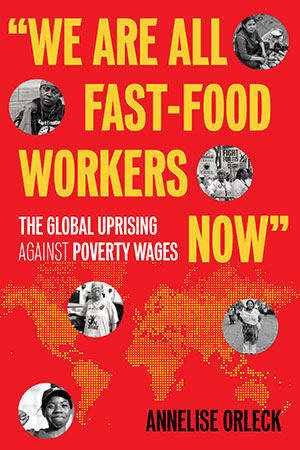
“We Are All Fast-Food Workers Now” The Global Uprising Against Poverty Wages

978-080708177-8

March 11, 2018

The story of low-wage workers rising up around the world to demand respect and a living wage.

Tracing a new labor movement sparked and sustained by low-wage workers from across the globe, “We Are All Fast-Food Workers Now” is an urgent, illuminating look at globalization as seen through the eyes of workers-activists: small farmers, fast-food servers, retail workers, hotel housekeepers, home-healthcare aides, airport workers, and adjunct professors who are fighting for respect, safety, and a living wage.

With original photographs by Liz Cooke and drawing on interviews with activists in many US cities and countries around the world, including Bangladesh, Cambodia, Mexico, South Africa, and the Philippines, it features stories of resistance and rebellion, as well as reflections on hope and change as it rises from the bottom up.

From: www.beacon.org

To Download, click link below:

We_Are_All_Fast-Food_Workers_Now_by_Annelise_Orlec

P.S.

This is my first post on my blog in almost two years, and I felt strongly about sharing this book, that chronicles the global fight of many low income earners for respect, safety and a living wage.

I dare you to be challenged; I dare you to confront your beliefs, your consciousness.

We are all by nature activists for ourselves, in our work, with our friends, family and in the community, in one way or another. Whether it is going for a bank loan for a new car, selling ourselves for a promotion at work, or a new job; casting our vote in a local, provincial or federal election.

I dare you to learn; I dare you to have your personal values and philosophy impacted, about a subject you may be ignorant of, know a little of or be well versed in——-because knowledge is power, and the pen is mighter than the sword——to coin two cliches.

Peace and out.

Raising low-wage workers out of poverty: What is the government doing?

By Jenny Carson   August 21, 2013  http://rabble.ca

Photo: Bob Simpson/flickr

That there has been a dramatic rise in the number of working poor in Canada is incontestable. In 2013, one in ten Canadians earn minimum wages, more than double the number ten years ago; half of those workers are in Ontario. A recent study conducted jointly by McMaster University and United Way Toronto found that barely half of all workers in the GTA-Hamilton area are employed in permanent full-time positions that provide benefits and a modicum of job security.

The explosion of precarious or insecure employment and the subsequent growth in income inequality are the result of both long and short-term changes in the labour market. The outsourcing of good-paying manufacturing jobs to the developing world, the expansion of the low-wage service sector, reckless Wall Street spending and the assault on unions have all contributed to the current plight of the working class. But also important is the erosion of state support for collective bargaining and basic employment protections.

Governments at all levels have abdicated their responsibility to balance corporate and worker interests to maintain a healthy and balanced economy. The consequences for workers — in the form of shrinking wages, increased job insecurity and declining health — have been disastrous.

It is with cautious optimism then that we should greet recent municipal, provincial and federal-level efforts to address worker poverty and income inequality. On July 19, Toronto City Council voted 28-3 to update the City’s Fair Wage Policy. First established in 1893, the Fair Wage Policy requires contractors and suppliers for the city to pay their workers the prevailing market wages and benefits in their field of employment or, for unionized fields, union rates. The policy was designed to protect workers from unscrupulous contractors trying to underbid their competitors by paying their workers less than the prevailing wage rates, and to enhance the city’s reputation as an ethical employer. However, because the rates had not been updated since 2003, until last month many of the city’s “fair wages” fell below the Ontario minimum wage of $10.25 an hour.

The July 19 vote to update the fair wage rates reveals that a majority of councilors understand that is bad policy for the city, as an employer, to add to the growing ranks of the working poor (this excludes councilors like Denzil Minnan-Wong who sees as any kind of wage control as “social engineering”) Under the new rates, contractors providing janitorial services for the city must pay their workers at least $12.43 an hour. Cleaners in the private sector in contrast almost always earn minimum wages.

Unfortunately, however, a fair wage is not a living wage, which the Canadian Centre for Policy Alternatives estimates to be $17.76 an hour in Toronto (a living wage covers the cost of basic necessities such as shelter, food, clothing and transportation). The city’s fair wage rate for cleaners would barely raise a worker out of poverty and, if she or he were supporting a family as is often the case, would in fact leave them in poverty. This then is only a first step if the city truly wants to be an ethical employer.

On July 19 City Council also agreed to devise a “job quality assessment tool” against which any jobs being contracted out would be measured. The basic idea behind this initiative is to ensure that the city is not turning good jobs into bad jobs through the contracting-out process. As well as considering wage levels, the tool will include other criteria such as worker health and safety, skills and training opportunities, working conditions and other factors which determine job quality. Ideally, the job quality assessment tool, which will be considered by Council at the end of this year, will provide some protection for city workers who will no doubt face another round of privatization pressure as Mayor Ford runs for re-election in 2014. How successful this initiative will be depends on whether workers and their unions are given a voice in its formulation and implementation, and it’s not yet clear if they will be.

At the provincial level, the Wynne government recently announced the creation of a minimum wage advisory panel that will consider how to calculate increases to Ontario’s minimum wage. The six-member panel, chaired by University of Toronto Industrial Relations and Human Resources professor Anil Verma includes representatives from labour, business and youth, the latter of whom are disproportionately represented among low-wage and precariously employed workers.

The minimum wage in Ontario has been frozen at $10.25 for the last three years, and will remain so for at least the next six months as the panel conducts public consultations and studies how other jurisdictions calculate minimum wage rates. Anti-poverty activists are justifiably angry that it has taken the Liberals more than two years to set up the panel, and wonder why, unlike many other provinces, Ontario does not provide automatic annual minimum wage increases pegged to inflation. Ontario Labour Minister Yasir Naqvi’s assertion that we need a “made-in-Ontario” solution raises more questions than answers.

Yet once again there is reason to be hopeful that this initiative will help low-wage workers, many of whom are newcomers to Canada climb out of poverty and contribute to the economic recovery we so desperately need (remember, low-wage workers tend to spend every cent they earn in the local economy). The panel will most certainly recommend a wage increase and, perhaps just as importantly, develop a more predictable formula for raising the minimum wage in the future (in the past this has been done on an arbitrary, ad hoc basis that resulted in a nine-year wage freeze under the Conservatives). Only time will tell whether the panel’s political masters, whoever they might be next spring support a progressive overhaul of the system.

Despite the chilly climate for workers on Parliament Hill, there may also be reason to hope for change at the federal level. Next spring NDP Member of Parliament for Toronto Davenport Andrew Cash will introduce a private member’s bill to expand EI access to part-time and self-employed workers and to eliminate the use of unpaid interns. Cash has a personal as well as professional interest in the issue as someone who spent most of his adult life precariously employed in the creative sector. His bill would modernize a program that no longer reflects the employment realities of many Canadians, and make it harder for employers to engage in unethical and often illegal practices such as hiring workers as “independent contractors” so as to avoid obligations under employment law. It would also reform a pension system that currently consigns large numbers of elderly Canadians to poverty.

Cash understands that legislative changes to EI are only part of the solution. He envisions a multi-pronged approach that includes affordable daycare (along the lines of Quebec), social programs to fight poverty, and decent and affordable public transit. While the chances of Cash’s bill passing under a Conservative government are next to zero, his laudable initiative has the potential to start a public dialogue about how the EI system is failing Canadian workers. It is also, as Cash explains, an issue which “spans the employment silos and class divides” that traditionally divides workers. His bill has the potential to mobilize a broad cross-section of the working class, from journalists to taxi drivers to computer programmers. Its long-term success depends in large part on whether this mobilization takes place.

Together, these initiatives reveal that government (or at least some within government) is finally beginning to heed worker and progressive demands for action that will stem the alarming growth of job precarity and worker poverty in Canada.

It is far from clear whether any of these initiatives will lead to real change for workers, but collectively they suggest that at least some of our elected officials understand that government has a stake in creating a more equitable society.   

Jenny Carson is Associate Professor in the Department of History at Ryerson University.

Photo: Bob Simpson/flickr

Supersize Those Wages, McDonald’s

Leo W. Gerard   Leo W. Gerard International President, United Steelworkers   http://www.huffingtonpost.com

August 12, 2013

Last month, McDonald’s gave its workers a little gift — a budget purporting to show how to survive on the starvation wages the burger behemoth pays. The bizarre financial plan made millionaire McDonald’s CEO Don Thompson look like a real clown.

Wearing oversized Ronald McDonald shoes, the CEO stepped in it big time when his budget suggested workers subsist with no money set aside for food, clothing or even soap to scrub off deep-fryer stench. To secure the laughable amount of $20 a month for health insurance, the McDonald’s budget requires the worker to take a second job. The McDonald’s plan: work 80 hours a week; but don’t eat. No happy meals. Not one.

More money would work so much better for McDonald’s employees than Thompson’s recommendation that they forego food or rely on food stamps. And welfare. And public housing. And Medicaid. That’s the real McDonald’s budget. Like other employers paying minimum wage or slightly more, McDonald’s leans on taxpayers to subsidize the payroll. Taxpayers cover the cost of McDonald’s workers’ health care and a big portion of their housing and food costs. The vastly profitable McDonald’s corporation is an unabashed welfare recipient. Coronate Ronald McDonald Welfare King. Sound the trumpets!

The payroll subsidy that low-wage paying corporations collect through welfare programs is way more valuable than the million dollar prize in McDonald’s Monopoly game. The U.S. House Committee on Education and the Workforce calculated what it costs taxpayers to prop up low-wage workers at a Walmart Supercenter. It’s as much as $1.7 million a year. For one store. That’s $5,815 a year for each Walmart worker that taxpayers fork over. No wonder the Walton family is the richest in the world. They win McWelfare Monopoly every day.

In fairytale McDonaldland, low-wage workers are teenagers flipping burgers to buy the newest video game system or expensive prom dress. In reality, low-wage workers are adults. Nearly 70 percent are 20 or older. And they’re not getting younger. The average age of low-wage workers increased 2.6 years since 1979. More than a quarter of them have children. The name of McDonald’s purple blob character describes life for them — “Grimace.”

There’s trouble in real-life McDonaldland now. Since late last year, in cities across the country, low-pay workers have banded together with community organizations, churches and unions to demand a wage increase. They’ve demonstrated, rallied and conducted one-hour and one-day walk outs.

The value of the minimum wage has declined since 1968 when it was worth $10.56 an hour in today’s terms. Now, it’s $7.25. It has not increased in four years. President Obama and Democrats in Congress are calling for it to rise to $9 or $10 an hour. Many low-wage demonstrators, however, are demanding something closer to a living wage – $15 an hour.

One of them, Christopher Drumgold, 32, a father of two earning $7.40 an hour at a McDonald’s in Detroit, told Steven Greenhouse of the New York Times, “Fifteen dollars an hour would be great — we’d be able to pay our living costs. . . On what I’m earning right now you have to choose between paying your rent and eating the next day.”

In other words, $15 an hour from McDonalds would liberate him from reliance on government assistance because he’d be paid enough to cover his expenses. It would mean taxpayers could stop subsidizing McDonald’s payroll.

McDonald’s, Walmart and other low-wage-paying, highly profitable corporations are shelling out a lot of money — not to their struggling workers — but to lobbyists to fight state and federal efforts to increase the minimum wage. They’re demanding that taxpayers continue to bankroll their businesses.

These corporations could pay workers more. But they are happy on the dole. There’s plenty of evidence that it’s possible to increase wages. For one thing, they already pay more in some places, like San Francisco, where the minimum wage is $10.55 and in Washington State, where it’s $9.19. In France, McDonald’s pays the equivalent of $12 at 1,200 thriving franchises.

In June, more than 100 economists signed a petition to raise the minimum wage to $10.50. In an attached report, they note that McDonald’s could cover half of the cost of that wage increase by raising the price of a Big Mac by one nickel. Mickey D patrons would still be “lovin’ it” at $4.05.

Here’s another telling example: McDonald’s spent $6 billion to repurchase shares and dividends in 2011 — the equivalent of $3,500 for each of its 1.7 million restaurant workers worldwide. The Hamburglar gave all of the money to stockholders and none of it to the people whose labor produced the profits.

And there’s this: Last year, McDonald’s more than tripled the compensation packages for its new CEO Thompson and for the man he replaced. Tripled. Thompson’s pay went from $4.1 million to $13.8 million.

The “Fight for Fifteen” workers are asking for just slightly more than double, from their current $15,000 a year before taxes to $31,200. They’d gracefully forego the free company car and free vacation rides in the McDonald’s jet that Thompson gets. They’d be OK with Thompson pulling down 442 times their pay as long as they could cover their own bills.

McDonald’s workers don’t need budgeting help from millionaire CEOs. What they need is for McDonald’s to supersize their wages. McDonald’s $1.3 billion in first quarter profits didn’t magically rain down from Golden Arches. The labor of McDonald’s workers produced it. McDonald’s led the nation in creating fast food. It’s time for it to lead again by stepping up and paying its workers a living wage. The nation’s 3.6 million minimum wage workers deserve a bigger piece of that McApple pie.

Leo W. Gerard, is the International President of the United Steelworkers (USW) union.
He also is a member of the
AFL-CIO Executive Committee and chairs the labor federation’s Public Policy Committee.
President Barack Obama appointed him to the President’s Advisory Committee on Trade Policy and Negotiations. He serves as co-chairman of the
BlueGreen Alliance and on the boards of Campaign for America’s Future and the Economic Policy Institute. He helped create the Washington-based public interest group, Alliance for American Manufacturing.
He is a member of the IndustriALL Global Labor federation and was instrumental in creating
Workers Uniting, the first global union, with leaders of the UK-based manufacturing union Unite.
The USW (United Steel, Paper and Forestry, Rubber, Manufacturing, Energy, Allied Industrial and Service Workers International Union). is the largest manufacturing union in North America, representing 1.2 million active and retired industrial and service sector workers in the U.S., Canada, Puerto Rico and the Virgin Islands.

Show full bio