August 14, 2013 From: http://rankandfile.ca
Author’s introduction:
Since the Conservatives won a majority government in May 2011, they have passed or threatened to pass back-to-work legislation against postal workers, CP Rail engineers, Air Canada flight attendants, baggage handlers, mechanics and pilots. Provincial legislation in BC and Ontario has seen teachers and education workers stripped of collective bargaining rights through Bill 22 and Bill 115, respectively. Less well-known in the rest of Canada is Quebec’s Bill 78 implemented by Liberal Jean Charest. The bill not only revoked freedom of assembly and expression for students, but also for any workers and unions who demonstrated solidarity with the students against the government’s austerity agenda and authoritarianism.
With right-to-work looming at the federal level and possibly one election away in Ontario, the legal rights of workers and unions will be narrowed even further. This begs the question as to whether or not workers and organized labour will be up to the task of defying unjust laws in order to assert what we deem are basic, fundamental rights. From today’s strike-first strategy of fast food workers in America, to the 1965 postal workers wildcat which ushered in public sector collective bargaining, civil disobedience has long been essential to breaking through legal barriers imposed on workers. In fact, the birth of Canada’s labour movement was during a movement of mass civil disobedience to secure the nine hour workday. This goal was not achieved but the unintended consequence of the movement was the legalization of unions. The following tells the story of that movement. -Doug Nesbitt
On June 14 1872, the Trade Union Act, introduced by Prime Minister John A. Macdonald, became law. Unions were now legal in Canada. How did this happen and what did it take for unions to achieve legal recognition? Was it enlightened and benevolent politicians looking out for the masses? Backroom deals between politicians and labour leaders? Or was it a law-breaking popular working-class movement which forced elites to make concessions?

Those familiar with Canadian labour history will have read about the Trade Union Act emerging directly from the Toronto Printers’ Strike of 1872. This is true, but what made the printers’ strike so significant was the mass movement surrounding it. It was only one of many nine-hour strikes and rallies that erupted across Ontario and Quebec during the spring and summer of that year. They were all part of a loosely organized campaign that included union members, non-union workers, men and women, and those who supported the simple demand for a shorter working day. The nine-hour day would take workers a step closer to the labour movement’s ideal at the time of “Eight Hours Work, Eight Hours Leisure, Eight Hours Rest.”
Industry and work
The Nine-Hour Movement was the first workers movement of its kind in Canada. It reflected both the growth of craft unions, representing specific trades, and the development of an urban working-class amidst the growth of towns and cities, early industrialization, and mass migration from the British Isles. With the railway boom of the 1850s, thousands of subsistence and small market farmers had connected with larger urban markets, making the growth of an urban population sustainable. The majority rural population of farmers, especially in Ontario, provided a large market for the consumer goods produced by the growing towns, such as shoes, clothing, farm tools and furniture.
The railway boom also demanded a wide range of specialized manufactured goods, leading to a proliferation of heavy manufacturing and metalworking along the major railway lines. The Grand Trunk and Great Western railways (now CP and CN), which carved out the Windsor-Montreal transit corridor, transformed Hamilton into a centre of heavy industry, and helped build many smaller industrial centres like Sarnia, Stratford, Belleville and Sherbrooke. Unlike today, manufacturing was more decentralized, with a substantial spectrum of available consumer goods being produced in most towns. Heavy industry was spread out along the railways instead of existing in one or two major centres. Industry was still so young that it had not yet become highly centralized and concentrated.

Map of Ontario railways, 1875 (Archives of Ontario, Reference Code: A-6, Accession 9367)
The railway boom turned into a bubble which burst with the economic crash of 1857. The crash took on global proportions because capitalism had spread rapidly around the world in only a few decades, mainly because of the British Empire. As a result of this global crisis, Canada moved towards a protectionist economic policy. For the first time, tariffs were placed on the import of manufactured goods. Because income tax didn’t exist until 1917, tariffs served to boost government revenues in difficult economic times. But the tariffs were also designed and implemented by politicians heavily invested in railways and manufacturing. Alexander Galt, the finance minister who introduced the first manufacturing tariff in 1858, was a major railway promoter and a leading figure in Sherbrooke’s industrialization. With tariffs protecting them from American competition, Canada’s new manufacturing sector survived the economic downturn of the late 1850s.
Nearly all commerce and industry was part of the private sector. This meant private sector employment was the norm. The notion of a public sector workforce didn’t exist. There was no welfare state with mass employment in public services such as public education and healthcare. Transportation, including the Grand Trunk, Great Western, and St. Lawrence-Atlantic Railway (Montreal to Portland), was privately-owned. This did not prevent the railways from being heavily-subsidized and bailed out by governments (governments composed of major railway investors!). Other federal and provincial government institutions were either in their infancy or had not been created yet. The federal government did not have a Department of Labour until 1900!
Organized labour
Unions grew and spread throughout British North America from the 1840s onward. They were, however, not legally recognized. Strikes were illegal, employers had no legal obligation to bargain collectively, and unionists could be arrested and charged for a range of crimes, including mischief, incitement to riot, conspiracy and sedition. Most unions were composed of skilled workmen who laboured in small workshops, often with only three or four employees. Larger workplaces with skilled workers included the shipbuilding, metalworking and railway industries. However, unskilled workers in these industries were not included in the union and often formed their own organizations. These early unions were often called “benevolent societies”. They not only acted as unions, but pooled resources for basic necessities, including paying for doctors for its members.
Most unions were craft unions composed of skilled workers of a specific trade. A workplace with a carpenter, metalworker and general labourer could be represented by three different unions! Industrial unions – covering all types of employees in a single workplace – didn’t exist yet.
Signing a union card was a pledge to one another to uphold democratically-agreed upon working conditions and wages. These demands would be presented to employers. If the demands were not met, then all hell could break loose. However, union organizing and strikes were illegal, making such demands (and threats) very risky and difficult to sustain. Instead of strikes, workers would often engage in other forms of protest, like slow-downs, sabotage or boycotts. Despite this, some employers did bargain with unions to avoid the costly effects of a strike and keep morale high.
Craft unions fought for the “closed shop”. They used their collective strength to keep non-union skilled workers out of their respective industries, often driving them out of town to find work elsewhere. This sort of activity also spread to unskilled workers and their organizations. The Irish Catholic and Canadien dockworkers and labourers of Quebec City, Montreal and Saint John were notorious for using their fists and bats to assert these goals. This culture of violence was part of the lives of these two cultural groups which comprised the largest and poorest, most exploited sections of the working class in Canada. Pseudo-scientific race theory permeated Victorian society and these workers were regarded as inferior to White Anglo-Saxon Protestants. They were also subjected to Orange Order violence and police harassment (sometimes the same thing), and their union activities were criminalized. Irish Catholic and Quebec’s francophone workers relied on collective action for self-defense and self-preservation, sometimes turning to violence to resist more powerful, more violent opponents.
Meanwhile, the modern factory system was only just developing. There were textile mills built in some of Canadian towns. These factories often employed women and children in large numbers. Between long working hours and no real mass transit system, most people lived within a reasonable walking distance of work. The factory system would eventually produce large working-class communities surrounding large workplaces (like the east end of Hamilton surrounding the steel mills), but this phenomenon would only become more common in the early twentieth century. Towns and cities were still geographically very small, and the main mode of transportation was walking. Canada’s first horse-pulled streetcars were introduced in Toronto in 1861, but such services could not yet be considered mass transit until a couple decades later.
Large workplaces were generally uncommon, with the exception of large metalworks and textile mills which were the least common and some of the most expensive industries to establish. Most urban workplaces were run by small business owners employing, as mentioned, three or four skilled workers. The owners did not have the deep pockets like corporations today. In fact, the rise of the modern corporation would occur later in the 1880s after the original “Great Depression” of the previous decade. With so many businesses going under in the 1870s, the surviving businesses were able to consolidate greater market share while crowding out and undercutting any new competitors. In 1872, Canadian and American capitalism hadn’t existed long enough for monopolies to emerge from the results of both competition and the boom-bust cycle. The only monopolies were the railway companies. These companies were reviled by most farmers for their shipping rates. They were also seen by urban and rural dwellers alike as deeply corrupt, in bed with politicians, and anti-democratic by their nature. Many politicians tried, sometimes successfully, to tap into this anti-monopoly sentiment to win votes and gain power. To do so required a newspaper.
Mass media and democracy
In the 1870s, the newspapers were not simply the main source of news, but a highly interactive form of social media. They were widely and frequently read. It was common for people to read the paper out loud to friends, family and co-workers at home or at the pub. The letters pages were lively and often involved exchanges with multiple writers spanning many days.
The owners of newspapers, who were usually also the editor, had no pretense to journalistic objectivity. Newspapers were unabashedly partisan. They advanced the political, social and economic interests of their owners. They openly ridiculed, attacked and criticized the editorial line of other newspapers, especially if they were associated with political opponents. However, the partisan perspective of a single newspaper was balanced out by the many newspapers available in most towns and all cities. Readers had real choice. For example, Toronto, with its 110,00 residents in 1871, had more than half a dozen daily newspapers and even more weeklies. Daily evening newspapers were also common and available. The popularity of newspapers reflected their central role in daily life as a means of communication and the only way to keep track of developments beyond one’s immediate world.

Joseph Howe’s January 1 1835 letter denouncing the colonial government. Howe signed the letter as “The People” (source)
Newspapers played an absolutely critical role in the emergence of a popular democratic consciousness in British North America from the 1830s onward. They participated in a transatlantic circulation of democratic ideas, ranging from American and French republicanism, to British working-class Chartism to Owenite socialism. Crucially, newspapers were able to knit together networks of people across large areas, providing a social base and facilitating an organized challenge to the autocratic power of the colonial governments.
These challenges manifested in various ways. The most spectacular was the rebellions in 1837-38 against the “Chateau Clique” in Lower Canada (Quebec) and the “Family Compact” in Upper Canada (Ontario). These rebellions only happened after efforts by democratic radicals and reformers in the elected legislative assemblies were squashed by the unelected executive councils appointed by the colonies’ respective Lieutanant Governor.
The democratic movements of the 1830s were note limited to central Canada. The Escheat movement of tenant farmers in Prince Edward Island sought to end the power of the absentee landlords. In Nova Scotia, Joseph Howe’s writings on political reform and democracy in the Novascotian, led to a pivotal free speech trial in which Howe was victorious and the colonial elite humiliated.
Many involved in these democratic movements of the 1830s would oversee the achievement of “responsible government” in the colonies between 1847 and 1852 as the British Empire restructured the management of its white colonies. “Responsible government” meant the British ceding far wider decision-making powers to the elected assemblies of each colony. The executive council and Lieutenant Governor no longer had absolute power, though interference continued at key junctures, notably the defeat of New Brunswick’s anti-Confederation government in 1865. Needless to say, every layer of society, including those favouring the status quo and those seeking to overturn it, had an overwhelming interest in reading newspapers, knowing their publishers and knowing their political-economic interests. Anyone seeking to build any political movement had to have a newspaper.
The political project of George Brown
In 1872, Canada’s most widely-read newspaper was The Globe. Its owner and editor, George Brown, founded the paper in 1844. Based in Toronto, Brown was able to build up a large political following in Ontario during the 1850s. He brought together southwestern Ontario’s farmers, the province’s Protestants and Toronto’s business community into a single party which became known as the Liberals. The newspaper amplified the grievances of farmers against the railways, attacked Montreal’s powerful Anglo-Scottish elites, and stoked the anti-Catholic sentiments of Ontario’s large Protestant population, much of it loyal to the Orange Order. Brown’s arch-enemy was John A. Macdonald and his Tory party. The Tories were a coalition of Eastern Ontario loyalists, Montreal’s Anglo-Scottish business elites, Quebec’s Ultramontane Catholic Church, and sections of the French-Canadian bourgeoisie led by George-Étienne Cartier.

Statue of George Brown in front of Queen’s Park, Toronto.
Prior to Confederation, Brown advocated two solutions to the problems he believed were affecting Ontario. First, he promoted the dissolution of the union with Quebec in which both provinces had the same number of seats despite Ontario’s larger population. He wanted seats to be allocated based on population so Ontario had a majority of seats (which would reduce Montreal’s political power). Second, he wanted the rapid colonization of today’s prairies in order to reduce the social pressures of population growth in the cities and rural areas and to prevent American expansionism into present-day Manitoba from Minnesota (which had become a state in 1858). This is why Brown was so vocal in the Globe when it came to sending troops west to suppress the 1869-70 Red River Rebellion of French-speaking Catholic Métis led by Louis Riel. Orange Order Ontarians, including Thomas Scott who was executed by Riel, were the foot soldiers of this military operation.
After several years of political deadlock, Brown formed an unlikely coalition in 1863 with Macdonald’s Tories to form a stable government in the Province of Canada (which comprised Ontario and Quebec). He did so in order to negotiate and create a federation of British colonies in North America. Over three conferences, in Charlottetown, Quebec City and London, England, Confederation was hammered out. Brown not only secured representation by population in the House of Commons, but helped ensure that the Senate was not elected – to the dismay of the Ontario farmers who supported him. He did not have to argue for westward expansion. The Fathers of Confederation were all on the same page when it came to this daunting project of colonization, railway construction and the cleansing of the land of its original inhabitants. Brown, not surprisingly, is recognized as a Father of Confederation. As soon as the terms of Confederation were secured, Brown broke away from the coalition and resumed his opposition to Macdonald’s Tories.
The Printers
The printers who made the newspapers, like The Globe, were skilled workers operating in print shops often employing about a dozen men or less. They were highly literate and well-read. They took great pride in their work and considered themselves to be the upper crust of the working class, if not apart and distinct from unskilled workers. But their jobs were difficult and tiring. They worked six days a week, often twelve hours a day.

New York City eight-hour demonstration in September 1871. From Frank Leslie’s Illustrated Newspaper, 9/30/1871 (source)
Printers had been amongst the first workers to organize in North America. The Toronto Typographical Union was formed in the 1840s and was among the earliest unions in Canada. The printers kept abreast of Canadian, American and British politics. They also took notice of a new upsurge in working-class militancy in the United States during the 1860s. In 1864, Chicago’s workers began agitating for the eight-hour day through petitions, rallies and strikes. They compelled the Illinois state government to pass an eight-hour law (subsequently defied by employers). Eight-hour campaigns then spread across the United States, with New York’s eight-hour movement gaining substantial strength and publicity in mid-1871.
Then, in August 1871, an engineers’ strike in Newcastle, England, made headlines throughout Canada. Workers successfully forced the owners to accept a nine-hour day. This gave a huge boost of confidence to Canadian workers, and unleashed the imaginations of many. New immigrant workers from England who arrived in Canada during the fall of 1871 also brought their ideas and experiences to Canada and set about contributing to what would become Canada’s first working-class movement.
The Nine-Hour Movement
It started in January 1872 with a gathering of Hamilton workers, skilled and unskilled. Together, they formed the Nine-Hour League. It was not a union, but an organization dedicated to securing the nine-hour day through collective protest and strike action. Within weeks, nine-hour groups sprung up in towns across Ontario and into Quebec. Many local unions passed motions in favour of the nine-hour day and endorsed protest or strike action to achieve it. The movement took hold in cities big and small, industrial and agricultural, financial and administrative. The demand for the nine-hour day also emerged in the Maritimes, particularly Halifax, but it was relatively isolated and independent of the movement in Ontario and Quebec (the Intercolonial Railway connecting Quebec City and Halifax would not be complete until 1876).
Nine-hour movement meetings involved dozens, sometimes several hundred people. The meetings would last a few hours. They involved speeches, debates and motions. Like the unions at the time, the meetings weren’t intended to be models of democratic decision-making, but they were still more democratic than Canada’s limited franchise elections and the notoriously corrupt parliament (the Pacific Scandal would bring down John A. Macdonald in 1873). Even George Brown openly criticized the parliament he had helped create as corrupt. He used The Globe to denounce it as dominated by railway and banking concerns. But he reserved such scorn for Montreal elites, not Toronto’s.
Brown and the other Fathers of Confederation were hardly democrats. In fact, they saw democracy as subversive and revolutionary. In addition to ensuring the Senate was unelected, Brown, was no opponent of property qualifications which still restricted the vote among men. Women were altogether excluded from voting. On an honest day, or perhaps after a few drinks, the Fathers of Confederation would likely agree with Karl Marx’s comment that “the oppressed are allowed once every few years to decide which particular representatives of the oppressing class are to represent and repress them.”
It is no wonder, then, that the Nine-Hour Movement gained so much support in so many towns. Inside the meetings, working people practiced democracy together as they worked towards a clear objective which would greatly improve their day-to-day lives.
Divisions
However, not all was rosy among working people. Racism and the exclusion of women from unions, as well as prejudices among skilled workers towards unskilled workers, were real divisions within the working classes of Canada. There were also deep hostilities between Protestants and Catholics, with riots and brawls featuring regularly in a number of cities, especially Saint John, Ottawa and Toronto. Further complicating divisions were the complex French-English tensions rooted in the various realities, processes and events that came with British Conquest in 1759. Sometimes workers organized unions along religious or ethnic lines. The docks of Montreal and Quebec City were occasionally the scene of large brawls between competing French Canadian and Irish Catholic workers for jobs. Despite these problems, the nine-hour groups worked in the opposite direction by bringing together skilled and unskilled, men and women, Protestant and Catholic.
Through democratic cooperation, workers could begin to dissolve distrust and develop relationships based on common goals. Breaking down such divisions was not the purpose of the Nine-Hour Movement, but through these experiences, workers became more aware of how such divisions could be exploited by employers or demagogues, undermining common goals and interests. The Nine-Hour Movement should not be understood as anti-racist, anti-sexist and non-sectarian. It was not. However, it started a process of combating prejudice and oppression within the ranks of labour itself; a process that first emerged in the crucible of struggle.
Building the Movement
The rapid growth of the movement ensured that coordination would be difficult. There was no infrastructure binding the movement together other than pre-existing relationships within certain unions. As a result, protest and strike actions were coordinated within localities but not across the movement as a whole. For example, Hamilton’s Nine-Hour League planned for a demonstration and strikes on May 15. Toronto’s nine-hour activists pledged do the same…on June 1.
The movement also had identifiable leaders. Printer John Hewitt of the Toronto Typographical Union was a major figure in the city’s labour movement and was instrumental in building the nine-hour campaign in Toronto. James Ryan, a machinist in Hamilton, helped initiate the city’s Nine-Hour League. He barnstormed across Ontario, helping to establish new local nine-hour chapters. Communications internal to North America’s craft unions also helped spread the word.
As the movement established itself, the Toronto Typographical Union passed a motion on January 10 in favour of a 55-hour work week (close to a nine-hour day/six-day week). By March 7 they formed a strike committee, and delivered a nine-hour petition to Toronto’s newspaper owners four days later. The owners were given two weeks to respond. Strikes would start on March 25 at newspaper shops which did not agree to the terms.
The Toronto Printers’ Strike
In his Globe editorials of August and September 1871, Brown had supported the nine-hour strike in Newcastle. But when the movement took hold in Ontario, he abandoned his position. Even before the printers delivered their petition in March, Brown was already claiming that the movement had gone “beyond the limits of friendly negotiation” and argued that workers were actually oppressing the employers.
By March 21, Brown had organized the Master Printers Association (MPA) of Toronto newspaper owners to coordinate its battle against the union. Only James Beaty, the Tory MP for Toronto East, and editor of The Leader, agreed to the union’s nine-hour demands. Beaty then turned his newspaper and its letters page into a platform for Toronto workers to attack both George Brown’s Liberals and George Brown’s Globe.
When the strike started on March 25, The Globe carried a prominent ad looking for non-union printers. Brown wrote an editorial attacking the strike as reckless and unreasonable. He claimed the strike was “the forerunner of the coming attack on employers and employed in all branches of industry,” adding that “the importance of firmly resisting it can hardly be over-estimated.” This was the attitude towards workers from one of the most important Fathers of Confederation and founder of the Ontario and federal Liberals.
It was inevitable that the strike would make headline news across Canada. Not only did Brown have many enemies, but the country’s largest newspaper was now at the centre of a huge labour battle involving the mass media. As a result, the demand for a nine-hour day received even more publicity and public support. It compelled politicians like Prime Minister Macdonald to take note, especially when Toronto’s workers responded so positively to Beaty’s unexpected pro-labour stance.
Escalation
Toronto’s unions and nine-hour supporters continued to build support through the first weeks of the strike. The Toronto Trades Assembly (forerunner of today’s labour council) called for a march on Queen’s Park. On April 15, three days after the call, two thousand workers and supporters gathered at the Trades Assembly Hall on King Street before marching down Yonge to College and then to Queen’s Park. By the time they arrived, the march had swelled to ten thousand people. Toronto’s population was only 110,000! And there were no union-funded buses bringing in protesters from around the province.
The printers’ strike had already frightened many employers who began scrambling to deal with the nine-hour petitions, and actions planned for May and June. But the April 15 demonstration proved to be a turning point as George Brown and Master Printers’ Association snapped – as employers often do – and caved to undemocratic and authoritarian practices.
The day after the demonstration, George Brown and his Master Printers’ Association used a law written in 1792 to secure the arrest of the 24-person strike committee for conspiracy. Within hours of the arrests, four thousand people gathered to protest at Market Square. Speakers from organized labour, and a representative from The Leader, denounced the arrests, attacked Brown, and restated their demands for a nine-hour day.
Macdonald and the labour movement
Recognizing an opportunity to consolidate support among skilled workers who could vote, and to land a blow against his arch-rival George Brown, Prime Minister John A. Macdonald introduced legislation on April 18 to legalize unions. This legislation, the Trade Union Act, was modeled on British legislation passed the previous year.
On the same day, the first issue of the Ontario Workman was published, heralding the birth of Canada’s independent labour press. The weekly newspaper was the brainchild of John Hewitt and became the official publication of the Toronto Trades Assembly. The paper was organized as a cooperative enterprise and gained a small circulation of two thousand (with many more readers). The Ontario Workman would fold two years later in 1874 at the onset of the original “Great Depression”. The Great Depression (1873-1879) would see many unions decimated or destroyed through unemployment and a calculated employers offensive to rollback the gains of the preceding decade.
While the Ontario Workman declared itself in favour of emancipating labour “from the thraldom of capital,” the new labour movement was far from clear on a number of political issues. With the introduction of the Trade Union Act on April 18, and its passing into law on June 14, the Tories were able to gain a fair degree of support among Toronto’s leading labour activists, especially those in the printers union who had major influence over the Toronto Trades Assembly. In fact, Prime Minister Macdonald went so far as to loan the newspaper $500 in late 1872, explaining “I do not suppose I will ever get the money, but I may as well keep it over them as a security for good behaviour.”
This was how Macdonald did politics. He had turned patronage politics into a science. If he didn’t get something in exchange right away, he was always lining himself up for a favour in the future. Macdonald was also willing to use the stick as much as the carrot. Macdonald had legalized unions, but the Trade Union Act did not make compel employers to recognize the union or bargain collectively. On May 7, three weeks after introducing the Trade Union Act, Macdonald brought forward the Criminal Law Amendment Act which made picketing illegal.

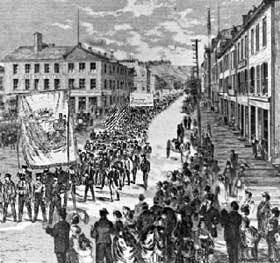
Hamilton’s 1,500-strong nine-hour procession. May 15 1872 (Canadian Illustrated News, courtesy Library and Archives Canada/C-58640).
The Strange Defeat of the Nine-Hour Movement
With Macdonald’s new legislation as a rebuke of Brown’s arrests, employers were provided the legal cover to take a hard line against the nine-hour demands. The Hamilton action on May 15 started with a 1,500-strong rally. But strikes in several industries, like in other nine-hour strikes initiated across Ontario that month, petered out by early June. In Montreal, major strikes persisted until August before collapsing.
The outcome of the Toronto Printers’ Strike wasn’t simply the Trade Union Act. It was also the defeat of the Nine-Hour Movement. The Toronto printers initiated their March 25 strike independently of the June 1 date set for the Toronto nine-hour demonstration and strikes. Having taken the initiative without coordination, the Toronto printers left the Nine-Hour Movement unprepared and unable to respond effectively, as all their organizing efforts had been focused on building for strikes in May and June. Even so, the monster rallies in Toronto were indicative of how much support there was for the movement as a whole, not simply the printers.
The movement’s lack of coordination combined with Macdonald’s double-edged intervention proved fatal. Despite this, the legalization of unions in Canada was a huge victory for a workers movement that had entirely different goals. Since 1872, unions, workers and various forms of protest have become incorporated into an expansive legal architecture that governs and manages the relationship between unions and management, labour and capital. The boundaries, limits and weaknesses of this legal architecture are shaped by which of these two contending social forces has the upper hand in terms of organization, strategy, ideas and public support.
Lessons from 1872
Strikes, demonstrations, local democratic organizations, and geographically-large movement were recognized by workers as necessary to secure their demands for a nine-hour day. The issue of legality was a problem but the Nine-Hour Movement solved this by emphasizing the use of mass public rallies to demonstrate its wide base of support and physically protect strike actions. With large numbers of people and a clear message, illegal activity could succeed in forcing employers and the government to address the unjust state of affairs.
Mass civil disobedience, democratic meetings, local organization and clear demands made the Nine-Hour Movement a force to be reckoned with. It also provided the atmosphere, energy and support for the Toronto Printers’ Strike to have the impact it did. The movement battled for public opinion through numerous public meetings and the establishment of groups in every town possible. They flooded the newspapers with letters, and produced their own independent media.
There were some unresolved difficulties. The question of strategy had been ignored by the Toronto printers who put their own immediate nine-hour demands ahead of the wider movement. This threw the movement off balance, allowing both employers and politicians to regain the initiative. Likewise, the tricky question of political representation emerged. Debates erupted over whether or not to support one of the two mainstream parties, or run independent labour candidates. Through the later 1870s, the printers and other union workers would support the Tories against the Liberals.
The struggle also exposed the leaders of the two mainstream parties. George Brown, the arch-Liberal, was a two-faced liar who professed to favour workers rights at one moment, and meted out repression at the next. Macdonald, the arch-Tory, only dealt with labour to gain electoral support while carefully ensuring that any future labour disruptions could be thrown off course through legal repression or financial co-optation. Even so, the state was forced to transform the industrial relations regime because a popular workers movement ignored a series of legal obstacles in seeking a nine-hour day for all workers.
References
Babcock, Robert H. “A Note on the Toronto Printers’ Strike, 1872,” Labour/Le Travail 7 (Spring 1981), p.127-129.
Battye, John. “The Nine Hour Pioneers: The Genesis of the Canadian Labour Movement,” Labour/Le Travail 4 (1979), p.25-56.
Burr, Christina Ann. “That Coming Curse – The Incompetent Compositress: Class and Gender Relations in the Toronto Typographical Union in the Late Nineteenth Century,” Canadian Historical Review 74/3 (1993), p.344-366.
Careless, J.M.S. Brown of the Globe. 2 vols. Toronto: Macmillan, 1959-1963.
Forsey, Eugene. Trade Unions in Canada, 1812-1902. Toronto: University of Toronto Press, 1982.
Kealey, Gregory S. Toronto Workers Respond to Industrial Capitalism 1867-1892. Toronto: University of Toronto Press, 1980.
Langdon, Steven. “The Emergence of the Canadian working class movement, 1845-1875,” Journal of Canadian Studies 8/2 (May 1973), p.3-12; 8/3 (August 1973), p.8-25.
Lipton, Charles. The Trade Union Movement of Canada. Montreal: Canadian Social Publications, 1960.
Nesbitt, Doug. “When the Tories supported Labour: The 1872 Toronto Printers’ Strike,” unpublished undergraduate paper, Carleton University, 2006.
Palmer, Bryan D. Working-Class Experience: Rethinking the History of Canadian Labour 1800-1991. Second edition. Toronto: McClelland and Stewart, 1992.
Pentland, H. Clare. Labour and Capital in Canada 1650-1860. Toronto: J. Lorimer, 1981.
Verzuh, Ron. Radical Rag: The Pioneer Labour Press in Canada. Ottawa: Steel Rail Publishing, 1988.
Zerker, Sally F. “George Brown and the printers union,” Journal of Canadian Studies 10/1 (1975), p.42-48.
Zerker, Sally F. The Rise and Fall of the Toronto Typographical Union, 1832-1972. Toronto: University of Toronto Press, 1982.




 Andrew Phillip Chernoff