Values and Principles Of A President of The United States And 2015 American Politics….Just Saying….

September 21, 2015       Andrew Chernoff


Ben Carson, currently a top contender for the GOP presidential nomination, taking third place with 14% of support in the latest CNN/ORC poll, released Sunday, is having to defend his thoughts about whether he would support a Muslim for, and as President, of the United States of America.

Carson said Sunday on NBC’s “Meet the Press” that he “would not advocate that we put a Muslim in charge of this nation. I absolutely would not agree with that.” He said he believed that Islam was “inconsistent with the values and principles of America” and inconsistent with the U.S. Constitution.   http://www.cnn.com/2015/09/21/politics/ben-carson-muslim-president-cair-drop-out/index.html

Nihad Awad, executive director of the Council on American-Islamic Relations, responded in part by saying Carson’s views are inconsistent with the Constitution, as the document states that there shall be “no religious test” for candidates seeking public office.

So, what does the United States Constitution say about “no religious test”? The history behind this is as follows, from Wikipedia, the free encyclopedia:

Separation of church and state” (sometimes “wall of separation between church and state“) is a phrase used by Thomas Jefferson and others expressing an understanding of the intent and function of the Establishment Clause and Free Exercise Clause of the First Amendment to the Constitution of the United States. Since the First Amendment clearly places the restrictions solely on the state, some argue a more correct phrase would be the “separation of state FROM church”. Either way, the “separation” phrase has since been repeatedly used by the Supreme Court of the United States.

The First Amendment to the United States Constitution provides that and Article VI specifies that “no religious Test shall ever be required as a Qualification to any Office or public Trust under the United States.” The modern concept of a wholly secular government is sometimes credited to the writings of English philosopher John Locke, but the phrase “separation of church and state” in this context is generally traced to a January 1, 1802 letter by Thomas Jefferson, addressed to the Danbury Baptist Association in Connecticut, and published in a Massachusetts newspaper.

Echoing the language of the founder of the first Baptist church in America, Roger Williams—who had written in 1644 of “[A] hedge or wall of separation between the garden of the church and the wilderness of the world”—Jefferson wrote, “I contemplate with sovereign reverence that act of the whole American people which declared that their legislature should ‘make no law respecting an establishment of religion, or prohibiting the free exercise thereof,’ thus building a wall of separation between Church & State.”[1]

Jefferson’s metaphor of a wall of separation has been cited repeatedly by the U.S. Supreme Court. In Reynolds v. United States (1879) the Court wrote that Jefferson’s comments “may be accepted almost as an authoritative declaration of the scope and effect of the [First] Amendment.” In Everson v. Board of Education (1947), Justice Hugo Black wrote: “In the words of Thomas Jefferson, the clause against establishment of religion by law was intended to erect a wall of separation between church and state.”[2]

However, the Court has not always interpreted the constitutional principle as absolute, and the proper extent of separation between government and religion in the U.S. remains an ongoing subject of impassioned debate.[3][4][5][6]


In political elections voters support particular people running for election for a number of reasons, including ones faith whether it be a religion or otherwise.

And it could be said that ones faith, whatever a person chooses to believe/not believe, will help develop and shape a persons values and principles, keeping in mind, that life experience, and as people age through life, may be redevelop and continue to shape  a persons vales and principles.

After all, human beings are not perfect and faith by definition includes (http://dictionary.reference.com/browse/faith):

1. confidence or trust in a person or thing: faith in another’s ability.

2. belief that is not based on proof: He had faith that the hypothesis would be substantiated by fact.

3. belief in God or in the doctrines or teachings of religion: the firm faith of the Pilgrims.

4. belief in anything, as a code of ethics, standards of merit, etc.: to be of the same faith with someone concerning honesty.

5. a system of religious belief: the Christian faith; the Jewish faith.

6. the obligation of loyalty or fidelity to a person, promise, engagement, etc.: Failure to appear would be breaking faith.

7. the observance of this obligation; fidelity to one’s promise, oath, allegiance, etc.: He was the only one who proved his faith during our recent troubles.

So, if you lose confidence or trust in a person or thing; if you are given proof or fact that does not support; if the observance of the faith is left lacking for some reason, a persons values and principles may be subject to change or refinement.

Now, let’s check out values and principles, and their differences. From http://www.differencebetween.com/:

Values vs Principles

As a human being, it is impossible to live in isolation. We live in a society of which we are a part and follow the unwritten rules, mores, customs, and traditions deemed right for the individuals. These rules can be about morality as to what is right and what is wrong or they can be religious in nature. There are two concepts of values and principles that become a guiding force in the lives of most of us. Though closely related and almost intertwined, values and principles have differences that will be talked about in this article.

Values

Values are sets of beliefs about good and bad, right and wrong, and about many other aspects of living and interacting in the society with others. Though there are universal values like love and compassion, it is found that values vary from culture to culture, and there are also personal values that are dear to people. Values are beliefs and opinions that people hold regarding issues and concepts such as liberty, freedom, love, sex, education, relations, friendship etc. Most of the times, values tend to have a religious sanction and people hold them without knowing much about them. They consider some things as sacred and some others profane just because it is written in their sacred texts.

Values serve as a guiding force in life and provide a sense of direction to an individual in a society. There are times when there is a lot of confusion in the minds of people regarding an issue or a feeling. At times like these, clear cut values help an individual to come out of dilemma and move ahead in life. For example, abortion may be prohibited and disapproved by a religion, but the modern government in a country may allow it to allow women to decide their family size. If a woman holds positive views about abortion, she will not have any dilemma, and there will be no battle between her own value about abortion and what her religion says about this issue. In the case of contradiction between values, there can be a lot of mental conflict that can torment an individual.

Principles

Principles can be described as rules or laws that are universal in nature. These principles are about human behavior and set or govern the interaction between people in a society. Principles are unwritten laws that are expected to be followed and those seen flouting these principles are looked down upon in a society. People also make their own guiding principles in life. Whenever they are in doubt, they can take recourse to these principles, and all doubts are cleared. Having a set of principles is like having a compass in the journey of life when we feel that we are lost or unable to find the right path.

As described above, principles are always about universal truths or standards. One must have clear cut principles about concepts such as fairness, justice, equality, truthfulness, honesty, etc so as to be able to take a stand on any social issue or event. Having a principle allows one to have a stand that is a comforting thought as he is not groping in the dark as to what he feels about important issues and concepts.

What is the difference between Values and Principles?

• Both values and principles serve important roles in the life of an individual while dealing with others and social issues and concepts.

• Values are sets of beliefs about subjective traits and ideal while principles are universal laws and truths.

• Principles serve the role of an anchor for a ship in its journey when confronted with conflicting issues, while values allow us move ahead with confidence expressing our beliefs.

Now, everybody has an opinion and  God only knows the process of  how it is formed. And we have a clue about Carson(http://www.cnn.com/2015/09/21/politics/ben-carson-muslim-president-cair-drop-out/index.html):

Carson’s business manager, Armstrong Williams, told CNN that Carson was not trying to “hurt or offend” but came to his conclusion about Islam “because of his love for America.”

“What an individual believes impacts how America is governed and what we become as a nation,” Williams said, adding that Carson is not alone in his view of Islam.

In fact, according to a Gallup survey published in June, 38% of Americans polled said they would not support a Muslim candidate for president, while 60% said they would.

“There are many Americans, if they search their hearts, they believe the same thing — they don’t want to believe it but when they look at the world and look at how Islam has become polluted and what is happening in Europe and in the Middle East and around the world, you have to take time to pause and ask what is happening around the world?” Williams said.

Williams also slammed what he called the “destructive tenets of Islam and Sharia law.”

And if that was not enough response to Carson, we have another organization weighing in on his comments(http://www.cnn.com/2015/09/21/politics/ben-carson-muslim-president-cair-drop-out/index.html):

The Anti-Defamation League, a group that fights anti-Semitism and other bigotry, called Carson’s comments “deeply offensive, un-American and contrary to the Constitution” in a statement from ADL National Director Jonathan Greenblatt.

“As the campaign season advances, we urge all presidential candidates to avoid innuendo and stereotyping of all sorts, including against people based on their faith, particularly American Muslims and, instead, to confront all forms of prejudice and bigotry. Remarks suggesting that all Muslims follow extremist interpretations of Islam have no basis in fact and fuel bigotry,” Greenblatt said.

Sooooo, love of country; painting all Muslims with the brush of “extremist interpretations of Islam”; belief in what an individual believes impacts how America is governed; and finally, a Gallup poll in June suggesting 38 per cent of Americans polled saying they would not support a Muslim candidate for President: what does all this mean??????

Have world events in the last two years  including 9/11, helped spread fear mongering and led to generalizing all Muslims of the Islam faith as supporting the extremist view of their faith? Has fear replaced faith in Ben Carson and his supporters????   http://www.gotquestions.org/faith-vs-fear.html

Question: “Faith vs. fear – what does the Bible say?”


Answer:
Faith and fear cannot exist together. Faith is described in Hebrews 11:1 as being “certain of what we do not see.” It is an absolute belief that God is constantly working behind the scenes in every area of our lives, even when there is no tangible evidence to support that fact. On the other hand, fear, simply stated, is unbelief or weak belief. As unbelief gains the upper hand in our thoughts, fear takes hold of our emotions. Our deliverance from fear and worry is based on faith, which is the very opposite of unbelief. We need to understand that faith is not something that we can produce in ourselves. Faith is a gift (Ephesians 2:8-9) and is described as a fruit (or characteristic) which is produced in our lives by the Holy Spirit (Galatians 5:22). The Christian’s faith is a confident assurance in a God who loves us, who knows our thoughts and cares about our deepest needs. That faith continues to grow as we study the Bible and learn the attributes of His amazing character. The more we learn about God, the more we can see Him working in our lives and the stronger our faith grows.

In all due respect to Ben Carson, I would suggest he come clean about his Christian faith and admit fear of Muslims in general and Islam period, which has weakened his belief in the word of his God to the point of fear mongering and spreading untruth of Muslims and Islam in general.

Love of country??? What does that mean?

Belief in what an individual believes impacting how America is governed?…..Remember Richard Nixon?

Nixon  was a Quaker, commonly referred to as  Religious Society of Friends.

It is a Christian movement which professes the priesthood of all believers,[2][3] a doctrine it derives from 1 Peter 2:9.[4] They include those with evangelical, holiness, liberal, and conservative understandings of Christianity. The Religious Society of Friends avoids creeds and hierarchical structures.[5] In 2007, there were approximately 359,000 adult Quakers.[6]

His religious faith did not stop him from the scandal of Watergate:

The Watergate scandal was a major political scandal that occurred in the United States in the 1970s as a result of the June 17, 1972 break-in at the Democratic National Committee (DNC) headquarters at the Watergate office complex in Washington, D.C., and President Richard Nixon‘s administration‘s attempted cover-up of its involvement. When the conspiracy was discovered and investigated by the U.S. Congress, the Nixon administration’s resistance to its probes led to a constitutional crisis.[1] The term Watergate has come to encompass an array of clandestine and often illegal activities undertaken by members of the Nixon administration. Those activities included such “dirty tricks” as bugging the offices of political opponents and people of whom Nixon or his officials were suspicious. Nixon and his close aides ordered harassment of activist groups and political figures, using the Federal Bureau of Investigation (FBI), the Central Intelligence Agency (CIA), and the Internal Revenue Service (IRS). The scandal led to the discovery of multiple abuses of power by the Nixon administration, articles of impeachment,[2] and the resignation of Nixon as President of the United States in August 1974. The scandal also resulted in the indictment of 69 people, with trials or pleas resulting in 48 being found guilty and incarcerated, many of whom were Nixon’s top administration officials.[3]

America had no doubts at all about what Nixon believed as exhibited by his actions. Yet Nixon was no Muslim. He was a Christian, so he said.

Jeb Bush, present candidate for GOP for 2016 Presidential election, was at one time of the Episcopalian religion:

The Episcopal Church was active in the Social Gospel movement of the late 19th and early 20th centuries.[11] Since the 1960s and 1970s, the church has pursued a more liberal course. It has opposed the death penalty and supported the civil rights movement and affirmative action. Some of its leaders and priests marched with civil rights demonstrators. Today the church calls for the full legal equality of gay and lesbian people, a movement partly inspired by their similar call for racial equality during the mid-1950s. The church’s General Convention has passed resolutions allowing the blessing of same-sex partnerships, and also approved an official liturgy to bless such unions, though it is not an official liturgy within the Book of Common Prayer. On the question of abortion, the church’s 26th Presiding Bishop, Katharine Jefferts Schori, adopted what she calls a “nuanced approach.”[12] The Episcopal Church ordains women to the priesthood as well as the diaconate and the episcopate.

In 1995, Jeb Bush converted to Catholicism. To this day, his father and brother, George H.W. Bush and George W. Bush, past President of the United States,  remain of the Episcopalian religion.

Would Carson suggest that the actions and comments of three past presidents and Jeb Bush, as declared Christians,  of their Christian denominations (Catholicism and Episcopalian) are  “inconsistent with the values and principles of America” and inconsistent with the U.S. Constitution?????

Ben Carson is a Seventh-day Adventist (SDA), the same tradition claimed by his mother and his estranged father, who was a minister in the denomination. From  http://thinkprogress.org/politics/2015/09/16/3702360/ben-carson-faith-profile/:

The enigmatic Protestant group emerged out of the Second Great Awakening — a 19th century American Christian revival movement — but has unusual origins. Its founder, Baptist preacher William Miller, was convinced he knew the exact date of Jesus Christ’s prophesied Second Coming, or return to earth. When several of Miller’s suggested dates passed without incident, however, swaths of his followers abandoned the tradition — including many who had given away all their possessions to be a part of the group. Still, a sizable portion kept the faith while fracturing into several subgroups, the largest of which is today’s Seventh-day Adventist Church, which now claims around 18 million members worldwide— but less than 7 percent reside in the United States.

Despite these odd beginnings and some unusual practices (for instance, members of the SDA church worship on Saturday, not Sunday), Carson has made it clear that he embraces many of his church’s eccentric teachings — especially its endorsement of health as a spiritual discipline. Carson, a highly successful pediatric neurosurgeon, has championed his faith’s reverence for a healthy body, where religious support for exercise, good diet, and aversion to alcohol and drugs has made it so that members of the SDA church live roughly 10 years longer than the average American. Carson has clearly taken this to heart himself, and an SDA Church-affiliated medical school in Nigeria currently bears his name.

Is the religion of Mr. Carson “inconsistent with the values and principles of America” and inconsistent with the U.S. Constitution?????     We are all the same Christians, are we not. Just like all Muslims are the same because they are of the same Muslims faith. Right????

Further, Carson seems to have taken a different opinion of Muslims then  voiced in his book: (http://thinkprogress.org/politics/2015/09/16/3702360/ben-carson-faith-profile/):

Carson has repeatedly voiced respect for multiple faith traditions, and described a tolerant approach to religious pluralism in his 2012 book America the Beautiful.

“As a Christian, I am not the least bit offended by the beliefs of Hindus, Buddhists, Muslims, Mormons and so forth,” Carson wrote. “In fact, I am delighted to know that they believe in something that is more likely to make them into a reasonable human being, as long as they don’t allow the religion to be distorted by those seeking power and wealth.”

By the way, Mormons consider themselves Christians: https://www.mormon.org/faq/mormon-christian  And Carson puts them into the same vein as Hindus, Buddhists, Muslims “and so forth”

What is all that about, Mr. Carson? Mitt Romney might want to talk to you about that, Mr. Carson.

Chuck Todd, moderator of Meet The Press, asked Ben Carson (http://thinkprogress.org/politics/2015/09/20/3703527/ben-carson-says-there-should-be-a-religious-litmus-test-for-presidential-candidates/):

Let me wrap this up by finally dealing with what’s been going on, Donald Trump, and a deal with a questioner that claimed that the president was Muslim. Let me ask you the question this way. Should a President’s faith matter? Should your faith matter to voters?

BEN CARSON: Well, I guess it depends on what that faith is. If it’s inconsistent with the values and principles of America, then of course it should matter. But if it fits within the realm of America and consistent with the constitution, no problem.

TODD: So do you believe that Islam is consistent with the constitution?

CARSON: No, I don’t, I do not.

TODD: So you–

CARSON: I would not advocate that we put a Muslim in charge of this nation. I absolutely would not agree with that.

Now we are at the heart of it: it is not Ben Carson’s God that the faith is to be consistent with. Faith can not be inconsistent with the values and principles of America.

Damn the Seventh Day Adventist Christian denomination bible. It comes down to the values and principles of America.

So what are those values and principles of America that Carson knows all too well?

I am conflicted and can not conclude this edition of Just Saying…..

I have too many questions that I need answers to:

1)-What are those values and principles of America that you know all too well, Mr. Carson?

2)-What religion/religious denomination must the President of the United States be of?

3)-Can President of the United States be an atheist, not a believer of any “God”?

4)-Who do you consider to be the greatest President of the United States and why?

I  welcome your thoughts….. I will start first at answering my own questions:


Just saying…
Mutualist Philosophy; Brownout;Power of Prayer, Meditation & Mindfulness….Just Saying….

September 19, 2015        Andrew Chernoff

Just-saying

Much has happened, is happening and will happen  in the world of yesterday, today and tomorrow.

I continue to listen, watch, and think about yesterday, today and tomorrow, and how much of it can affect our ability to be and stay engaged in what we do; how it affects personal, emotional, mental  and physical wellbeing.

I have come across a few people with thoughts I believe offer a window into yesterday,  today and tomorrows world.

First, from Pierre-Joseph Proudhon (15 January 1809 – 19 January 1865) was a French politician and the founder of mutualist philosophy.

In The General idea of the Revolution 1851 Proudhon urged a “society without authority.” In a subchapter called “What is Government?” he wrote:

To be GOVERNED is to be watched, inspected, spied upon, directed, law-driven, numbered, regulated, enrolled, indoctrinated, preached at, controlled, checked, estimated, valued, censured, commanded, by creatures who have neither the right nor the wisdom nor the virtue to do so. To be GOVERNED is to be at every operation, at every transaction noted, registered, counted, taxed, stamped, measured, numbered, assessed, licensed, authorized, admonished, prevented, forbidden, reformed, corrected, punished. It is, under pretext of public utility, and in the name of the general interest, to be place[d] under contribution, drilled, fleeced, exploited, monopolized, extorted from, squeezed, hoaxed, robbed; then, at the slightest resistance, the first word of complaint, to be repressed, fined, vilified, harassed, hunted down, abused, clubbed, disarmed, bound, choked, imprisoned, judged, condemned, shot, deported, sacrificed, sold, betrayed; and to crown all, mocked, ridiculed, derided, outraged, dishonored. That is government; that is its justice; that is its morality.[29]

If you have been keeping up with the news on the internet, television, newspapers, radio and social media, you may or may not be able to relate to the above quote. Thanks to https://en.wikipedia.org/wiki/Mutualism_%28economic_theory%29 and https://en.wikipedia.org/wiki/Pierre-Joseph_Proudhon for the information.

Things that are happening in the communities, regions, provinces/states, countries that we live in can make us laugh, bring us joy, make us think, bring us down, make us cry, shock, bring anger and other kinds of emotion. The same as we view the rest of the world through our forms of media or on personal visits.

Everywhere we are, everywhere we go, there is a form of authority. That authority does not have to be a government per se.  It can be:   http://www.merriam-webster.com/dictionary/authority

: the power to give orders or make decisions : the power or right to direct or control someone or something

: the confident quality of someone who knows a lot about something or who is respected or obeyed by other people

: a quality that makes something seem true or real

Over the centuries, people have seen the results of  “authority” on human lives and world history. Obviously just as we human beings…. authority is corrupt from imperfection because human beings are not perfect  and the concept of try and try again has just not worked.  Getting it right one hundred per cent of the time, all the time just is not possible with human beings.

And of course tomorrow, we  will continue to strive for that attainable……. that up to now has been unattainable…… heaven on earth…..because, well, some “authority” or “authorities”  just can not be happy or satisfied…..and of course it will be just within striking distance (whatever that means)…..but of course always out of reach.

Second, brownout. Yes, you read it right….brownout.

While “burnout” is a psychological condition in which a person routinely feels physically and emotionally exhausted, is cynical and critical of him or herself and others, and works less efficiently than usual,   “brownout” is characterized by people suffering a drop in energy levels, motivation and job satisfaction,  a loss of interest and a feeling of “giving up” or failure. If not diagnosed or dealt with, could lead to the more serious “burnout” condition.

According to, Are you suffering from ‘brownout’?,

The idea of burnout at work has been with us for decades. But recently, executive coaches and business psychologists have started talking about “brownout”, which is a sort of junior sibling. Staff affected by brownout become disengaged, demotivated and lose interest in their jobs.

As the name suggests, brownout is not as serious as burnout, but it is much more prevalent. The US coaching firm Corporate Balance Concepts recently looked at 1,000 executives: it estimated that five per cent of them suffered from burnout while 40 per cent suffered from brownout. Brownout can be fairly mild and is usually reversible, but in the long term can cause serious problems.

Writing in the Harvard Business Review, Michael E Kibler, the CEO of Corporate Balance Concepts cited a chief executive who talked of being so overwhelmed by work that, “Sometimes… I find myself actually hoping I’ll have a heart attack. At least it would be an honourable way out.”

The more usual symptoms of brownout tend to be disengagement, discontent, and lethargy. You’ll turn up for work (and may even put in very long hours) but your heart isn’t in it. “You’re not interested in new ideas, you’re not proactive and you’re less communicative and sociable,” says Sir Cary Cooper, professor of organisational psychology and health at Manchester Business School. “You’ll use any excuse to not show up. A cold becomes flu.”

It’s not just work either. Brownout will often spill over into your home life. You could become withdrawn and passive aggressive. Rather than wanting to read with your children and talk to your wife, you’ll flop in front of the TV and be sullen and indifferent to those around you.

Ten signs you’re experiencing brownout
  1. You work long hours, but without any real interest in your job. The work itself is a dull slog and lacks intellectual challenge or stimulation.
  2. You feel as if you never really finish tasks. There’s always more to do.
  3. You no longer know where your career is going and don’t make important decisions.
  4. You contribute the minimum in meetings and have little interest in new suggestions. You’re the person who pours cold water on other people’s ideas.
  5. You’ll use any excuse not to show up. A headache becomes a migraine and a cold is always flu.
  6. You check emails when you get up in the morning and in bed before you to sleep. You are glued to your smartphone on holidays, on weekends and even during social occasions.
  7. Physically you’ve started to suffer. You’re out of shape, you eat junk food, you don’t get enough sleep and you’ve given up exercising.
  8. You’ve lost your sense of humour and tend towards passive aggressiveness and surliness. If anyone (in work or outside) asks you how things are going, you tend to snap or answer in monosyllables.
  9. Family life is no longer what it once was. You come home late to watch TV and show little interest in your spouse and children. Friendships have withered on the vine and outside interests have been forgotten.
  10. You don’t hate your boss, but they’re moody and unpredictable. You never know whether they’ll like or hate a given piece of work.

So much can affect people both at work and away from the work environment in our non-work lives and relationships. Sometimes it sneaks up on us and other times it hits us between the eyes.

Third, the power of prayer, meditation and mindfulness.

Prayer can be a form of religious practice, may be either individual or communal and take place in public or in private. It may involve the use of words, song or complete silence. When language is used, prayer may take the form of a hymn, incantation, formal creedal statement, or a spontaneous utterance in the praying person. There are different forms of prayer such as petitionary prayer, prayers of supplication, thanksgiving, and praise. Prayer may be directed towards a deity, spirit, deceased person, or lofty idea, for the purpose of worshipping, requesting guidance, requesting assistance, confessing transgressions (sins) or to express one’s thoughts and emotions. Thus, people pray for many reasons such as personal benefit or for the sake of others. https://en.wikipedia.org/wiki/Prayer

Meditation is a practice in which an individual trains the mind or induces a mode of consciousness, either to realize some benefit or for the mind to simply acknowledge its content without becoming identified with that content,[1] or as an end in itself.[2]

The term meditation refers to a broad variety of practices that includes techniques designed to promote relaxation, build internal energy or life force (qi, ki, prana, etc.) and develop compassion,[3] love, patience, generosity and forgiveness. A particularly ambitious form of meditation aims at effortlessly sustained single-pointed concentration[4] meant to enable its practitioner to enjoy an indestructible sense of well-being while engaging in any life activity.  https://en.wikipedia.org/wiki/Meditation

Mindfulness is the intentional, accepting and non-judgmental focus of one’s attention on the emotions, thoughts and sensations occurring in the present moment,[1] which can be trained by meditational practices that are described in detail in the Buddhist tradition.

The term “mindfulness” is derived from the Pali-term sati[2] which is an essential element of Buddhist practice, including vipassana, satipaṭṭhāna and anapanasati. It has been popularized in the West by Jon Kabat-Zinn with his mindfulness-based stress reduction (MBSR) program.[3] Mindfulness is also an attribute of consciousness long believed to promote well-being.[4] Large population-based surveys have indicated that the construct of mindfulness is strongly correlated with well-being and perceived health.[5][6] Studies have also shown that rumination and worry contribute to mental illnesses such as depression and anxiety,[7][8] and that mindfulness-based interventions are effective in the reduction of both rumination and worry.[9][7]           

I leave you with a prayer that is well known in different forms. The prayer is the Serenity Prayer by American theologian Reinhold Niebuhr[1][2] (1892–1971).

Use it as a prayer……meditate on it…..or in your desire to be more mindful….keep it in mind.

The most well-known form of the prayer attributed to Niebuhr is a late version, as it includes a reference to grace not found before 1951:[1]    

God, give me grace to accept with serenity                                                              The things that cannot be changed,                                                                    Courage to change the things                                                                                      Which should be changed,                                                                                                 And the Wisdom to distinguish                                                                                      The one from the other.                                                                                                   Living one day at a time,                                                                                            Enjoying one moment at a time,                                                                         Accepting hardship as a pathway to peace,                                                       Taking, as Jesus did,                                                                                                                This sinful world as it is,                                                                                                        Not as I would have it,                                                                                                 Trusting that You will make all things right,                                                                  If I surrender to Your will,                                                                                                       So that I may be reasonably happy in this life,                                                        And supremely happy with You forever in the next.

Amen.
Or you can use Calgon to get away and escape…….
Just saying…..


Just Saying…..Donald Trump and Megyn Kelly

August 7, 2015       Andrew Chernoff

What is more appalling in the video: the quotes in the question of accountability of Donald Trump by Megyn Kelly OR the laughter of both men and women to the alleged derogatory comments attributed to Donald Trump to specific women and of woman kind in general?

I watched the debate from the comfort of my couch and could not believe that the live audience did such disrespect to women and woman kind by laughing, deriving entertainment to something that Trump not only said and was being held accountable for, but Megyn Kelly purposely allowed to go unchallenged,  with out comment or condemnation,  either during the debate or after it was over. SHAME!!!!!!!

The hypocrisy shown by Kelly and her fellow moderators impeaches their credibility, as they condoned and aided the ”war on women” .

It is fine to make somebody accountable for what they say or do…but to let others go unchallenged when they obviously have no real distaste for those same actions or comments, is nothing more then continuing to enable the degrading of women and woman kind. SHAME!!!!!!

Kelly knew she was going to quote Trump regarding those comments. Prior to starting the question, she could have politely asked the audience and candidates for no reaction out of respect for women and woman kind. Or phrased the question differently.

Kelly phrased the question for maximum reaction and FOX bite material, feeding her narcissism and desire to increase her stature in the media and with the FOX network. SHAME!!!!!!!

Kelly diminished herself as a woman, by demonstrating insincerity behind the intent behind the question. It seems her temperament is just fine thank you and clearly not worried about Hilary Clinton calling her out for being part of the “war on women” . A double standard and sexist as well.

It was not first and foremost to make Trump accountable for what Trump said. The sensationalism of Trumps actual words, was what was first and foremost in her mind….she rubbed her hands together and put herself in the position of a Morton Downey Jr and relished the opportunity to become an evocateur. SHAME!!!!!!!

A fact check on August 7 by CNN, the day after the GOP first debate, indicated that Kelly lacked in professionalism by not making sure her quotes attributed to Donald Trump were accurate and true; or that the women made subject to such comments actually took offense in the way Kelly believed they should and thereby actually perpetuated the “war on women”.

It seems many people leave their morals, ethics and beliefs they say they aspire to behind when a GOP Debate on television attracts millions of viewers and candidates running for President. And when faced with the shoe being on the other foot, look for sandals to wear instead. WHAT A SHAME.

Just saying……

Miller Signing Continues Canuck Changes….Just Saying….

Just-saying By Andrew Chernoff         July 1, 2014

Since the trading deadline in the 2013-2014 season much has happened concerning Canucks management and player personnel with the Vancouver hockey club, and as demonstrated on their webpage, with the promise of  “Change Is Coming”, that change has come and continues this offseason.

I have resisted jumping to opinions and have let the process develop the way it has before taking the time to comment on my thoughts with the Canucks hockey club and whether the organization seems to be taking positive steps in making tweaks and changes to make the club not only competitive in their division but also provide excitement, security and stability for the many loyal, long serving and Stanley Cup hopeful Canuck fans.

The addition of Trevor Linden, who played 16 seasons as a Canuck and earned the nickname “Captain Canuck”,  as President of Hockey Operations for the Vancouver Canucks by team owner Francesco Aquilini on Wednesday, April 9, 2014; the hiring of Jim Benning on Wednesday, May 21, 2014, a former teammate of Linden, to be the Canucks 11th general manager; the announcement of Willie Desjardins as the 18th coach of the franchise on Monday, June 23, 2014, who led the AHL’s Texas Stars to a Calder Cup championship on Tuesday, June 17, 2014—demonstrated aggressive leadership by Canucks ownership and new management to put the club right and demonstrate to the media, fans and the league, that the Canucks are not dead or dying and are prepared to be competitive, relevant and put the pieces in place in the off season to make the playoffs in Spring 2015 after missing them this past Spring.

The trading of Ryan Kesler, before the start of the 2014 NHL Draft, ensured that Kesler would not be an issue with the Canucks moving forward and the moving of Jason Garrison which freed up cap space, continued the theme of “Change Is Coming” and reinforced my confidence in the sincerity and faith in the Canucks to do as they talk.

Linden and Benning also knew they needed to address the acquisition of a veteran goaltender that would fit the organization and the plan the Canucks are rolling out for the start of the 2014-2015 season.

And acquire they did with former Buffalo goalie Ryan Miller becoming a Vancouver Canuck on Tuesday, July 1, 2014 on a 3-year deal for 18-million dollars. A proven starter, and a veteran for Eddie Lack to learn from, without the pressure Lack faced last season when he played twenty games in a row and faced considerable attention after Roberto Luongo was moved at the trading deadline.

The 2014 draft choices the Canucks made were: left wing Jake Virtanen sixth overall, centre Jared McCann 24th overall, goaltender Thatcher Demko 36th overall, defenceman Nikita Tryamkin 66th overall, defenceman Gustav Forsling 126th overall, centre Kyle Pettit 156th overall and defenceman MacKenzie Stewart 186th overall in the 2014 NHL Entry Draft. Right wing Linden Vey from the Los Angeles Kings was also acquired in exchange for Vancouver’s 50th selection in the 2014 NHL Entry Draft.

I am excited by left wing Jake Virtanen being a Canuck. Hopeful this BC boy will be a Canuck for years to come and be to Vancouver what a former Canuck and BC boy was to Boston: Cam Neely.

The Canucks said change was coming, it definitely has, and remains to be seen how it will continue and shape the team and its fortunes for the coming season.

Whatever happens further this offseason with the Canucks, I will continue to support the Canucks as I have for over 45 years. As  the Sam Cooke song, “A Change Is Going To Come”, says:

There been times when I thought I couldn’t last for long
But now I think I’m able to carry on
It’s been a long, a long time coming
But I know a change gon’ come, oh yes it will

Just saying……………

Canucks have to do more than knock on the door of the NHL playoffs….Just Saying….

By Andrew Chernoff    January 1, 2014    Just-saying

Back on September 11, in this column, on the Vancouver Canucks and the upcoming 2013-2014 season titled Tortorella Has To Be True To His Coaching Style, I wrote:

I am not confident that they have the speed, finesse, the toughness or the depth to match or better most of the teams in their division or in the league at this point of training camp.

I will hold my thoughts of how well the Canucks might size up against the teams in their division, and whether they will make the playoffs until they have played their first month.

My pessimistic side says to wait until the end of January, 2014 to see if the Canucks take a nosedive and their more often than not “seasonal slump” or whether they defy the odds and play at least .500 or better and make a strong playoff run to finish the season on a high note.

I will not wait that long. I will give it 15 games.

Well, I have given it more than 15 games. I have given it until the end of 2013 before making further comment on the Canucks chances and how well the team sizes up against teams in their own division and whether they are a playoff contending team.

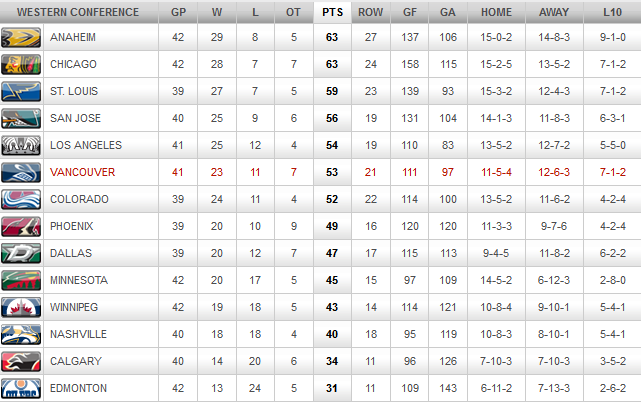
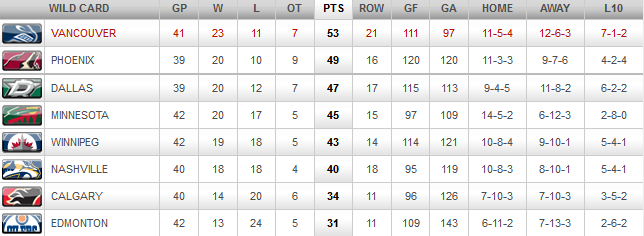
Obviously, I under estimated the Canucks, who as of this writing are twelve games above .500 and would have a playoff position today if the playoffs started, as a wildcard team.

So????? How have the Canucks faired:

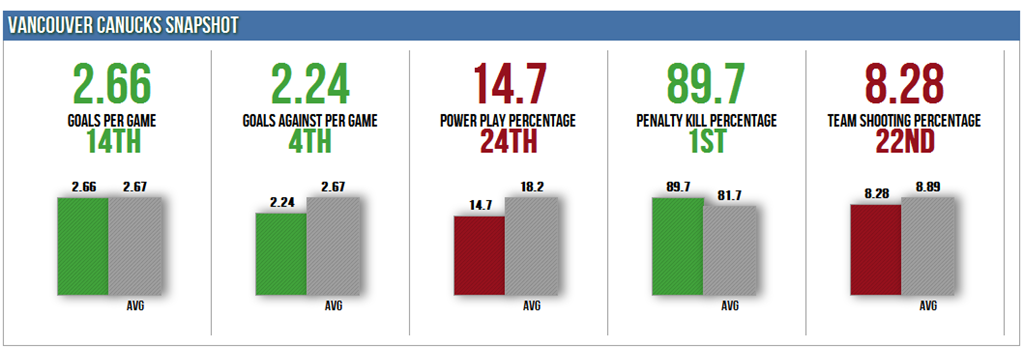
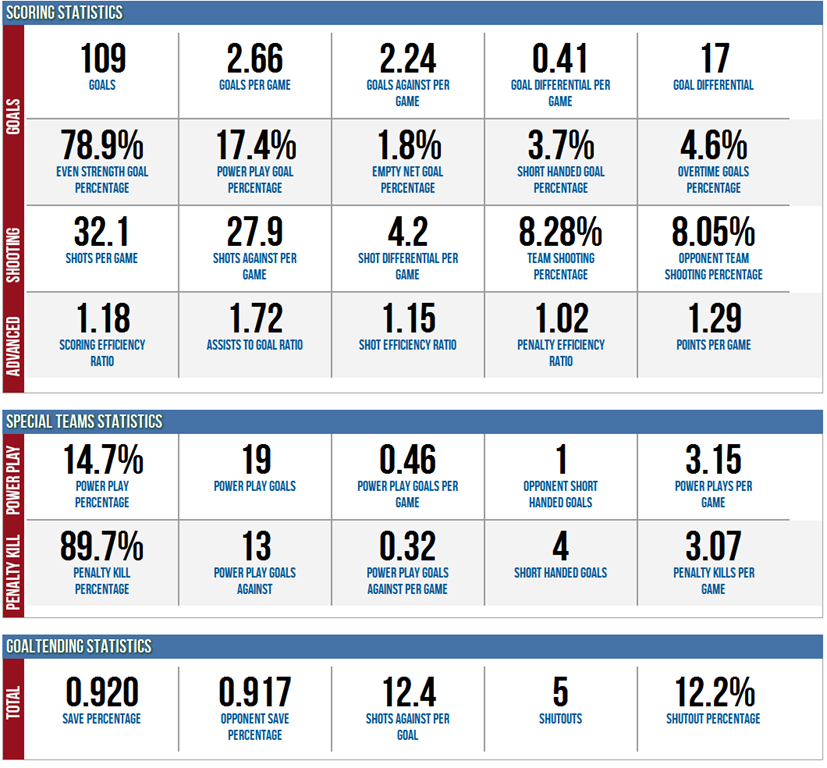
CANUCK TEAM CHARTS

image

image

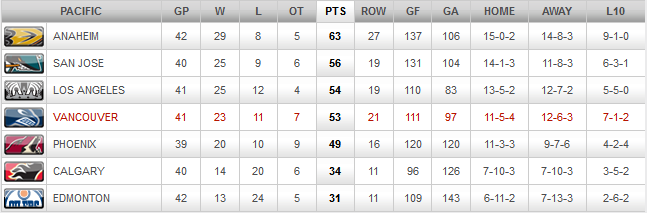
Vancouver Canucks record as of morning of January, 2014:

image

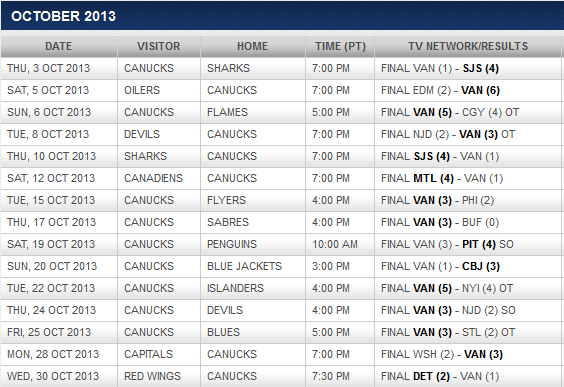
On that October 2013 road trip I said in my September 11, 2013 column:

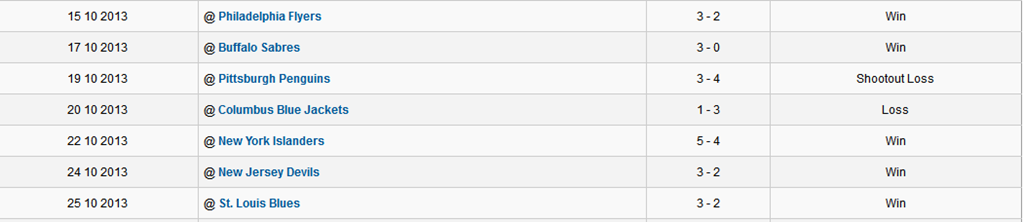
Canucks will play seven road game stretch on the road from October 15 to October 25 which will indicate what their mettle is and how well forged they are as a competitive team and excelling at that high level of expectation or not.

So?? How’d they do? As you can see by the chart below they had 5 wins, 1 overtime loss and 1 regulation loss for 11 points out of a possible 14 points on the 7 game road trip.

image

The Canucks showed that they were more than prepared for the seven game road trip, and more than impressed, and made a success of their first month of the season.

November was not so pleasant, and provided some adversity and struggles, that impacted the Canucks from having a winning month.

December showed the team come together under the system of their new coach and rack up 10 wins and 1 loss in 13 games for 22 points, putting Vancouver squarely in the hunt for a playoff position at the half way point of the season.

THE CANUCKS LAST HALF OF THE 2013-2014: MY THOUGHTS

So, stats aside, I am left with a three part question: what do the Canucks have to do, what does the future hold for the Canucks and how will it figure in the Canucks success the second half of the season?

Well, it won’t take long to get the answer to the first part of the question. It is simple and quickly answered.

As Iain MacIntyre, Vancouver Sun columnist, in his article Canucks second half must be equal to the first pointed out:

Despite a series of December injuries, including a broken jaw to front-line winger Alex Burrows and a strained groin suffered by starting goalie Roberto Luongo, the Canucks had a brilliant month, which gave them a good opening half of the National Hockey League season. Now, they need a second half that’s equally strong.

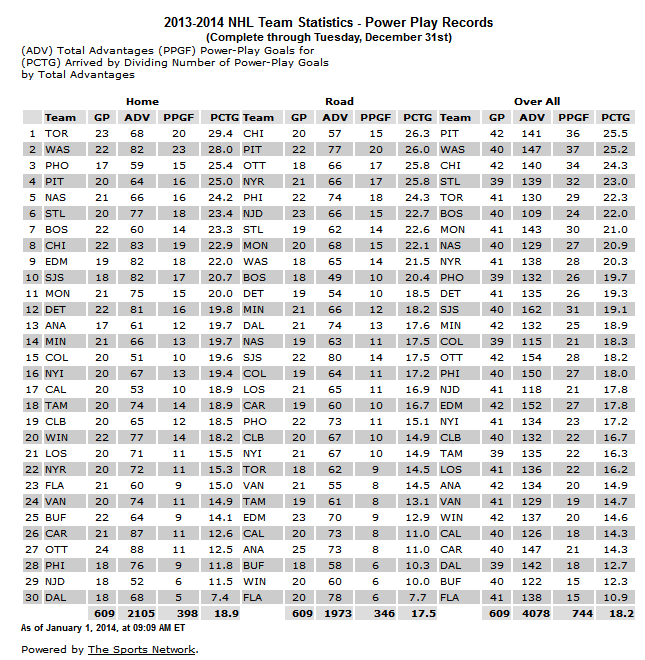
A healthy defence would help. So would a power play, which was 0-for-4 against the Flyers and, except for one three-week surge, has had awful results all season.

But, really, there is little for which to fault the Canucks through the first three months of the season, except for taking much of the fall to learn new coach John Tortorella‘s go-go-go system.

“I think we understand how we play and everybody is comfortable with that,” Tortorella said just before the game. “Some of the most important things when you get into the second half of the year and into playoffs – if we’re fortunate enough to get there – is situational play. I talk about it a lot. Everybody asks me: What’s situational play? There are a lot of things. It’s so many things.

“It’s how you win games. Understanding how to get momentum back on your side, how to keep it on your side. Third periods – down by a goal, up by a goal. All those things have to become second nature and we’ve still got a lot of work to do in that area.”

Apparently so.

I concur with Mr. MacIntyre, and that answers the first part of the question.

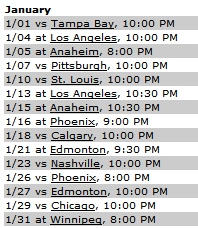
As for the second part of the question, we won’t have to wait long as January, like October, presents a big challenge for the Canucks, especially in their first eight games:

image

As you can see by the schedule for January, the Canucks first eight games have some strong opponents, with five games on the road and three at home.

My comments in my column on September 11, I repeat here for the first eight games of 2014, with some slight revision:

Canucks will play eight games from January 1 to January 16 which will indicate what their mettle is and how well forged they are as a competitive team and excelling at that high level of expectation or not, after a one week rest at the Christmas break and a shootout loss on December 30 against the Philadelphia Flyers at home.

I think Iain MacIntyre would agree. I quote from his article previously quoted above:

So December, 2013, with injuries and travel and four back-to-backs was pretty remarkable.

It gives the Canucks an eight-point cushion in the Western Conference playoff race.

“We realized at the time, when we started winning, we had to get on a roll or we were going to be out of the playoffs,” Sedin said. “And a lot of points out of the playoffs. We climbed back in, and now we need to keep going.

“The feeling we have right now is a great feeling. We feel we’re going to win every game. For sure, we’ve won games because of this mindset.”

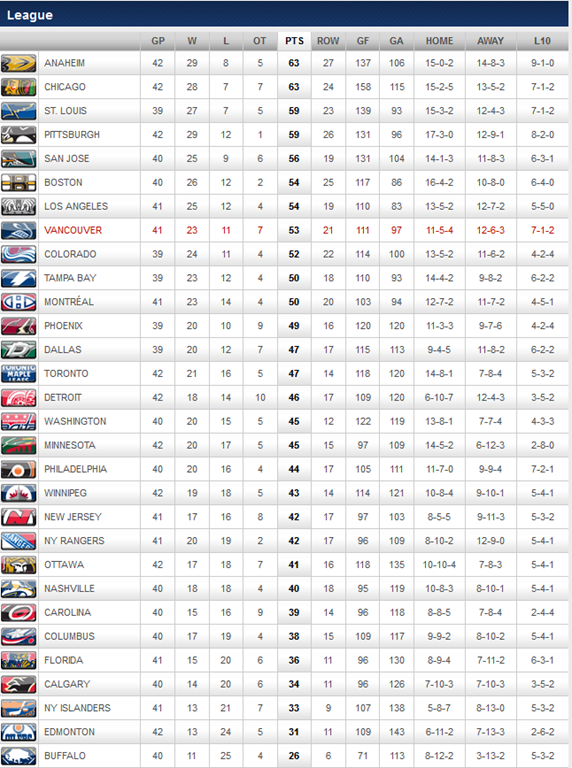
But confidence and positive energy got them only one point on Monday, giving the 23-11-7 Canucks 53 through 41 games. Their second half starts Wednesday with a New Year’s Day game against the Tampa Bay Lightning. Vancouver’s six games after that are against Stanley Cup contenders: the Los Angeles Kings (twice), Anaheim Ducks (twice), Pittsburgh Penguins and St. Louis Blues.

We’re going to know more about the Canucks two weeks from now, and they’re going to know more about themselves.

Luongo, who had a lengthy practice session Monday morning, should be the first injured player back. Edler, out since Dec. 3, may be ready by the middle of the month.

What else do the Canucks need in the second half?

“More Decembers,” defenceman Dan Hamhuis, who played a staggering 32:30 on Monday, said. “We just have to build off what we’re doing. Our penalty kill has been great, but we’d like better results for our power play. Our goaltending has been great. We just have to continue to play good defence and find small ways to get better.

“You get a new coaching staff with new systems and new ways to play, and a run like this really solidifies everyone’s belief in our style of play and our identity.”

The third part of the question, how will the first two parts of the question figure in the Canucks success the second half of the season?

The Canucks need, as already stated, but emphasized here, need to keep playing as they are, improving as they make a playoff run. That won’t be easy, as the teams they are chasing are playing just as well as they are, and secondly, an Winters Olympic break is coming up.

The conclusion to the Olympic break will test the Canucks, coaches and players alike, to play well enough to make a last push, to not just make the playoffs, but do so with impact, excelling at a high level, being a legitimate threat to go deep into the playoffs.

The Stanley Cup challengers they face in January will give them a few answers as to where they are, what they lack and what they need to do.

In conclusion, with the Canucks game against Tampa Bay just minutes away:

John Tortorella has to do what he does best and which helped Tampa Bay to its first Stanley Cup—be the best coach he can be and get the most out of his players, letting every player know that he is boss,

The players are paid to execute the plan and perform as professionals. Tortorella must be accountable for being outcoached and for misjudgements regarding his assessments regarding each players abilities, capabilities, to execute the plan that he has developed to make the Canucks successful in all areas; and the players must be accountable for not executing that coaching plan, and playing up to that high level of expectation.

The Canucks have to do more than knock on the door of the NHL playoffs. They have to kick it in and live in it like they own it, with a passion only found on the streets, made for hockey on ice. And then the ultimate prize—–the Stanley Cup—–will be theirs.

Just saying…..

The following is a summary of where the Canucks are relative to the league, and play in the two conferences:

Canucks record in October, 2013: 9–5–1 (Home: 3–3–0 ; Road: 6–2–1)

image

Canucks record in November, 2013: 4–5–4 (Home: 2–2–3 ; Road: 2–3–1)

image

Canucks record in December, 2013: 10–1–2 (Home: 6–0–1 ; Road: 4–1–1)

image

Western Conference Standings: as of morning of January 1, 2014:

image

Western Conference-Wild Card Race: as of morning of January 1, 2014:

image

League Standings: as of January 1, 2014 @ 1 pm PST:

image

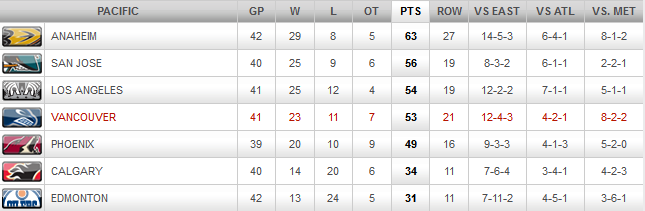
Canucks Against Eastern Conference: as of morning of January 1, 2014:

image

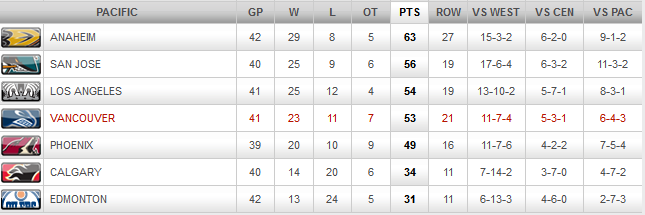
Canucks Against Western Conference: as of morning of January 1, 2014:

image

image

image

image