
Neuroscientists Release New Map of Human Cortex

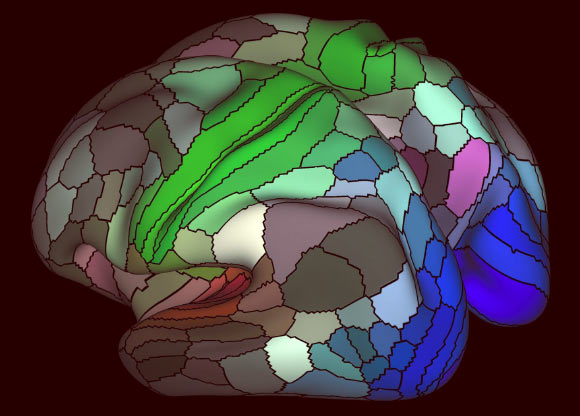
Matthew Glasser et al. discovered that our brain’s cortex is composed of 180 distinct areas per hemisphere. For example, the image above shows areas connected to the three main senses — hearing (red), touch (green), vision (blue) and opposing cognitive systems (light and dark). Image credit: Matthew Glasser / David Van Essen.

An international team of neuroscientists from the United States and Europe has mapped 180 distinct areas, including 97 that were previously unknown, in human brain cortex, or outer mantle.

The team, led by Washington University in St. Louis researchers Dr. David Van Essen and Dr. Matthew Glasser, has also developed software that automatically detects the ‘fingerprint’ of each of cortex areas in an individual’s brain scans.

“Using multi-modal magnetic resonance images from the Human Connectome Project (HCP) and an objective semi-automated neuroanatomical approach, we delineated 180 areas per hemisphere bounded by sharp changes in cortical architecture, function, connectivity, and/or topography in a precisely aligned group average of 210 healthy young adults,” the scientists said.

“We characterized 97 new areas and 83 areas previously reported using post-mortem microscopy or other specialized study-specific approaches.”

Earlier studies often used just one measure, such as examining postmortem tissue with a microscope. Uncertain delineation of cortex areas has sometimes led to shaky comparability of brain imaging findings.

“The situation is analogous to astronomy where ground-based telescopes produced relatively blurry images of the sky before the advent of adaptive optics and space telescopes,” Dr. Glasser said.

The team set out to banish this blurriness by using multiple, precisely aligned, magnetic resonance imaging (MRI) modalities to measure cortical architecture, activity, connectivity, and topography in a group of 210 healthy participants.

These measures – including cortex thickness, cortex myelin content, task and resting-state functional MRI (fMRI) – cross-validated each other.

The findings were, in turn, confirmed in an additional independent sample of 210 healthy participants.

Even though some cortex areas turned out to be atypically located in a small minority of subjects, the data-derived algorithms incorporated into the software were able to successfully map them.

While the study included fMRI scans of subjects performing tasks, the team determined that resting-state MRI techniques should suffice to map the areas in future studies using the tools they developed.

“Some areas may turn out to have further subdivisions or be subunits of other areas, in light of new data,” Dr. Van Essen said.

“The ability to discriminate individual differences in the location, size, and topology of cortical areas from differences in their activity or connectivity should facilitate understanding of how each property is related to behavior and genetic underpinnings,” Dr. Glasser added.

The team’s results were published online this week in the journal Nature.

_____

Matthew F. Glasser et al. A multi-modal parcellation of human cerebral cortex. Nature, published online July 20, 2016; doi: 10.1038/nature18933

Source: Neuroscientists Release New Map of Human Cortex | Neuroscience | Sci-News.com
Researchers Create Detailed ‘Semantic Atlas’ of the Mind 

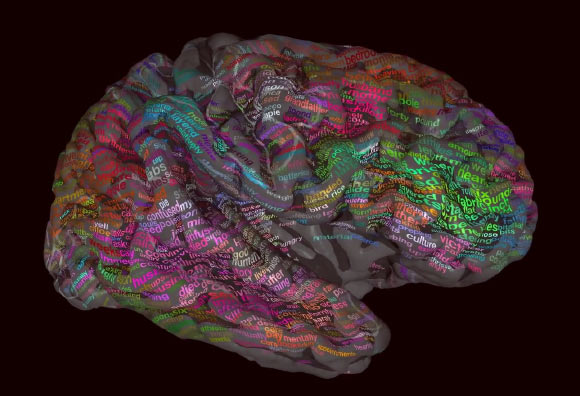
Scientists at the University of California, Berkeley, build a semantic atlas to chart how the brain responds to language. Image credit: University of California, Berkeley.

A team of neuroscientists and psychologists at the University of California, Berkeley, has created a detailed ‘semantic atlas’ showing which human brain areas respond to hearing different words. The results were published this week in the journal Nature.

“Our goal in this study was to map how the brain represents the meaning (or semantic content) of language,” explained lead author Alexander Huth, from the University of California’s Helen Wills Neuroscience Institute. “Most earlier studies of language in the brain have used isolated words or sentences.”

“We used natural, narrative story stimuli because we wanted to map the full range of semantic concepts in a single study. This made it possible for us to construct a semantic map for each individual, which shows which brain areas respond to words with similar meaning or semantic content.”

“Another aim of this study was to create a semantic atlas by combining data from multiple subjects, showing which brain areas represented similar information across subjects.”

Huth and six other native English-speakers served as subjects for the experiment.

They listened passively to several stories selected from The Moth Radio Hourwhile brain activity was monitored using functional magnetic resonance imaging (fMRI). The stories were then transcribed and annotated with the time each word was spoken.

Then the scientists used the fMRI data and story transcripts to build computational models that predict brain activity as a function of which words the subject heard. To validate these models, they were used to predict fMRI responses to a new story that had not been used before.

“We found that the models were able to predict responses relatively well throughout several broad regions of the cerebral cortex,” Huth said.

“Next, we aimed to discover what types of semantic information were represented at each point in cortex. In order to visualize the very high-dimensional semantic models, we used a dimensionality reduction technique called principal components analysis (PCA).”

PCA finds the most important dimensions in a dataset, which allowed the team to reduce the 985-dimensional models to only three dimensions, while preserving as much information as possible.

“We used these three dimensions to visualize roughly which types of semantic information were represented at every location in the cortex, revealing complex semantic maps that tile the brain,” Huth said.

“Finally, to discover which aspects of these maps are shared across subjects we developed and applied a new computational approach called PrAGMATiC. This approach finds functional areas that are shared across subjects, while also allowing for individual variability in the anatomical location of each area.”

According to Huth and co-authors, detailed maps showing how the brain organizes different words by their meanings could eventually help give voice to those who cannot speak, such as victims of stroke or brain damage, or motor neuron diseases such as ALS.

“While mind-reading technology remains far off on the horizon, charting how language is organized in the brain brings the decoding of inner dialogue a step closer to reality,” they said.

For example, clinicians could track the brain activity of patients who have difficulty communicating and then match that data to semantic language maps to determine what their patients are trying to express.

Another potential application is a decoder that translates what you say into another language as you speak.

_____

Alexander G. Huth et al. 2016. Natural speech reveals the semantic maps that tile human cerebral cortex. Nature 532, 453-458; doi: 10.1038/nature17637

Source: Researchers Create Detailed ‘Semantic Atlas’ of the Mind | Neuroscience | Sci-News.com