CUPE takes supervisory battle to the next step | Canadian Union of Public Employees

July 22, 2016

CUPE has filed a notice of constitutional question in the cases of three employers who are attempting to unilaterally remove unionized supervisors out of the bargaining unit of their choosing.

The City of Moose Jaw, the Saskatoon Public Library, and Cypress Hills Abilities Centre are some of the first employers in the province to use new provisions under The Saskatchewan Employee Act (SEA) which allow employers to try to remove workers with supervisory duties from the bargaining unit. A fourth employer, the Regina Public Library, has applied to have similar employees removed from the bargaining unit claiming that they are managers.

“Working people have the right to belong to the union of their choosing. CUPE will fight any employer who moves forward with attempting to exclude supervisory members with every tool in our tool box, including legal avenues,” said Tom Graham, president of CUPE Saskatchewan. “Filing a notice of constitutional question is the first step in what could be a very lengthy and expensive legal battle.”

CUPE has serious concerns about the constitutionality of this legislation, as well as the impact the legislation is having on workers.

“This legislative change is causing a lot of stress and uncertainty for union members who have supervisory duties. People are worried about their job security. They are worried about what will happen to their benefits and wages if they get removed from their bargaining unit. They are worried about what their future holds,” added Graham.

CUPE believes that removing supervisors from the bargaining unit is completely unnecessary. Many major employers in the province have already signed irrevocable agreements to keep the status quo arrangement, including the Ministry of Health, SAHO, and the Government of Saskatchewan.

“Saskatchewan is now the only jurisdiction in Canada with this type of legislation. And I can see why,” said Graham. “This legislation is a solution in search of a problem. In my 37 years with CUPE, we have never had a problem with supervisors being in the same bargaining unit as the people they supervise that was not solved through application of the collective agreement.

“It is in both the union and the employer’s interests to maintain the integrity of the current bargaining unit, rather than create a separate bargaining unit within the local for supervisory employees. The status quo has worked and can continue to work.”

Source: CUPE takes supervisory battle to the next step | Canadian Union of Public Employees

Bloomberg Nanos Weekly Consumer Confidence Tracking: October 23, 2015

Bloomberg-Nanos Economic Banner


Every region in Canada posted positive movement in the Bloomberg Nanos Canadian Consumer Confidence Index over the week following the Trudeau Liberals winning a majority national government.

“Positive sentiment on the economy trended up as the election pointed to a Liberal win”, said Nanos Research Group Chairman Nik Nanos.

“There is now the prospect of a fiscal partner to the Bank of Canada’s extremely accommodative monetary policy stance, and that should keep consumer expectations on its uptrend. Of note, both the money market and the consensus of economic analysts is assigning little probability to a change in monetary policy until the end of 2016, which should continue to help consumer spending–the main driver of growth at the moment”, said Robert Lawrie of Bloomberg Economics.

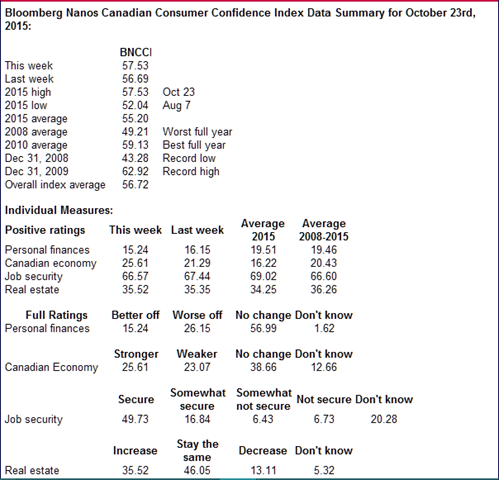
The BNCCI, a composite of a weekly measure of financial health and economic expectations, registered at 57.53 compared with last week’s 56.69. The twelve month high stands at 57.99.

The Bloomberg Nanos Pocketbook Index is based on survey responses to questions on personal finances and job security. This sub-indice was at 58.83 this week compared to 58.78 the previous week. The Bloomberg Nanos Expectations Index, based on surveys for the outlook for the economy and real estate prices, was at 56.24 this week (compared to 54.59 last week).

The average for the BNCCI since 2008 has been 56.72 with a low of 43.28 in December 2008 and a high of 62.92 in December 2009. The index has averaged 55.20 this year.

To view the weekly tracking visit our website.

Methodology

The BNCCI is produced by the Nanos Research Corporation, headquartered in Canada,  which operates in Canada and the United States.  The data is based on random telephone interviews with 1,000 Canadian consumers (land- and cell-lines), using a four week rolling average of 250 respondents each week, 18 years of age and over. The random sample of 1,000 respondents may be weighted by age and gender using the latest census information for Canada and the sample is geographically stratified to be representative of Canada. The interviews are compiled into a four week rolling average of 1,000 interviews where each week, the oldest group of 250 interviews is dropped and a new group of 250 interviews is added. The views of 1,000 respondents are compiled into a diffusion index from 0 to 100. A score of 50 on the diffusion index indicates that positive and negative views are a wash while scores above 50 suggest net positive views, while those below 50 suggest net negative views in terms of the economic mood of Canadians.

A random telephone survey of 1,000 consumers in Canada is accurate 3.1 percentage points, plus or minus, 19 times out of 20.

All references or use of this data must cite Bloomberg Nanos as the source.

Bloomberg Nanos Canadian Consumer Confidence Index Data Summary for October 23rd, 2015:


image

ITUC World Congress – Poll: Governments told to tame corporate power

http://talkingunion.wordpress.com

Workers across the globe are losing faith in their national governments whom they see as putting the interests of big corporations ahead of their own, according to a new international public opinion poll from the International Trade Union Confederation (ITUC).

Released at the opening of the 3rd ITUC World Congress in Berlin, Sunday 18th May, the ITUC Global Poll 2014 commissioned from market research company TNS Opinion, covers the general public of fourteen countries which have half the world’s population.

The global economy needs co-ordinated action to raise living standards around the world. Seven years into the economic crisis has left structural damage to the global economy and the global workforce with more than 200 million people unemployed and many more struggling with low wages. Governments are in the grip of corporate power and are failing their people”  said Sharan Burrow, General Secretary, International Trade Union Confederation.

The poll showed:

  • 79 percent do not believe the minimum wage is enough for a decent life.
  • 82 percent say their wages have fallen behind the cost of living or remained stagnant.
  • 88 percent support lifting the minimum wage in every country around the world.

“The global labour movement meeting in Berlin at the ITUC World Congress has put entrenched business interests on notice. Nearly two-thirds of people want governments to tame corporate power.

People, dissatisfied with their own government’s performance, know they are increasingly in the grip of corporate power.   The world has to change, power needs to be rebalanced.

Big business and big finance must be tamed or democratically elected governments risk becoming mere puppets in economic and social decisions,” said Sharan Burrow.

The poll showed growing levels of uncertainty about family income:

  • One in two can’t keep up with the rising cost of living.
  • Seven out of ten European respondents say their income has not kept up with the cost of living.
  • In the past three years over half the world’s population have not been able to save any money.

Realising decent wages for working families and those on low incomes means tackling the excesses of the 1 %. When people can’t save, family security is threatened with no capacity to invest in housing or other assets. Savings represent an essential component of long-term balanced growth,” said Sharan Burrow.

The poll showed rising levels of concern about job security:

  • One in two have direct or family experience of unemployment.
  • 41 percent expect their job to be less secure in the next two years.
  • Only one in two people believe the next generation will find decent jobs.

The poll showed distrust in government and the economic system:

  • 68 percent think their government is doing a bad job at tackling unemployment.
  • Four out of five people (78 percent) believe the economic system favours the wealthy, rather than being fair to most.
  • More than half rate the current economic situation in their country as bad.

“When people increasingly fear for the next generation, it should be a warning for governments to act.

People want their governments to reduce the gap between rich and poor, ensure fair wages, and increase job security.

The ITUC represents the largest global democratic community. Workers and their families expect better. We expect better of our governments, and we oppose the corporate bullies that are driving inequality in their own interests,” said Sharan Burrow.

The results of the poll conducted in January in Australia, Belgium, Brazil, Canada, China, France, Germany, India, Italy, Japan, Russia, South Africa, the United Kingdom and the United States represent the views of more than 3.7 billion people, or half the world’s population.