Prime Minister attends the G7 Summit in Ise-Shima

Ise-Shima, Japan
27 May 2016

The Government of Canada remains committed to creating jobs, strengthening the middle class, and helping those working hard to join it. When the majority of middle class Canadians feel confident about their future – and their families’ future – the whole country benefits.

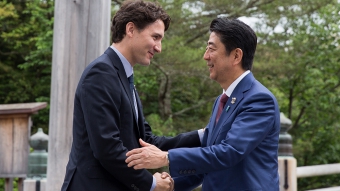
Today, the Prime Minister, Justin Trudeau, concluded the G7 Leaders’ Summit in Ise-Shima, Japan. Following the Summit, the G7 leaders issued a joint-declaration where they committed to tackle major global challenges such as the need to promote sustainable economic growth that benefits all citizens, not just the wealthiest one per cent.

While in Ise-Shima, Prime Minister Trudeau shared Canada’s proactive approach to bolster economic growth by making strategic investments in infrastructure and clean technologies – investments that will support good, well-paying jobs and strengthen the middle class. He underscored the need to improve growth around the world, but also stressed the need to question who the growth is going to benefit.

The G7 leaders also discussed pressing foreign policy and security challenges, including Russian interference in Ukraine, the fight against the Islamic State of Iraq and the Levant (ISIL), and the global migration crisis. The Prime Minister highlighted the need for G7 solidarity to refrain from paying ransom to terrorist groups.

During the Summit, the Prime Minister also supported Japan’s decision – as host country of the Summit – to place a particular focus on women’s empowerment and health. He shared Canada’s commitment to advancing gender equality and advancing women’s rights, and he encouraged his G7 counterparts to demonstrate leadership in the context of the Fifth Replenishment Conference of the Global Fund to Fight AIDS, Tuberculosis and Malaria, which will be held in Montreal in September 2016.

Quote

“For Canada, we know what made us successful in the past – a strong middle class. At the G7 this week, we had the opportunity to sit down with some of our closest international partners and discuss ways to not only improve global economic growth, but to also make sure that growth benefits all our citizens, not just a select few.”
– Rt. Hon. Justin Trudeau, Prime Minister of Canada

Quick Facts

  • The Leaders of the G7 – united by common values of freedom and democracy, and respect for human rights and the rule of law – come together each year to discuss issues of domestic and global concern. The G7 includes Canada, France, Germany, Italy, Japan, the United Kingdom and the United States. Representatives of the European Union also attend meetings.
  • The G7 presidency rotates annually among country members. Japan holds the G7 presidency in 2016, and will be followed by Italy in 2017 and Canada in 2018.
  • G7 Leaders also took part in discussions with the Leaders of Laos, Indonesia, Vietnam, Bangladesh, Sri Lanka, Papua New Guinea, and Chad, who had been invited by Japan to discuss shared challenges.
  • G7 ministerial-level meetings are also held each year to build on the Leaders’ agenda. Japan has convened a total of 10 G7 ministerial meetings in 2016.

Associated links

Source: Prime Minister attends the G7 Summit in Ise-Shima

Prime Minister to travel to Japan for an official working visit and to attend the G7 Leaders’ Summit

Fort McMurray, Alberta

13 May 2016

The Prime Minister, Justin Trudeau, today announced that he will travel to Japan to participate in the G7 Leaders’ Summit on May 26 and 27 in Ise-Shima. Prior to the Leaders’ Summit, and at the invitation of Prime Minister Shinzo Abe, Prime Minister Trudeau will participate in an official working visit from May 23-25.

While in Japan, Prime Minister Trudeau will have an audience with the Emperor and Empress of Japan, and will meet with Prime Minister Abe to reaffirm the close and growing ties between Canada and Japan across a broad range of areas of cooperation. The Prime Minister will also meet with leaders in the automotive sector to discuss ways to further promote trade and investment between Canada and Japan, all of this in an effort to create good-paying jobs for Canadians, strengthen the middle class, and work towards clean and sustainable economic growth.

During the G7 Leaders’ Summit, Canada will reaffirm its new approach to global engagement. The Prime Minister will highlight Canada’s resolve to work with its G7 partners on a number of key global issues, including the economy, trade, climate change, peace and security, development and women’s empowerment, which will all contribute to advancing the government’s priorities.

Quotes

“Japan is a long-standing and important partner for Canada. I look forward to meeting the Emperor and Empress of Japan.  During my meeting with Prime Minister Shinzo Abe, we will explore ways to deepen Canadian and Japanese ties on many levels, including trade, investment, peace and security, culture, education, environment, and science, technology and innovation.”
– Rt. Hon. Justin Trudeau, Prime Minister of Canada

“In this new era of Canada’s international engagement, I look forward to meeting my G7 counterparts to bolster collaboration on shared domestic and global priorities and challenges, including our work to build inclusive and sustainable economies and societies that support a strong middle-class.”
– Rt. Hon. Justin Trudeau, Prime Minister of Canada

Source: Prime Minister to travel to Japan for an official working visit and to attend the G7 Leaders’ Summit | Prime Minister of Canada

Japan proposes tariff cuts for products sourced from TPP countries

Kyodo     Aug 29, 2013    http://www.japantimes.co.jp

BANDAR SERI BEGAWAN – Japan has proposed tariff cuts for products made from materials produced in countries involved in the Trans-Pacific Partnership free trade talks, negotiation sources said Thursday.

For Japan, the proposal made during the ongoing round of TPP talks in Brunei means lower or no tariffs would be levied on Japanese firms’ products, subsequently boosting their competitiveness against those of countries not included in the TPP.

Twelve members of the TPP talks, including the United States, have been negotiating the rules for setting the scope of tariff reductions and eliminations in the working group for “rules of origin” in the TPP negotiations.

The 19th round is under way from Aug. 22 to Friday as countries aim to conclude a deal by the end of the year.

Japan is seeking a common rule among the TPP countries instead of having variations depending on each member country.

The negotiations on the rules of origin had been stalled, however, as Vietnam has been aiming to expand exports of its apparel and textiles by including those items made from yarn produced in China, a non-TPP member, in the target of tariff cuts and elimination, against the U.S. plan to limit the scope.

To facilitate the talks, the TPP countries have separated the negotiations on textiles from those on rules of origin.

The nine other countries involved in the TPP talks are Australia, Brunei, Canada, Chile, Malaysia, Mexico, New Zealand, Peru and Singapore.

The U.S. has a $7.25 minimum wage. Australia’s is $16.88


By Dylan Matthews, Published: August 19 http://www.washingtonpost.com

Minimum wage advocates love to point to Australia’s $16.88 an hour minimum as evidence that a very high wage floor needn’t stifle a country’s growth. After all, Australia hasn’t had a recession in 20 years. But Australia is hardly an outlier. Most developed countries have a higher minimum wage than we do, as this chart from Business Insider’s Matthew Boesler — using data from the ConvergEx Group — shows:

minimum_wages_around_world

This holds up if you compare the minimums to the median wage in the country in question, as the OECD did. Here’s what they found:

minimum_wage_comparison

The U.S., unsurprisingly, is on the bottom but it’s tied with Japan. And Australia isn’t on top; that goes to France, which has a lower average wage than Australia, which makes up for a lower minimum wage and leads to a higher ratio.

The Center for American Progress has proposed setting the minimum wage at half the average wage (mean, not median as used above) for production and non-supervisory workers; at the current level, that means a $10.07 minimum. If we were to adopt France’s 60 percent ratio, that’d put us at about $12.08.

Of course, there are all kinds of pros and cons to that kind of increase. I went through many of them here. And it’s worth noting that Australia’s minimum wage comes with all kinds of exceptions, especially for younger workers.

Update: Another point, which Guan Yang reminded me of on Twitter – a large number of countries, including Denmark, Germany, Italy, Norway, Singapore, Sweden, and Switzerland, don’t have minimum wages at all. Most of them make up for it with widespread collective bargaining, which sets de facto minimums.