
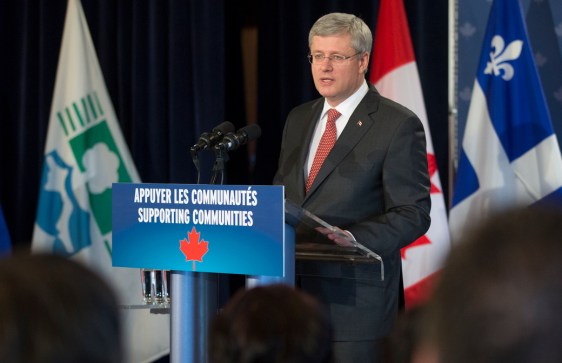
 During the 2015 Canadian election campaign, Harper capitalized on dividing the nation with his dead cat, the niqab issue.
Tag Archives: harper conservatives
Terror documents so secret feds can’t tell you why they’re secret – National | Globalnews.ca
 Thousands of pages of correspondence and briefing notes on the federal government’s anti-terror Bill C-51 are so secret the government won’t even disclose its reasons for censoring them.
Source: Terror documents so secret feds can’t tell you why they’re secret – National | Globalnews.ca
How Harper set the developed world on a course to austerity
 By Linda McQuaig http://rabble.ca
July 30, 2013

In June 2010, the transformation of the city’s downtown core into a pseudo war zone seemed like the worst aspect of the Harper government’s handling of the G20 summit in Toronto.
But perhaps just as insidious was Stephen Harper’s personal role at that summit in pushing the developed world to abandon stimulus spending and veer sharply toward austerity.
That embrace of austerity has led to deep government spending cuts, with devastating consequences, particularly in some southern European nations. Canadians have suffered, too.
Harper likes to boast that he’s shepherded the Canadian economy to a full recovery from the 2008 crash — even though 1.4 million Canadians remain unemployed. Our employment rate is stuck at 61.9 per cent, down from 63.8 per cent just before the crash, notes Jim Stanford, economist for the Canadian Auto Workers.
This explains Canada’s poor ranking in a recent OECD Employment Outlook report, where Canada ranks 20th out of 34 nations.
Similarly, Canada’s Parliamentary Budget Office estimated last fall that Ottawa’s spending reductions will cost Canada approximately 125,000 jobs in 2016 . (Reports like that angered the Harper government, which last spring ended Parliamentary Budget Officer Kevin Page’s impressive stint in the watchdog job.)
The embrace of austerity at the 2010 Toronto summit was a dramatic reversal of the stimulus spending that the world’s rich nations had quite effectively adopted to counter the devastating 2008 financial crash — in line with the lessons taught by the great 20th century British economist John Maynard Keynes.
Keynes argued that, when businesses are unwilling to invest during a major downturn, the only solution is for governments to invest, and on a massive scale. This insight sharply contradicted the dogma of austerity that prevailed after the 1929 crash, prolonging the 1930s Depression. Although fiercely resisted, Keynes’ insight was eventually accepted.
But right-wing economists, including Stephen Harper, have long bristled at Keynesianism — with its important role for government — and opposed its revival after the 2008 crash. (The minority Harper government only introduced a stimulus package in Canada because the opposition threatened to topple it otherwise.)
By early 2010, Keynesianism was losing ground on the international scene. But it was the G20 summit in Toronto later that year which “above all” resulted in the world’s rich nations changing course and embracing austerity, according to a recent article by British financial journalist Martin Wolf in the New York Review of Books.
Harper played a key role in that lamentable change of direction. At his urging, the G20 nations agreed to commit themselves to halve their deficits by 2013 — a draconian approach that returned the developed world to obsessing about deficits and ignoring unemployment.
(Ironically, the high unemployment produced by austerity reduces tax revenues and increases social spending, making deficit-reduction difficult. Much to its embarrassment, the Harper government has had to revise its deficit estimates upward. So far this year, Canada’s deficit is rising, not falling.)
But the fixation on deficits, which has dominated public discourse for much of the last 30 years, has helped divert attention from the fact that austerity is part of a larger agenda (including tax cuts and privatization) that’s redistributed money toward the top.
While members of the public are guilted into believing they’re living beyond their means and must tighten their belts, they’ve been distracted from noticing the transfer of income and wealth to the rich.
Thaddeus Hwong, a professor of tax policy at York University, has calculated just how much inequality has increased in Canada.
Using the model developed by University of California professor Emmanel Sáez, one of the world’s leading experts in income inequality, Hwong found that between 1982 and 2010, the top-earning 1 per cent of Canadians captured fully 60.3 per cent of all the income growth in Canada.
That was even more dramatic than the U.S., where the top 1 per cent captured 59.6 per cent of income growth in the same period. This highlights that, while inequality is more extreme in the U.S., it is growing faster in Canada.
But with all those deficits to obsess about, who’s noticing the rich, slightly offstage, quietly getting richer.
Linda McQuaig is author, with Neil Brooks, of The Trouble with Billionaires: How the Super-Rich Hijacked the World and How We Can Take It Back. This article was first published in the Toronto Star.
Photo: Remy Steinegger/World Economic Forum/flickr
Veterans furious as federal lawyers argue Ottawa owes ex-soldiers nothing
By Murray Brewster and Dene Moore The Canadian Press
July 30, 2013

At least one veterans group promises to campaign against the Harper Conservatives because of a stand taken by federal lawyers, who argue the country holds no extraordinary social obligation to ex-soldiers.
The lawyers, fighting a class-action lawsuit in British Columbia, asked a judge to dismiss the court action filed by injured Afghan veterans, saying Ottawa owes them nothing more than what they have already received under its controversial New Veterans Charter.
The stand drew an incendiary reaction from veterans advocates, who warned they are losing patience with the Harper government, which has made supporting the troops one of its political battle cries.
Mike Blais, president of Canadian Veterans Advocacy, told a Parliament Hill news conference that since the First World War, the federal government has recognized it has a “sacred obligation” to veterans — and that notion was abandoned with the adoption of the veterans charter by the Conservatives.
“We are asking the government to stand down on this ridiculous position (and) to accept the obligation that successive generations of Parliament have wilfully embraced,” said Blais, who pointed out veterans of Afghanistan deserve the same commitment as those who fought in the world wars.
“We’re damned determined to ensure (the same) standard of care is provided by this government or we shall work to provide and elect another government that will fulfil its sacred obligation.”
The lawsuit filed last fall by six veterans claims that the new charter, which replaces life-time pensions with workers compensation-style lump sum awards for wounds, violates the Charter of Rights and Freedoms.
In all cases, the awards are substantially less than what service members would have received under the old Pension Act system, which was initially set up following the First World War.
Veterans advocates, including Blais, see the new veterans charter as a bottom-line exercise.
“We went to war, signed up to serve this nation, nobody told us we would be abandoned,” he said.
“Nobody told us they were going to change the game in mid-flights and that our government would turn its back on us, and put the budget ahead of their sacred obligation.”
A spokesman for newly appointed veterans minister Julian Fantino said he wasn’t able to comment directly on the court case. But Joshua Zanin noted that more than 190,000 veterans and their families received benefits under the revised charter and the “government has taken important steps to modernize and improve services to veterans.”
Even so, federal lawyers argued that the veterans lawsuit is “abuse of process” that should be thrown out.
“In support of their claim, the representative plaintiffs assert the existence of a ‘social covenant,’ a public law duty, and a fiduciary duty on the part of the federal government,” Jasvinder S. Basran, the regional director general for the federal Justice Department, said in a court application.
The lawsuit invokes the “honour of the Crown,” a concept that has been argued in aboriginal rights claims.
“The defendant submits that none of the claims asserted by the representative plaintiffs constitutes a reasonable claim, that the claims are frivolous or vexatious, and accordingly that they should be struck out in their entirety.”
New Democrat veterans critic Peter Stoffer says the legal implication of claiming the government has no special obligation to veterans is far-reaching and he demanded the Conservatives clarify what it means.
He noted that unlike the previous legislation, the new veterans charter — passed unanimously by all parties in 2005 and enacted by the Conservatives in 2006 — contained no reference to social obligation.
Both Stoffer and Blais do not advocate for a complete return to the old pension system, but rather that veterans be given a choice of how the benefit is paid.
Among the soldiers named in the suit is Maj. Mark Douglas Campbell, a 32-year veteran of the Canadian Forces who served in Cyprus, Bosnia and Afghanistan.
In June 2008, Campbell, of the Edmonton-based Princess Patricia’s Canadian Light Infantry, was struck by an improvised explosive device and Taliban ambush.
He lost both legs above the knee, one testicle, suffered numerous lacerations and a ruptured eardrum. He has since been diagnosed with depressive disorder and post-traumatic stress disorder.
Campbell received a lump-sum payment for pain and suffering of $260,000. He will receive his military pension, with an earnings loss benefit and a permanent impairment allowance but he is entirely unable to work and will suffer a net earnings loss due to his injuries, the lawsuit claims.
Another plaintiff soldier suffered severe injuries to his leg and foot in the blast that killed Canadian journalist Michelle Lang and four soldiers. He was awarded $200,000 in total payments for pain and suffering and post-traumatic stress.
The allegations in the lawsuit have not been proven in court.
The federal government application says policy decisions of the government and legislation passed by Parliament are not subject to review by the courts.
“The basic argument that they’re making is that Parliament can do what it wants,” said Don Sorochan, the soldiers’ lawyer.
He said he receives calls almost daily from soldiers affected by the changes, and thousands ultimately could be involved.
Sorochan, who is handling the case for free, said he doesn’t believe the objective of the legislation was to save money at the expense of injured soldiers, but that’s what has happened.
“When the legislation was brought in it was believed by the politicians involved — and I’ve talked to several of them, in all parties — that they were doing a good thing,” Sorochan said.
“But anybody that can objectively look at what is happening to these men and women who have served us, can’t keep believing that.”
 Andrew Phillip Chernoff