By Andrew Phillip Chernoff
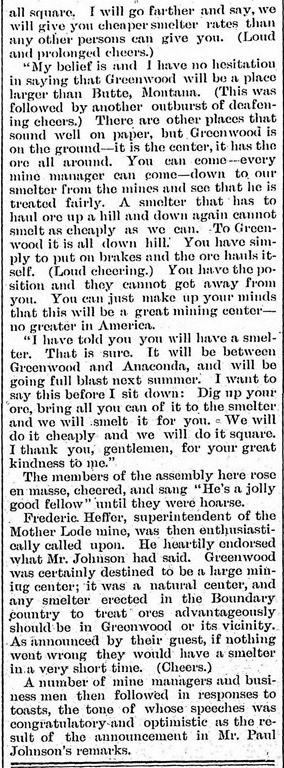
Source: The Greenwood Ledge, Greenwood, B.C., July 18, 1907
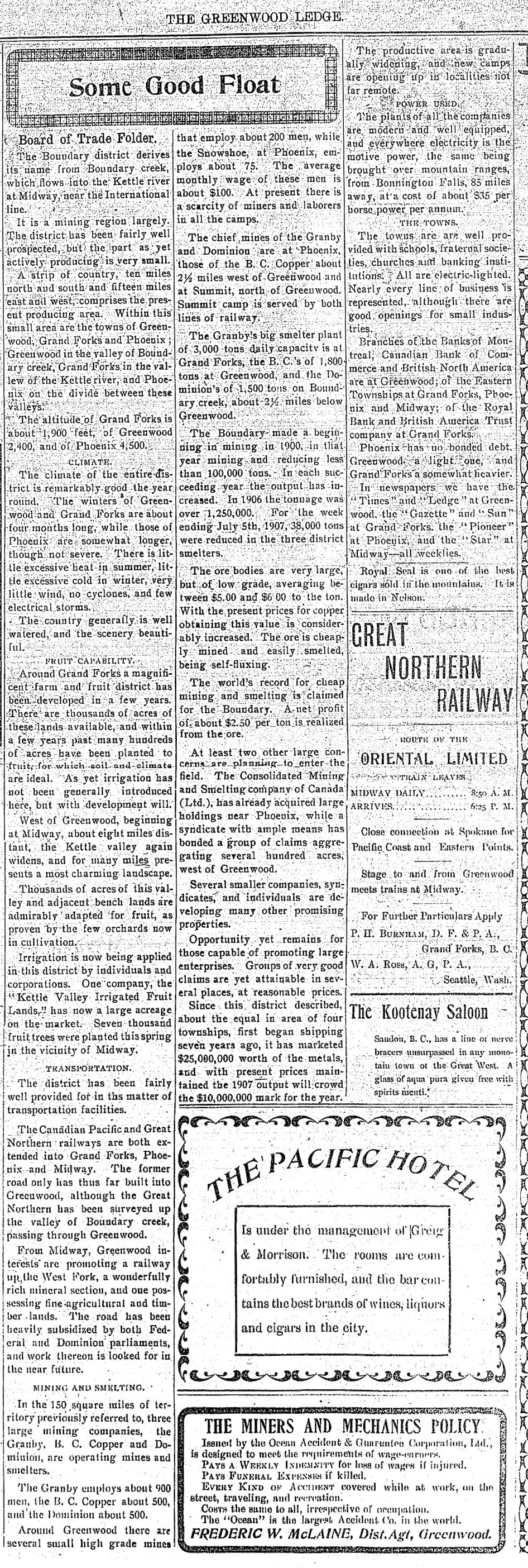
Greenwood Ledge, Greenwood, B.C., July 18, 1907

By Andrew Phillip Chernoff
Source: The Greenwood Ledge, Greenwood, B.C., July 18, 1907
Greenwood Ledge, Greenwood, B.C., July 18, 1907
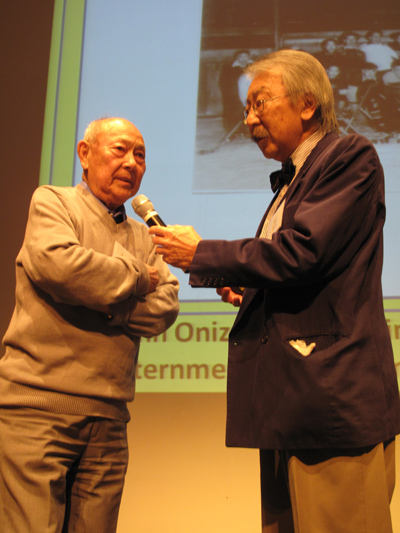
By Mel Tsuji JANUARY 25, 2013 http://jccabulletin-geppo.ca
John Onizuka admitted he was very surprised to be honoured at the 50th anniversary celebration last year of the Canadian Japanese Hockey League.
At 85, the retired pharmacist was a long way from his hockey-playing days in Greenwood, BC. He was 14 years of age at the time when he and his family were among the 1,200 Japanese Canadians uprooted from their homes in Vancouver and interned at the then ghost-town of Greenwood.
Yes, you read right. John, or Yuki as he was known then, learned to play hockey in that isolated community. \
“There was already an indoor rink there, but with natural ice,” he said. “The mayor of Greenwood fixed it up for us young kids because he was so happy about getting 1,200 JCs to his town.”
John recounted those days after he was contacted to be part of the Toronto-based league’s 50th anniversary, because the special night was also to be a “Celebration of Hockey” in the JC community.
He wasn’t able to reach any of his Greenwood team-mates at the time¸ but they soon found about the event and though they’re now well into their eighties several of his hockey-playing buddies showed up for an unexpected mini-reunion.
“I hadn’t seen them since those days, so it was nice to get together,” he said.
The anniversary gathering brought together many of Toronto’s hockey oldtimers, who started playing the game in the 1946-47 period in Toronto, after being released from internment camps and arriving with their families in Ontario.
Over 200 former players and their families came to mark the 50th anniversary of the founding of the Canadian Japanese Hockey League, a four-team league that is still going strong today in Toronto.
But as things turned out, the CJHL, as it’s known today, wasn’t the first for JC players. Newly-arrived Nisei teenagers found the colder, winter temperatures in Toronto better suited than BC for outdoor shinny games. And those informal get-togethers led to the formation of their NHL, the Nisei Hockey League that played on the outdoor rinks of Alexandra and Riverdale Parks in the mid-1940s.
The players who started JC hockey in Toronto were the same skaters from Greenwood, including John Onizuka, who went on to play a year in the newly-formed Nisei League then had to give it up to concentrate on his pharmacy studies at the University of Toronto.
John credits his hockey career to the mayor of Greenwood, W.E. McArthur Sr. who, he said, enthusiastically rebuilt the town’s hotels, stores, businesses and especially the hockey rink.
“He was happy because the town had died in the 1930s, when the copper boom went bust,” he said. “So the JCs brought money, business and new prosperity to the town. It also brought jobs to JCs, who worked in the sawmills, which happened to be owned by the mayor.”
Just before the JCs were bussed to Greenwood, the town only had about 200 residents, down drastically from about 10,000 to 20,000 at the turn of the 20th century.
After the Mayor refurbished the local rink, John joined many other JC teens to take up the game of hockey. “It was surprising how fast the fellows picked up skating,” he said. “I wasn’t a very good skater and because of this I tried goal.”
He said he can’t remember how he got goalie equipment, but thinks because he played goal in lacrosse, he must have used the same equipment for hockey.
He said after the Nisei players learned how to play the game and wanted to get more involved, they decided to make up two teams and join the local “hakujin” (white Greenwood players) league. “There was enough equipment to go around and they really enjoyed playing with us,” he says.
Eventually, John remembers the Nisei playing local teams from nearby towns. There are very few accounts of JCs playing hockey during the internment years, but John’s memories coincide with the scenes in the CBC movie, The War Between Us, that showed a Nisei team from an internment camp playing a local Caucasian team.
John said he played about three years in the Greenwood league, then left with his family in 1945 to move to Ontario.
Source: Former Goalie Remembers Internment Camp Hockey – The Bulletin
NOTE:
On February 4, 2015, John Onizuka peacefully passed away at the age of 87 surrounded by his loving family at Mackenzie Health Hospital in Toronto, Ontario.
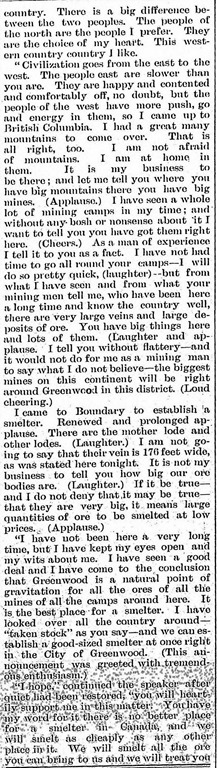
From: The Tribune, Nelson, B.C., August 30, 1899

By Andrew Chernoff August 24, 2013
Lately I have been doing a fair bit of research online of the early history of the West Boundary area of British Columbia, including the origin of the Boundary Hockey League and its impact and significance on Canada’s game of hockey.
I came across one persons account of the early beginnings of hockey in the Boundary area. I found it highly enlightening.
For you history buffs, I present for your pleasure a quote from the chapter, “In The Beginning” from the book “Spokane Hockey Book” by Pauil Delaney:
Back in the early 1890s the battle of Wounded Knee had just taken place, Jim Hill’s transcontinental railroad was nearing completion and ice hockey was just having it’s beginnings in the Northwest.
The first recorded competition in hockey began in the 1890s and was centered mainly around the Boundary District near Grand Forks, and the Kootenay Region in Trail, Rossland and Nelson.
Games were played primarily between Nelson and neighboring Kaslo, and the fans had to make the best of things when braving the elements, as the covered rink was still a few years in the future.
Back in 1903, around the logging and mining camps of the British Columbia interior, many transplanted Easterners used to eagerly await the winter freeze-up so that they could take to frozen ponds and play their crude form of hockey.
Players in Grand Forks and Phoenix, a mining town just west of Grand Forks, decided to put more at stake so they formed two set teams with the idea of a series of exchange games.
It was a small and difficult start because travel between the two towns in the rugged Kettle Range was virtually impossible in the dead of winter.
A covered natural ice rink came to Grand Forks in the fall of 1906. Phoenix and Grand Forks both lay claim to having the region’s first covered arenas – perhaps the first in British Columbia.
The following year, Greenwood also built enclosed rinks and the cornerstone was laid for the first Boundary Hockey League and B.C.’s first hockey trophy, the Boundary Hockey Championship Cup, which Grand Forks won in the 1908-09 season.
Just as mining played an important part in the development of the game around Rossland and Grand Forks, lumber did likewise in Nelson.
A booming milling operation, plus the bonus of added inexpensive water transportation for logs cut many miles to the north, brought in the famed Patrick family, father Joe and his sons, Lester and Frank.
As tested athletes, the Patricks’ interests didn’t lie entirely with the crosscut saw and choker. They were responsible for building the first covered rink in Nelson.
With Lester and Frank leading the way on the ice, Nelson treated many new fans, and their new rink, to a British Columbia championship in 190809, three years before J.M. Savage of Victoria donated the provincial championship cup that would later bear his name.
In 1910, hockey interest continued to grow and teams began to look outside the area for players. Grand Forks brought in Barney Quinn and Art Mann, two hockey-playing doctors from Toronto. Phoenix added Roy Clark and Roy Clothier and Greenwood brought in enough new bodies to win the 1910 title.
Phoenix got hot, and famous in 1911, beating Grand Forks and Greenwood in all league games. Phoenix went to Rossland and won the provincial title by beating Rossland and Nelson.
An entire trainload of Phoenix fans, complete with brass band, accompanied the team to Rossland.
By this time, hockey in B.C. was feeling its muscles and, accordingly, a challenge was sent to eastern Canada for a Stanley Cup series.
The snobby Easterners quickly turned down the challenge presented by a bunch of crass and crusty miners.
Some of the rejection was soothed in 1912 when the Premier of B.C., Sir Richard McBride, presented the McBride Cup, for the Interior championship. To help equalize competition for the cup, strict residence rules were drawn up.
The turn of the century saw real rough-house hockey. Fans were just as rabid then, or maybe even more so, as they are now. Every time a team went on a road trip, they would be accompanied by a special train carrying up to 500 fans.
Competition for top-notch players was as intense then as it is today. When Easterner Dummy Lobsinger (yes Dummy was his real name) moved to the Boundary District. He became as sought-after as a high-draft college football or basketball player is now.
Money talked quite loudly then as it does now.
One afternoon Lobsinger sat quietly listening to bids. Phoenix and Grand Forks officials bartered for him in a strict auction manner.
Lobsinger soon became the highest paid player in the area. The same applied to Joel Rochon, who came to Grand Forks and introduced the hook check to the area.
Just when hockey began booming in the Boundary District, booming of another type, the guns of World War I, interrupted the growth of the game and many top players marched off to serve their country.
(Copyright 2001 – Pauil Delaney)
From: http://www.museevirtuel-virtualmuseum.ca
The roundhouse crew at Eholt B.C. Circa 1900

Credits: Courtesy of Stanley Bubar

Credits: Kettle River Museum, Midway, B.C.

Credits: Kettle River Museum, Midway, B.C.

Credits: Courtesy of Stanley Bubar
 Andrew Phillip Chernoff