Fraser Institute thinks sending your kid to university counts as “child care”

MAY 05, 2016 by

Apparently when the Fraser Institute hears “child care,” they seem to think about sending young adults off to university.

When most Canadians hear “child care,” they probably picture toddlers in daycare.

But when the Fraser Institute hears “child care,” they seem to think about sending young adults off to college or university.

In their latest report examining “child care in Canada,” the right-wing think tank sets out to calculate just how much money Canada spends on child care every year.

But a closer look at how they came up with their numbers shows a few interesting surprises!
fraser-childcare-header.jpg

What surprises?

Well, although the cover of the report features a photo of a tiny infant struggling with a set of building blocks, the report itself says it counts saving for university as a “child care” cost.

In calculating child care costs in Canada, the Fraser Institute includes the $800 million Canada Education Savings Grant program that the report itself describes as something designed to help parents “save for their child’s post-secondary education.”

Which only begs the question: is it reasonable to include the cost of saving for college or university as a “child care” program?

fraser-university-childcare.jpg

The Fraser Institute has a few other “child care” costs that may stretch the definition of “child care”:

The former Conservative government’s Children’s Fitness Tax Credit, eliminated in the Liberal government’s 2016 budget, which deducted up to $150 for kids under 16 involved in organized sports. Canada Revenue Agency said that includes “strenuous games like hockey or soccer, activities such as golf lessons, horseback riding, sailing and bowling.”

 The Canada Child Tax Benefit, a means-tested grant aimed at lower-income families to “help them with the cost of raising children under 18 years of age” – although it’s a direct-payment that is not explicitly tied to child care costs.

The former Conservative government’s Universal Child Care Benefit, also eliminated in the 2016 budget, which was a direct-payment of between $100 to $160 per month for everyone under the age of 18 – it too was not explicitly tied to child care costs.

The Fraser Institute includes all of these in their estimate of what Canada spends on child care.

If any of this seems a bit off from what most Canadians think when they hear “child care,” the Fraser Institute has an explanation:

“It is important to explain the distinction between child care and daycare as those terms are used in public policy discussions in Canada. Child care is the broader term and encompasses a range of services and benefits that flow to children. It includes daycare programs, but also covers cash benefits flowing to families to assist them with raising their children.”

But it’s not clear whose “distinction” that is, though.

A 2014 Statistics Canada report on child care limited their scope to “nannies, home daycares, daycare centres, preschool programs and before and after school services.”

Quebec’s government defines child care programs as “childcare centres, private day care centres and home childcare services.”

Meanwhile, Canada Revenue Agency defines a “child care expense” as any amount you pay “to have someone look after an eligible child” under the age of 16 because you have to work or go to school.

Saving for university or subsidizing a teenager’s sporting activities are also notably absent from “discussions” about “child care” hereherehereherehere and here.

What’s else? One of the citations hiding at the end of the report pegs child care costs in Canada about $20 billion lower than the Fraser Institute’s own estimate.

$20 billion is roughly the amount the Fraser Institute’s report pegs as the combined cost of the CESG, CCTB and UCCB.

That might not be a big surprise.

The right-wing Institute’s annual reports on how much average Canadians pay in taxes have also been criticized for including things that average Canadians don’t actually see on their tax bills, like corporate taxes and oil and gas royalties.

As the former editor of The Walrus John MacFarlane once noted:

“Critics of the Fraser Institute report have also pointed to a bias in its definition of taxes, in terms of what it included in its calculation of the average tax bill. Are royalties on oil and gas revenues taxes? Are import duties taxes? Are taxes on goods and services, property, vehicles, fuel, alcohol, and tobacco — so-called consumption taxes — as burdensome as those applied to income? Is it reasonable to include corporate taxes in the total that Canadian families pay?”

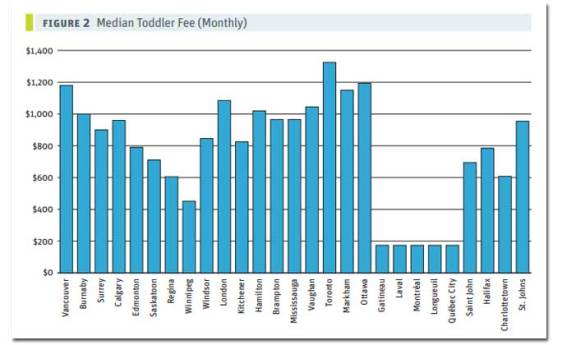
But despite what the Fraser Institute thinks, in reality, child care costs for Canadian families who actually have young children to worry about are still out of control:
childcarecosts-2015-02.jpg

Photo: robtowneo. Used under Creative Commons license. Shutterstock.

Source: Fraser Institute thinks sending your kid to university counts as “child care”

Lowering our standards for workers’ rights

By Trish Hennessy   September 3, 2013   http://rabble.ca

Missouri rallies against Right to Work & corporate greed. Photo: Jobs with Justi

The right-wing Fraser Institute has released a paper that, if implemented, would dramatically lower our standards for worker pay, workers’ rights and workplace protections.

It urges governments in Ontario and B.C. to adopt American-style “right-to-work” (RTW) laws which violate a core principle upheld in Canadian law: if a majority of workers in a workplace vote to form a union, everyone should be a member and pay dues — because all workers in that workplace benefit from the gains made by the union in their workplace.

Effectively, it would undermine unions’ right to organize in Canada.

It also promotes the right-wing frame of the day: “worker choice”. That’s the language the Fraser Institute is touting in its latest paper. The frame is an American import; an expression of the oft-touted freedom values in that country. It’s Orwellian language, really, because what we’ve witnessed under similar anti-worker laws in the U.S. is that workers there have far fewer options, worse working conditions and lower pay.

Here’s the harsh reality of workers who live in American states that have implemented such anti-worker laws:

–  The average worker in RTW states earns $1,540 less a year than workers who live in states with more robust worker protection laws;

–  Median household income is $6,437 less ($46,402 vs. $52,839);

–  The percentage of jobs in low-wage occupations is higher (26.7 per cent vs. 19.5 per cent);

–  Poverty rates are higher (15.3 per cent vs. 13.1 per cent);

–  More infants die (infant mortality rates are 15 per cent higher);

–  And more workers die in the workplace (36 per cent higher).

Learn more about the harmful effects of RTW laws in the U.S. here.

Clearly, this is not the direction we should be advising our governments to head towards. But the Fraser Institute’s latest volley is part of a strategic, concerted effort among right-wing groups in Canada to launch wave after wave of assaults on this country’s labour movement following the great disruption of the 2008-09 global economic recession.

Ontario is proving to be one of the major testing grounds for this concerted effort. Shortly after the Ontario government plunged into deficit as a result of recession — coupled with some of its own questionable decisions, such as ORNG and cancelled gas plant projects — right-wingers started in with a major blamestorming campaign to pin the deficit on unionized workers.

The fact of the matter is that polling reflects the majority of Canadians believe unions effectively improve the salaries and working conditions of Canadian employees; they believe that unions are necessary and important in society.

The goal of the right-wing narrative in Canada is to stir resentment, to pit workers against workers, to erode the public’s support for this legitimate public institution.

The Fraser Institute’s most recent paper would take Ontario back to a world where corporate giants could exploit workers with impunity, because workers on their own lack the resources to do much about it. They are powerless.

As this Toronto Star editorial aptly states, the labour movement plays an important role in our society: “Business may not welcome it, but organized labour is a well-established force for social good — one that has raised the standard of living of a great many of us. Statistics Canada rightly counts union membership as a key ‘indicator of well-being’ and it rose last year. About 31.5 per cent of employees were represented by a union, up from 31.2 per cent in 2011.”

In Ontario, 28 per cent of all employees belong to a union. As the Canadian Labour Congress calculated, their weekly payroll amounts to more than $1.7 billion — a third of the total provincial payroll. “On average, unionized workers earned $6.11/hour more than non-union employees. That union advantage translated into $351.6 million more every week paid into local economies to support local businesses and community services.”

That union advantage contributes to all Ontarians’ economic well-being.

By urging Ontario to emulate American states that embrace anti-worker laws, the Fraser Institute is prescribing a race to the bottom. Contrary to the Fraser Institute’s claim that it would benefit Ontario’s economy, research from the Economic Policy Institute shows the reality in American RTW states has been exactly the opposite of what advocates had promised.

Implementing anti-worker laws would slow down Ontario’s economy, because once workers earn less, they spend less — and right now it’s workers who are propping up economic growth by spending locally.

It would put more workers in dire straights, because they’d lose protections that unions secured for all workers generations ago.

It would weaken workers’ rights, making it harder for a worker to turn down unsafe work.

It would turn back the clock to the days before Ontario had a stable middle class.

It would return Ontario to the days in the late-1800s and early-1900s where worker strife led to work stoppages, strikes, and labour unrest.

We’ve come too far to turn back now. Our standards are, and will continue to be, higher than that. We are all worth more.

Trish Hennessy is director of the CCPA Ontario office, located in Toronto. The CCPA Ontario will be posting a compendium of papers to help inform workers about the benefits of the Rand Formula and the current assault on workers’ rights.

Photo: Jobs with Justice/flickr